
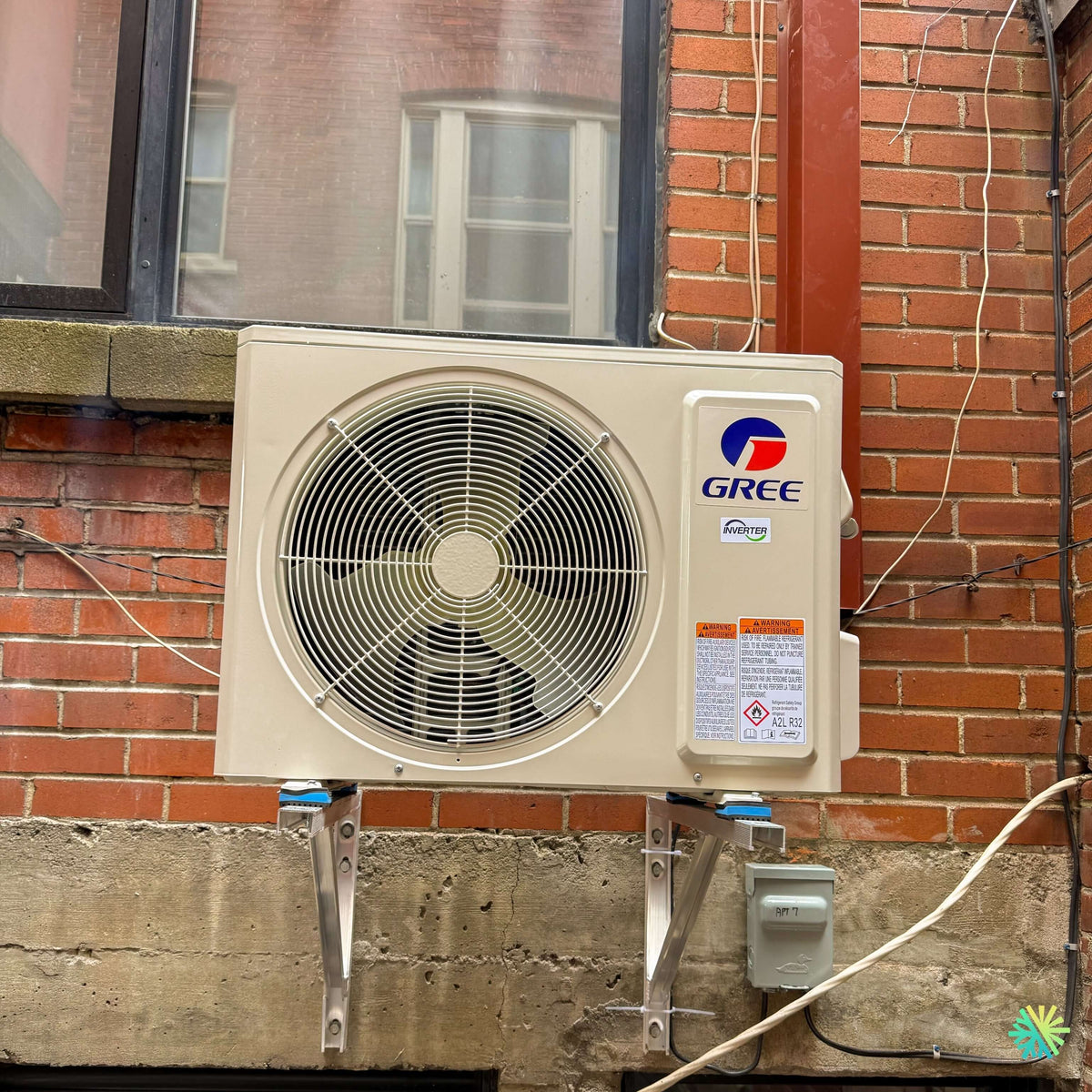
Installation of a GREE EXTREME R32 wall-mounted heat pump in Dorval – R-32 mini split on brick facade with AirGreen wall bracket
AirGreen installs a GREE EXTREME R32 wall-mounted heat pump in Dorval on a brick facade: mini split R-32, wall mounts, energy efficiency, lasting comfort, and local HVAC expertise.
- City
- Region
- Equipment
- Brand
- Challenges
- Published
The job on one screen
The article, chapter by chapter
A precise HVAC installation in a typical urban environment of Dorval
In Dorval, residential buildings and multi-unit dwellings often present a well-known challenge in HVAC installation: an wall-mounted heat pump must be added effectively without compromising the facade’s aesthetics, window access, air circulation around the outdoor unit, or the strength of the anchoring. This installation of a GREE EXTREME R32 perfectly illustrates the type of project where the choice of location matters as much as the choice of the machine.
In the photo, you can see a GREE outdoor unit installed on a brick wall, mounted on two sturdy wall brackets and positioned above ground level. This type of installation is especially relevant in an area like Dorval, where side yards, rear walls, and mechanical spaces can be narrow. At AirGreen, we are used to working under these conditions in Montreal, Laval, Longueuil, on the North Shore and the South Shore, where each building imposes its own constraints: limited clearance, old masonry, high access, close neighbors, existing wiring, drainage slope, and sometimes condominium requirements.
In this case, the goal was clear: to install a wall-mounted heat pump – air conditioner – mini split capable of providing stable comfort, while respecting the existing architecture. The brick facade required a clean mounting, without excessive vibration, with particular attention to anchors, leveling the unit, and the clearance needed for future maintenance.
Why the GREE EXTREME R32 was well suited for this project
The GREE EXTREME R32 is a popular solution when a customer is looking for a discreet, efficient system suited to Quebec winters. In the EXTREME R32 range, configurations vary according to the chosen capacity, but the technical sheet for the 18,000 BTU version notably indicates heating operation down to -30 °C, an R-32 refrigerant, included Wi-Fi, a SEER2 efficiency of 27.5, an HSPF2 of 9.7, and a LogisVert subsidy displayed at $1,860 according to the update of November 26, 2025.
This information is important for owners comparing several options of wall air conditioner or heat pump before making a decision. Energy performance is not just a matter of technical specifications: it affects daily comfort, electricity consumption, heating capacity in winter, and the overall value of the installation.
In a project like this one in Dorval, choosing a device with R-32 is also relevant. This refrigerant is now very common in new residential systems, notably for its efficiency and improved environmental profile compared to several older generations of refrigerants. The label visible on the unit also reminds of the importance of entrusting this type of installation to qualified professionals: a heat pump is not a simple household appliance, it is a refrigeration system that requires connections, vacuuming, electrical checks, and rigorous commissioning.
Reading of the installation visible in the photo
Several technical elements are immediately noticeable.
First, the outdoor unit is installed on metal wall mounts. This solution is often preferable to a ground base in certain urban environments, especially when you want to:
- prevent snow accumulation around the device;
- protect the unit from water, ice, or debris on the ground;
- free up space in a yard or narrow passage;
- maintain good air circulation;
- facilitate certain HVAC maintenance tasks.
Next, the unit is positioned near a window but sufficiently clear to allow air to be expelled by the front fan. This is a crucial point. A common mistake is placing an outdoor unit in a tight corner, under a closed gallery, or too close to an obstacle. The result can be recirculation of hot air in summer or cold air in winter, which reduces efficiency and increases the compressor's workload.
The photo also shows an electrical box near the unit. In a well-planned installation, the electrical supply must be accessible, protected, and compliant with the manufacturer's requirements as well as applicable standards. For example, the GREE EXTREME R32 18,000 BTU datasheet specifies a 220 V supply, a minimum circuit current (MCA) of 21 A, and a maximum overcurrent protection (MOP) of 25 A. These values must always be verified according to the exact installed capacity and the final site configuration.
The particular challenge of a brick wall
Installing a wall-mounted heat pump on a brick wall requires a different approach than installation on concrete or light cladding. Brick can be solid, but it does not accept just any anchoring. A poorly chosen fixing can create vibrations, weaken certain masonry sections, or become problematic after several freeze-thaw cycles.
In this project in Dorval, our focus was on three elements:
-
Weight distribution
Both supports must distribute the load of the outdoor unit evenly. The device must remain perfectly stable, even when the compressor modulates or during defrost cycles. -
Vibration reduction
The anti-vibration pads visible under the unit help limit the transmission of vibrations to the structure. This is especially important in brick buildings, where noise can sometimes travel through the facade. -
Future access for maintenance
A clean installation must allow the technician to access the unit for cleaning, inspection, pressure checks, and any necessary interventions. Too often, units are installed solely based on available space, without considering future HVAC maintenance.
A solution adapted to the realities of Dorval and the West Island
Dorval has an interesting mix of single-family homes, duplexes, triplexes, condos, and older buildings. In many areas, owners want to improve their comfort without undertaking major work in walls, ceilings, or existing ducts. This is where a mini split wall heat pump becomes a very interesting option.
It allows efficient cooling in summer and targeted heating in winter, without ductwork. For a living room, an open area, an office, a rental unit, or a less comfortable section of the house, this type of system can transform the daily use of the space.
The GREE EXTREME R32 also offers modern comfort management. The manufacturer states that the EXTREME R32 series integrates G-AI Learning technology aimed at analyzing heat pump usage and optimizing efficiency, with a potential reduction in annual consumption of up to 15%. For a customer who often uses their device morning and evening, or who wants better remote temperature control, this feature adds tangible value.
What this installation teaches owners planning a wall heat pump
Never choose the location just because it is "convenient"
In wall air conditioner and wall heat pump projects, the outdoor location is sometimes chosen too quickly. However, the position of the unit influences noise, efficiency, durability, and ease of maintenance.
In Dorval, we took into account:
- the structure of the brick wall;
- the proximity to the window;
- the clearance in front of the fan;
- the height above the ground;
- the routing of the refrigerant piping;
- the position of the electrical connection;
- the final appearance of the installation.
A good location is a compromise between performance, safety, aesthetics, and accessibility. This is precisely where the experience of a contractor specialized in HVAC makes a difference.
Properly sizing the capacity in BTU
The choice of capacity should never be limited to the approximate area. Two rooms of the same size can have very different needs depending on solar orientation, insulation, ceiling height, number of windows, floor level, wind exposure, and actual use of the space.
A machine that is too weak will run for a long time without reaching the desired comfort. A machine that is too large can reach the temperature quickly without properly dehumidifying, which gives a less pleasant feeling in summer. At AirGreen, we assess the entire context before recommending a capacity, whether for an installation in Dorval, in Montreal, in Laval, in Longueuil, on the North Shore or on the South Shore.
Pay attention to clearances around the outdoor unit
The outdoor unit must breathe. The front fan expels air, while the back and sides participate in heat exchange. If the device is too close to an opposite wall, a fence, a guardrail, or other equipment, its efficiency may decrease.
In this project, the wall installation frees up space under the unit and protects the device from several ground constraints. This approach is often recommended when the immediate environment does not allow for a stable or sufficiently clear base.
Check the subsidy before presenting the final cost
Subsidy programs, like LogisVert, can significantly influence the net cost of a project. However, amounts vary depending on models, capacities, certifications, and program updates. For this reason, AirGreen always validates the applicable information at the time of submission and helps the client understand the necessary documents after installation.
In the case of the GREE EXTREME R32, some configurations display ENERGY STAR and ENERGY STAR cold climate certification, which can be decisive for eligibility according to the current program.
What the client gets with an AirGreen installation
An installation like this is not just about placing a unit on two supports. Our work includes evaluation, planning, building protection, refrigeration installation, connections, testing, commissioning, and explanations to the client.
Specifically, this means:
- a model recommendation adapted to the building;
- an installation respectful of the facade;
- a precise leveling of the outdoor unit;
- solid and suitable supports;
- special attention to vibrations;
- a check of the drainage and air clearance;
- an installation compliant with industry best practices;
- usage and CVAC maintenance tips.
In our projects completed in Montreal, Laval, Longueuil, on the North Shore and the South Shore, we often see the same difference after installation: the client not only notices an improvement in temperature but also better comfort stability. A good heat pump doesn’t just cool or heat; it maintains a more consistent, quieter, and more pleasant atmosphere.
Practical advice after installation
To maintain good performance, we recommend homeowners:
- clean the indoor unit’s filters regularly;
- keep the outdoor unit clear, especially after heavy snowfall;
- avoid storing objects in front of the fan;
- monitor for unusual noises;
- schedule periodic maintenance;
- use programming modes rather than constantly turning the device off and on.
These simple actions can extend the system’s lifespan and maintain more stable consumption.
An installation that reflects the AirGreen method
This project in Dorval clearly shows our way of working: observing the building, choosing a logical location, protecting the structure, installing neatly, and delivering a system ready to operate under Quebec’s real conditions.
The GREE EXTREME R32 is an excellent choice for homeowners looking for an efficient, modern wall-mounted heat pump suited for cold winters. But the final performance always depends on the quality of the installation. A high-performance device poorly installed will deliver average results. A well-chosen and well-installed device becomes a lasting investment in comfort, energy efficiency, and peace of mind.
For residents of Dorval, West Island, Montreal, Laval, Longueuil, the North Shore and the South Shore, AirGreen offers a comprehensive approach: clear estimate, honest recommendation, professional installation, and reliable after-sales service.
The job tools
Two quick checks with real numbers: what heat costs, and what your current heaters add up to in BTU/h.
Conversion: 1 W = 3.412 BTU/h. An indication, not a load calculation: baseboards and furnaces are often stronger than the real need, and they can stay as backup. AirGreen confirms the capacity on site.
How the job unfolds
The main steps of this kind of job at AirGreen. Every house has its quirks: the estimate brings them out.
We look at the room, the outside wall, the line route and where the outdoor unit will go. That is where the capacity gets chosen.
Model, capacity and price, in writing. We also check whether the model qualifies for assistance programs.
Floors and furniture protected, wall plate position marked level, wall opening located.
A single opening, with the slope the drain needs to flow outside.
Set on a stand raised above the snow, with the clearances the manufacturer requires.
Connected, insulated and protected. The opening is then sealed against water, cold air and insects.
A dedicated circuit and an accessible disconnect near the outdoor unit.
Leak test, vacuum, then start-up and a check of heating and cooling.
Remote, modes, filters: we show you the essentials before we leave.
- The on-site estimateWe look at the room, the outside wall, the line route and where the outdoor unit will go. That is where the capacity gets chosen.
- The quoteModel, capacity and price, in writing. We also check whether the model qualifies for assistance programs.
- Getting readyFloors and furniture protected, wall plate position marked level, wall opening located.
- The wall openingA single opening, with the slope the drain needs to flow outside.
- The outdoor unitSet on a stand raised above the snow, with the clearances the manufacturer requires.
- Lines, cable and drainConnected, insulated and protected. The opening is then sealed against water, cold air and insects.
- The electrical workA dedicated circuit and an accessible disconnect near the outdoor unit.
- Tests and start-upLeak test, vacuum, then start-up and a check of heating and cooling.
- The walkthroughRemote, modes, filters: we show you the essentials before we leave.
What we check on a job like this one
Each number is a point we check on site. Switch between summer and winter to watch air and heat move.
In summer, the outdoor unit rejects the house's heat outside.
Generic illustration of this type of installation, not a survey of this job site. Tap a number.
Mounted level on a wall plate, high enough for the air to reach the whole room, with enough space around it to slide the filters out easily.
The refrigerant lines, the communication cable and the drain go through the wall in a single opening, sealed against water, cold air and insects.
Two insulated copper pipes connect the two units. Outside, a line cover can protect them from sun, knocks and weather.
A shut-off switch near the outdoor unit isolates it safely for service. It must stay accessible at all times.
The compressor and the fan. In heating mode it captures heat from the outdoor air, even in winter, and moves it inside.
On the ground or on the wall, it keeps the unit above accumulated snow. The unit stays clear and defrost water can drain away.
The fan needs to blow freely. Storage, a fence or a wall too close, and efficiency drops while noise goes up.
Is your home ready?
Check what applies at your place. A "no" is not a refusal: it is what we sort out during the estimate.
Good habits, once the unit is in place
Six simple habits that keep the unit going. Your list stays on this device.
What to do, season by season
Three habits per season for this unit. They take a few minutes and prevent many calls.
- Clean the indoor unit's filters.
- Clear leaves and debris left on the outdoor unit by winter.
- Test cooling before the first hot days.
- Clean the filters more often when the unit runs a lot.
- Keep plants away from the outdoor unit.
- Check that no water drips from the indoor unit.
- Rake the leaves around the outdoor unit.
- Test heating before the first cold days.
- Book periodic maintenance before winter.
- Keep snow away from the stand and the front of the unit.
- Let the unit defrost: it is normal.
- Never hit the ice on the fins; call us if the unit stays iced up.
The right pages, at the right time
Four statements: true or false?
It all comes down to details you have just seen.
1. In heating mode, the outdoor unit can produce water.
During defrost cycles. That water must drain away without forming ice.
2. You pick the capacity with a simple square-footage rule.
Windows, insulation, orientation and how the room is used all count. Capacity is chosen on site.
3. A multi-zone connects several indoor heads to a single condenser.
One head per room, all on the same condenser. Each room keeps its own temperature.
4. The disconnect can sit behind the patio furniture.
It must stay accessible: it is what shuts the unit off for service.
0 / 4 right answers
What people ask us about this kind of work
Does a wall-mounted heat pump heat in winter?
Wall-mounted or multi-zone: how do I choose?
Where does the outdoor unit go?
Are there grants?
Do I need a permit?
How cold can it heat?
How much can I save?
How is the LogisVert assistance calculated?
Is it noisy?
The outdoor unit is covered in ice: is that normal?
Does AirGreen hold the required licences?
Is the estimate free?
No question matches. Write to us: we answer.
More jobs to see, near you
By town, by equipment or by region: browse more than 4,700 published projects.
Each dot: a town where AirGreen has published projects. The glowing dot: this job.
An on-site estimate, the right capacity, the right equipment.
The on-site estimate is free and the quote follows within 24 hours.
Text and photo: a real AirGreen Climatisation & Chauffage job. The diagrams are generic illustrations of the type of installation, not a survey of this job site. Sources of the added figures: airgreen.ca product pages (NEEP / AHRI performance), Hydro-Québec (Heat pumps page, LogisVert, read on 13 October 2026), Régie de l’énergie (rate D as of 1 April 2026).