
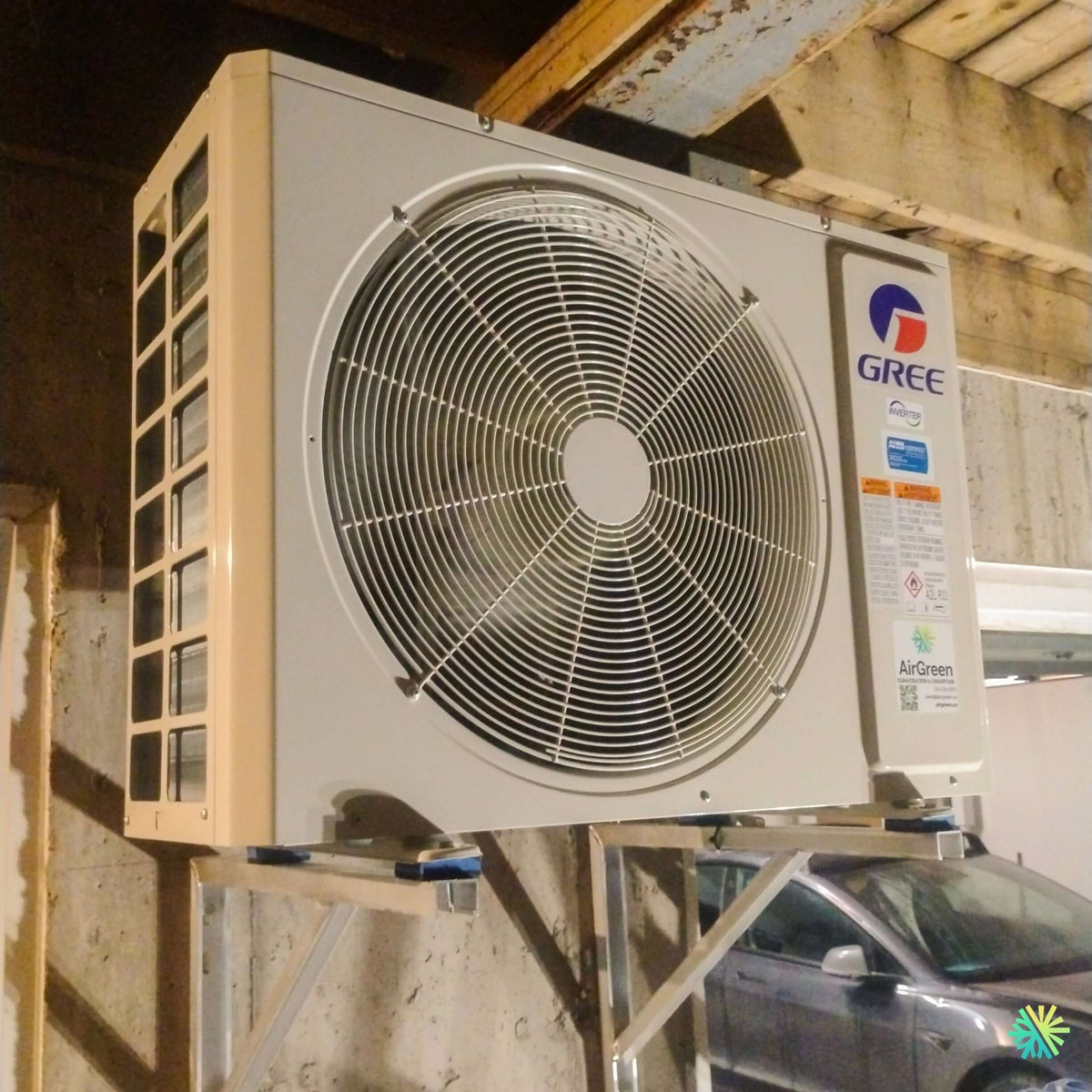
Installation of a GREE LIVO R32 wall-mounted heat pump in Fabreville, Laval: a mini split installed high up in a covered space with reinforced supports
AirGreen installs a GREE LIVO R32 wall-mounted heat pump in Fabreville, Laval: R32 mini split mounted high, sturdy supports, anti-vibration pads, and HVAC installation adapted to a covered space.
Take a tour of the installation
Each number is a point we check on site. Switch between summer and winter to watch air and heat move.
In summer, the outdoor unit rejects the house's heat outside.
Generic illustration of this type of installation, not a survey of this job site. Tap a number.
Mounted level on a wall plate, high enough for the air to reach the whole room, with enough space around it to slide the filters out easily.
The refrigerant lines, the communication cable and the drain go through the wall in a single opening, sealed against water, cold air and insects.
Two insulated copper pipes connect the two units. Outside, a line cover can protect them from sun, knocks and weather.
A shut-off switch near the outdoor unit isolates it safely for service. It must stay accessible at all times.
The compressor and the fan. In heating mode it captures heat from the outdoor air, even in winter, and moves it inside.
On the ground or on the wall, it keeps the unit above accumulated snow. The unit stays clear and defrost water can drain away.
The fan needs to blow freely. Storage, a fence or a wall too close, and efficiency drops while noise goes up.
An HVAC installation in Fabreville where the outdoor location made all the difference
In Fabreville, a well-established residential area of Laval, our AirGreen team installed a wall-mounted heat pump GREE LIVO R32, a mini split system designed to provide efficient comfort in cooling and heating while adapting to the real constraints of the building. This project stands out by an essential detail visible in the photo: the outdoor unit was not installed on the ground but rather elevated on sturdy wall mounts, in a covered space like a parking area or integrated shelter.
This setup requires special attention. Installing a heat pump under an existing structure, near a concrete wall, and under framing elements is never an improvised decision. You must consider air clearance, anchor strength, vibration, future access for HVAC maintenance, safe height, and protection against snow, water, and debris.
In this specific case, the GREE LIVO R32 was placed on a pair of metal supports fixed to a solid structure. You can also see blue anti-vibration pads under the unit’s feet, a simple but important technical detail to reduce vibration transmission to the structure. The installation is compact, clean, and designed to last in an environment that imposes more constraints than an open exterior wall.
Why a high installation was the right choice
In Laval, and especially in areas like Fabreville, many properties have side access, covered parking spaces, concrete walls, or outdoor areas where ground clearance is limited. In this project, ground installation could have caused several problems: blocking passage, snow accumulation around the unit, risk of impact, reduced car access, and exposure to water at ground level.
Mounting it high allowed these challenges to be addressed effectively:
- the outdoor unit stays clear of the ground;
- the passage under the unit remains usable;
- the heat pump is better protected against snow accumulation;
- connections remain accessible for inspection;
- the support structure limits unwanted movements;
- the overall appearance remains tidy despite the technical space.
This type of installation, however, requires careful execution. An outdoor unit of a wall air conditioner or a wall-mounted heat pump must remain perfectly level, well secured, and properly cleared so that the fan can expel air without excessive recirculation. In a covered space, this point is even more important, as poor air circulation can reduce system efficiency.
The GREE LIVO R32: a mini split solution adapted to residential needs
The GREE LIVO R32 is a wall-mounted heat pump of the mini split type that is particularly well suited for residential projects where the goal is to improve comfort in a specific area without installing a duct network. It allows heating and cooling of an indoor space with a discreet wall unit connected to a compact outdoor unit.
Its refrigerant R32 belongs to a new generation of residential HVAC devices, with better thermal transfer efficiency than many older refrigerants used in previous systems. For homeowners, this translates into a modern, higher-performing solution better suited to current market demands.
In a house in Fabreville, this type of system can be chosen for several reasons:
- improve the comfort of a living room, a floor, an office, or an open area;
- add efficient air conditioning without major ductwork;
- reduce the use of electric baseboards during certain heating periods;
- offer more precise temperature control in a targeted area;
- modernize the property with a compact HVAC solution.
The BTU capacity must always be chosen according to the actual needs of the building. At AirGreen, we do not recommend a heat pump based solely on an approximate area. We take into account insulation, orientation, windows, air volume, interior distribution, room usage, and building configuration. This step helps avoid a unit that is too weak and constantly overworked, or a unit that is too strong and starts and stops too frequently.
Specific challenges observed on this site
The photo shows an installation in an environment where the outdoor unit is placed near a concrete wall, under beams or visible structural elements, with a vehicle parked nearby. This context requires precise coordination between technical performance and the client’s daily reality.
Air clearance around the outdoor unit
A GREE outdoor unit must be able to properly intake and exhaust air. In a covered space, it is necessary to avoid the hot air exhausted during cooling or the cold air exhausted during heating from being drawn back into the unit. Excessive recirculation can make the compressor work harder and reduce efficiency.
Our team therefore paid special attention to the position of the unit, its orientation, and the available space around the fan. The goal was to maintain good air circulation while respecting the physical limits of the site.
The strength of the supports
Installing a wall-mounted heat pump at height requires suitable supports, a solid fixing, and level verification. The supports must be able to bear the weight of the unit, but also the vibrations, start-up cycles, winter conditions, and normal structural movements.
The supports visible in the photo are metal and installed to distribute the load stably. The anti-vibration pads add an extra layer of protection between the unit and its support points.
Proximity to the parking lot
An important detail of this project is the presence of a vehicle under or near the installation area. It was therefore necessary to position the unit so as not to interfere with the normal use of the parking lot, while ensuring sufficient access for the technicians. An installation that was too low would have been exposed to contact risks; an installation that was too high would have complicated maintenance. The right compromise was to place the unit at a functional, safe, and accessible height.
Protection against Quebec conditions
Even in a covered space, an outdoor unit remains exposed to temperature variations, humidity, wind, dust, and freeze-thaw cycles. In Laval, as in Montreal, Longueuil, on the North Shore and the South Shore, the quality of the anchors and finishing plays a direct role in the durability of the installation.
A clean installation, but also designed for maintenance
A good HVAC installation is not judged only on the day the device starts. It is also judged after a winter, after a cooling season, during cleaning, and during inspection. For this reason, we place great importance on future access.
In this project in Fabreville, the outdoor unit is visible, accessible, and placed to allow necessary checks: coil condition, mounting, fan, connections, drainage, and clearance. This accessibility is an element that many homeowners underestimate when comparing quotes.
A poorly placed device can make maintenance longer, more expensive, and riskier. Conversely, a well-thought-out installation simplifies interventions and helps maintain system performance.
Concrete lessons from this GREE LIVO R32 project in Laval
This installation of a GREE LIVO R32 in Fabreville clearly shows that a wall-mounted heat pump project must be adapted to the building, not just the chosen model. The same device can deliver excellent results or cause problems depending on the quality of the installation, the position of the outdoor unit, the protection of the pipes, and the accuracy of the connection.
Mistakes to avoid in a similar installation
For homeowners considering an installation similar to Laval, several mistakes must be avoided.
Installing the unit in a space that is too enclosed
A covered space is not automatically a problem, but it must allow for adequate air circulation. An outdoor unit installed too close to a wall, a low ceiling, or an obstacle can lose efficiency.
Underestimating vibrations
Vibrations can transfer to the structure, especially when the unit is installed at height. Using solid supports and anti-vibration pads is an important precaution.
Placing the unit without considering vehicles or passage
In a parking area, every inch counts. A poorly positioned installation can hinder movement, create a risk of impact, or complicate daily use of the space.
Neglecting access for maintenance
An inaccessible heat pump quickly becomes problematic. It must be possible to inspect, clean, and maintain the outdoor unit without having to dismantle parts or work in a dangerous position.
Choosing capacity in BTU without analysis
The right capacity depends on the actual thermal load. A simple estimate based on area is not always enough, especially in homes with high ceilings, large windows, open areas, or variable insulation.
Why AirGreen places so much importance on preparation
At AirGreen, every project starts with a site analysis. For a GREE LIVO R32 wall heat pump, we assess the indoor location, outdoor location, piping route, distance between units, drain management, electrical supply, access constraints, and final appearance.
This preparation helps reduce surprises and provides a more reliable installation. In the case of this property in Fabreville, preparation was especially important because the outdoor unit had to coexist with an existing structure and a parking space. A rushed installation could have caused clearance, vibration, or access issues.
Local expertise in Laval, Montreal, and on both shores
We regularly carry out installations of wall air conditioners, heat pumps, mini split systems, and other HVAC solutions in Laval, including Fabreville, Sainte-Dorothée, Vimont, Chomedey, Laval-des-Rapides, and Pont-Viau. This local presence gives us a good understanding of common constraints: concrete walls, limited spaces, covered parking, condominiums, semi-detached houses, narrow side access, and tight outdoor areas.
This experience also extends to Montreal, Longueuil, the North Shore, and the South Shore, where buildings often impose different requirements. In some cases, the priority is aesthetics. In others, it is the distance between the indoor and outdoor units. Sometimes, noise management, access to the electrical panel, or integration into a condominium determines the best solution.
Subsidies and eligibility: an aspect to check before purchase
For owners considering a wall-mounted heat pump in Laval, subsidy programs can represent a significant financial advantage. Eligibility, however, depends on the exact model, capacity, current technical criteria, and program conditions at the time of installation.
For a GREE LIVO R32, it is therefore essential to verify the technical information of the installed model before confirming the file. At AirGreen, we help our clients prepare the necessary information, including the brand, model, detailed invoice, and relevant data required by applicable programs.
The final result: a stable, functional installation well adapted to the site
The result of this project in Fabreville is an installation that respects the building's constraints while ensuring a reliable base for the heat pump's operation. The outdoor unit is well supported, placed at height, protected from the ground, and installed with a clean finish. The metal supports, anti-vibration pads, and chosen location demonstrate a consistent technical approach.
For the client, the benefits are clear: better indoor comfort, an effective air conditioning solution for summer, convenient supplemental heating during cooler periods, and an outdoor installation that does not compromise parking use.
This project confirms one important thing: a good HVAC installation depends as much on the team's expertise as on the quality of the machine. The GREE LIVO R32 provides a solid foundation, but it is the precision of the installation that allows the system to deliver its full performance throughout the seasons.
The unit on this job, in figures
The range as published on airgreen.ca: pick a size to see its capacity in deep cold.
| Size | Heating at −8 °C | Heating at −15 °C | Coldest certified point | COP at −15 °C | SEER | HSPF | Indicative LogisVert aid |
|---|---|---|---|---|---|---|---|
| Gree Livo R32 9 000 (115 V) | 10,000 | 7,600 | −25 °C: 5,700 | 1.86 | 20.5 | 8.8 | – |
| Gree Livo R32 9 000 | 9,600 | 7,600 | −25 °C: 5,500 | 1.94 | 20.5 | 8.8 | – |
| Gree Livo R32 12 000 (115 V) | 9,700 | 8,500 | −25 °C: 6,500 | 1.75 | 19.0 | 8.5 | – |
| Gree Livo R32 12 000 | 9,700 | 9,100 | −25 °C: 6,500 | 1.8 | 19.0 | 8.5 | $1,164 |
| Gree Livo R32 18 000 | 15,300 | 12,100 | −25 °C: 10,200 | 1.85 | 20.0 | 8.5 | $1,836 |
| Gree Livo R32 24 000 | 19,200 | 15,700 | −25 °C: 10,500 | 1.75 | 19.0 | 8.5 | $2,304 |
| Gree Livo R32 30 000 | 24,000 | 23,000 | −25 °C: 16,900 | 1.8 | 22.0 | 9.0 | $2,880 |
| Gree Livo R32 36 000 | 27,400 | 24,600 | −25 °C: 21,000 | 1.8 | 21.0 | 8.5 | $3,288 |
According to NEEP, it delivers 10,000 BTU/h at −8 °C (17 °F), as much as at 8 °C. It heats as hard in moderate cold as in mild weather.
According to NEEP, its certified maximum capacity at −25 °C (−13 °F) is 5,700 BTU/h, 63% of its nominal 9,000 BTU size.
At 8 °C, its certified maximum capacity reaches 13,300 BTU/h, 48% more than its nominal 9,000 BTU size.
According to NEEP, its COP at −15 °C is 1.94: the highest of the Livo R32 line, which ranges from 1.75 to 1.86 at that temperature.
According to NEEP, its certified maximum capacity at −25 °C (−13 °F) is 5,500 BTU/h, 61% of its nominal 9,000 BTU size.
At 8 °C, its certified maximum capacity reaches 13,136 BTU/h, 46% more than its nominal 9,000 BTU size.
According to NEEP, it delivers 8,500 BTU/h at −15 °C, against 9,100 for the Gree Livo R32 12 000.
At −25 °C, its certified minimum capacity is 1,800 BTU/h (3,070 at 8 °C). It slows down instead of cycling on and off.
According to NEEP, its certified heating capacity at −15 °C (5 °F) is 8,500 BTU/h, 71% of its nominal 12,000 BTU size. Its COP there is 1.75.
According to NEEP, it delivers 9,100 BTU/h at −15 °C, against 8,500 for the Gree Livo R32 12 000 (115 V).
At −25 °C, its certified minimum capacity is 1,800 BTU/h (3,070 at 8 °C). It slows down instead of cycling on and off.
According to NEEP, its certified heating capacity at −15 °C (5 °F) is 9,100 BTU/h, 76% of its nominal 12,000 BTU size. Its COP there is 1.80.
At 8 °C, its certified maximum capacity reaches 22,500 BTU/h, 25% more than its nominal 18,000 BTU size.
According to NEEP, its certified minimum capacity is at least 7,000 BTU/h at every temperature. In a small, well-insulated room it will cycle on and off more often: size it carefully.
According to NEEP, its certified heating capacity at −15 °C (5 °F) is 12,100 BTU/h, 67% of its nominal 18,000 BTU size. Its COP there is 1.85.
At −25 °C, its certified minimum capacity is 3,100 BTU/h (5,800 at 8 °C). It slows down instead of cycling on and off.
According to NEEP, its certified heating capacity at −15 °C (5 °F) is 15,700 BTU/h, 65% of its nominal 24,000 BTU size. Its COP there is 1.75.
According to NEEP, its certified heating capacity at −15 °C (5 °F) is 23,000 BTU/h, 77% of its nominal 30,000 BTU size. Its COP there is 1.80.
According to NEEP, its COP at −25 °C is 1.54: the highest of the Livo R32 line, which ranges from 1.30 to 1.52 at that temperature.
At −25 °C, its certified minimum capacity is 7,000 BTU/h (10,000 at 8 °C). It slows down instead of cycling on and off.
According to NEEP, its certified heating capacity at −15 °C (5 °F) is 24,600 BTU/h, 68% of its nominal 36,000 BTU size. Its COP there is 1.80.
Data read live from the airgreen.ca page of each size (NEEP / AHRI certified performance). When the title names the installed size, it is highlighted; otherwise the whole range is shown. The aid shown is today’s, using Hydro-Québec’s rule ($120 per 1,000 BTU/h at −8 °C); amounts quoted in the article date from its publication. Only Hydro-Québec confirms the assistance granted.A dash in the aid column: amount to be confirmed for this model.
The big day, step by step
The main steps of this kind of job at AirGreen. Every house has its quirks: the estimate brings them out.
We look at the room, the outside wall, the line route and where the outdoor unit will go. That is where the capacity gets chosen.
Model, capacity and price, in writing. We also check whether the model qualifies for assistance programs.
Floors and furniture protected, wall plate position marked level, wall opening located.
A single opening, with the slope the drain needs to flow outside.
Set on a stand raised above the snow, with the clearances the manufacturer requires.
Connected, insulated and protected. The opening is then sealed against water, cold air and insects.
A dedicated circuit and an accessible disconnect near the outdoor unit.
Leak test, vacuum, then start-up and a check of heating and cooling.
Remote, modes, filters: we show you the essentials before we leave.
- The on-site estimateWe look at the room, the outside wall, the line route and where the outdoor unit will go. That is where the capacity gets chosen.
- The quoteModel, capacity and price, in writing. We also check whether the model qualifies for assistance programs.
- Getting readyFloors and furniture protected, wall plate position marked level, wall opening located.
- The wall openingA single opening, with the slope the drain needs to flow outside.
- The outdoor unitSet on a stand raised above the snow, with the clearances the manufacturer requires.
- Lines, cable and drainConnected, insulated and protected. The opening is then sealed against water, cold air and insects.
- The electrical workA dedicated circuit and an accessible disconnect near the outdoor unit.
- Tests and start-upLeak test, vacuum, then start-up and a check of heating and cooling.
- The walkthroughRemote, modes, filters: we show you the essentials before we leave.
What would it look like at your place?
Two quick checks with real numbers: what heat costs, and what your current heaters add up to in BTU/h.
Baseboards and electric furnaces turn 1 kWh of electricity into 1 kWh of heat. A heat pump delivers more: that is its COP. At Hydro-Québec’s rate D (11.142¢/kWh above 40 kWh a day, since 1 April 2026):
Hydro-Québec: a heat pump can be up to three times more efficient than baseboards for heating in the colder months.
Estimate per kWh of heat, at the chosen temperature, using the certified COP from the product page. Taxes, access charge and backup heat not included.
Conversion: 1 W = 3.412 BTU/h. An indication, not a load calculation: baseboards and furnaces are often stronger than the real need, and they can stay as backup. AirGreen confirms the capacity on site.
Four mistakes we do not make
Flip each card to see what we do instead.
Your own project, step by step
What to do, season by season
Three habits per season for this unit. They take a few minutes and prevent many calls.
- Clean the indoor unit's filters.
- Clear leaves and debris left on the outdoor unit by winter.
- Test cooling before the first hot days.
- Clean the filters more often when the unit runs a lot.
- Keep plants away from the outdoor unit.
- Check that no water drips from the indoor unit.
- Rake the leaves around the outdoor unit.
- Test heating before the first cold days.
- Book periodic maintenance before winter.
- Keep snow away from the stand and the front of the unit.
- Let the unit defrost: it is normal.
- Never hit the ice on the fins; call us if the unit stays iced up.
Is your home ready?
Check what applies at your place. A "no" is not a refusal: it is what we sort out during the estimate.
Four statements: true or false?
It all comes down to details you have just seen.
1. In heating mode, the outdoor unit can produce water.
During defrost cycles. That water must drain away without forming ice.
2. You pick the capacity with a simple square-footage rule.
Windows, insulation, orientation and how the room is used all count. Capacity is chosen on site.
3. A multi-zone connects several indoor heads to a single condenser.
One head per room, all on the same condenser. Each room keeps its own temperature.
4. The disconnect can sit behind the patio furniture.
It must stay accessible: it is what shuts the unit off for service.
0 / 4 right answers
What people ask us about this kind of work
Does a wall-mounted heat pump heat in winter?
Wall-mounted or multi-zone: how do I choose?
Where does the outdoor unit go?
Are there grants?
Do I need a permit?
How cold can it heat?
How much can I save?
How is the LogisVert assistance calculated?
Is it noisy?
The outdoor unit is covered in ice: is that normal?
Does AirGreen hold the required licences?
Is the estimate free?
No question matches. Write to us: we answer.
More jobs to see, near you
By town, by equipment or by region: browse more than 4,700 published projects.
Each dot: a town where AirGreen has published projects. The glowing dot: this job.
Every house has its constraints. We see them before we install.
The on-site estimate is free and the quote follows within 24 hours.
Text and photo: a real AirGreen Climatisation & Chauffage job. The diagrams are generic illustrations of the type of installation, not a survey of this job site. Sources of the added figures: airgreen.ca product pages (NEEP / AHRI performance), Hydro-Québec (Heat pumps page, LogisVert, read on 13 October 2026), Régie de l’énergie (rate D as of 1 April 2026).