
Installation of a GREE LIVO R32 Wall-Mounted Heat Pump in Anjou, Montreal – Residential Mini Split Air Conditioner by AirGreen
AirGreen installs a GREE LIVO R32 wall-mounted heat pump in Anjou: a discreet mini split near a window, neat installation, and HVAC comfort adapted to residential spaces in Montreal.
In summer, the outdoor unit rejects the house's heat outside.
Generic illustration of this type of installation, not a survey of this job site. Tap a number.
Mounted level on a wall plate, high enough for the air to reach the whole room, with enough space around it to slide the filters out easily.
The refrigerant lines, the communication cable and the drain go through the wall in a single opening, sealed against water, cold air and insects.
Two insulated copper pipes connect the two units. Outside, a line cover can protect them from sun, knocks and weather.
A shut-off switch near the outdoor unit isolates it safely for service. It must stay accessible at all times.
The compressor and the fan. In heating mode it captures heat from the outdoor air, even in winter, and moves it inside.
On the ground or on the wall, it keeps the unit above accumulated snow. The unit stays clear and defrost water can drain away.
The fan needs to blow freely. Storage, a fence or a wall too close, and efficiency drops while noise goes up.
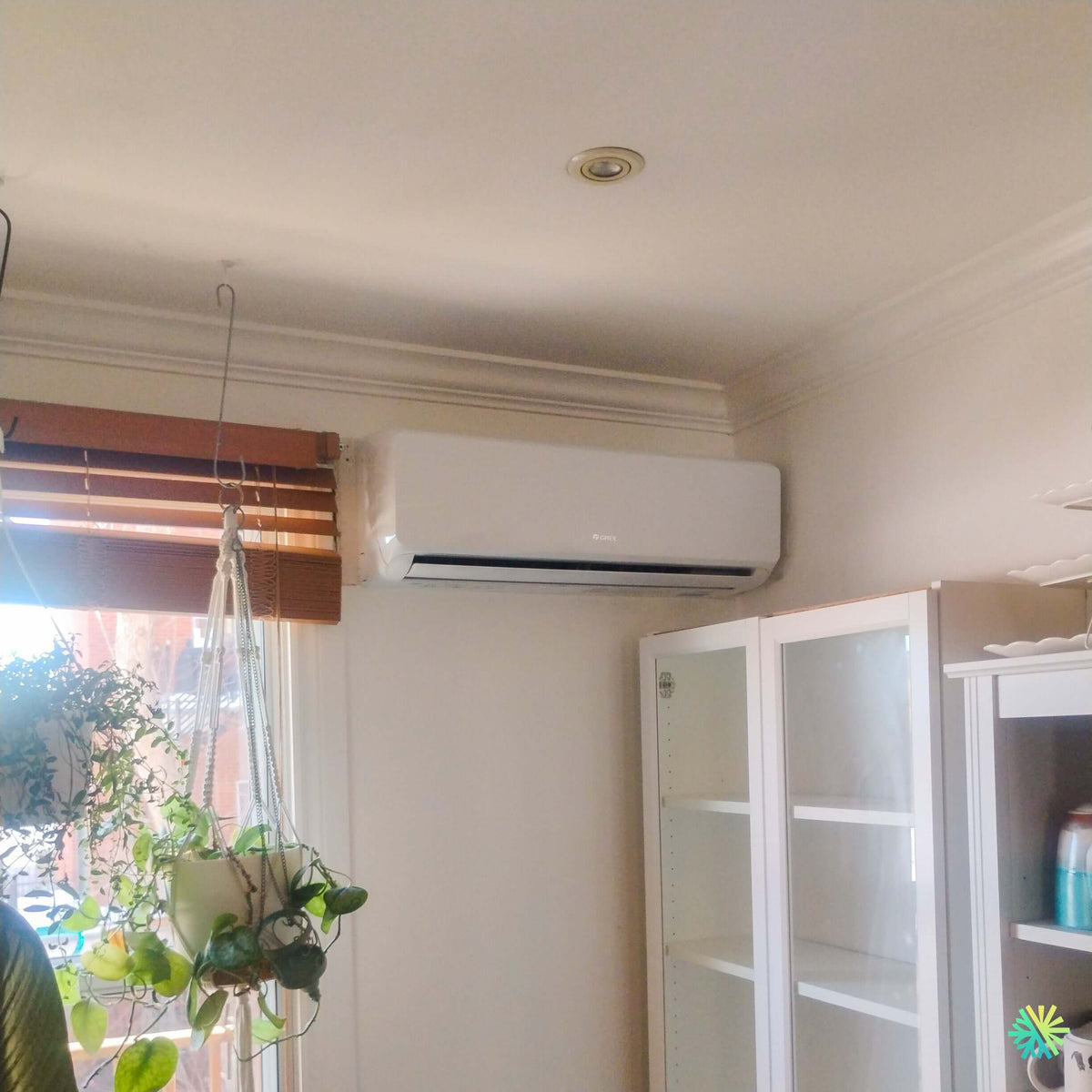
A precise wall installation in a living space, near a window, hanging plants, and upper storage units
In Anjou, in the east of Montreal, our AirGreen team completed the installation of a wall-mounted heat pump GREE LIVO R32, a mini split wall air conditioner system designed to improve comfort in a residential area occupied daily. The indoor unit was installed high on a wall adjacent to a large window with wooden blinds, near a corner with hanging plants and close to white storage furniture. The image clearly shows an environment where the available wall space was limited, but where visual integration had to remain clean, discreet, and functional.
This type of installation reflects the reality of many homes in Montreal: rooms are not always perfectly clear, windows take up a large part of the wall, furniture is already in place, ceilings have moldings, and every location decision influences both the system’s performance and the final appearance of the room. For a successful HVAC installation, it is therefore necessary to go beyond simply installing a unit. You must analyze the layout, available clearance, air movement, maintenance access, and how occupants actually use the space.
In this project in Anjou, the GREE LIVO R32 was placed in a strategic location: high enough to promote air diffusion, clear enough to allow good air intake, and well integrated enough to respect the existing interior style.
A carefully chosen location despite limited wall space
The wall unit was installed in the upper part of the wall, between the window and the storage furniture. This choice required great precision. On one side, the window with wooden blinds reduces the available space. On the other, the upper storage units impose a visual and physical limit. On the ceiling, the moldings add an additional constraint, as a wall-mounted heat pump must maintain adequate clearance above the unit to ensure good air circulation.
In this context, our team worked with a clear logic: use the best available space without compromising the device's performance. A unit installed too close to the ceiling might lack air return. A unit placed too low could interfere with furniture or create uncomfortable airflow. A unit too close to the window might be less effective during periods of strong solar gains.
The final positioning allows the wall air conditioner to blow air into the room while maintaining a discreet visual presence. The white unit blends with the light wall and storage elements, giving a coherent finish.
Why the GREE LIVO R32 was suitable for this installation in Anjou
The GREE LIVO R32 is a relevant choice for owners looking for a reliable, modern wall-mounted solution adapted to common residential needs. This mini split model is well suited for living rooms, dining rooms, open kitchens, lounges, or mixed areas where better temperature control is desired without changing the entire home layout.
The refrigerant R32 is an important aspect of this generation of devices. It is used in several recent systems due to its characteristics suited to modern HVAC equipment. For owners, this translates into a current solution designed to meet expectations for comfort, efficiency, and daily operation.
The BTU capacity must always be confirmed according to the actual area, insulation, solar orientation, ceiling height, window openings, and interior layout. In this installation, the presence of a large window, tall furniture, and an area potentially exposed to temperature variations made sizing particularly important. At AirGreen, we never choose a heat pump based solely on an approximate area rule. We analyze the room as a whole: air volume, obstacles, heat sources, usage habits, and customer expectations.
An installation near a window: beware of solar gains and air diffusion
The window visible in the image plays an important role in the thermal behavior of the room. Windows can bring natural light, but they can also increase heat in summer and contribute to heat loss during cold periods. In an installation like this, the device must be positioned to compensate for these variations without blowing directly on occupants or hanging plants.
The presence of wooden blinds also adds a practical dimension. It was necessary to avoid the airflow being blocked or disturbed by the blinds, while keeping the unit accessible for filter cleaning. A mini split air conditioner must be able to draw in and blow air freely. A poor location can reduce comfort, increase operating cycles, and make the device less pleasant to use.
In Anjou, the device was installed to promote balanced air distribution. This type of detail is essential in homes and condos in Montreal, Laval, Longueuil, the North Shore, and the South Shore, where rooms often have windows, blinds, furniture, and architectural constraints that require precise planning.
The challenge of high furniture and hanging objects
The photo shows high storage or shelves on the right side, as well as a hanging plant near the window. These elements make the installation more delicate. A wall-mounted heat pump should not be placed in an overly cluttered area, as air must circulate freely in front of the unit. Hanging objects, shelves, and cabinets can alter the airflow and reduce the perceived efficiency in the room.
Our team therefore took the entire environment into account. The goal was not just to fix the unit in an available spot, but to choose a position that protects the system's performance. In many residential projects, these are precisely the details that make the difference between a correct installation and a truly well-thought-out installation.
The installation in Anjou demonstrates this approach: the unit is placed in a compact space, but without giving the impression of being cramped. It remains accessible, stable, and visually well integrated.
A clean finish that respects the character of the room
Ceiling moldings, wooden blinds, plants, and storage give the room an already established character. In this type of interior, a poorly planned installation can quickly seem intrusive. That’s why AirGreen places great importance on alignment, height, pipe routing, and finishing around the unit.
A good HVAC installation must look clean at first glance. The unit must be straight, securely fixed, placed at a consistent height, and carefully connected. The pipes, drain, and penetrations must be planned to avoid unnecessary marks or visible corrections.
In this project, the integration of the GREE LIVO R32 respects the room’s aesthetics. The unit does not overload the wall and maintains a clean appearance. For homeowners, this result is important: they want comfort, but not at the cost of an installation that disrupts their decor.
Drainage management: an essential technical point
In cooling mode, the indoor unit removes moisture from the air and produces condensation. This water must be reliably drained. Drain management is therefore a critical step in any wall air conditioner installation.
In a space like this, near a window and furniture, a path must be planned that respects the necessary slope and avoids leakage risks. An insufficient slope, a poorly executed connection, or a too complex passage can cause problems after installation: water stains, odors, irregular drainage, or wall damage.
At AirGreen, we always check the drainage before completing the work. This thoroughness helps avoid unnecessary service calls and protects the interior finish. A wall-mounted heat pump must operate efficiently but also remain reliable over time.
Mistakes to avoid in a similar installation
Several common mistakes occur when a wall unit is installed in a room with windows, furniture, and molded ceilings.
Placing the unit too close to moldings or the ceiling
The top of the unit needs space to draw in air. Insufficient clearance can reduce performance and complicate HVAC maintenance.
Underestimating the impact of tall furniture
Storage and shelves can block airflow. You should always consider the actual layout of the room, not just the available wall.
Installing the device too close to a hanging plant
Plants should not block the airflow or be exposed to a constant draft. Proper placement protects both comfort and decorative elements.
Ignoring the effect of the window
A large window can change the thermal load of the room. The choice of BTU count must take this reality into account.
Neglecting access to filters
Filters must be cleaned regularly. A unit that is hard to access will be less well maintained, which can reduce its efficiency.
AirGreen expertise tailored to residential installations in Anjou and Greater Montreal
AirGreen carries out installations of wall-mounted heat pumps, mini split air conditioners, and HVAC systems throughout the region: Montreal, Laval, Longueuil, North Shore, and South Shore. Each area has its own realities. In Anjou, many homes have well-designed interior spaces, semi-open kitchens or dining rooms, large windows, and walls where the ideal placement is not always obvious.
Our role is to turn these constraints into practical solutions. We analyze the space, recommend the right capacity, install the device precisely, and explain to the customer how to use it effectively.
A complete commissioning after installation
After installing the indoor unit and connecting it to the outdoor system, our team performs a complete commissioning. This step includes checking the connections, inspecting the drainage, vacuuming the lines, running operational tests, and explaining the basic settings.
We also take the time to remind you of good maintenance practices:
- clean the filters regularly;
- keep the space in front of the unit clear;
- avoid blocking the airflow with hanging objects;
- monitor any unusual noise or behavior;
- schedule periodic maintenance to maintain performance.
These simple actions help extend the lifespan of the GREE heat pump and preserve its performance.
Subsidies and eligibility: validation to be done according to the exact model
Some wall heat pumps may be eligible for subsidy programs, depending on the installed combination, model number, BTU capacity, energy efficiency, and applicable AHRI number. For the GREE LIVO R32, this verification must be done case by case before confirming financial expectations.
At AirGreen, we help clients understand this step. A subsidy should not be assumed just because a device is recent or efficient. The exact configuration must be validated. This approach avoids misunderstandings and allows owners to plan their project with clear information.
A discreet, efficient result well suited to the room
This installation in Anjou shows the importance of a professional approach in compact residential spaces. The GREE LIVO R32 wall heat pump had to be integrated near a window, between decorative elements and tall furniture, while maintaining good air circulation. The final result is a clean, stable installation consistent with the interior layout.
For owners considering a wall air conditioner in Montreal, this project illustrates a key point: performance does not depend solely on the chosen device. It also depends on the technical assessment of the room, positioning, quality of finishing, and the experience of the installation team.
AirGreen brings this rigor to every project, whether it’s a condo in Anjou, a house in Laval, a plex in Longueuil, a residence on the North Shore, or a property on the South Shore. A well-thought-out installation improves comfort, protects interior aesthetics, and ensures reliable operation season after season.
How it goes, from the first call to the end
The main steps of this kind of job at AirGreen. Every house has its quirks: the estimate brings them out.
We look at the room, the outside wall, the line route and where the outdoor unit will go. That is where the capacity gets chosen.
Model, capacity and price, in writing. We also check whether the model qualifies for assistance programs.
Floors and furniture protected, wall plate position marked level, wall opening located.
A single opening, with the slope the drain needs to flow outside.
Set on a stand raised above the snow, with the clearances the manufacturer requires.
Connected, insulated and protected. The opening is then sealed against water, cold air and insects.
A dedicated circuit and an accessible disconnect near the outdoor unit.
Leak test, vacuum, then start-up and a check of heating and cooling.
Remote, modes, filters: we show you the essentials before we leave.
- The on-site estimateWe look at the room, the outside wall, the line route and where the outdoor unit will go. That is where the capacity gets chosen.
- The quoteModel, capacity and price, in writing. We also check whether the model qualifies for assistance programs.
- Getting readyFloors and furniture protected, wall plate position marked level, wall opening located.
- The wall openingA single opening, with the slope the drain needs to flow outside.
- The outdoor unitSet on a stand raised above the snow, with the clearances the manufacturer requires.
- Lines, cable and drainConnected, insulated and protected. The opening is then sealed against water, cold air and insects.
- The electrical workA dedicated circuit and an accessible disconnect near the outdoor unit.
- Tests and start-upLeak test, vacuum, then start-up and a check of heating and cooling.
- The walkthroughRemote, modes, filters: we show you the essentials before we leave.
What the unit delivers when it is cold
The range as published on airgreen.ca: pick a size to see its capacity in deep cold.
| Size | Heating at −8 °C | Heating at −15 °C | Coldest certified point | COP at −15 °C | SEER | HSPF | Indicative LogisVert aid |
|---|---|---|---|---|---|---|---|
| Gree Livo R32 9 000 (115 V) | 10,000 | 7,600 | −25 °C: 5,700 | 1.86 | 20.5 | 8.8 | – |
| Gree Livo R32 9 000 | 9,600 | 7,600 | −25 °C: 5,500 | 1.94 | 20.5 | 8.8 | – |
| Gree Livo R32 12 000 (115 V) | 9,700 | 8,500 | −25 °C: 6,500 | 1.75 | 19.0 | 8.5 | – |
| Gree Livo R32 12 000 | 9,700 | 9,100 | −25 °C: 6,500 | 1.8 | 19.0 | 8.5 | $1,164 |
| Gree Livo R32 18 000 | 15,300 | 12,100 | −25 °C: 10,200 | 1.85 | 20.0 | 8.5 | $1,836 |
| Gree Livo R32 24 000 | 19,200 | 15,700 | −25 °C: 10,500 | 1.75 | 19.0 | 8.5 | $2,304 |
| Gree Livo R32 30 000 | 24,000 | 23,000 | −25 °C: 16,900 | 1.8 | 22.0 | 9.0 | $2,880 |
| Gree Livo R32 36 000 | 27,400 | 24,600 | −25 °C: 21,000 | 1.8 | 21.0 | 8.5 | $3,288 |
According to NEEP, it delivers 10,000 BTU/h at −8 °C (17 °F), as much as at 8 °C. It heats as hard in moderate cold as in mild weather.
According to NEEP, its certified maximum capacity at −25 °C (−13 °F) is 5,700 BTU/h, 63% of its nominal 9,000 BTU size.
At 8 °C, its certified maximum capacity reaches 13,300 BTU/h, 48% more than its nominal 9,000 BTU size.
According to NEEP, its COP at −15 °C is 1.94: the highest of the Livo R32 line, which ranges from 1.75 to 1.86 at that temperature.
According to NEEP, its certified maximum capacity at −25 °C (−13 °F) is 5,500 BTU/h, 61% of its nominal 9,000 BTU size.
At 8 °C, its certified maximum capacity reaches 13,136 BTU/h, 46% more than its nominal 9,000 BTU size.
According to NEEP, it delivers 8,500 BTU/h at −15 °C, against 9,100 for the Gree Livo R32 12 000.
At −25 °C, its certified minimum capacity is 1,800 BTU/h (3,070 at 8 °C). It slows down instead of cycling on and off.
According to NEEP, its certified heating capacity at −15 °C (5 °F) is 8,500 BTU/h, 71% of its nominal 12,000 BTU size. Its COP there is 1.75.
According to NEEP, it delivers 9,100 BTU/h at −15 °C, against 8,500 for the Gree Livo R32 12 000 (115 V).
At −25 °C, its certified minimum capacity is 1,800 BTU/h (3,070 at 8 °C). It slows down instead of cycling on and off.
According to NEEP, its certified heating capacity at −15 °C (5 °F) is 9,100 BTU/h, 76% of its nominal 12,000 BTU size. Its COP there is 1.80.
At 8 °C, its certified maximum capacity reaches 22,500 BTU/h, 25% more than its nominal 18,000 BTU size.
According to NEEP, its certified minimum capacity is at least 7,000 BTU/h at every temperature. In a small, well-insulated room it will cycle on and off more often: size it carefully.
According to NEEP, its certified heating capacity at −15 °C (5 °F) is 12,100 BTU/h, 67% of its nominal 18,000 BTU size. Its COP there is 1.85.
At −25 °C, its certified minimum capacity is 3,100 BTU/h (5,800 at 8 °C). It slows down instead of cycling on and off.
According to NEEP, its certified heating capacity at −15 °C (5 °F) is 15,700 BTU/h, 65% of its nominal 24,000 BTU size. Its COP there is 1.75.
According to NEEP, its certified heating capacity at −15 °C (5 °F) is 23,000 BTU/h, 77% of its nominal 30,000 BTU size. Its COP there is 1.80.
According to NEEP, its COP at −25 °C is 1.54: the highest of the Livo R32 line, which ranges from 1.30 to 1.52 at that temperature.
At −25 °C, its certified minimum capacity is 7,000 BTU/h (10,000 at 8 °C). It slows down instead of cycling on and off.
According to NEEP, its certified heating capacity at −15 °C (5 °F) is 24,600 BTU/h, 68% of its nominal 36,000 BTU size. Its COP there is 1.80.
Data read live from the airgreen.ca page of each size (NEEP / AHRI certified performance). When the title names the installed size, it is highlighted; otherwise the whole range is shown. The aid shown is today’s, using Hydro-Québec’s rule ($120 per 1,000 BTU/h at −8 °C); amounts quoted in the article date from its publication. Only Hydro-Québec confirms the assistance granted.A dash in the aid column: amount to be confirmed for this model.
And at your place?
Two quick checks with real numbers: what heat costs, and what your current heaters add up to in BTU/h.
Baseboards and electric furnaces turn 1 kWh of electricity into 1 kWh of heat. A heat pump delivers more: that is its COP. At Hydro-Québec’s rate D (11.142¢/kWh above 40 kWh a day, since 1 April 2026):
Hydro-Québec: a heat pump can be up to three times more efficient than baseboards for heating in the colder months.
Estimate per kWh of heat, at the chosen temperature, using the certified COP from the product page. Taxes, access charge and backup heat not included.
Conversion: 1 W = 3.412 BTU/h. An indication, not a load calculation: baseboards and furnaces are often stronger than the real need, and they can stay as backup. AirGreen confirms the capacity on site.
What to do, season by season
Three habits per season for this unit. They take a few minutes and prevent many calls.
- Clean the indoor unit's filters.
- Clear leaves and debris left on the outdoor unit by winter.
- Test cooling before the first hot days.
- Clean the filters more often when the unit runs a lot.
- Keep plants away from the outdoor unit.
- Check that no water drips from the indoor unit.
- Rake the leaves around the outdoor unit.
- Test heating before the first cold days.
- Book periodic maintenance before winter.
- Keep snow away from the stand and the front of the unit.
- Let the unit defrost: it is normal.
- Never hit the ice on the fins; call us if the unit stays iced up.
Which type of equipment for your project?
Pick what looks like your need.
Four mistakes we do not make
Flip each card to see what we do instead.
What people ask us about this kind of work
Does a wall-mounted heat pump heat in winter?
Wall-mounted or multi-zone: how do I choose?
Where does the outdoor unit go?
Are there grants?
Do I need a permit?
How cold can it heat?
How much can I save?
How is the LogisVert assistance calculated?
Is it noisy?
The outdoor unit is covered in ice: is that normal?
Does AirGreen hold the required licences?
Is the estimate free?
No question matches. Write to us: we answer.
Useful pages for what comes next
More jobs to see, near you
By town, by equipment or by region: browse more than 4,700 published projects.
Each dot: a town where AirGreen has published projects. The glowing dot: this job.
Tell us about your house. We come and see it for free.
The on-site estimate is free and the quote follows within 24 hours.
Text and photo: a real AirGreen Climatisation & Chauffage job. The diagrams are generic illustrations of the type of installation, not a survey of this job site. Sources of the added figures: airgreen.ca product pages (NEEP / AHRI performance), Hydro-Québec (Heat pumps page, LogisVert, read on 13 October 2026), Régie de l’énergie (rate D as of 1 April 2026).