
Installation of a GREE VITA R32 18,000 BTU wall-mounted heat pump in a commercial space in Rosemont–La Petite-Patrie, Montreal
AirGreen installs a GREE VITA R32 18,000 BTU wall-mounted heat pump in a commercial space in Rosemont–La Petite-Patrie: R-32 mini split, high installation, built-in WiFi, and four-season comfort.
- City
- Region
- Equipment
- Brand
- Challenges
- Published
The job on one screen
The article, chapter by chapter
A high installation designed for an active commercial space in Rosemont–La Petite-Patrie
In a commercial space, a wall heat pump cannot be installed like in a typical residential living room. The choice of location must consider the air volume, ceiling height, customer flow, work zones, interior aesthetics, ambient noise, available structure, and ease of access for HVAC maintenance. This is precisely what made this installation of a GREE VITA R32 in Rosemont–La Petite-Patrie, in the heart of Montreal, particularly interesting for our AirGreen team.
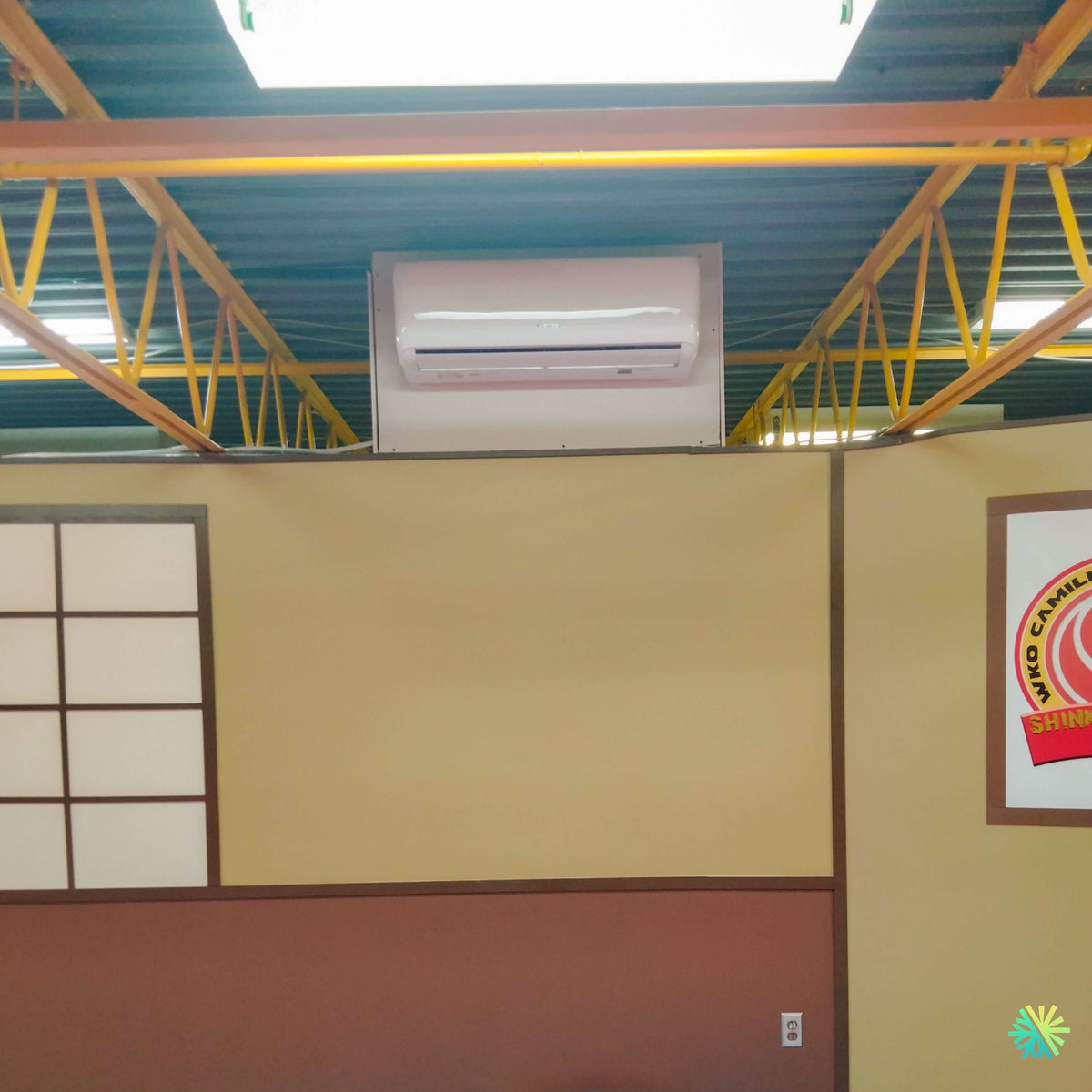
In the photo, you can see a wall-mounted indoor unit installed high up, above an interior partition, in a space with an open ceiling featuring exposed structure, yellow beams, commercial lighting, and a large clear height. This type of environment requires a detailed understanding of the building. The goal was not just to add a wall air conditioner: it was necessary to create a stable comfort solution capable of handling a space more demanding than a standard residential room, while respecting the visual and functional constraints of the business.
The GREE VITA R32 installed here belongs to a category highly appreciated for neighborhood shops, small restaurants, open offices, studios, workshops, and spaces with variable occupancy. The 18,000 BTU model offers a capacity suited to spaces where the door opens regularly, where lighting adds heat, where several people may be present at the same time, and where comfort must remain constant during business hours.
A high placement to better distribute the air
In this project, the indoor unit was placed very high, on a vertical surface above a partition. This configuration had several advantages. It avoided using a lower wall already occupied by interior furnishings, protected the unit from accidental contact, and promoted wider air diffusion in the room.
In a commercial space, the cooled air often has to travel a longer distance than in a condo or duplex. If the unit is placed too low, it can create a very cold zone near the device and leave the rest of the space less comfortable. At height, with a good diffusion angle, the mini split can better mix the air and stabilize the temperature in the occupied zone.
This placement decision is never automatic. Before installation, we evaluate:
- the natural direction of airflow;
- visual and physical obstacles;
- areas where customers or employees spend the most time;
- internal heat sources;
- the available structure to securely mount the unit;
- the possible routing of refrigerant lines and the drain;
- future access for filter cleaning and maintenance.
The final result is clean, discreet, and consistent with the interior architecture of the space. The unit does not cut off the space, does not hinder circulation, and remains visually integrated with the whole.
An HVAC installation that takes into account the reality of a business
The needs of a business in Rosemont–La Petite-Patrie are not the same as those of a single-family home in Laval or a condo in Longueuil. A commercial space can experience rapid variations in thermal load: door openings, cooking or food preparation, continuous lighting, customer traffic, electrical equipment, sun-exposed display windows, and concentrated occupancy periods.
For this reason, we treated this HVAC installation as a light commercial comfort project. The system had to provide good cooling performance, but also useful heating capacity during the colder months. The GREE VITA R32 is designed as a wall-mounted heat pump operating with a variable speed compressor and integrated WiFi control via the GREE+ app, according to the manufacturer's documentation.
The variable speed compressor is a significant advantage in a commercial setting. Instead of operating only in abrupt cycles, the system can modulate its operation according to demand. This helps reduce temperature fluctuations, improve perceived comfort, and limit periods when the device blows too strongly or not enough.
Relevant technical data for the GREE VITA R32 18,000 BTU model
For this installation, choosing an 18,000 BTU model was consistent with the interior volume and commercial use of the space. The AirGreen sheet for the GREE VITA R32 18,000 BTU model indicates a cooling capacity of 18,000 BTU, operation with refrigerant R-32, included WiFi, heating capacity down to -25 °C, as well as the references GWH18ATDXD-D6DNA3F/I for the indoor unit and GWH18ATDXD-D6DNA4F/O for the outdoor unit.
In terms of performance, the model sheet indicates a SEER2 of 20.0, an HSPF2 of 8.5, an EER2 of 12.4, a heating capacity of 15,300 BTU at -8 °C and 12,100 BTU at -15 °C. This data is especially useful for a business owner who wants to understand not only the nominal capacity but also the machine’s behavior when the outside temperature drops.
The manufacturer also highlights several practical features of the VITA R32 series: G20 Inverter technology, WiFi connectivity, wireless remote control with LCD screen, wired wall thermostat option, composite drainage tray, copper/aluminum coils, and blue fins tested with salt spray. These elements are relevant in a commercial context, where the equipment often operates for long hours and must remain easy to use for the staff.
The technical challenges behind a simple and neat appearance
Fixing on a high partition: precision and rigidity
The indoor unit is installed on a wall section located near the ceiling structure. This positioning requires a secure fixing. A wall-mounted heat pump contains a fan, a heat exchanger, motorized flaps, an electronic board, and a drainage tray. Even if the indoor unit seems light, it must remain perfectly stable during operating cycles, especially when installed at height.
Our team therefore paid special attention to the wall support, alignment, leveling, and service space around the device. In a high installation, a slight leveling defect can harm condensation drainage. Poor support can also generate vibrations or unwanted noise noticeable in the room.
The visible finish in the photo shows a clean integration: the unit is centered on its panel, aligned with the partition, and clear of structural elements. This is exactly the kind of detail that customers do not always notice at the time of the quote but appreciate once the system is installed.
Condensation drainage: a critical point in commercial spaces
In cooling mode, a wall air conditioner extracts moisture from the air. This water must be properly drained. In a commercial space, a poorly planned drain can become a source of problems: drips, marks on walls, odors, water backflow, pump noise, or more frequent maintenance.
For this type of installation, we plan the drainage from the start. Depending on the building layout, gravity is preferred when possible. If the natural slope is not available, a drainage pump can be considered. The choice depends on the routing, the height of the unit, access to existing outlets, and the acceptable noise level.
A durable installation is not just about making the device work on the day of commissioning. It must remain reliable during the humid days of July, periods of high occupancy, and long business hours.
Air distribution and occupant comfort
One of the main risks in a business is creating localized discomfort. A poorly oriented device can blow directly on a table, counter, waiting area, or workstation. Conversely, a poorly placed unit may not reach certain areas of the premises.
In this project, the unit installed high up directs air toward the main space rather than toward a single person or workstation. We always adjust the louvers during commissioning so the customer can use the main modes without constantly compensating with the remote control.
The VITA R32 series offers operation with remote control and smart control, making it easy to adjust according to times of the day. For example, a business can maintain a more moderate temperature before opening, increase air conditioning during busy hours, then reduce demand after closing. The built-in WiFi control allows this type of remote management via the GREE+ app.
Why R-32 is an advantage in this type of project
The refrigerant R-32 has become a common choice in new wall-mounted systems. In the VITA R32 documentation, GREE presents this refrigerant as a component of the series design, combined with Inverter technology and an energy efficiency approach.
For the customer, the advantage mainly translates into access to a newer generation of devices designed to offer good efficiency in a compact format. For us, as HVAC contractors, this reinforces the importance of an installation carried out by qualified technicians. Connections, vacuum pulling, pipe lengths, insulation, and commissioning must be executed precisely.
At AirGreen, we never consider refrigerant handling as a mere formality. Refrigeration work is at the heart of the system's real performance. A well-chosen but poorly installed machine will not deliver the expected results.
LogisVert Subsidy: a factor to check before every project
The AirGreen sheet for the GREE VITA R32 18,000 BTU model shows a provincial LogisVert subsidy of $1,836, with an update indicated on November 26, 2025. For a client, this amount can strongly influence the final budget, especially when the project concerns a business or a building where several energy improvements are planned.
However, eligibility must be validated at the exact time of the project. Programs may depend on the installed model, installation date, current criteria, provided documents, and building type. Hydro-Québec specifies that financial aid is determined according to the heat pump installation date.
Our role is to provide a detailed invoice, model information, and the necessary elements to facilitate the client's request. This administrative rigor is part of a good HVAC installation, whether in Montreal, the North Shore, the South Shore, Laval, or Longueuil.
Mistakes to avoid in a commercial space
A mini split installation in a business may seem simple, but several mistakes often recur when the project is not sufficiently planned.
Choosing the location only based on available space
The indoor unit should not be placed only where there is a free wall. It should be placed where the air will be useful. In this project, installation at height allowed preserving the interior layout while improving the reach of the airflow.
Neglecting ceiling height
An open or semi-industrial ceiling changes the comfort dynamics. Warm air can accumulate at height, while the air conditioning must be properly distributed in the occupied area. The choice of capacity and the orientation of the vents must take this volume into account.
Underestimating humidity
In some businesses, humidity can be as bothersome as heat. A properly sized machine helps stabilize the temperature and improve comfort, but the drainage must be flawless.
Install without thinking about maintenance
Filters will need to be cleaned. The unit must remain accessible. A technician must be able to inspect the system. Even in a well-designed business, future HVAC maintenance must be planned from the installation stage.
Compare price only
Two quotes may mention the same brand and the same number of BTUs but not include the same finish quality, technical support, drainage planning, or care in commissioning. At AirGreen, we focus on a complete, clear, and durable installation.
A coherent solution for Rosemont–La Petite-Patrie
This project clearly illustrates the typical needs of neighborhood businesses in Rosemont–La Petite-Patrie: sometimes atypical premises, open ceilings, interior partitions, variable occupancy, and a strong expectation of comfort. The GREE VITA R32 18,000 BTU met these requirements thanks to its wall-mounted format, performance, WiFi control, and heating capacity effective down to the low temperatures indicated by the model’s datasheet.
For AirGreen, the success of this project depends on all the decisions made before and during installation: high placement, careful mounting, air direction, drainage anticipation, choosing an appropriate capacity, and complete commissioning. The result is a clean, efficient installation well integrated into the space.
This type of project reflects our daily expertise in heat pump, wall air conditioner, mini split, and HVAC installation in the greater Montreal area. Whether the building is located in Rosemont–La Petite-Patrie, Plateau-Mont-Royal, Laval, Longueuil, on the North Shore or on the South Shore, our approach remains the same: analyze the actual site, choose the right solution, install with precision, and deliver a system that is easy to use daily.
The job tools
Two quick checks with real numbers: what heat costs, and what your current heaters add up to in BTU/h.
Conversion: 1 W = 3.412 BTU/h. An indication, not a load calculation: baseboards and furnaces are often stronger than the real need, and they can stay as backup. AirGreen confirms the capacity on site.
How the job unfolds
The main steps of this kind of job at AirGreen. Every house has its quirks: the estimate brings them out.
We look at the room, the outside wall, the line route and where the outdoor unit will go. That is where the capacity gets chosen.
Model, capacity and price, in writing. We also check whether the model qualifies for assistance programs.
Floors and furniture protected, wall plate position marked level, wall opening located.
A single opening, with the slope the drain needs to flow outside.
Set on a stand raised above the snow, with the clearances the manufacturer requires.
Connected, insulated and protected. The opening is then sealed against water, cold air and insects.
A dedicated circuit and an accessible disconnect near the outdoor unit.
Leak test, vacuum, then start-up and a check of heating and cooling.
Remote, modes, filters: we show you the essentials before we leave.
- The on-site estimateWe look at the room, the outside wall, the line route and where the outdoor unit will go. That is where the capacity gets chosen.
- The quoteModel, capacity and price, in writing. We also check whether the model qualifies for assistance programs.
- Getting readyFloors and furniture protected, wall plate position marked level, wall opening located.
- The wall openingA single opening, with the slope the drain needs to flow outside.
- The outdoor unitSet on a stand raised above the snow, with the clearances the manufacturer requires.
- Lines, cable and drainConnected, insulated and protected. The opening is then sealed against water, cold air and insects.
- The electrical workA dedicated circuit and an accessible disconnect near the outdoor unit.
- Tests and start-upLeak test, vacuum, then start-up and a check of heating and cooling.
- The walkthroughRemote, modes, filters: we show you the essentials before we leave.
What we check on a job like this one
Each number is a point we check on site. Switch between summer and winter to watch air and heat move.
In summer, the outdoor unit rejects the house's heat outside.
Generic illustration of this type of installation, not a survey of this job site. Tap a number.
Mounted level on a wall plate, high enough for the air to reach the whole room, with enough space around it to slide the filters out easily.
The refrigerant lines, the communication cable and the drain go through the wall in a single opening, sealed against water, cold air and insects.
Two insulated copper pipes connect the two units. Outside, a line cover can protect them from sun, knocks and weather.
A shut-off switch near the outdoor unit isolates it safely for service. It must stay accessible at all times.
The compressor and the fan. In heating mode it captures heat from the outdoor air, even in winter, and moves it inside.
On the ground or on the wall, it keeps the unit above accumulated snow. The unit stays clear and defrost water can drain away.
The fan needs to blow freely. Storage, a fence or a wall too close, and efficiency drops while noise goes up.
Is your home ready?
Check what applies at your place. A "no" is not a refusal: it is what we sort out during the estimate.
Good habits, once the unit is in place
Six simple habits that keep the unit going. Your list stays on this device.
What to do, season by season
Three habits per season for this unit. They take a few minutes and prevent many calls.
- Clean the indoor unit's filters.
- Clear leaves and debris left on the outdoor unit by winter.
- Test cooling before the first hot days.
- Clean the filters more often when the unit runs a lot.
- Keep plants away from the outdoor unit.
- Check that no water drips from the indoor unit.
- Rake the leaves around the outdoor unit.
- Test heating before the first cold days.
- Book periodic maintenance before winter.
- Keep snow away from the stand and the front of the unit.
- Let the unit defrost: it is normal.
- Never hit the ice on the fins; call us if the unit stays iced up.
The right pages, at the right time
Four statements: true or false?
It all comes down to details you have just seen.
1. In heating mode, the outdoor unit can produce water.
During defrost cycles. That water must drain away without forming ice.
2. You pick the capacity with a simple square-footage rule.
Windows, insulation, orientation and how the room is used all count. Capacity is chosen on site.
3. A multi-zone connects several indoor heads to a single condenser.
One head per room, all on the same condenser. Each room keeps its own temperature.
4. The disconnect can sit behind the patio furniture.
It must stay accessible: it is what shuts the unit off for service.
0 / 4 right answers
What people ask us about this kind of work
Does a wall-mounted heat pump heat in winter?
Wall-mounted or multi-zone: how do I choose?
Where does the outdoor unit go?
Are there grants?
Do I need a permit?
How cold can it heat?
How much can I save?
How is the LogisVert assistance calculated?
Is it noisy?
The outdoor unit is covered in ice: is that normal?
Does AirGreen hold the required licences?
Is the estimate free?
No question matches. Write to us: we answer.
More jobs to see, near you
By town, by equipment or by region: browse more than 4,700 published projects.
Each dot: a town where AirGreen has published projects. The glowing dot: this job.
An on-site estimate, the right capacity, the right equipment.
The on-site estimate is free and the quote follows within 24 hours.
Text and photo: a real AirGreen Climatisation & Chauffage job. The diagrams are generic illustrations of the type of installation, not a survey of this job site. Sources of the added figures: airgreen.ca product pages (NEEP / AHRI performance), Hydro-Québec (Heat pumps page, LogisVert, read on 13 October 2026), Régie de l’énergie (rate D as of 1 April 2026).