
Installation of a Hitachi airHome 400 wall-mounted heat pump in a bedroom in Ville Mont-Royal
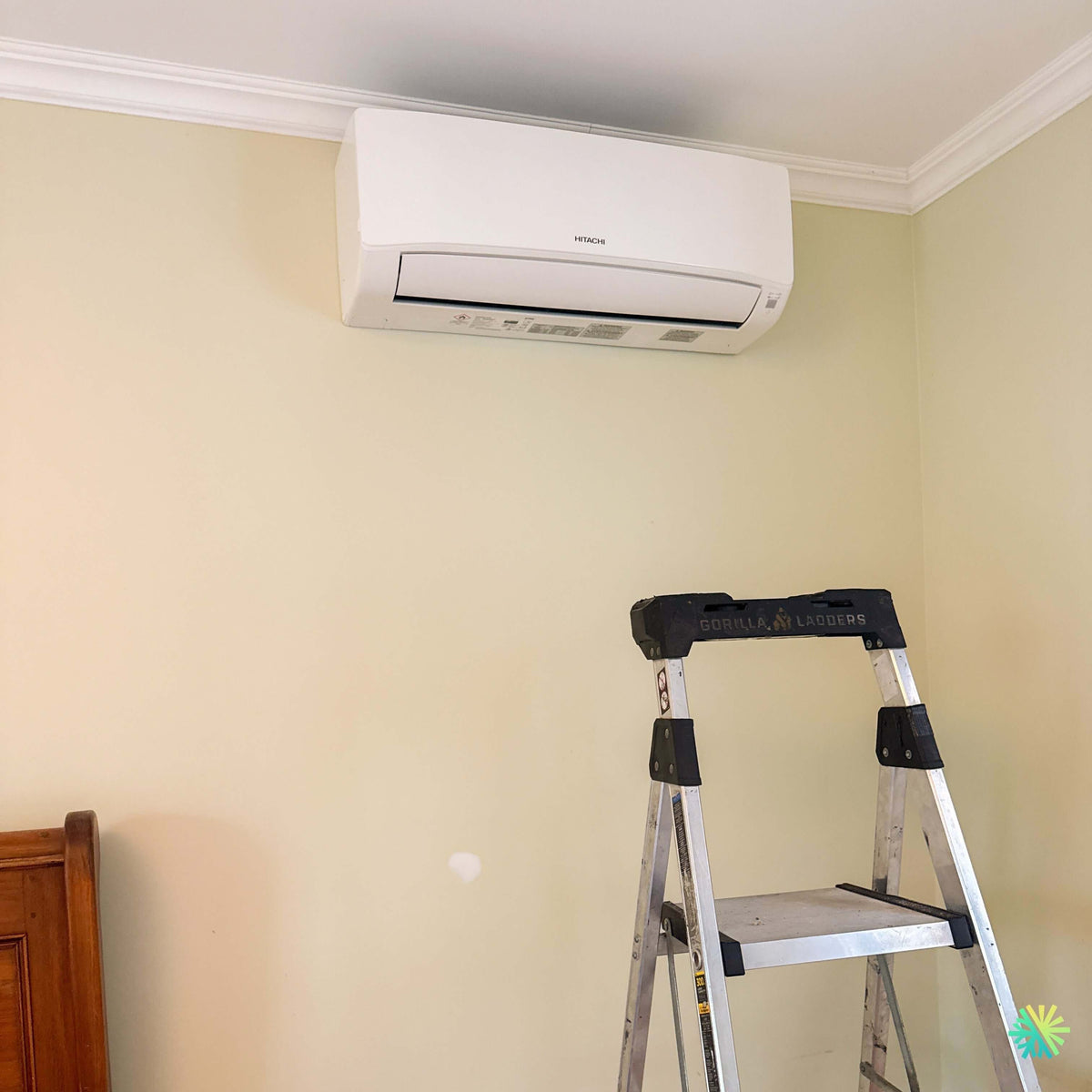
In Ville Mont-Royal, we installed a Hitachi airHome 400 near the ceiling of a bedroom, while accommodating the moldings, airflow distribution, drainage, and future access to the filters.
- City
- Region
- Equipment
- Brand
- Challenges
- Published
The job on one screen
The article, chapter by chapter
A high installation that respects the molding, frees up wall space, and improves bedroom comfort
In this residence in Ville Mont-Royal, we installed a Hitachi airHome 400 wall-mounted heat pump in a bedroom where every positioning detail mattered. The room has well-defined ceiling molding, furniture already in place, and a layout that required preserving as much usable wall surface as possible.
The indoor unit was installed high up, near a corner of the room. This position preserves the space beneath the unit for furniture while directing the air toward the open part of the bedroom. The photograph taken during the installation also shows the step ladder still in place, illustrating the care required to work neatly near the ceiling and decorative molding.
In a bedroom, a successful installation is measured by more than the unit's capacity. Noise level, airflow direction, filter access, drainage, and temperature stability directly affect everyday comfort. We therefore treated the placement of this Hitachi airHome 400 in Ville Mont-Royal as a complete technical decision, not simply an aesthetic choice.
Work around ceiling molding without throwing the room off balance
The visible molding around the ceiling adds character to the bedroom, but it also reduces the area available for mounting the indoor unit. We had to avoid several problems:
- damage the molding while drilling;
- install the unit crooked in relation to the ceiling lines;
- excessively reduce the air intake space above the unit;
- place the cabinet too close to the adjacent wall;
- make it more difficult to open the front panel;
- prevent the filters from being removed during future HVAC maintenance.
A wall-mounted heat pump generally draws in air through its upper section before treating it and redistributing it through the lower louver. Functional clearance must therefore be maintained around the cabinet, even when a very high installation may seem visually preferable.
In this project, the unit follows the lines of the room without being recessed into the molding. The cabinet remains separate from the ceiling, allowing air to enter properly and leaving the space needed for maintenance operations.
Why install the unit near a corner
Choosing a position near the corner of the bedroom offers several advantages when properly planned.
It notably allows us to:
- preserve a large section of wall for furniture;
- reduce the unit's visual presence from certain areas of the room;
- organize the route of the lines more efficiently;
- project the air toward the center of the bedroom;
- avoid installing the unit directly above the head of the bed;
- limit modifications to the existing decorative elements.
However, a unit placed near a corner should not blow directly against the adjacent wall. The motorized louver must be able to open freely and direct the air toward the occupied area.
We also check that the proximity of the corner does not hinder access to the unit's technical side. Depending on the orientation of the connections, insufficient space can make it difficult to inspect the drain, refrigerant lines, or sensors.
Air distribution suited to a bedroom
In a room intended for rest, the temperature should not only be correct on the thermostat. It must remain comfortable at bed level, without an unpleasant draft.
In cooling mode, cold air naturally falls. A unit installed high up can therefore project air across the bedroom before it gradually descends. This airflow distribution limits very cold areas directly beneath the unit.
In heating mode, the strategy is different. Since warm air rises, we generally recommend directing the louvers more downward. This positioning helps send heat toward the occupied area rather than allowing it to accumulate near the ceiling.
For a bedroom, several settings can improve comfort:
- use a stable temperature rather than constantly changing the setpoint;
- reduce the fan speed once the room is comfortable;
- angle the louver to avoid blowing toward the bed;
- keep the door partially open when air needs to circulate toward an adjacent space;
- clean the filters before the airflow decreases.
The Hitachi airHome 400 offers different fan speeds and a GoodSleep function designed to gradually reduce noise and gently adjust the temperature during the night.
Noise level, a priority criterion for this installation
A unit installed in a bedroom must operate quietly, particularly when the compressor modulates during the night.
The 9,000 and 12,000 BTU indoor models in the Hitachi airHome 400 range can go as low as 29 dB(A) in quiet mode. Higher-capacity units have different sound levels because their fans must move a greater volume of air.
The actual sound level also depends on the installation. An appliance that is quiet on paper can become bothersome if:
- the wall plate is not properly secured;
- the cabinet is touching trim;
- a pipe is vibrating against a stud;
- the drain is making a flowing-water noise;
- the fan is dirty;
- the capacity is too large for the room;
- the air is blowing directly onto a nearby surface.
Our job is therefore to control all of these factors, not merely select a heat pump with a good sound rating.
A capacity selected according to the actual load, not the wall size
The photograph does not make it possible to read the unit's complete model number. We therefore cannot confirm its exact BTU capacity based on its appearance.
The Hitachi airHome 400 range is available in several capacities, from 9,000 to 36,000 BTU/h. The 9,000 and 12,000 BTU units use an indoor cabinet approximately 30.71 in. wide, while the 18,000, 24,000, and 36,000 BTU models are progressively wider.
For a bedroom, the calculation should not be limited to floor area. We analyze, among other factors:
- the number and size of windows;
- exposure to sunlight;
- insulation quality;
- ceiling height;
- the presence of an exterior wall;
- the amount of air entering through doors and windows;
- air circulation toward adjacent rooms;
- the actual heating requirement;
- the desired temperature at night.
An oversized heat pump can cool the air quickly without running long enough to properly remove humidity. It can also create a stronger airflow than necessary in a small bedroom.
Conversely, an undersized unit could run almost continuously during very hot or very cold periods. Comfort therefore depends on a balance between capacity, modulation, and room configuration.
Vector DC Inverter technology to prevent sudden fluctuations
The airHome 400 uses Vector DC Inverter technology. The compressor adjusts its speed according to demand instead of operating only at full capacity before stopping.
At the beginning of a cycle, the heat pump may produce more output to reach the set temperature. Once the room has stabilized, it reduces its output and maintains more consistent operation.
This modulation is particularly useful in a bedroom because it helps:
- reduce sudden temperature changes;
- reduce repeated start-and-stop cycles;
- maintain more continuous dehumidification;
- reduce noise associated with restarts;
- adapt energy consumption to actual needs.
Depending on the model, the range offers seasonal efficiency of up to 20.0 SEER2. Heating performance varies according to capacity, with coefficients of performance and low-temperature capacities detailed in the manufacturer’s technical documentation.
A heat pump designed for heating and cooling
This installation does more than simply replace an air conditioner. The airHome 400 can provide both heating and cooling, with an advertised heating operating range down to approximately -20.5 °C.
This means that the unit can help heat the bedroom during much of the Montreal winter. However, the available capacity decreases as the outdoor temperature drops, as it does with any heat pump.
In a Mont-Royal residence, the heat pump can be used with the existing heating system. The operating strategy depends on the installed capacity, the home’s insulation, and the capacity of the main system.
It is best to avoid constant changes between very high and very low settings. An Inverter heat pump generally performs better when it maintains a relatively stable temperature.
R32 refrigerant and connections specific to each capacity
The Hitachi airHome 400 series uses R32 refrigerant. Line diameters vary according to the heat pump’s capacity.
The documentation indicates, in particular:
- a 1/4-inch liquid line on several models;
- a 3/8-inch liquid line on the higher-capacity version;
- a 3/8-inch, 1/2-inch, or 5/8-inch gas line, depending on the model;
- maximum piping lengths ranging from approximately 82 to 165 feet;
- maximum elevation differences ranging from approximately 49 to 98 feet.
These differences explain why we always check the model number before preparing the lines. Existing piping in the house should not be reused without confirming the diameters, the condition of the copper, and compatibility with the new system.
A discreet technical route behind the unit
In the photograph, no line-hide cover is visible around the unit. This finish suggests that the lines were routed directly behind the unit or through the nearby wall.
When the structure allows it, this configuration offers several advantages:
- fewer visible moldings in the room;
- protection of the connections;
- reduced visual clutter;
- more direct route;
- more natural integration with the décor.
The most discreet route is not necessarily the best one, however. It must also preserve the drain slope and allow installation without pinching the lines.
Drainage: an essential step in a bedroom
In cooling mode, the indoor unit removes moisture from the air. The water collects in the condensate pan and then drains through a hose.
In a bedroom, a drainage problem can cause visible damage to the wall, floor, or furniture. We therefore check that:
- the drain has a continuous slope;
- no bend retains water;
- the hose is not pinched behind the unit;
- the connections are watertight;
- the water drains at an appropriate location;
- no abnormal noise is produced during drainage.
The airHome 400 series has a drain connection that can be configured on the left or right, as well as a removable drain pan. This flexibility makes it easier to adapt the installation to the building’s structure.
FrostWash to help keep the coil clean
The FrostWash technology uses a freezing and thawing process on the indoor coil. Some of the accumulated impurities are captured and then carried away with the water.
According to the tests presented by the manufacturer, the system is designed to better maintain airflow performance when dust and contaminants accumulate on the heat exchanger.
This function does not replace routine maintenance. The owner must always:
- remove and clean the prefilters;
- watch for unusual odors;
- check that the airflow remains normal;
- have the appliance inspected when the fan becomes noisy;
- schedule a thorough cleaning if buildup becomes visible.
The high location of this unit in Mont-Royal requires a stable stepladder to access the filters. We recommend not waiting until the appliance is heavily soiled, as regular maintenance is simpler and faster.
Mold Guard and residual moisture reduction
After a cooling cycle, the coil may remain damp. The Mold Guard function circulates air through the appliance and heats the coil to reduce this residual moisture.
This function helps limit conditions that favor odors and mold growth in a clean appliance. It cannot eliminate contamination that is already established.
The bedroom is a space where perceived air quality matters greatly. A well-maintained indoor unit, a functional drain, and clean filters help maintain more comfortable operation.
PM2.5 filtration and activated carbon
The airHome 400 includes an activated carbon PM2.5 air purification filter as well as a stainless-steel prefilter.
These elements help capture certain particles in recirculated air and reduce certain odors. However, a wall-mounted heat pump does not replace an air exchanger or a ventilation system.
It primarily treats the air already present in the bedroom. To maintain good indoor air quality, you must also consider:
- the home's general ventilation;
- humidity;
- periodically opening the doors;
- the cleanliness of the exhaust ducts;
- filter maintenance;
- sources of dust in the room.
The details that make the difference in a heat pump installation in Mont-Royal
The photograph shows a unit neatly installed near the ceiling, but much of the work is behind the cabinet.
A perfectly level mounting plate
The wall plate must support the unit without movement. It must be secured to appropriate structural points and installed level.
A slightly tilted unit can:
- affect drainage;
- create a visible gap with the molding;
- cause vibrations;
- prevent the cabinet from locking properly;
- give the appearance of an unfinished installation.
In a room with such a crisp crown molding, visual alignment is immediately apparent. The precision of the mounting plate is therefore essential.
Evacuating the lines before startup
After the refrigerant connections are made, we remove air and moisture from the lines using a vacuum pump.
This step is not visible in the photograph, but it directly affects system reliability. Moisture left in the circuit can harm the refrigerant and compressor oil and impair performance.
An installation should never be commissioned simply by purging the lines with refrigerant. We also check the tightness of the connections before completing the tests.
Tests performed before leaving the residence
A complete commissioning includes, among other things:
- checking the electrical connections;
- checking the drainage;
- checking the airflow;
- testing cooling mode;
- testing heating mode;
- checking the motorized louvers;
- listening for vibrations;
- checking the remote control;
- explaining the main modes to the owner;
- confirming access to the filters.
We also show how to adjust the airflow direction to avoid blowing directly onto the bed.
Mistakes to avoid in a bedroom
Place the unit directly above the bed
Even a quiet unit can become uncomfortable if air constantly blows over the occupants. We prioritize an orientation that allows the airflow to pass through the room.
Placing the unit against the molding
The upper intake and panel opening must remain functional. A finish that is too tight can hinder maintenance.
Choosing excessive capacity
A larger unit does not necessarily provide better comfort. In a bedroom, an oversized unit can cause rapid fluctuations and airflow that is too intense.
Neglecting the drain slope
Even a unit that is perfectly level on the wall must still be connected to a drain with the required slope.
Allowing the filters to become dirty
A clogged filter reduces airflow, increases noise and decreases heat exchange capacity.
Painting or enclosing the unit
The cabinet must not be covered, enclosed in a box or surrounded by decorative panels that block airflow and make maintenance more difficult.
Equipment warranties and registration
Hitachi documentation states a standard warranty of seven years for the compressor and five years for parts. For certain registered residential installations, an extended warranty of ten years for the compressor and ten years for parts may be available.
An enhanced option may also provide coverage of up to twelve years for the compressor, ten years for parts and ten years for labor, depending on the terms, registration and purchase of the corresponding upgrade.
The owner must keep the model and serial numbers, the invoice and the registration documents.
A clean installation that preserves the bedroom
This Hitachi airHome 400 wall-mounted heat pump installation in Ville Mont-Royal demonstrates that a unit can be integrated into a bedroom without sacrificing wall space or compromising decorative elements.
The elevated position preserves the space beneath the unit, respects the moldings and allows air to be directed into the room. However, the final result depends on much more than the appearance of the cabinet: sizing, mounting, drainage, refrigerant line connections, vacuuming and airflow direction.
At AirGreen, we install wall-mounted heat pumps in Ville Mont-Royal, throughout Montreal, as well as in Laval, Longueuil, the North Shore and the South Shore. We adapt each project to the structure, furnishings and occupants’ habits to achieve stable comfort and an accessible installation for years to come.
The job tools
Two quick checks with real numbers: what heat costs, and what your current heaters add up to in BTU/h.
Conversion: 1 W = 3.412 BTU/h. An indication, not a load calculation: baseboards and furnaces are often stronger than the real need, and they can stay as backup. AirGreen confirms the capacity on site.
How the job unfolds
The main steps of this kind of job at AirGreen. Every house has its quirks: the estimate brings them out.
We look at the room, the outside wall, the line route and where the outdoor unit will go. That is where the capacity gets chosen.
Model, capacity and price, in writing. We also check whether the model qualifies for assistance programs.
Floors and furniture protected, wall plate position marked level, wall opening located.
A single opening, with the slope the drain needs to flow outside.
Set on a stand raised above the snow, with the clearances the manufacturer requires.
Connected, insulated and protected. The opening is then sealed against water, cold air and insects.
A dedicated circuit and an accessible disconnect near the outdoor unit.
Leak test, vacuum, then start-up and a check of heating and cooling.
Remote, modes, filters: we show you the essentials before we leave.
- The on-site estimateWe look at the room, the outside wall, the line route and where the outdoor unit will go. That is where the capacity gets chosen.
- The quoteModel, capacity and price, in writing. We also check whether the model qualifies for assistance programs.
- Getting readyFloors and furniture protected, wall plate position marked level, wall opening located.
- The wall openingA single opening, with the slope the drain needs to flow outside.
- The outdoor unitSet on a stand raised above the snow, with the clearances the manufacturer requires.
- Lines, cable and drainConnected, insulated and protected. The opening is then sealed against water, cold air and insects.
- The electrical workA dedicated circuit and an accessible disconnect near the outdoor unit.
- Tests and start-upLeak test, vacuum, then start-up and a check of heating and cooling.
- The walkthroughRemote, modes, filters: we show you the essentials before we leave.
What we check on a job like this one
Each number is a point we check on site. Switch between summer and winter to watch air and heat move.
In summer, the outdoor unit rejects the house's heat outside.
Generic illustration of this type of installation, not a survey of this job site. Tap a number.
Mounted level on a wall plate, high enough for the air to reach the whole room, with enough space around it to slide the filters out easily.
The refrigerant lines, the communication cable and the drain go through the wall in a single opening, sealed against water, cold air and insects.
Two insulated copper pipes connect the two units. Outside, a line cover can protect them from sun, knocks and weather.
A shut-off switch near the outdoor unit isolates it safely for service. It must stay accessible at all times.
The compressor and the fan. In heating mode it captures heat from the outdoor air, even in winter, and moves it inside.
On the ground or on the wall, it keeps the unit above accumulated snow. The unit stays clear and defrost water can drain away.
The fan needs to blow freely. Storage, a fence or a wall too close, and efficiency drops while noise goes up.
Is your home ready?
Check what applies at your place. A "no" is not a refusal: it is what we sort out during the estimate.
Good habits, once the unit is in place
Six simple habits that keep the unit going. Your list stays on this device.
What to do, season by season
Three habits per season for this unit. They take a few minutes and prevent many calls.
- Clean the indoor unit's filters.
- Clear leaves and debris left on the outdoor unit by winter.
- Test cooling before the first hot days.
- Clean the filters more often when the unit runs a lot.
- Keep plants away from the outdoor unit.
- Check that no water drips from the indoor unit.
- Rake the leaves around the outdoor unit.
- Test heating before the first cold days.
- Book periodic maintenance before winter.
- Keep snow away from the stand and the front of the unit.
- Let the unit defrost: it is normal.
- Never hit the ice on the fins; call us if the unit stays iced up.
The right pages, at the right time
Four statements: true or false?
It all comes down to details you have just seen.
1. In heating mode, the outdoor unit can produce water.
During defrost cycles. That water must drain away without forming ice.
2. You pick the capacity with a simple square-footage rule.
Windows, insulation, orientation and how the room is used all count. Capacity is chosen on site.
3. A multi-zone connects several indoor heads to a single condenser.
One head per room, all on the same condenser. Each room keeps its own temperature.
4. The disconnect can sit behind the patio furniture.
It must stay accessible: it is what shuts the unit off for service.
0 / 4 right answers
What people ask us about this kind of work
Does a wall-mounted heat pump heat in winter?
Wall-mounted or multi-zone: how do I choose?
Where does the outdoor unit go?
Are there grants?
Do I need a permit?
How cold can it heat?
How much can I save?
How is the LogisVert assistance calculated?
Is it noisy?
The outdoor unit is covered in ice: is that normal?
Does AirGreen hold the required licences?
Is the estimate free?
No question matches. Write to us: we answer.
More jobs to see, near you
By town, by equipment or by region: browse more than 4,700 published projects.
Each dot: a town where AirGreen has published projects. The glowing dot: this job.
An on-site estimate, the right capacity, the right equipment.
The on-site estimate is free and the quote follows within 24 hours.
Text and photo: a real AirGreen Climatisation & Chauffage job. The diagrams are generic illustrations of the type of installation, not a survey of this job site. Sources of the added figures: airgreen.ca product pages (NEEP / AHRI performance), Hydro-Québec (Heat pumps page, LogisVert, read on 13 October 2026), Régie de l’énergie (rate D as of 1 April 2026).