
Installation of a Hitachi airHome 400 wall-mounted heat pump in a residence in Anjou, Montreal
Professional installation of a Hitachi airHome 400 wall-mounted heat pump in Anjou: precise positioning, Inverter technology, heating, air conditioning, filtration, and advice from AirGreen.
In summer, the outdoor unit rejects the house's heat outside.
Generic illustration of this type of installation, not a survey of this job site. Tap a number.
Mounted level on a wall plate, high enough for the air to reach the whole room, with enough space around it to slide the filters out easily.
The refrigerant lines, the communication cable and the drain go through the wall in a single opening, sealed against water, cold air and insects.
Two insulated copper pipes connect the two units. Outside, a line cover can protect them from sun, knocks and weather.
A shut-off switch near the outdoor unit isolates it safely for service. It must stay accessible at all times.
The compressor and the fan. In heating mode it captures heat from the outdoor air, even in winter, and moves it inside.
On the ground or on the wall, it keeps the unit above accumulated snow. The unit stays clear and defrost water can drain away.
The fan needs to blow freely. Storage, a fence or a wall too close, and efficiency drops while noise goes up.
A compact installation designed to maintain comfort without cluttering the interior space
In this residence located in Anjou, in eastern Montreal, our AirGreen team had to integrate a Hitachi airHome 400 wall-mounted heat pump into a room where every positioning detail mattered. The goal was not simply to mount a unit on the wall: we had to achieve efficient airflow, maintain a discreet appearance, and keep the unit accessible for future maintenance.
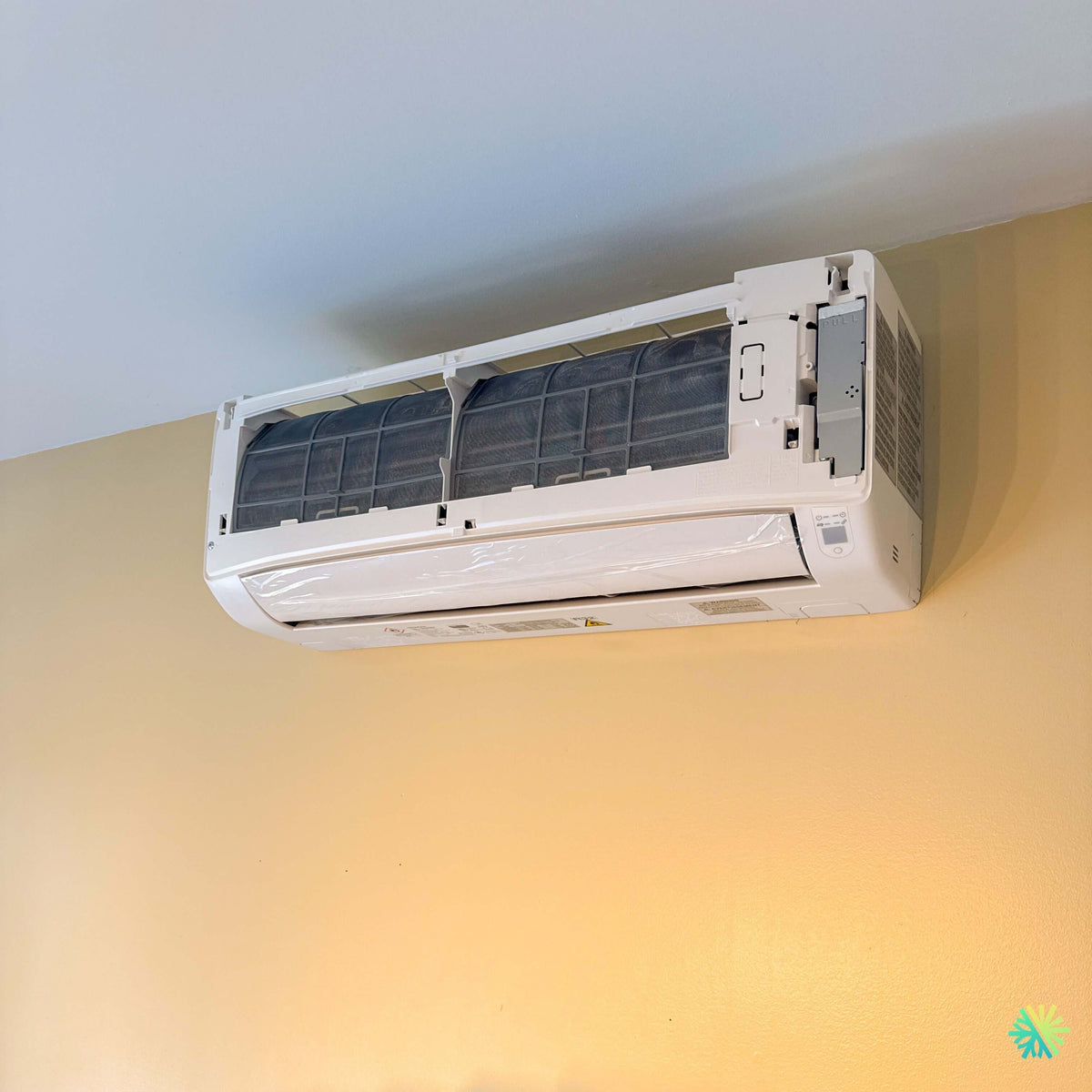
The photo taken during our work shows the indoor unit installed very high on the wall, close to the ceiling. Its front panel is open, the filters are visible, and the protective film is still on the lower louver. This is a typical stage of our installations: before handing the system over to the owner, we inspect the accessible components, check that the filters are properly installed, test the movement of the deflectors, and confirm that the condensate drainage is working properly.
This methodical approach is essential for an HVAC installation in Anjou, where a heat pump must provide cooling during hot periods and contribute to heating through much of the Montreal winter.
Why install the indoor unit so close to the ceiling?
A wall-mounted unit generally draws in room air through its upper section before cooling or heating it, then redistributes it through its lower louver. Its location therefore directly affects:
- the reach of the airflow;
- temperature uniformity;
- the speed at which the room reaches the setpoint;
- the sound level perceived by occupants;
- filter accessibility;
- the quality of the condensate drainage.
In this project in Anjou, the high installation frees up wall space and promotes air circulation in the occupied part of the room. However, we maintained the necessary technical clearance above and around the unit. A heat pump installed too close to the ceiling may not receive enough air at the intake, become noisier, or lose part of its actual capacity.
Our technicians also take moldings, wall corners, doors, windows, and the natural direction of the airflow into account. The best location is not always the one that appears simplest at first glance.
A complete opening of the unit before commissioning
The raised panel visible in the photograph provides access to the washable filters and the main components of the indoor unit. This inspection allows us to confirm, among other things, that:
- the filters are properly engaged in their guides;
- no packaging material is blocking the air intake;
- the side panels and fasteners are securely locked;
- the motorized louver moves freely;
- no abnormal vibration is coming from the casing;
- the drain discharges water without backflow;
- the unit is level according to the manufacturer’s requirements.
On the Hitachi airHome 400, the removable side covers facilitate access to the refrigerant connections and drain. The manufacturer also provides a removable drain pan, a large installation plate, and a front cover that can be removed with just a few screws. These features simplify both the initial installation and long-term HVAC maintenance work.
A range available from 9,000 to 36,000 BTU/h
The Hitachi airHome 400 range includes several nominal capacities, from 9,000 to 36,000 BTU/h. The photograph does not allow us to read the model number with certainty, and we never assume the capacity based solely on the appearance of the casing.
At AirGreen, the choice between a 9,000, 12,000, 18,000, 24,000, or 36,000 BTU heat pump depends in particular on:
- the area actually served;
- ceiling height;
- the number of floors;
- sun exposure;
- the quality of the windows;
- the level of insulation;
- the openings between rooms;
- heat gains produced by occupants and appliances;
- low-temperature heating requirements.
An undersized unit will run for a long time without always reaching the desired temperature. An oversized unit may reach its setpoint too quickly, reduce dehumidification in summer, and create comfort fluctuations. Sizing must therefore be based on the building, not solely on a rough rule based on square footage.
This analysis is particularly important in Anjou, where there are single-family homes, duplexes, condominiums, and older buildings whose insulation levels and interior layouts can vary considerably.
Energy efficiency and Inverter technology
The Hitachi airHome 400 uses Vector DC Inverter technology. Rather than operating only at full power and then stopping, the compressor can modulate its speed according to the heating or cooling demand.
In practice, the system can start at a higher capacity to quickly bring the room closer to the requested temperature, then slow down to maintain that temperature with fewer variations. This modulation helps to:
- improve comfort;
- reduce on-off cycles;
- limit noise peaks;
- stabilize the temperature;
- better control electricity consumption.
Depending on the selected capacity, the product line offers seasonal cooling efficiency of up to SEER2 of 20.0. However, exact performance varies from one model to another. For example, the 9,000 and 12,000 BTU models do not have exactly the same COP, airflow, or low-temperature heating capacity values as the 18,000 or 24,000 BTU versions.
That is why we list the precise model numbers of the indoor and outdoor units in our proposals. Two units from the same product line may have different electrical and thermal characteristics.
Heating down to an outdoor temperature of -20.5 °C
The airHome 400 line is designed to operate in heating mode down to approximately -20.5 °C, according to data published by Hitachi. This means it can make a significant contribution to heating a home in Anjou during the winter.
However, the minimum operating temperature must be distinguished from the capacity actually available. As the outdoor temperature drops, a heat pump generally transfers less heat. The capacity at -8 °C or -15 °C is therefore more useful than the nominal capacity alone for assessing its winter performance.
For example, the product line data indicates the following nominal heating capacities at -8 °C:
- 6,500 BTU/h for the nominal 9,000 BTU model;
- 8,400 BTU/h for the nominal 12,000 BTU model;
- 13,300 BTU/h for the nominal 18,000 BTU model;
- 17,500 BTU/h for the nominal 24,000 BTU model;
- 25,200 BTU/h for the nominal 36,000 BTU model.
These figures show why choosing a heat pump should not be based solely on its advertised cooling capacity. For a homeowner in Anjou, Montreal, Laval, Longueuil, on the North Shore or the South Shore, heating performance deserves a separate analysis.
Indoor operation starting at 29 dB(A)
The compact 9,000 and 12,000 BTU models can reach an indoor sound level of 29 dB(A) in silent mode. Higher-capacity models produce more airflow, and their minimum sound level is slightly higher.
Silence also depends on the installation. Even a high-performance unit can generate unwanted noise if:
- the wall plate is not firmly anchored;
- the casing touches a molding;
- the piping bundle puts pressure on the chassis;
- the drain vibrates against the wall;
- a panel is not properly closed;
- the wall easily transmits vibrations.
During commissioning, we therefore test several fan speeds. We listen to the unit in cooling and heating modes, then check that no rattling or humming is coming from the installation.
FrostWash, Mold Guard, and PM2.5 filtration
The airHome 400 includes several functions related to keeping the indoor unit clean.
The FrostWash technology uses a freezing and thawing process on the heat exchanger to capture and remove some of the accumulated impurities. The Mold Guard function circulates air through the internal components and heats the coil to reduce conditions conducive to the formation of odors and mold.
The unit also includes a stainless steel prefilter and an activated-carbon purifying filter designed for fine PM2.5 particles.
However, these functions do not replace manual maintenance. We always recommend:
- clean the prefilters regularly;
- keep the top of the unit clear;
- monitor for the appearance of odors;
- have the drain inspected in the event of unusual drainage;
- schedule a thorough cleaning when the coil or fan wheel accumulates dust.
A common mistake is to believe that a self-cleaning function eliminates any need for maintenance. It helps preserve the unit, but it cannot remove all the particles deposited on the fan wheel, condensate pan, and internal surfaces over the years.
What this Hitachi installation provides for the homeowner in Anjou
More stable comfort during hot periods
In summer, the heat pump removes indoor heat while reducing humidity. Depending on the capacity selected, the airHome 400 can extract from 1.1 to more than 5 liters of water per hour under certain operating conditions.
In a residence in Anjou, dehumidification is particularly important during Montreal’s hot and humid days. A temperature of 23 °C can feel uncomfortable when humidity remains high. A properly sized heat pump runs long enough to cool the air and remove a useful amount of moisture.
The positioning of the unit visible in the photo also encourages horizontal airflow into the room. We adjust the louvers to prevent cold air from being directed straight toward a bed, sofa, or workstation.
A discreet unit that remains accessible
The white unit blends discreetly into the pale wall. Installing it near the ceiling reduces its visual impact without enclosing it in a niche or cabinet.
We advise against installations where the unit is surrounded by shelves, curtains, or furniture. Although the result may look attractive, these elements can obstruct the intake, deflect the airflow, and make filter removal more difficult.
In this project in Anjou, the front panel can be raised and the filters can be removed without disassembling the unit. This accessibility is a practical advantage for the owner, who will be able to perform routine maintenance without specialized tools.
An installation using R32 refrigerant
The Hitachi airHome 400 range uses R32 refrigerant. Using this refrigerant requires appropriate work methods, compatible tools, and an installation that complies with the manufacturer's requirements.
Our technicians pay particular attention to flared connections. These must be prepared properly, tightened to the appropriate torque, and tested before commissioning. Even a minor leak can gradually reduce performance, increase consumption, and damage the compressor.
Our procedure includes, among other things:
- preparing the copper lines;
- connecting the units;
- leak testing;
- evacuating the system;
- checking that the vacuum holds;
- opening the service valves;
- starting the unit in cooling and heating modes;
- checking the discharge temperatures;
- inspecting the drain;
- explaining the controls to the owner.
Different electrical requirements depending on capacity
The 9,000 to 36,000 BTU airHome 400 units generally operate on a 208-230 V, while a 12,000 BTU version is also available at 115 V.
Circuit requirements vary considerably. The maximum protection indicated in the documentation ranges from 15 A for some smaller capacities to 40 A for the 36,000 BTU model.
It would therefore be risky to choose a circuit breaker based only on the number of BTUs. We always check:
- the outdoor model number;
- the minimum circuit ampacity;
- the maximum overcurrent protection;
- the conductor gauge;
- the presence of a disconnect switch;
- the available capacity in the electrical panel.
This check prevents improperly sized circuit breakers and unexpected electrical modifications on the day of the work.
Optional Wi-Fi control
The airHome 400 can receive an optional Wi-Fi adapter that enables management from a phone. Depending on the accessories selected, the owner can schedule weekly operation, view certain consumption data, and use compatible voice commands.
However, Wi-Fi is not integrated as standard in every configuration. This must be confirmed in the proposal to avoid different expectations at the time of delivery.
A Hitachi airPoint Room H700 wall-mounted thermostat is also available as an option for projects where a fixed control is preferable to a handheld remote.
The mistakes we avoid during a wall-mounted installation in Anjou
Many problems observed in the field stem less from the machine than from the quality of the installation.
Installing the unit without planning the drain
Condensate should normally drain by gravity with a continuous slope. A drain that rises, forms an unintended trap or is crushed behind the unit can cause water to leak indoors.
Choosing capacity based on floor area alone
Two rooms of the same size can have very different needs depending on their windows, orientation and insulation.
Neglecting the airflow range
A unit installed above a door may seem practical, but its airflow can be blocked by a beam or directed into an area where it is of little use.
Making the filters inaccessible
Limited clearance beneath the ceiling, a shelf or trim can prevent the panel from opening fully.
Starting the system without proper vacuuming
Air and moisture left in the lines interfere with refrigeration operation and can affect compressor durability.
An installation adapted to Anjou’s residential realities
Our work on this Hitachi airHome 400 wall-mounted heat pump in Anjou illustrates what distinguishes a rigorous installation from a simple equipment installation. Final performance depends on many details that become invisible once the panels are closed: mounting-plate anchoring, connection quality, drain slope, vacuuming, electrical supply, clearances and louver orientation.
At AirGreen, we install wall-mounted heat pumps in Anjou, Montreal, Laval, Longueuil, the North Shore and the South Shore. We assess each location based on the building’s actual configuration, the owner’s expectations and the specific characteristics of the proposed model.
This installation leaves the customer with a clean, compact and accessible indoor unit, capable of providing air conditioning, dehumidification and effective supplemental heating. The panel can now be closed, the protective coverings removed and the settings explained to the owner: one final important step before considering the work complete.
How it goes, from the first call to the end
The main steps of this kind of job at AirGreen. Every house has its quirks: the estimate brings them out.
We look at the room, the outside wall, the line route and where the outdoor unit will go. That is where the capacity gets chosen.
Model, capacity and price, in writing. We also check whether the model qualifies for assistance programs.
Floors and furniture protected, wall plate position marked level, wall opening located.
A single opening, with the slope the drain needs to flow outside.
Set on a stand raised above the snow, with the clearances the manufacturer requires.
Connected, insulated and protected. The opening is then sealed against water, cold air and insects.
A dedicated circuit and an accessible disconnect near the outdoor unit.
Leak test, vacuum, then start-up and a check of heating and cooling.
Remote, modes, filters: we show you the essentials before we leave.
- The on-site estimateWe look at the room, the outside wall, the line route and where the outdoor unit will go. That is where the capacity gets chosen.
- The quoteModel, capacity and price, in writing. We also check whether the model qualifies for assistance programs.
- Getting readyFloors and furniture protected, wall plate position marked level, wall opening located.
- The wall openingA single opening, with the slope the drain needs to flow outside.
- The outdoor unitSet on a stand raised above the snow, with the clearances the manufacturer requires.
- Lines, cable and drainConnected, insulated and protected. The opening is then sealed against water, cold air and insects.
- The electrical workA dedicated circuit and an accessible disconnect near the outdoor unit.
- Tests and start-upLeak test, vacuum, then start-up and a check of heating and cooling.
- The walkthroughRemote, modes, filters: we show you the essentials before we leave.
And at your place?
Two quick checks with real numbers: what heat costs, and what your current heaters add up to in BTU/h.
Conversion: 1 W = 3.412 BTU/h. An indication, not a load calculation: baseboards and furnaces are often stronger than the real need, and they can stay as backup. AirGreen confirms the capacity on site.
What to do, season by season
Three habits per season for this unit. They take a few minutes and prevent many calls.
- Clean the indoor unit's filters.
- Clear leaves and debris left on the outdoor unit by winter.
- Test cooling before the first hot days.
- Clean the filters more often when the unit runs a lot.
- Keep plants away from the outdoor unit.
- Check that no water drips from the indoor unit.
- Rake the leaves around the outdoor unit.
- Test heating before the first cold days.
- Book periodic maintenance before winter.
- Keep snow away from the stand and the front of the unit.
- Let the unit defrost: it is normal.
- Never hit the ice on the fins; call us if the unit stays iced up.
Which type of equipment for your project?
Pick what looks like your need.
Four mistakes we do not make
Flip each card to see what we do instead.
What people ask us about this kind of work
Does a wall-mounted heat pump heat in winter?
Wall-mounted or multi-zone: how do I choose?
Where does the outdoor unit go?
Are there grants?
Do I need a permit?
How cold can it heat?
How much can I save?
How is the LogisVert assistance calculated?
Is it noisy?
The outdoor unit is covered in ice: is that normal?
Does AirGreen hold the required licences?
Is the estimate free?
No question matches. Write to us: we answer.
Useful pages for what comes next
More jobs to see, near you
By town, by equipment or by region: browse more than 4,700 published projects.
Each dot: a town where AirGreen has published projects. The glowing dot: this job.
Tell us about your house. We come and see it for free.
The on-site estimate is free and the quote follows within 24 hours.
Text and photo: a real AirGreen Climatisation & Chauffage job. The diagrams are generic illustrations of the type of installation, not a survey of this job site. Sources of the added figures: airgreen.ca product pages (NEEP / AHRI performance), Hydro-Québec (Heat pumps page, LogisVert, read on 13 October 2026), Régie de l’énergie (rate D as of 1 April 2026).