
Installation of a Hitachi airHome 600 wall-mounted heat pump in Delson, on Montreal’s South Shore
In Delson, AirGreen installs a Hitachi airHome 600 wall-mounted heat pump in a tight space: optimized air distribution, easy access for maintenance, Inverter technology, heating down to -25 °C, and Wi-Fi control.
Take a tour of the installation
Each number is a point we check on site. Switch between summer and winter to watch air and heat move.
In summer, the outdoor unit rejects the house's heat outside.
Generic illustration of this type of installation, not a survey of this job site. Tap a number.
Mounted level on a wall plate, high enough for the air to reach the whole room, with enough space around it to slide the filters out easily.
The refrigerant lines, the communication cable and the drain go through the wall in a single opening, sealed against water, cold air and insects.
Two insulated copper pipes connect the two units. Outside, a line cover can protect them from sun, knocks and weather.
A shut-off switch near the outdoor unit isolates it safely for service. It must stay accessible at all times.
The compressor and the fan. In heating mode it captures heat from the outdoor air, even in winter, and moves it inside.
On the ground or on the wall, it keeps the unit above accumulated snow. The unit stays clear and defrost water can drain away.
The fan needs to blow freely. Storage, a fence or a wall too close, and efficiency drops while noise goes up.
An indoor installation designed to distribute air effectively in a narrow space
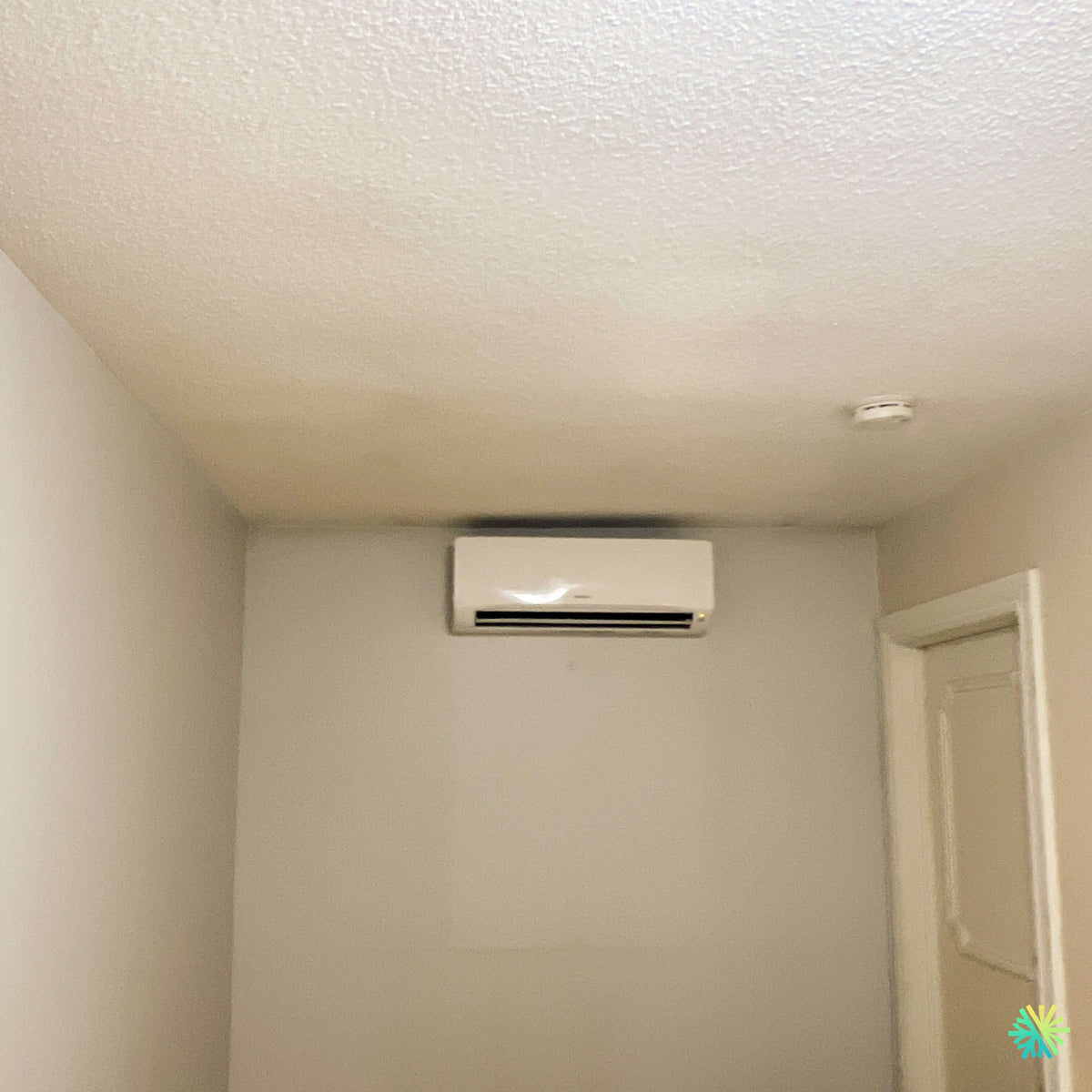
In this residence in Delson, our team had to integrate a new Hitachi airHome 600 wall-mounted heat pump into a room whose layout imposed several practical constraints. The available wall was narrow, a door was immediately to the right of the installation area, and the relatively low ceiling limited the positioning options.
The photograph taken at the end of the work shows an indoor unit installed high on the wall, centered on the unobstructed section and far enough from the door frame. This arrangement was not chosen solely for its appearance. It allows good air intake through the top of the unit, directs conditioned air along the length of the room, and maintains convenient access to the filters for future heat pump maintenance.
In a space like this, a few centimeters can make a significant difference. A unit installed too close to the ceiling may not have enough intake airflow. Installing it too close to the door can interfere with opening it, complicate removal of the front panel, or cause uneven air distribution toward the adjacent hallway. Our task was therefore to find the right balance between air circulation, accessibility, line routing, and visual integration.
Why the Hitachi airHome 600 was a good fit for this project in Delson
The Hitachi airHome 600 is an Inverter wall-mounted heat pump designed to provide three main functions in the home:
- provide air conditioning during hot and humid periods;
- heat during a large part of the winter;
- help keep the indoor unit cleaner thanks to its filtration and self-cleaning technologies.
The series is available in several capacities, from 9,000 to 24,000 BTU/h, making it possible to size the installation according to the room’s actual heating load rather than solely its area. Depending on the selected combination, efficiency can reach a TRÉS2 of 23.0 and a region 5 CPSC2 of 9.2. The manufacturer also states that it can operate in heating mode down to -25 °C, with up to 100% of the available capacity at -15 °C for certain combinations.
For a property located in Delson, on the South Shore, these characteristics are particularly relevant. The system must cope with humid summer days, changing temperatures in the spring and fall, and winter periods when outdoor temperatures drop rapidly.
Inverter technology allows the heat pump to modulate its operation. Instead of starting at full power, stopping completely, and starting again a few minutes later, the compressor adjusts its speed according to demand. This promotes:
- a more stable indoor temperature;
- better humidity control;
- more consistent energy consumption;
- fewer abrupt cycles;
- generally quieter operation.
A high-mounted position that requires precise preparation
In the photo, the indoor unit is installed on a relatively narrow wall, between a corner of the room and a doorway. The top of the heat pump remains below the ceiling, with enough clearance to draw in air.
This installation required careful measurements before drilling. In particular, we had to verify:
- the actual width of the indoor unit;
- the position of the mounting plate;
- the distance from the ceiling;
- the clearance on the right near the door;
- the location of the line-set outlet;
- the slope required for the condensate drain;
- the possible presence of studs, wires, or pipes in the wall.
An error of a few centimetres could have made the panel difficult to open or caused the heat pump to look visually off-center. In a minimalist room with light-colored walls, a misaligned unit would be immediately noticeable.
Why the unit should not be installed flush against the ceiling
A wall-mounted heat pump generally draws room air in through its upper section before circulating it through its filters and heat exchanger. When there is insufficient clearance above the unit, several problems can arise:
- reduced airflow;
- less accurate temperature readings;
- reduced performance;
- increased noise;
- difficult access to the filters;
- faster dust accumulation.
We therefore preserved the necessary space while installing the unit high enough to promote effective air circulation. In cooling mode, cool air naturally descends into the room. In heating mode, the louvers can be directed downward to distribute heat more effectively throughout the occupied area.
Installation near a door without compromising access
The door visible to the right of the unit represents a significant constraint. An indoor unit must not prevent the door from opening fully or be exposed to repeated impacts from the frame or objects being carried through the room.
We positioned the Hitachi unit to maintain a clear separation between the appliance and the trim. This clearance also simplifies future servicing, including:
- removing the front panel;
- cleaning the filters;
- accessing the condensate pan;
- inspecting the ventilation motor;
- checking the drainage connection;
- thorough coil cleaning.
The airHome 600 series was designed with several features that make maintenance easier. The manufacturer's documentation indicates, in particular, a front panel secured with only a few screws, a removable drain pan, drainage connections accessible from both sides, and a lower plate that can be removed to provide easier access to the connections on most models.
Air distribution in a long or narrow room
In a small square room, several locations may sometimes be suitable. In a narrow area like the one shown in the photograph, the direction of the airflow becomes much more important.
We generally try to avoid having the air projected directly:
- against a wall located a short distance away;
- toward an open door;
- toward a tall obstacle;
- over a bed or workstation;
- in a corner where it will circulate poorly.
Installing it on the back wall allows the air to be directed toward the open part of the room. The horizontal and vertical louvers can then be adjusted to distribute the airflow without creating a concentrated draft.
The ventilation mode should match the use of the room
Maximum speed is not always necessary. In a bedroom, office, or relaxation area, a low or automatic speed often provides better acoustic comfort.
Depending on the selected capacity, Hitachi airHome 600 indoor units can operate at very low sound levels. The manufacturer indicates, in particular, a level as low as approximately 27 dB(A) in quiet mode for the 12,000 BTU combination, while the values listed in the technical table vary according to capacity and fan speed.
The perceived noise level also depends on the installation. A poorly secured unit, a pipe in contact with the structure, or a drain vibrating against the wall can generate noise that does not come directly from the machine. The mounting plate must therefore be installed level, firmly anchored, and suitable for the composition of the wall.
Reliable drainage behind a visually discreet installation
In cooling and dehumidification mode, the indoor unit removes moisture from the air. This water collects in the condensate pan before being discharged through a drain.
The drain route is one of the most important elements of an HVAC installation, even though it becomes almost invisible once the work is complete. It must have a constant slope toward the discharge point. A section that rises or forms a low spot can retain water and cause:
- gurgling sounds;
- odors;
- a buildup of deposits;
- a blockage;
- a leak beneath the unit;
- damage to the wall or floor.
Before handing the system over to the customer, we check drain flow and the tightness of the connections. Where gravity drainage is not possible, a condensate pump may be required, but a well-planned gravity solution is generally simpler and quieter.
Refrigerant lines suited to the installed model
The Hitachi airHome 600 range uses R32 refrigerant. Pipe diameters vary according to capacity:
- liquid line for 1/4 po for all capacities;
- gas line for 3/8 po for the 9,000 and 12,000 BTU models;
- gas line for 1/2 po for the 15,000 and 18,000 BTU models;
- gas line for 5/8 po for the higher-capacity model.
Adhering to these diameters is essential. Improper piping can reduce capacity, alter operating pressures, and hinder oil return to the compressor.
During installation, we also pay attention to the quality of the flares, the insulation of the lines, tightening them according to the manufacturer's requirements, and creating a proper vacuum before startup.
FrostWash 3.0: a useful technology, but not a replacement for maintenance
The Hitachi airHome 600 incorporates FrostWash 3.0 technology, which operates in three steps:
- the coil is heated to loosen greasy particles;
- it is cooled to form ice and trap certain dirt particles;
- the ice melts and helps flush out contaminants.
The unit also includes a stainless steel prefilter and a PM2.5 activated carbon purification filter. These components can help capture small particles and reduce certain odors while the heat pump is operating.
However, this function does not relieve the owner of the responsibility to clean the filters. Nor does it replace professional HVAC maintenance, especially when the unit is used every day.
Signs indicating that more thorough cleaning is needed
We recommend having the unit inspected when occupants notice:
- a persistent odor at startup;
- a reduction in airflow;
- visible particles on the blower wheel;
- water leaking under the unit;
- an unusual noise;
- a longer operating time than before;
- filters that become dirty very quickly.
In a narrow room, airflow can carry dust toward the unit in a more concentrated manner. Regular maintenance helps preserve performance and prevent marks from appearing on the wall or ceiling around the unit.
The mold protection function
After certain cycles, the mold protection function circulates air through the internal components and heats the coil to limit residual moisture.
This step is particularly useful after prolonged operation in cooling mode, when the indoor coil remains damp. It can help reduce odor-promoting conditions, but it cannot eliminate contamination that is already present.
To achieve good results, we recommend:
- keep the filters clean;
- keep the air outlets clear;
- do not block the drain;
- avoid systematically cutting off the power at the circuit breaker;
- have the unit inspected if an odor returns despite cleaning the filters.
Winter performance, intelligent control, and advice for a durable installation
Continuous heating down to -25 °C
The Hitachi airHome 600 is designed to continue heating when the outdoor temperature drops as low as -25 °C. However, the actual available capacity varies by model and conditions.
The manufacturer’s technical table shows a maximum capacity at -25 °C ranging approximately from:
- 7,200 BTU/h for the 9,000 BTU model;
- 8,800 BTU/h for the 12,000 BTU model;
- 10,500 BTU/h for the 15,000 BTU model;
- 12,900 BTU/h for the 18,000 BTU model;
- 15,000 BTU/h for the highest-capacity model.
These figures show why sizing must account for winter heating needs. A heat pump capable of operating at -25 °C does not necessarily deliver its full rated capacity at that temperature.
In some homes in Delson, Longueuil, Montréal, Laval, the North Shore, or the South Shore, electric baseboard heaters or another system may remain useful as supplemental heating during the coldest periods.
Defrosting adapted to winter conditions
When the outdoor unit operates in heating mode, its coil can accumulate frost. The heat pump must then run a defrost cycle.
The airHome 600 series includes adaptive defrost technology as well as a heating element in the condensate pan. This device helps drain the water produced by defrosting and limit ice accumulation in the base.
The outdoor unit’s location nevertheless remains important. It must be installed high enough to stay above snow accumulation and allow water to drain. On a support that is too low, ice may eventually reach the coil or fan.
Wi-Fi control with airCloud Go
The Wi-Fi adapter is included with the combinations presented in the brochure. The airCloud Go app allows users in particular to:
- adjust the temperature remotely;
- create a weekly schedule;
- monitor an estimated energy consumption;
- use certain voice commands;
- automate operation based on the phone’s location.
For homeowners who are regularly away, this function makes it possible to check operation without being on-site. It can also be used to lower the temperature during an absence and restore comfort before returning home.
Smart Eco and SleepSense
The Smart Eco motion sensor can detect when a room remains empty and adjust operation after a period of inactivity. When occupancy is detected again, the unit resumes its usual settings.
The SleepSense function is intended to reduce temperature fluctuations during sleep. These options can improve comfort, but they depend on the unit’s positioning and the sensor’s ability to properly cover the room.
In this installation in Delson, the high-mounted installation and the absence of an immediate obstruction in front of the unit promote a clear view of the space.
Mistakes to avoid in a similar room
Installing the unit too close to the corner
A unit installed right against the side wall may draw in air unevenly and make removing certain panels more difficult.
Neglecting the door clearance
The heat pump must not interfere with the frame, door, rod, or a future piece of furniture.
Directing the air straight toward an occupied area
A stream of cold air directed toward a bed, desk, or armchair can become uncomfortable, even if the room’s average temperature is correct.
Choosing excessive capacity
An oversized heat pump can quickly reach the requested temperature and interrupt its cycle before sufficiently dehumidifying the air.
Concealing the drain without checking its slope
A discreet installation is desirable, but reliable condensate drainage remains the priority.
Forgetting the clearance needed for cleaning
The front panel and filters must remain accessible. A shelf, cabinet or curtain added after installation may complicate maintenance.
Eligibility for incentives and the importance of the exact combination
Hitachi documentation presents airHome 600 models as ENERGY STAR certified and eligible for several provincial incentives. Final eligibility nevertheless depends on the program in effect, the address, the type of building and the exact combination of indoor and outdoor units.
Before confirming financial assistance, we verify:
- the complete model numbers;
- the applicable certification;
- the recognized heating capacity;
- the purchase date;
- the installation date;
- the type of dwelling;
- the program's documentation requirements.
A commercial designation such as “airHome 600” is not sufficient on its own. The numbers shown on the nameplates and invoice must match the eligible combination.
Hitachi warranties and equipment registration
According to the manufacturer's documentation, the standard warranty provides seven years of compressor coverage and five years of parts coverage. An extended warranty of up to ten years on the compressor and ten years on parts is available for certain residential installations, subject to online registration.
An enhanced warranty option is also available, with coverage of up to twelve years on the compressor, ten years on parts and ten years on labor, depending on the conditions and the upgrade purchased.
Registering the unit after installation is therefore a step that should not be overlooked. You must keep:
- the detailed invoice;
- the serial numbers;
- the model numbers;
- the commissioning date;
- the documents related to the warranty;
- the required documentation for a potential rebate.
The result of our Delson installation
This installation demonstrates that a limited space can accommodate a high-performance wall-mounted heat pump when positioning is carefully planned.
The Hitachi airHome 600 unit is:
- installed at a height conducive to effective air distribution;
- properly aligned on the wall;
- separated from the door frame;
- accessible for filter cleaning;
- positioned to project air toward the open area;
- integrated without visually weighing down the room.
At AirGreen, we apply the same rigor to our installations of wall-mounted heat pumps in Delson, Montreal, Laval, Longueuil, the North Shore and the South Shore. The choice of equipment matters, but the quality of the installation, drainage, connections and commissioning largely determines the comfort provided in the years that follow.
The big day, step by step
The main steps of this kind of job at AirGreen. Every house has its quirks: the estimate brings them out.
We look at the room, the outside wall, the line route and where the outdoor unit will go. That is where the capacity gets chosen.
Model, capacity and price, in writing. We also check whether the model qualifies for assistance programs.
Floors and furniture protected, wall plate position marked level, wall opening located.
A single opening, with the slope the drain needs to flow outside.
Set on a stand raised above the snow, with the clearances the manufacturer requires.
Connected, insulated and protected. The opening is then sealed against water, cold air and insects.
A dedicated circuit and an accessible disconnect near the outdoor unit.
Leak test, vacuum, then start-up and a check of heating and cooling.
Remote, modes, filters: we show you the essentials before we leave.
- The on-site estimateWe look at the room, the outside wall, the line route and where the outdoor unit will go. That is where the capacity gets chosen.
- The quoteModel, capacity and price, in writing. We also check whether the model qualifies for assistance programs.
- Getting readyFloors and furniture protected, wall plate position marked level, wall opening located.
- The wall openingA single opening, with the slope the drain needs to flow outside.
- The outdoor unitSet on a stand raised above the snow, with the clearances the manufacturer requires.
- Lines, cable and drainConnected, insulated and protected. The opening is then sealed against water, cold air and insects.
- The electrical workA dedicated circuit and an accessible disconnect near the outdoor unit.
- Tests and start-upLeak test, vacuum, then start-up and a check of heating and cooling.
- The walkthroughRemote, modes, filters: we show you the essentials before we leave.
What would it look like at your place?
Two quick checks with real numbers: what heat costs, and what your current heaters add up to in BTU/h.
Conversion: 1 W = 3.412 BTU/h. An indication, not a load calculation: baseboards and furnaces are often stronger than the real need, and they can stay as backup. AirGreen confirms the capacity on site.
Four mistakes we do not make
Flip each card to see what we do instead.
Your own project, step by step
What to do, season by season
Three habits per season for this unit. They take a few minutes and prevent many calls.
- Clean the indoor unit's filters.
- Clear leaves and debris left on the outdoor unit by winter.
- Test cooling before the first hot days.
- Clean the filters more often when the unit runs a lot.
- Keep plants away from the outdoor unit.
- Check that no water drips from the indoor unit.
- Rake the leaves around the outdoor unit.
- Test heating before the first cold days.
- Book periodic maintenance before winter.
- Keep snow away from the stand and the front of the unit.
- Let the unit defrost: it is normal.
- Never hit the ice on the fins; call us if the unit stays iced up.
Is your home ready?
Check what applies at your place. A "no" is not a refusal: it is what we sort out during the estimate.
Four statements: true or false?
It all comes down to details you have just seen.
1. In heating mode, the outdoor unit can produce water.
During defrost cycles. That water must drain away without forming ice.
2. You pick the capacity with a simple square-footage rule.
Windows, insulation, orientation and how the room is used all count. Capacity is chosen on site.
3. A multi-zone connects several indoor heads to a single condenser.
One head per room, all on the same condenser. Each room keeps its own temperature.
4. The disconnect can sit behind the patio furniture.
It must stay accessible: it is what shuts the unit off for service.
0 / 4 right answers
What people ask us about this kind of work
Does a wall-mounted heat pump heat in winter?
Wall-mounted or multi-zone: how do I choose?
Where does the outdoor unit go?
Are there grants?
Do I need a permit?
How cold can it heat?
How much can I save?
How is the LogisVert assistance calculated?
Is it noisy?
The outdoor unit is covered in ice: is that normal?
Does AirGreen hold the required licences?
Is the estimate free?
No question matches. Write to us: we answer.
More jobs to see, near you
By town, by equipment or by region: browse more than 4,700 published projects.
Each dot: a town where AirGreen has published projects. The glowing dot: this job.
Every house has its constraints. We see them before we install.
The on-site estimate is free and the quote follows within 24 hours.
Text and photo: a real AirGreen Climatisation & Chauffage job. The diagrams are generic illustrations of the type of installation, not a survey of this job site. Sources of the added figures: airgreen.ca product pages (NEEP / AHRI performance), Hydro-Québec (Heat pumps page, LogisVert, read on 13 October 2026), Régie de l’énergie (rate D as of 1 April 2026).