
Installation of a Midea28 wall-mounted heat pump in Rosemont–La Petite-Patrie
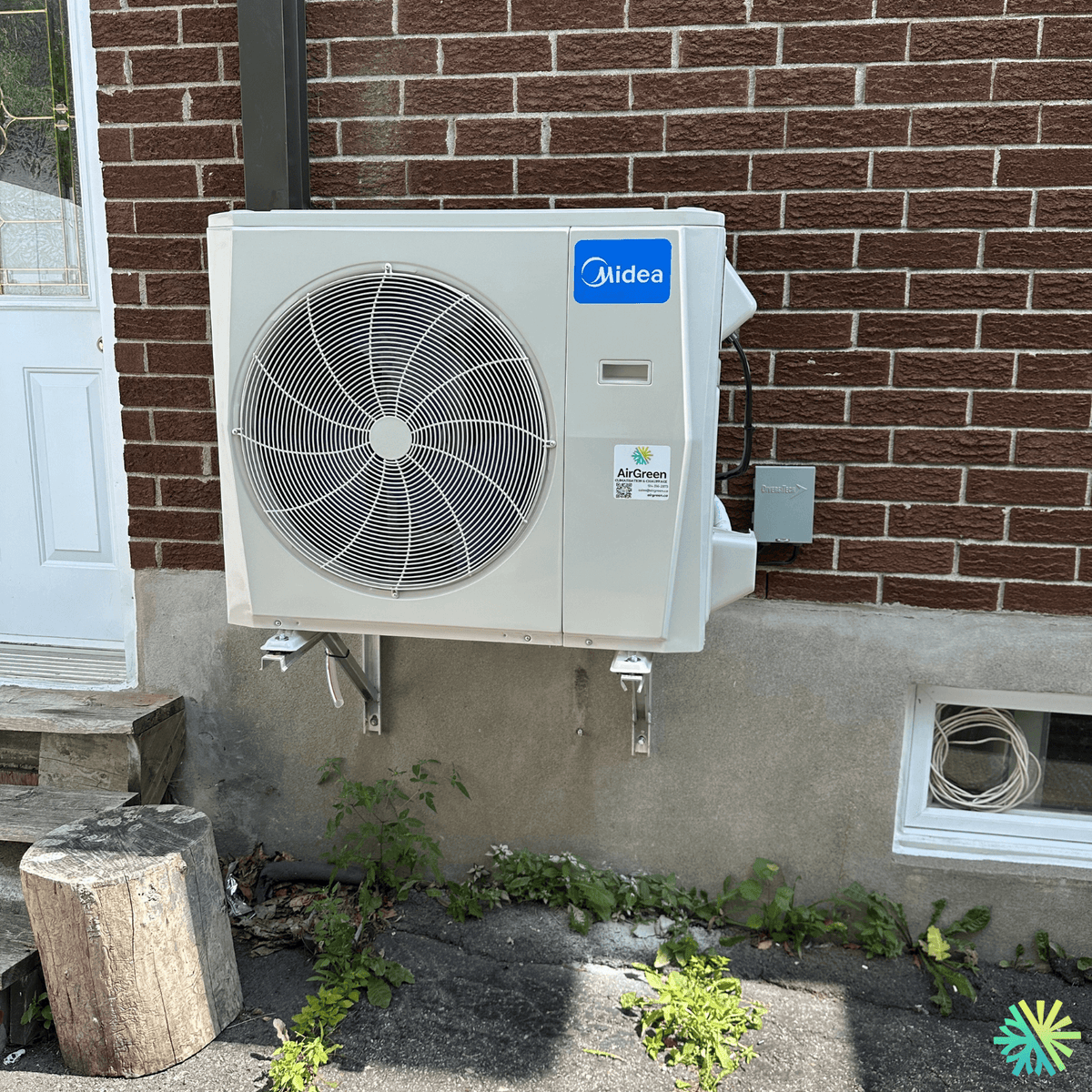
In Rosemont–La Petite-Patrie, AirGreen installed a Midea28 wall-mounted heat pump on the rear facade of a brick duplex. Mounted on wall brackets with a dedicated electrical disconnect and discreet routing of connections, this heat pump now provides the client with optimal heating and cooling comfort, while reducing their electricity bill.
In summer, the outdoor unit rejects the house's heat outside.
Generic illustration of this type of installation, not a survey of this job site. Tap a number.
Mounted level on a wall plate, high enough for the air to reach the whole room, with enough space around it to slide the filters out easily.
The refrigerant lines, the communication cable and the drain go through the wall in a single opening, sealed against water, cold air and insects.
Two insulated copper pipes connect the two units. Outside, a line cover can protect them from sun, knocks and weather.
A shut-off switch near the outdoor unit isolates it safely for service. It must stay accessible at all times.
The compressor and the fan. In heating mode it captures heat from the outdoor air, even in winter, and moves it inside.
On the ground or on the wall, it keeps the unit above accumulated snow. The unit stays clear and defrost water can drain away.
The fan needs to blow freely. Storage, a fence or a wall too close, and efficiency drops while noise goes up.
In Rosemont–La Petite-Patrie, many brick duplexes and triplexes are seeking improved comfort year-round without compromising the aesthetics of their facades. This is precisely the challenge we met for this client by installing a Midea28 wall-mounted heat pump on the exterior wall of their property, in a small, typically Montreal backyard.
In this article, we present this project by AirGreen , as well as the concrete advantages of the Midea28 for a residential building in this sector.
Context of the house in Rosemont–La Petite-Patrie
The residence is a brick duplex with a semi-above-ground basement, an exterior wooden staircase, and a small asphalt driveway. The client wanted:
-
Replacing an energy-inefficient electric heater.
-
Add air conditioning for periods of extreme heat.
-
Minimize noise as much as possible for the neighborhood and for the occupants.
-
Preserve the integrity of the brick facade and foundation.
We recommended the installation of a Midea28 wall-mounted heat pump , a high-performance system perfectly suited to Quebec winters and the sometimes scorching summers of Montreal.
Type of system installed: Midea28 wall-mounted heat pump
The chosen system is a Midea28 wall-mounted heat pump (mini-split) , operating with R-454B refrigerant and designed to:
-
Heat efficiently down to approximately −30 °C depending on the configuration;
-
To provide quiet and stable air conditioning;
-
Reduce energy consumption compared to electric baseboard heaters.
The Midea28 model is distinguished by:
-
An inverter compressor that continuously modulates its power;
-
A design geared towards extreme cold for Montreal's climate;
-
An excellent performance/price ratio, ideal for Rosemont–La Petite-Patrie homes looking for a reliable and durable system.
Installation details visible in the photo
Several technical elements stand out in this installation:
-
Outdoor condenser on wall brackets
The Midea outdoor unit is securely fixed to galvanized wall brackets .-
This helps to keep it above ground level and above the snow.
-
This limits the risk of ice, dirt or stagnant water accumulating around the base of the device.
-
Maintenance, snow removal and visual inspection become much simpler.
-
-
Installation on a brick facade and concrete foundation
The heat pump is anchored in the concrete foundation section, just below the brick wall.-
This configuration ensures excellent mechanical strength .
-
It also avoids unnecessarily drilling through the brick beyond what is needed for the refrigeration connections.
-
-
Dedicated electrical disconnect box
To the right of the outdoor unit, there is a disconnect box installed in accordance with the Electrical Code.-
It allows the heat pump to be quickly shut off for maintenance or in case of emergency.
-
This proximity meets safety requirements and simplifies the work of the technicians.
-
-
Discreet routing of refrigeration lines
The refrigeration pipes and communication cables are grouped together and protected by sheaths and covers .-
Everything is installed in such a way as to remain visually discreet.
-
The components are protected against weathering and accidental impacts.
-
-
Managing limited backyard space
The unit is positioned so that:-
Maintain sufficient clearance from the back door and wooden steps;
-
Avoid blowing directly towards the basement windows;
-
Do not obstruct traffic in the small asphalt alley.
-
This type of configuration is very representative of the realities of Rosemont–La Petite-Patrie, where every centimeter of backyard counts.
Four-season comfort for the customer
Thanks to this Midea28 wall-mounted heat pump , the customer now benefits from:
-
In summer
-
Efficient and quiet air conditioning in the rooms served by the indoor wall-mounted unit(s).
-
Precise temperature control even during Montreal heat waves.
-
-
In winter
-
From efficient heating even in very low outside temperatures.
-
A significant reduction in reliance on electric baseboard heaters.
-
More uniform comfort, without cold spots near the windows.
-
-
per year
-
Energy savings compared to traditional 100% electric heating.
-
Improved control of humidity and indoor air quality through heat pump modulation.
-
Energy performance and potential savings
The Midea28 series is designed to offer:
-
A high COP (coefficient of performance) in heating, even in cold weather;
-
Superior seasonal energy efficiency compared to older systems;
-
Power modulation avoids frequent on/off cycles, thus increasing the lifespan of the components.
For a typical Rosemont–La Petite-Patrie home, installing a Midea28 heat pump can:
-
Significantly reduce the annual electricity bill;
-
Improve the perceived comfort in living spaces;
-
Increase the perceived value of the property for a possible resale.
Noise management and respect for the neighborhood
In a densely populated area like Rosemont–La Petite-Patrie , noise is a critical issue. During installation, we:
-
Choose a height and positioning that limits the propagation of sound towards neighboring windows;
-
Checked the clearances to maintain good air circulation, which reduces the compressor's effort and therefore the noise;
-
Use supports with anti-vibration pads as needed to prevent the transmission of vibrations into the structure.
Midea28 heat pumps are already known for their low noise level; combined with careful installation, this makes them an excellent choice for Montreal alleyways and backyards.
Why entrust your Midea heat pump to AirGreen?
At AirGreen , we install and maintain Midea wall-mounted heat pumps throughout Greater Montreal. For this project in Rosemont–La Petite-Patrie, as with all our others, we have:
-
Analyzed the building's configuration and the client's needs;
-
The Midea28 model is recommended for its heating and air conditioning performance;
-
Compliant with the electrical and mechanical standards in force in Quebec;
-
The aesthetics of the installation were carefully considered so that it would blend harmoniously with the brick facade.
We also offer:
-
Annual maintenance services to keep the heat pump performing at its best;
-
After-sales service and support for warranty and operational issues;
-
Personalized advice to optimize the use of the system throughout the seasons.
Do you live in Rosemont–La Petite-Patrie or Greater Montreal?
If you live in Rosemont–La Petite-Patrie , or elsewhere in Greater Montreal, and are considering installing a Midea28 wall-mounted heat pump , our team will be happy to assist you:
-
Analysis of your heating and air conditioning needs;
-
Advice on sizing and best location of the unit;
-
Detailed and transparent estimate;
-
Professional, clean and safe installation.
We put the same rigor into every project as we did into this Midea28 installation in Rosemont–La Petite-Patrie.
How it goes, from the first call to the end
The main steps of this kind of job at AirGreen. Every house has its quirks: the estimate brings them out.
We look at the room, the outside wall, the line route and where the outdoor unit will go. That is where the capacity gets chosen.
Model, capacity and price, in writing. We also check whether the model qualifies for assistance programs.
Floors and furniture protected, wall plate position marked level, wall opening located.
A single opening, with the slope the drain needs to flow outside.
Set on a stand raised above the snow, with the clearances the manufacturer requires.
Connected, insulated and protected. The opening is then sealed against water, cold air and insects.
A dedicated circuit and an accessible disconnect near the outdoor unit.
Leak test, vacuum, then start-up and a check of heating and cooling.
Remote, modes, filters: we show you the essentials before we leave.
- The on-site estimateWe look at the room, the outside wall, the line route and where the outdoor unit will go. That is where the capacity gets chosen.
- The quoteModel, capacity and price, in writing. We also check whether the model qualifies for assistance programs.
- Getting readyFloors and furniture protected, wall plate position marked level, wall opening located.
- The wall openingA single opening, with the slope the drain needs to flow outside.
- The outdoor unitSet on a stand raised above the snow, with the clearances the manufacturer requires.
- Lines, cable and drainConnected, insulated and protected. The opening is then sealed against water, cold air and insects.
- The electrical workA dedicated circuit and an accessible disconnect near the outdoor unit.
- Tests and start-upLeak test, vacuum, then start-up and a check of heating and cooling.
- The walkthroughRemote, modes, filters: we show you the essentials before we leave.
What the unit delivers when it is cold
The range as published on airgreen.ca: pick a size to see its capacity in deep cold.
| Size | Heating at −8 °C | Heating at −15 °C | Coldest certified point | COP at −15 °C | SEER | HSPF | Indicative LogisVert aid |
|---|---|---|---|---|---|---|---|
| Midea Série 28 9 000 | 12,000 | 11,500 | −30 °C: 5,100 | 1.8 | 27.4 | 12.5 | – |
| Midea Série 28 12 000 | 12,000 | 11,500 | −30 °C: 5,900 | 1.8 | 25.4 | 10.5 | $1,440 |
| Midea Série 28 18 000 | 18,000 | 18,000 | −30 °C: 8,000 | 1.92 | 21.4 | 11.0 | $2,160 |
| Midea Série 28 24 000 | 22,200 | 24,200 | −30 °C: 11,900 | 2.34 | 21.0 | 13.5 | $2,664 |
| Midea Série 28 33 000 | 32,000 | 35,000 | −30 °C: 20,700 | 1.98 | 19.5 | 10.5 | $3,840 |
According to NEEP, it delivers 12,000 BTU/h at −8 °C (17 °F), as much as at 8 °C. It heats as hard in moderate cold as in mild weather.
At 8 °C, its certified maximum capacity reaches 16,000 BTU/h, 78% more than its nominal 9,000 BTU size.
According to NEEP, its certified heating capacity at −15 °C (5 °F) is 11,500 BTU/h, 128% of its nominal 9,000 BTU size. Its COP there is 1.80.
According to NEEP, it delivers 12,000 BTU/h at −8 °C (17 °F), as much as at 8 °C. It heats as hard in moderate cold as in mild weather.
At 8 °C, its certified maximum capacity reaches 16,000 BTU/h, 33% more than its nominal 12,000 BTU size.
At −30 °C, its certified minimum capacity is 2,000 BTU/h (3,800 at 8 °C). It slows down instead of cycling on and off.
According to NEEP, it delivers 18,000 BTU/h at −8 °C (17 °F), as much as at 8 °C. It heats as hard in moderate cold as in mild weather.
According to NEEP, its certified heating capacity at −15 °C (5 °F) is 18,000 BTU/h, 100% of its nominal 18,000 BTU size. Its COP there is 1.92.
According to NEEP, its COP at −15 °C is 2.34: the highest of the Série 28 line, which ranges from 1.80 to 1.98 at that temperature.
At −30 °C, its certified minimum capacity is 2,400 BTU/h (11,800 at 8 °C). It slows down instead of cycling on and off.
According to NEEP, its certified heating capacity at −15 °C (5 °F) is 24,200 BTU/h, 101% of its nominal 24,000 BTU size. Its COP there is 2.34.
According to NEEP, its certified maximum capacity at −30 °C (−22 °F) is 20,700 BTU/h, 63% of its nominal 33,000 BTU size.
At −30 °C, its certified minimum capacity is 4,200 BTU/h (19,700 at 8 °C). It slows down instead of cycling on and off.
According to NEEP, its certified heating capacity at −15 °C (5 °F) is 35,000 BTU/h, 106% of its nominal 33,000 BTU size. Its COP there is 1.98.
Data read live from the airgreen.ca page of each size (NEEP / AHRI certified performance). When the title names the installed size, it is highlighted; otherwise the whole range is shown. The aid shown is today’s, using Hydro-Québec’s rule ($120 per 1,000 BTU/h at −8 °C); amounts quoted in the article date from its publication. Only Hydro-Québec confirms the assistance granted.A dash in the aid column: amount to be confirmed for this model.
And at your place?
Two quick checks with real numbers: what heat costs, and what your current heaters add up to in BTU/h.
Baseboards and electric furnaces turn 1 kWh of electricity into 1 kWh of heat. A heat pump delivers more: that is its COP. At Hydro-Québec’s rate D (11.142¢/kWh above 40 kWh a day, since 1 April 2026):
Hydro-Québec: a heat pump can be up to three times more efficient than baseboards for heating in the colder months.
Estimate per kWh of heat, at the chosen temperature, using the certified COP from the product page. Taxes, access charge and backup heat not included.
Conversion: 1 W = 3.412 BTU/h. An indication, not a load calculation: baseboards and furnaces are often stronger than the real need, and they can stay as backup. AirGreen confirms the capacity on site.
What to do, season by season
Three habits per season for this unit. They take a few minutes and prevent many calls.
- Clean the indoor unit's filters.
- Clear leaves and debris left on the outdoor unit by winter.
- Test cooling before the first hot days.
- Clean the filters more often when the unit runs a lot.
- Keep plants away from the outdoor unit.
- Check that no water drips from the indoor unit.
- Rake the leaves around the outdoor unit.
- Test heating before the first cold days.
- Book periodic maintenance before winter.
- Keep snow away from the stand and the front of the unit.
- Let the unit defrost: it is normal.
- Never hit the ice on the fins; call us if the unit stays iced up.
Which type of equipment for your project?
Pick what looks like your need.
Four mistakes we do not make
Flip each card to see what we do instead.
What people ask us about this kind of work
Does a wall-mounted heat pump heat in winter?
Wall-mounted or multi-zone: how do I choose?
Where does the outdoor unit go?
Are there grants?
Do I need a permit?
How cold can it heat?
How much can I save?
How is the LogisVert assistance calculated?
Is it noisy?
The outdoor unit is covered in ice: is that normal?
Does AirGreen hold the required licences?
Is the estimate free?
No question matches. Write to us: we answer.
Useful pages for what comes next
More jobs to see, near you
By town, by equipment or by region: browse more than 4,700 published projects.
Each dot: a town where AirGreen has published projects. The glowing dot: this job.
Tell us about your house. We come and see it for free.
The on-site estimate is free and the quote follows within 24 hours.
Text and photo: a real AirGreen Climatisation & Chauffage job. The diagrams are generic illustrations of the type of installation, not a survey of this job site. Sources of the added figures: airgreen.ca product pages (NEEP / AHRI performance), Hydro-Québec (Heat pumps page, LogisVert, read on 13 October 2026), Régie de l’énergie (rate D as of 1 April 2026).