
Installation of a FUJITSU ALTAIR 700 Mini Split wall-mounted heat pump in Île-Bizard–Sainte-Geneviève: strategic replacement in a very confined outdoor space
AirGreen installs a FUJITSU ALTAIR 700 Mini Split wall-mounted heat pump in Île-Bizard–Sainte-Geneviève, in a confined outdoor space under a deck, with a sustainable and precise HVAC approach.
- City
- Region
- Equipment
- Brand
- Challenges
- Published
The job on one screen
The article, chapter by chapter
An HVAC Installation Where Outdoor Placement Made All the Difference
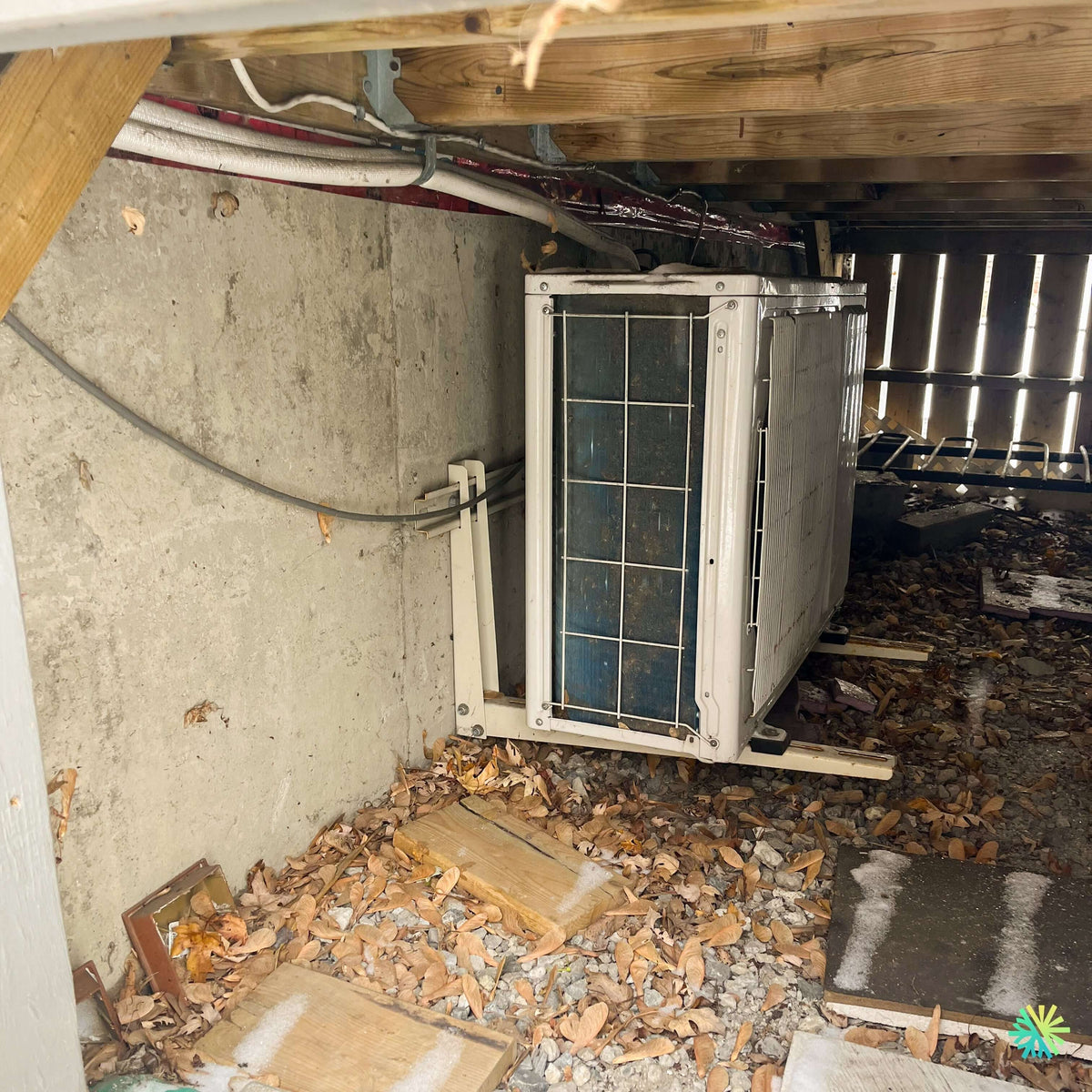
In the residential sector of Île-Bizard–Sainte-Geneviève, we carried out the installation of a FUJITSU ALTAIR 700 Mini Split wall-mounted heat pump, a project that perfectly illustrates the importance of a thorough site analysis before replacing or installing an HVAC system. The job site photo immediately reveals a specific context: the outdoor unit is located under a wooden structure, in a low, narrow space, exposed to fallen leaves, ground moisture, and ventilation constraints.
This type of installation requires much more than a simple mechanical connection. In an environment like this, every detail counts: clearance around the unit, access for HVAC maintenance, protection of refrigerant lines, drainage, support stability, air circulation, and prevention of debris accumulation. At AirGreen, we know that the quality of an HVAC installation is measured as much by the machine's performance as by how it is integrated into its real environment.
The client wanted to modernize their indoor comfort with a more efficient, quieter, and better-suited solution for Quebec seasons. The old location showed several typical signs of an aging installation: cluttered space, accumulated leaves around the base, limited access, lateral clearance to watch out for, and existing lines running along the foundation. Our role was to assess whether the location could be optimized, secured, and adapted for a new wall-mounted heat pump without compromising its long-term performance.
The FUJITSU ALTAIR 700 emerged as a relevant solution for this project, particularly due to its compact size, quiet operation, and attractive energy efficiency. According to available manufacturer and distributor data, the Altair 700 series can achieve up to 30 SEER2, with an indoor sound level as low as 19 dB depending on the chosen capacity and configuration. The 12,000 BTU model is notably associated with an efficiency of 27.5 SEER2, an indoor sound pressure of 19 to 49 dB(A), and typical refrigerant lines of 1/4 in. and 3/8 in. according to published specifications.
Why this Île-Bizard–Sainte-Geneviève job site was technically delicate
Installing a Mini Split heat pump in a residential neighborhood like Île-Bizard–Sainte-Geneviève might seem straightforward at first glance. However, this photo shows a challenge that our technicians regularly encounter in Greater Montreal: the outdoor unit is not always placed in an ideal location.
Here, the space is located under a deck or elevated structure, with limited height and restricted access. This context raises several issues:
- Ventilation around the outdoor unit: a heat pump must breathe properly to exhaust or capture heat depending on the season.
- Accumulation of leaves and debris: visible leaves on the ground can hinder air circulation, partially block the exchanger, or retain moisture.
- Access for maintenance: a cramped space complicates coil cleaning, inspections, and future interventions.
- Protection of lines: refrigerant lines and electrical wiring must be neatly secured, protected, and installed according to applicable regulations.
- Support stability: the outdoor unit must be installed on a solid and level base, especially in an area exposed to freezing, thawing, and humidity.
In this project, our first step was to verify that the new equipment could be installed sustainably without replicating the weaknesses of the old configuration. A replacement without correcting the environment could have led to performance issues, noise, premature wear, and difficult maintenance.
Choosing the FUJITSU ALTAIR 700 for a residential home
The FUJITSU ALTAIR 700 is a wall-mounted heat pump well-suited for homeowners seeking an efficient system for cooling and heating a main zone of the house. It is particularly suitable for living rooms, open-plan areas, residential extensions, duplexes, single-family homes, and spaces where a good balance between comfort, performance, and discretion is desired.
In the case of this residence in Île-Bizard–Sainte-Geneviève, the client wanted a solution capable of improving daily comfort without turning the house into a major construction site. A Mini Split wall-mounted heat pump specifically avoids adding ducts, while offering power modulation thanks to Inverter technology. This modulation is important in Quebec: rather than operating in abrupt cycles, the system adjusts its capacity according to real demand, which promotes a more stable temperature.
The Altair 700 range is also associated with R-32 refrigerant, an increasingly common option in new generations of wall-mounted systems. The Altair 700 is available in several capacities, notably 9,000 and 12,000 BTU depending on available configurations, with high energy performance and a wall-mounted design conceived for modern residential installations.
Essential site preparation before installation
Before proceeding with the installation of the new outdoor unit, our technicians paid particular attention to preparing the space. Under a deck, the ground can easily become an accumulation zone: leaves, dust, small wood debris, stagnant moisture, displaced gravel, and forgotten objects. These elements may seem minor, but they directly influence the lifespan of a heat pump.
We therefore analyzed:
-
Clearance available around the outdoor unit
A unit too close to a wall, railing, or wooden structure can lose efficiency. Even a high-performance machine like the FUJITSU ALTAIR 700 must be installed in an environment allowing adequate heat exchange. -
Air discharge and suction direction
Under a structure, it is necessary to prevent the hot or cold air rejected by the unit from being immediately re-absorbed by the appliance. This recirculation reduces efficiency and can increase electricity consumption. -
Routing of lines
Refrigerant lines, communication wiring, and power supply must be installed neatly, with adequate slope and protection where necessary. In this project, the visible lines near the foundation required particular attention to avoid excessive bends and vulnerable points. -
Drainage management
The indoor unit's drainage and the flow conditions around the outdoor unit must be examined, especially in an area where water can accumulate near the foundation. -
Future accessibility
A well-done installation today must remain accessible tomorrow. For AirGreen, a good job site is not just clean on the day of installation: it must also allow for realistic HVAC maintenance in two, five, or ten years.
What the photo reveals about mistakes to avoid
This image is very instructive for homeowners in Montreal, Laval, Longueuil, the North Shore, and the South Shore who are considering installing a wall-mounted heat pump. It shows several points not to overlook.
The first mistake would be to consider the outdoor unit as a simple mechanical block that can be placed anywhere. A heat pump operates through constant exchange with the outside air. If it's cramped in a poorly ventilated space, its performance can decrease.
The second mistake would be to let debris accumulate around the appliance. The visible leaves on the ground can eventually partially obstruct the exchanger, retain moisture, and complicate maintenance. In a low space like this, periodic cleaning is essential.
The third mistake would be to neglect technical access. A homeowner might sometimes want to completely hide the outdoor unit for aesthetic reasons. This is understandable, but sufficient access for inspections, repairs, cleaning, and pressure checks must always be maintained.
The fourth mistake would be to install a new machine without reviewing the old line routing. When replacing an old system, it's tempting to reuse everything that's already in place. At AirGreen, we always check if existing lines are compatible, clean, properly sized, and compliant with the new installation. A quick saving at this stage can be costly later.
An installation designed for comfort, durability, and long-term maintenance
The desired outcome for this installation in Île-Bizard–Sainte-Geneviève was clear: to provide the client with a reliable heating and cooling solution, neatly installed, adapted to the physical reality of the house, and easy to maintain. The FUJITSU ALTAIR 700 met this need well, but our primary task was to ensure that its installation environment did not become an obstacle to its performance.
Our technicians' work on site
Our teams proceeded with a methodical approach. In this type of job site, it's not enough to quickly install the outdoor unit and connect the indoor wall-mounted unit. One must consider the system's behavior during heat waves, during humid periods, during heating cycles, during winter defrosts, and during future maintenance.
We paid particular attention to the fastening, the unit's level, available clearance, line routing, and connection protection. In a space under a deck, vibrations can sometimes transmit differently than on an open facade. The choice of support and the quality of the base therefore play a direct role in acoustic comfort.
The positioning of the outdoor unit also had to respect the existing structure. Joists, foundation, metal supports, and lateral clearances imposed precise limits. Our technicians therefore worked carefully to ensure a safe, stable, and consistent installation with the building's configuration.
Concrete benefits for the homeowner
For the client, this wall-mounted heat pump installation brings several immediate benefits:
- Better comfort in summer, with more stable air conditioning in the serviced area.
- Efficient auxiliary heating during a large part of the cold season, depending on the outdoor temperature and the house's needs.
- Quiet operation, an important criterion in homes where the indoor unit is located near a living space.
- Reduced reliance on traditional electric systems, when the heat pump is used correctly.
- Modernization of the HVAC system without duct installation.
- Better space management, thanks to the compact size of a Mini Split solution.
The client also benefited from our advice on daily system use: temperature settings, operating modes, filter cleaning, the importance of not obstructing the outdoor unit, and recommended maintenance frequency.
Eligibility for subsidies and importance of documentation
Homeowners installing a high-performance heat pump in Greater Montreal are often interested in financial assistance programs, notably Hydro-Québec's LogisVert when applicable criteria are met. Some reference pages indicate that FUJITSU ALTAIR 700 models may be eligible for a provincial subsidy, with amounts varying according to capacity, program criteria, and available updates. For example, an AirGreen page on the Altair 700 12,000 BTU mentions a LogisVert subsidy of $1,044, subject to eligibility.
At AirGreen, we always remind clients that eligibility must be validated according to the exact model, the applicable AHRI number, the installation date, the type of building, the electricity rate, and the rules in effect at the time of application. We provide the necessary documents after installation to facilitate the client's process.
Practical tips for homeowners with a unit under a deck
For homes in Montreal, Laval, Longueuil, the North Shore, and the South Shore, outdoor units placed under a deck, balcony, or wooden structure are quite common. This type of location can work, but it must be properly evaluated.
Here are our recommendations:
- Keep the space around the unit clean and clear.
- Regularly remove accumulated leaves, branches, dust, and objects.
- Never completely enclose the space with solid panels without validating ventilation.
- Provide sufficient access for a technician.
- Avoid storing materials near the outdoor unit.
- Have the system inspected before peak usage seasons.
- Check that water does not stagnate under or around the equipment.
- Avoid deck or fence modifications that would block airflow.
These tips may seem simple, but they often make the difference between a wall-mounted heat pump that operates efficiently for many years and a system that gradually loses performance.
The AirGreen approach: install for today, plan for tomorrow
Every project reminds us that a good HVAC installation isn't just about choosing the right brand. Even a renowned machine like the FUJITSU ALTAIR 700 needs to be installed under the right conditions. That's why we always analyze the building, its location, access constraints, client habits, actual heating and cooling needs, as well as future maintenance possibilities.
In Île-Bizard–Sainte-Geneviève, this project demonstrated our ability to work in a complex space, correct the typical weaknesses of an old installation, and integrate a modern solution without compromising the existing structure. This level of attention is essential for owners who want to invest in a sustainable, efficient, and well-adapted system for the Quebec climate.
We carry out this type of installation throughout Greater Montreal, including Montreal, Laval, Longueuil, the North Shore, and the South Shore. Whether the project involves a single-family home, a condo, a duplex, a triplex, or a property with difficult outdoor access, our team takes the time to recommend a realistic, high-performing, and neatly executed solution.
Why choose AirGreen for a FUJITSU ALTAIR 700 heat pump
Working with AirGreen means choosing a team accustomed to the realities of Quebec buildings: confined spaces, co-ownerships, old foundations, balconies, terraces, brick walls, electrical constraints, local standards, and subsidy requirements. We know that owners want a clear installation, transparent pricing, understandable explanations, and after-installation service.
For a FUJITSU ALTAIR 700 Mini Split wall-mounted heat pump, our work includes evaluating the actual need, choosing the appropriate capacity, installation by qualified technicians, commissioning, usage explanations, and maintenance recommendations. In a project like the one in Île-Bizard–Sainte-Geneviève, this rigor becomes even more important, as the outdoor location directly influences the appliance's performance.
A project that perfectly summarizes our HVAC expertise
This installation shows that a good heating and air conditioning project is never just about the machine. It's a combination of the right equipment, the right location, careful installation, and honest advice. The FUJITSU ALTAIR 700 offered an excellent technical basis here, but it was the attention paid to the actual site conditions that allowed us to deliver a reliable solution.
For owners who look at this photo and recognize a similar situation at home — an outdoor unit under a deck, tight space, accumulated leaves, difficult access — the message is simple: it is possible to install a high-performance wall-mounted heat pump in a complex environment, but it must be done methodically. A professional evaluation helps avoid costly mistakes and ensures lasting comfort.
The job tools
Two quick checks with real numbers: what heat costs, and what your current heaters add up to in BTU/h.
Conversion: 1 W = 3.412 BTU/h. An indication, not a load calculation: baseboards and furnaces are often stronger than the real need, and they can stay as backup. AirGreen confirms the capacity on site.
How the job unfolds
The main steps of this kind of job at AirGreen. Every house has its quirks: the estimate brings them out.
We look at the room, the outside wall, the line route and where the outdoor unit will go. That is where the capacity gets chosen.
Model, capacity and price, in writing. We also check whether the model qualifies for assistance programs.
Floors and furniture protected, wall plate position marked level, wall opening located.
A single opening, with the slope the drain needs to flow outside.
Set on a stand raised above the snow, with the clearances the manufacturer requires.
Connected, insulated and protected. The opening is then sealed against water, cold air and insects.
A dedicated circuit and an accessible disconnect near the outdoor unit.
Leak test, vacuum, then start-up and a check of heating and cooling.
Remote, modes, filters: we show you the essentials before we leave.
- The on-site estimateWe look at the room, the outside wall, the line route and where the outdoor unit will go. That is where the capacity gets chosen.
- The quoteModel, capacity and price, in writing. We also check whether the model qualifies for assistance programs.
- Getting readyFloors and furniture protected, wall plate position marked level, wall opening located.
- The wall openingA single opening, with the slope the drain needs to flow outside.
- The outdoor unitSet on a stand raised above the snow, with the clearances the manufacturer requires.
- Lines, cable and drainConnected, insulated and protected. The opening is then sealed against water, cold air and insects.
- The electrical workA dedicated circuit and an accessible disconnect near the outdoor unit.
- Tests and start-upLeak test, vacuum, then start-up and a check of heating and cooling.
- The walkthroughRemote, modes, filters: we show you the essentials before we leave.
What we check on a job like this one
Each number is a point we check on site. Switch between summer and winter to watch air and heat move.
In summer, the outdoor unit rejects the house's heat outside.
Generic illustration of this type of installation, not a survey of this job site. Tap a number.
Mounted level on a wall plate, high enough for the air to reach the whole room, with enough space around it to slide the filters out easily.
The refrigerant lines, the communication cable and the drain go through the wall in a single opening, sealed against water, cold air and insects.
Two insulated copper pipes connect the two units. Outside, a line cover can protect them from sun, knocks and weather.
A shut-off switch near the outdoor unit isolates it safely for service. It must stay accessible at all times.
The compressor and the fan. In heating mode it captures heat from the outdoor air, even in winter, and moves it inside.
On the ground or on the wall, it keeps the unit above accumulated snow. The unit stays clear and defrost water can drain away.
The fan needs to blow freely. Storage, a fence or a wall too close, and efficiency drops while noise goes up.
Is your home ready?
Check what applies at your place. A "no" is not a refusal: it is what we sort out during the estimate.
Good habits, once the unit is in place
Six simple habits that keep the unit going. Your list stays on this device.
What to do, season by season
Three habits per season for this unit. They take a few minutes and prevent many calls.
- Clean the indoor unit's filters.
- Clear leaves and debris left on the outdoor unit by winter.
- Test cooling before the first hot days.
- Clean the filters more often when the unit runs a lot.
- Keep plants away from the outdoor unit.
- Check that no water drips from the indoor unit.
- Rake the leaves around the outdoor unit.
- Test heating before the first cold days.
- Book periodic maintenance before winter.
- Keep snow away from the stand and the front of the unit.
- Let the unit defrost: it is normal.
- Never hit the ice on the fins; call us if the unit stays iced up.
The right pages, at the right time
Four statements: true or false?
It all comes down to details you have just seen.
1. In heating mode, the outdoor unit can produce water.
During defrost cycles. That water must drain away without forming ice.
2. You pick the capacity with a simple square-footage rule.
Windows, insulation, orientation and how the room is used all count. Capacity is chosen on site.
3. A multi-zone connects several indoor heads to a single condenser.
One head per room, all on the same condenser. Each room keeps its own temperature.
4. The disconnect can sit behind the patio furniture.
It must stay accessible: it is what shuts the unit off for service.
0 / 4 right answers
What people ask us about this kind of work
Does a wall-mounted heat pump heat in winter?
Wall-mounted or multi-zone: how do I choose?
Where does the outdoor unit go?
Are there grants?
Do I need a permit?
How cold can it heat?
How much can I save?
How is the LogisVert assistance calculated?
Is it noisy?
The outdoor unit is covered in ice: is that normal?
Does AirGreen hold the required licences?
Is the estimate free?
No question matches. Write to us: we answer.
More jobs to see, near you
By town, by equipment or by region: browse more than 4,700 published projects.
Each dot: a town where AirGreen has published projects. The glowing dot: this job.
An on-site estimate, the right capacity, the right equipment.
The on-site estimate is free and the quote follows within 24 hours.
Text and photo: a real AirGreen Climatisation & Chauffage job. The diagrams are generic illustrations of the type of installation, not a survey of this job site. Sources of the added figures: airgreen.ca product pages (NEEP / AHRI performance), Hydro-Québec (Heat pumps page, LogisVert, read on 13 October 2026), Régie de l’énergie (rate D as of 1 April 2026).