
Installation of a Sharp wall-mounted heat pump in Rosemont–La Petite-Patrie (Montreal)
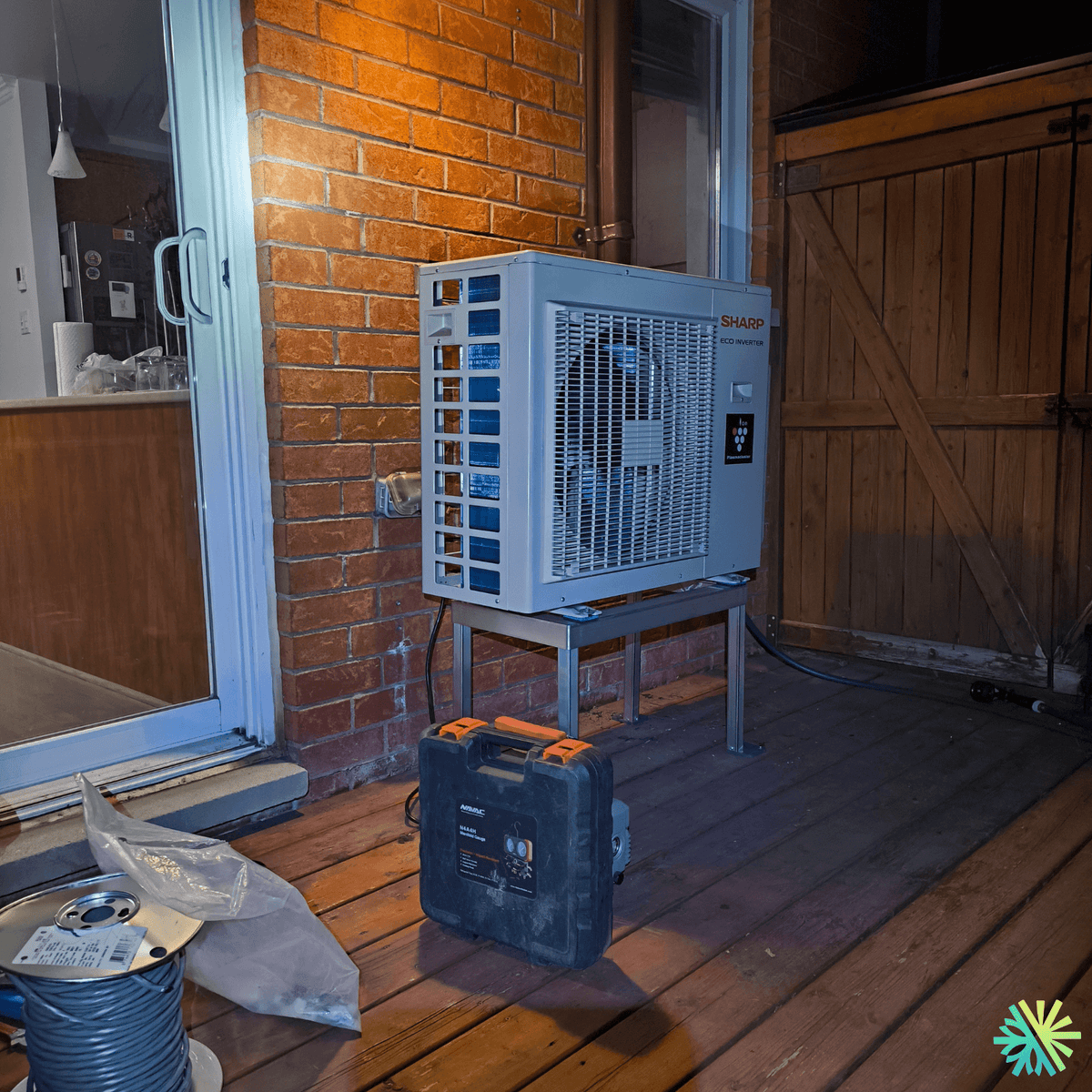
In Rosemont–La Petite-Patrie, AirGreen installed a Sharp wall-mounted heat pump (model ZU1) with an outdoor unit on a raised platform, perfect for snow removal and defrosting. A clean, stable installation designed for urban comfort.
- City
- Region
- Equipment
- Brand
- Challenges
- Published
The job on one screen
The article, chapter by chapter
When installing a heat pump in an urban environment , every detail counts: space is often limited, neighbors live in close proximity, and the equipment must remain efficient despite Quebec winters. In this project completed in Rosemont–La Petite-Patrie , our AirGreen team installed a Sharp wall-mounted heat pump (recent generation, Sharp ZU1 model – consistent with the Sharp residential line) paying particular attention to stability , clearance around the outdoor unit, and snow protection .
A condo with a terrace: a typical… and demanding setting
The photo illustrates a very common situation in Montreal: a wooden deck , a brick wall, a nearby patio door, and often limited service space. This type of environment requires adherence to essential criteria:
-
Maintain adequate clearances for air circulation (suction/exhaust).
-
Limit the vibrations transmitted to the structure (terrace, wall, joists).
-
Protect the device from snow and ice accumulation .
-
Maintain easy access for maintenance and future interventions.
At AirGreen, we treat this type of installation as a “whole”: location, support, orientation and finish have as much impact on long-term satisfaction as the machine itself.
Machine type: Sharp wall-mounted heat pump (mini-split)
Here, we're talking about a wall-mounted heat pump (residential mini-split). This system consists of:
-
of an indoor wall unit (not visible in the photo), which distributes heating and air conditioning;
-
of an outdoor unit (visible), which manages heat exchange and compression (inverter technology).
This type of solution is appreciated in Rosemont for its versatility: efficient air conditioning in the summer , economical heating in the mid-season , and stable comfort thanks to inverter modulation.
Model: Sharp (consistent with the ZU1 range, “Eco Inverter”)
Even when the exact model isn't perfectly clear in a photo, the outdoor unit shown is very likely a Sharp “Eco Inverter” from the ZU1 family (Sharp's residential range, renowned for its efficiency and comfort). The goal in this type of project is to opt for a balanced configuration: performance, reliability, and quiet operation—particularly important in urban environments.
Prominent installation details visible in the photo
1) Outdoor unit on an elevated support: a strategic choice in Montreal
We placed the unit on a raised metal stand , directly on the terrace. This choice is not only aesthetic: it is functional .
-
Reduction of the risk of being buried during snowstorms.
-
Improved drainage management (defrosting in heating mode).
-
Increased protection against slush, leaves, and standing moisture.
-
More comfortable access for maintenance (cleaning, inspections, service).
In winter, a heat pump in heating mode produces defrost cycles: the water must be able to drain properly. Elevating the unit directly contributes to its reliability and longevity .
2) Clearances and positioning near a brick wall
On a brick wall, two common mistakes must be avoided: placing the unit too close or positioning it in such a way as to "recycle" its own air. Here, the placement is designed to:
-
maintain sufficient breathing around the equipment;
-
limit air recirculation;
-
maintain stable operation, even during extreme cold or heat waves.
3) Stability and vibration reduction
A wooden deck can amplify vibrations if the equipment is improperly installed. Therefore, we recommend:
-
a sturdy support,
-
a careful upgrade,
-
and, when required, suitable support points/insulators (anti-vibration) to limit any resonance.
The result: quieter operation and increased comfort inside — especially at night.
4) Discrete integration (cabling and connections)
In an urban installation, the visual aspect matters. We aim for a clean finish, with a logical routing of technical elements (electrical supply, passage of refrigeration lines to the interior), so that the installation integrates naturally into the outdoor living space.
Why this configuration is ideal for Rosemont–La Petite-Patrie
This area often features brick buildings, duplexes/triplexes, condos with terraces, and limited outdoor spaces. A properly installed Sharp wall-mounted heat pump offers tangible benefits:
-
Four-season comfort : air conditioning in summer, efficient heating in mid-season.
-
Stable temperature : thanks to inverter modulation (less jerkiness).
-
Optimized space : no need for ducts, very relevant for renovation.
-
Silence : a crucial point when dwellings are close together.
AirGreen's best practices for maximizing lifespan
Even the best device needs a smart installation context. To ensure lasting performance, we emphasize:
-
Clearances respected around the outdoor unit (air, maintenance, safety).
-
Raised roof adapted to the Quebec climate (snow, ice, de-icing).
-
Fixings and level are impeccable (noise, wear, vibrations).
-
Preventive maintenance : periodic cleaning and seasonal checks.
In the long run, these details make a difference: less mechanical stress, less noise, better energy efficiency and a much more satisfying customer experience.
A clean, durable result, ready for winter
This installation in Rosemont perfectly illustrates our approach: a reliable Sharp solution, integrated into a real space, with the constraints of everyday Montreal life. The raised support, the positioning on the terrace, and the meticulous finish combine performance , discretion , and peace of mind .
At AirGreen, we install heat pumps with the real-world conditions in mind: humidity, freeze-thaw cycles, storms, patios, brick walls, and proximity to neighbors. The result: an installation that makes sense today and remains robust year after year.
The job tools
Two quick checks with real numbers: what heat costs, and what your current heaters add up to in BTU/h.
Conversion: 1 W = 3.412 BTU/h. An indication, not a load calculation: baseboards and furnaces are often stronger than the real need, and they can stay as backup. AirGreen confirms the capacity on site.
How the job unfolds
The main steps of this kind of job at AirGreen. Every house has its quirks: the estimate brings them out.
We look at the room, the outside wall, the line route and where the outdoor unit will go. That is where the capacity gets chosen.
Model, capacity and price, in writing. We also check whether the model qualifies for assistance programs.
Floors and furniture protected, wall plate position marked level, wall opening located.
A single opening, with the slope the drain needs to flow outside.
Set on a stand raised above the snow, with the clearances the manufacturer requires.
Connected, insulated and protected. The opening is then sealed against water, cold air and insects.
A dedicated circuit and an accessible disconnect near the outdoor unit.
Leak test, vacuum, then start-up and a check of heating and cooling.
Remote, modes, filters: we show you the essentials before we leave.
- The on-site estimateWe look at the room, the outside wall, the line route and where the outdoor unit will go. That is where the capacity gets chosen.
- The quoteModel, capacity and price, in writing. We also check whether the model qualifies for assistance programs.
- Getting readyFloors and furniture protected, wall plate position marked level, wall opening located.
- The wall openingA single opening, with the slope the drain needs to flow outside.
- The outdoor unitSet on a stand raised above the snow, with the clearances the manufacturer requires.
- Lines, cable and drainConnected, insulated and protected. The opening is then sealed against water, cold air and insects.
- The electrical workA dedicated circuit and an accessible disconnect near the outdoor unit.
- Tests and start-upLeak test, vacuum, then start-up and a check of heating and cooling.
- The walkthroughRemote, modes, filters: we show you the essentials before we leave.
What we check on a job like this one
Each number is a point we check on site. Switch between summer and winter to watch air and heat move.
In summer, the outdoor unit rejects the house's heat outside.
Generic illustration of this type of installation, not a survey of this job site. Tap a number.
Mounted level on a wall plate, high enough for the air to reach the whole room, with enough space around it to slide the filters out easily.
The refrigerant lines, the communication cable and the drain go through the wall in a single opening, sealed against water, cold air and insects.
Two insulated copper pipes connect the two units. Outside, a line cover can protect them from sun, knocks and weather.
A shut-off switch near the outdoor unit isolates it safely for service. It must stay accessible at all times.
The compressor and the fan. In heating mode it captures heat from the outdoor air, even in winter, and moves it inside.
On the ground or on the wall, it keeps the unit above accumulated snow. The unit stays clear and defrost water can drain away.
The fan needs to blow freely. Storage, a fence or a wall too close, and efficiency drops while noise goes up.
Is your home ready?
Check what applies at your place. A "no" is not a refusal: it is what we sort out during the estimate.
Good habits, once the unit is in place
Six simple habits that keep the unit going. Your list stays on this device.
What to do, season by season
Three habits per season for this unit. They take a few minutes and prevent many calls.
- Clean the indoor unit's filters.
- Clear leaves and debris left on the outdoor unit by winter.
- Test cooling before the first hot days.
- Clean the filters more often when the unit runs a lot.
- Keep plants away from the outdoor unit.
- Check that no water drips from the indoor unit.
- Rake the leaves around the outdoor unit.
- Test heating before the first cold days.
- Book periodic maintenance before winter.
- Keep snow away from the stand and the front of the unit.
- Let the unit defrost: it is normal.
- Never hit the ice on the fins; call us if the unit stays iced up.
The right pages, at the right time
Four statements: true or false?
It all comes down to details you have just seen.
1. In heating mode, the outdoor unit can produce water.
During defrost cycles. That water must drain away without forming ice.
2. You pick the capacity with a simple square-footage rule.
Windows, insulation, orientation and how the room is used all count. Capacity is chosen on site.
3. A multi-zone connects several indoor heads to a single condenser.
One head per room, all on the same condenser. Each room keeps its own temperature.
4. The disconnect can sit behind the patio furniture.
It must stay accessible: it is what shuts the unit off for service.
0 / 4 right answers
What people ask us about this kind of work
Does a wall-mounted heat pump heat in winter?
Wall-mounted or multi-zone: how do I choose?
Where does the outdoor unit go?
Are there grants?
Do I need a permit?
How cold can it heat?
How much can I save?
How is the LogisVert assistance calculated?
Is it noisy?
The outdoor unit is covered in ice: is that normal?
Does AirGreen hold the required licences?
Is the estimate free?
No question matches. Write to us: we answer.
More jobs to see, near you
By town, by equipment or by region: browse more than 4,700 published projects.
Each dot: a town where AirGreen has published projects. The glowing dot: this job.
An on-site estimate, the right capacity, the right equipment.
The on-site estimate is free and the quote follows within 24 hours.
Text and photo: a real AirGreen Climatisation & Chauffage job. The diagrams are generic illustrations of the type of installation, not a survey of this job site. Sources of the added figures: airgreen.ca product pages (NEEP / AHRI performance), Hydro-Québec (Heat pumps page, LogisVert, read on 13 October 2026), Régie de l’énergie (rate D as of 1 April 2026).