
SHARP
ZU1 · 18,000 BTU
Indoor AY-XP18ZU1 · outdoor AE-X18ZU1
AHRI certificate 213246053 · NEEP 507396
The model installed in Côte Saint-Luc.
See the product page
514-316-2973
sales@airgreen.ca
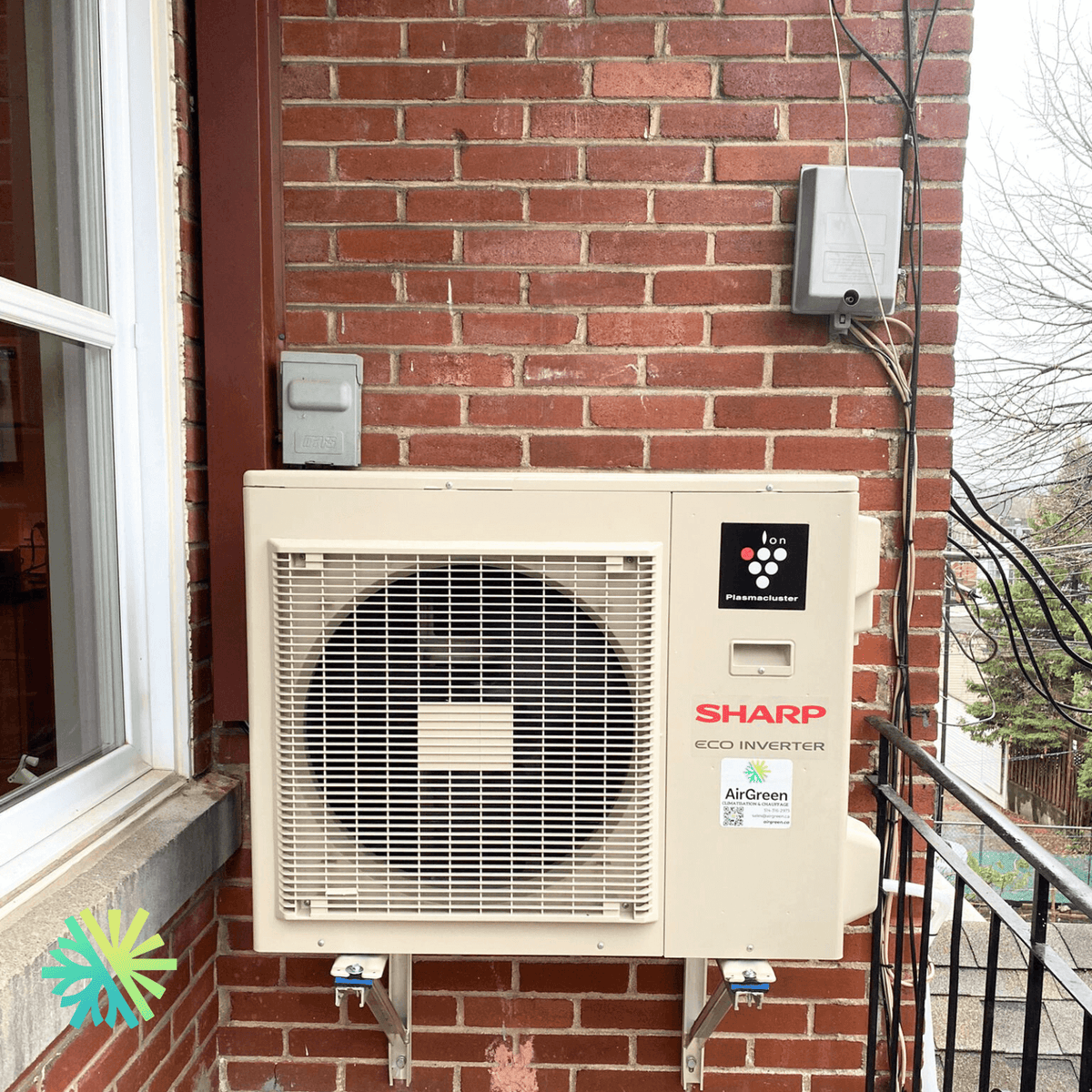
An 18,000 BTU SHARP ZU1 in Côte Saint-Luc, its outdoor unit on a wall bracket against the brick. The project, then the same-size HITACHI airHome 400: outdoor unit size and weight, snow, sound, deep cold and estimated electricity cost.
The range as published on airgreen.ca: pick a size to see its capacity in deep cold.
| Size | Heating at −8 °C | Heating at −15 °C | Coldest certified point | COP at −15 °C | SEER | HSPF | Indicative LogisVert aid |
|---|---|---|---|---|---|---|---|
| Sharp ZU1 12 000 | 14,500 | 12,000 | −27 °C: 7,200 | 2.11 | 22.0 | 11.0 | $1,740 |
| Sharp ZU1 15 000 | 18,100 | 15,300 | −27 °C: 10,100 | 2.1 | 24.0 | 11.0 | $2,172 |
| Sharp ZU1 18 000 | 22,000 | 18,000 | −27 °C: 11,500 | 2.2 | 24.0 | 11.0 | $2,640 |
| Sharp ZU1 24 000 | 22,400 | 19,000 | −27 °C: 12,300 | 2.2 | 22.0 | 11.0 | $2,688 |
According to NEEP, it delivers 14,500 BTU/h at −8 °C (17 °F), more than at 8 °C (14,000 BTU/h). It heats as hard in moderate cold as in mild weather.
According to NEEP, its certified maximum capacity at −27 °C (−17 °F) is 7,200 BTU/h, 60% of its nominal 12,000 BTU size.
At 8 °C, its certified maximum capacity reaches 17,100 BTU/h, 42% more than its nominal 12,000 BTU size.
According to NEEP, it delivers 18,100 BTU/h at −8 °C (17 °F), more than at 8 °C (18,000 BTU/h). It heats as hard in moderate cold as in mild weather.
According to NEEP, its certified maximum capacity at −27 °C (−17 °F) is 10,100 BTU/h, 67% of its nominal 15,000 BTU size.
At 8 °C, its certified maximum capacity reaches 21,800 BTU/h, 45% more than its nominal 15,000 BTU size.
According to NEEP, it delivers 22,000 BTU/h at −8 °C (17 °F), more than at 8 °C (21,600 BTU/h). It heats as hard in moderate cold as in mild weather.
According to NEEP, its COP at −27 °C is 1.88: the highest of the ZU1 line, which ranges from 1.79 to 1.82 at that temperature.
According to NEEP, its certified maximum capacity at −27 °C (−17 °F) is 11,500 BTU/h, 64% of its nominal 18,000 BTU size.
At −27 °C, its certified minimum capacity is 3,200 BTU/h (5,500 at 8 °C). It slows down instead of cycling on and off.
According to NEEP, its certified heating capacity at −15 °C (5 °F) is 19,000 BTU/h, 79% of its nominal 24,000 BTU size. Its COP there is 2.20.
Data read live from the airgreen.ca page of each size (NEEP / AHRI certified performance). When the title names the installed size, it is highlighted; otherwise the whole range is shown. The aid shown is today’s, using Hydro-Québec’s rule ($120 per 1,000 BTU/h at −8 °C); amounts quoted in the article date from its publication. Only Hydro-Québec confirms the assistance granted.
In Côte Saint-Luc, AirGreen installed an 18,000 BTU SHARP ZU1 and mounted its outdoor unit on a wall bracket, against the brick façade, next to a balcony. Here is that project, then the same-size HITACHI airHome 400: what each manufacturer publishes about the unit that stays outside, on the wall, winter and summer. Neither one is ranked.
Indoor AY-XP18ZU1 · outdoor AE-X18ZU1
AHRI certificate 213246053 · NEEP 507396
The model installed in Côte Saint-Luc.
See the product page
Indoor RAK-DJ18RHAA · outdoor RAC-DJ18WHAA
AHRI certificate 216759657 · NEEP 484703
Sold by AirGreen, same nominal size, same refrigerant.
See the product pageAirGreen product cards; the grant and certification badges are masked. Both units use R-32, an A2L class refrigerant. Values in BTU/h, AHRI certificates published by NEEP.
How much electricity does it take to heat and cool the same 18,000 BTU/h zone in Montréal, at Hydro-Québec Rate D, taxes included? Both heat pumps go through the same calculation, each with its certified efficiencies; electric baseboards are the benchmark.
AirGreen method v1.1 of November 9, 2026, applied the same way to each unit. The result is for comparison; your bill will depend on the home, insulation, settings and use. It is not a promise.
The owners wanted one unit to stay warm in winter and cool in summer. AirGreen installed an 18,000 BTU SHARP ZU1 wall heat pump.
Outside, the outdoor unit is fixed on a wall bracket, against the brick façade, next to a window and the balcony, with the electrical disconnect just above it. On a façade, three figures count before anything else: the unit's size, its weight and how far it stays above the snow.
That is this page's angle. The 18,000 BTU HITACHI airHome 400 is the point of comparison: same type, same nominal size, same refrigerant, and its outdoor unit has the same published width as the ZU1's, within a few hundredths of an inch.

Both units are drawn to the scale of their published width and height, on a brick wall. Set the bracket height and the snow depth: the diagram shows the space left under each unit.
Down to −15 °C, each certificate publishes capacity; below that, it gives just one point: −27.2 °C for the ZU1, −20 °C for the airHome 400. The SHARP brochure also publishes maximum capacities at −20 and −25 °C. HITACHI advertises a heating range that stops at −20.5 °C: beyond it, the page shows its last published value, with its temperature.
Only the features named in the SHARP ZU/ZHU brochure, its installation manual, the HITACHI airHome 400 brochure and its technical catalogue are listed. If a document says nothing about a feature, the page states it: that silence does not mean the feature is absent.
SHARP ZU1 Built-in Wi-Fi on every unit in the series, per the brochure.
HITACHI airHome 400 SPX-WFG03 Wi-Fi adapter and airCloud Go app, optional, per the brochure.
SHARP ZU1 At least 10 in between the unit and the ground or snow; drain hose not recommended in cold regions (installation manual, EN-2).
HITACHI airHome 400 Snow hood available as an accessory; anti-rust painted casing and anti-corrosion blue fins (brochure).
SHARP ZU1 RAPID DEFROST and DEFROST modes; HOT GAS PIPE system with multiple drain holes and PRE-WARM.
HITACHI airHome 400 The technical catalogue publishes a capacity correction factor during defrost; no defrost mode is named in the brochure.
SHARP ZU1 Automatic restart after a power outage.
HITACHI airHome 400 Service setting: disabled, or restart in the previous mode (technical catalogue).
SHARP ZU1 Plasmacluster cleaning function: the page gives the function's name, not the claimed effects.
HITACHI airHome 400 FrostWash (indoor coil), Mold Guard, stainless pre-filter and PM2.5 activated-carbon filter, per the brochure.
SHARP ZU1 Not stated in the documents consulted.
HITACHI airHome 400 airPoint Room H700 wall thermostat (SPX-URFG1), optional.
SHARP ZU1 Coanda airflow with a long vane, and the Multi Space function, per SHARP.
HITACHI airHome 400 Up-down louver set from the remote (technical catalogue).
SHARP ZU1 According to the ZU/ZHU brochure, the motion sensor and its options belong to the ZHU series; the ZU1 installed in Côte Saint-Luc is a ZU series unit.
HITACHI airHome 400 Not stated in the documents consulted.
On a façade, the outdoor unit is heard first from the balcony and the windows nearby. Here is each outdoor unit's published level, then the indoor unit's levels, speed by speed.
SHARP: five speeds (Sh, H, M, B, Sb), heating, measurement method not stated in the brochure. HITACHI: five speeds (HH, H, M, L, SL), sound pressure measured in an anechoic room at 1 m, per the technical catalogue.
SHARP: 52 dB(A) in heating, method not stated. HITACHI: 52 dB(A), sound pressure measured 1 m in front of the unit and 1 m above the floor, per the technical catalogue.
How to read these figures. Each dot is a published speed. dB(A) follows a logarithmic scale: 3 dB more is roughly twice the sound energy. The lower the figure, the quieter the unit at that speed. For a unit mounted on a façade, the outdoor level is what you hear from the balcony and the windows.
Why this is not a ranking. Both outdoor units show 52 dB(A), but only HITACHI describes its measuring conditions. The same figure does not guarantee the same conditions: different method — not comparable.
Each manufacturer measures with its own method; the figures give an order of magnitude, not a ranking.
Dimensions, piping lengths and electrical protection, as published by each manufacturer. The indoor units are shown to the scale of their width.


Cabinet width only. The clearances needed on each side are in each model's installation manual.
| Published data | SHARP ZU1 | HITACHI airHome 400 |
|---|---|---|
| Maximum piping length | 65.6 ft (20 m)ZU/ZHU/BU installation manual, EN-2 | 98.4 ft (30 m)Brochure and technical catalogue |
| Pre-charged length | 25 ft (7.6 m)Beyond that: 0.16 oz/ft | Length not publishedFactory charge 2.76 lb (1.25 kg), maximum 3.09 lb (1.40 kg) |
| Maximum height difference | 32.8 ft (10 m) | 65.6 ft (20 m) |
| Liquid – gas diameters | 1/4 – 3/8 in | 1/4 – 1/2 in |
| Outdoor unit W × H × D, weight | 33 15/32 × 27 15/16 × 13 in, 95 lb | 33.46 × 31.50 × 11.73 in, 103.6 lb |
| Indoor unit W × H × D, weight | 41 27/64 × 12 7/16 × 9 51/64 in, 31 lb | 37.40 × 11.57 × 9.06 in, 24.3 lb |
| Clearance above snow | At least 10 inInstallation manual, EN-2 | Distance not stated in the documents consultedSnow hood available as an accessory |
| Power supply | 208-230 V, single phase, 60 Hz | 208-230 V, single phase, 60 Hz |
| Electrical protection | 20 A circuit breakerInstallation manual, EN-6; the brochure prints a 25 A max. fuse | MCA 13 A, MOP 25 AHITACHI airHome 400 brochure |
| Dehumidification | 5.1 pt/hUnit printed “Pt/h” | 2.7 L/h |
| Advertised heating / cooling range | −27 to 24 °C / −10 to 46 °C | −20.5 to 24 °C / −18 to 46 °C |
| Fan speeds | 5 speeds (Sh, H, M, B, Sb) | 5 speeds (HH, H, M, L, SL) |
Data from SHARP's and HITACHI's documents. Mounting a unit on a wall bracket follows the exact model's installation manual.
Because a buyer who has to put the outdoor unit on a wall looks at units of the same type and size, and these two have outdoor units of the same published width. The 18,000 BTU airHome 400 is sold by AirGreen and uses the same refrigerant. This choice is not a ranking.
No. It sets what SHARP and HITACHI publish side by side, with the source and conditions of each value. The “higher” marker only appears when the measure and test conditions are the same for both units. The right choice depends on your wall, your home and how you use it.
According to the manufacturers, the ZU1 outdoor unit weighs 95 lb and the airHome 400's, 103.6 lb (47 kg), net weights. They have the same published width, about 33 1/2 in; the HITACHI unit is taller (31.50 in against 27 15/16 in) and shallower (11.73 in against 13 in). The bracket and anchors are chosen on site, depending on the wall.
HITACHI advertises a heating range down to −20.5 °C in its brochure (−20 °C in the technical catalogue's working-range table). Its coldest certified point is at −20 °C: 11,400 BTU/h maximum. SHARP advertises the ZU1 down to −27 °C, with a certified point at −27.2 °C.
Both manufacturers publish 52 dB(A). HITACHI specifies the measurement: sound pressure 1 m in front of the unit and 1 m above the floor, in an anechoic room. SHARP does not specify it in the documents consulted. The same figure therefore does not guarantee the same measuring conditions.
The SHARP brochure consulted names the Coanda airflow but gives no distance for it. This page therefore states no throw distance.
That depends on Hydro-Québec's official list on the day of purchase, a list that can change. Look up the exact model number there. No amount is announced here.
| Value | SHARP ZU1 | HITACHI airHome 400 |
|---|---|---|
| Certificate | ||
| AHRI certificate · NEEP record | 213246053 · NEEP 507396 | 216759657 · NEEP 484703 |
| Refrigerant | R-32 · GWP 675 (IPCC AR4) · class A2L | R-32 · GWP 675 (IPCC AR4) · class A2L |
| ENERGY STAR (NEEP record) | Yes, cold climate included | No on the record; the “cold climate” box is checked |
| Seasonal efficiency | ||
| SEER2 | 24 | 19.5 |
| EER2 | 13 | 12 |
| HSPF2 region IV | 11 | 10.5 |
| HSPF2 region V | 9 | 8 |
| Heating at 8.3 °C (47 °F) | ||
| Capacity min. / rated / max. | 5,500 / 21,600 / 25,600 BTU/h | 6,700 / 18,000 / 19,500 BTU/h |
| COP min. / rated / max. | 5.76 / 4.22 / 3.68 | 2.98 / 2.95 / 3.19 |
| Heating at −8.3 °C (17 °F) | ||
| Capacity min. / rated / max. | 7,500 / 22,000 / 22,000 BTU/h | 5,000 / 13,300 / 17,100 BTU/h |
| COP min. / rated / max. | 3.38 / 2.38 / 2.38 | 1.70 / 2.35 / 2.10 |
| Heating at −15 °C (5 °F) | ||
| Capacity min. / rated / max. | 5,800 / 18,000 / 18,000 BTU/h | 4,200 / 14,200 / 14,200 BTU/h |
| COP min. / rated / max. | 2.93 / 2.20 / 2.20 | 1.52 / 1.90 / 1.90 |
| Coldest certified point | ||
| Test temperature | −27.2 °C (−17 °F) | −20 °C (−4 °F) |
| Capacity min. / max. | 3,200 / 11,500 BTU/h | 3,800 / 11,400 BTU/h |
| COP min. / max. | 2.04 / 1.88 | 1.47 / 1.85 |
| Cooling at 35 °C (95 °F) | ||
| Rated capacity at 35 °C: min. / rated / max. | 6,000 / 18,000 / 21,600 BTU/h | 6,350 / 18,000 / 18,600 BTU/h |
| COP min. / rated / max. | 5.67 / 3.82 / 2.93 | 3.38 / 3.52 / 3.36 |
“higher” marks the higher value of the same measure under the same conditions. It is not a recommendation.
The product pages of the 18,000 BTU SHARP ZU1 and HITACHI airHome 400, with their documents, are on airgreen.ca. Will your outdoor unit have to go on a wall, as in Côte Saint-Luc? Call us or request an estimate.
Data verified on November 17, 2026. Certified values come from the AHRI certificates published by NEEP; declared values come from the manufacturers' documents cited. The cost is an AirGreen estimate whose method is described above.
SHARP, HITACHI, airHome and the other brands mentioned belong to their owners. Logos and images identify the products. AirGreen is a dealer; this page is not produced, sponsored or approved by the manufacturers.
Photos: AirGreen and manufacturers, for identification.
Does a figure look wrong? Write to us at sales@airgreen.ca.
Two quick checks with real numbers: what heat costs, and what your current heaters add up to in BTU/h.
Baseboards and electric furnaces turn 1 kWh of electricity into 1 kWh of heat. A heat pump delivers more: that is its COP. At Hydro-Québec’s rate D (11.142¢/kWh above 40 kWh a day, since 1 April 2026):
Hydro-Québec: a heat pump can be up to three times more efficient than baseboards for heating in the colder months.
Estimate per kWh of heat, at the chosen temperature, using the certified COP from the product page. Taxes, access charge and backup heat not included.
Conversion: 1 W = 3.412 BTU/h. An indication, not a load calculation: baseboards and furnaces are often stronger than the real need, and they can stay as backup. AirGreen confirms the capacity on site.
The main steps of this kind of job at AirGreen. Every house has its quirks: the estimate brings them out.
We look at the room, the outside wall, the line route and where the outdoor unit will go. That is where the capacity gets chosen.
Model, capacity and price, in writing. We also check whether the model qualifies for assistance programs.
Floors and furniture protected, wall plate position marked level, wall opening located.
A single opening, with the slope the drain needs to flow outside.
Set on a stand raised above the snow, with the clearances the manufacturer requires.
Connected, insulated and protected. The opening is then sealed against water, cold air and insects.
A dedicated circuit and an accessible disconnect near the outdoor unit.
Leak test, vacuum, then start-up and a check of heating and cooling.
Remote, modes, filters: we show you the essentials before we leave.
Each number is a point we check on site. Switch between summer and winter to watch air and heat move.
In summer, the outdoor unit rejects the house's heat outside.
Generic illustration of this type of installation, not a survey of this job site. Tap a number.
Mounted level on a wall plate, high enough for the air to reach the whole room, with enough space around it to slide the filters out easily.
The refrigerant lines, the communication cable and the drain go through the wall in a single opening, sealed against water, cold air and insects.
Two insulated copper pipes connect the two units. Outside, a line cover can protect them from sun, knocks and weather.
A shut-off switch near the outdoor unit isolates it safely for service. It must stay accessible at all times.
The compressor and the fan. In heating mode it captures heat from the outdoor air, even in winter, and moves it inside.
On the ground or on the wall, it keeps the unit above accumulated snow. The unit stays clear and defrost water can drain away.
The fan needs to blow freely. Storage, a fence or a wall too close, and efficiency drops while noise goes up.
Check what applies at your place. A "no" is not a refusal: it is what we sort out during the estimate.
Six simple habits that keep the unit going. Your list stays on this device.
Three habits per season for this unit. They take a few minutes and prevent many calls.
It all comes down to details you have just seen.
1. In heating mode, the outdoor unit can produce water.
During defrost cycles. That water must drain away without forming ice.
2. You pick the capacity with a simple square-footage rule.
Windows, insulation, orientation and how the room is used all count. Capacity is chosen on site.
3. A multi-zone connects several indoor heads to a single condenser.
One head per room, all on the same condenser. Each room keeps its own temperature.
4. The disconnect can sit behind the patio furniture.
It must stay accessible: it is what shuts the unit off for service.
0 / 4 right answers
No question matches. Write to us: we answer.
By town, by equipment or by region: browse more than 4,700 published projects.
Each dot: a town where AirGreen has published projects. The glowing dot: this job.
The on-site estimate is free and the quote follows within 24 hours.
Text and photo: a real AirGreen Climatisation & Chauffage job. The diagrams are generic illustrations of the type of installation, not a survey of this job site. Sources of the added figures: airgreen.ca product pages (NEEP / AHRI performance), Hydro-Québec (Heat pumps page, LogisVert, read on 13 October 2026), Régie de l’énergie (rate D as of 1 April 2026).