
Zephyr wall-mounted heat pump installation in Ville-Marie (Montreal): discreet comfort, real performance
AirGreen project in Ville-Marie: installation of a Zephyr wall-mounted heat pump in a condo, with careful integration above a window, optimized air diffusion and complete commissioning for four-season comfort in Montreal.
Take a tour of the installation
Each number is a point we check on site. Switch between summer and winter to watch air and heat move.
In summer, the outdoor unit rejects the house's heat outside.
Generic illustration of this type of installation, not a survey of this job site. Tap a number.
Mounted level on a wall plate, high enough for the air to reach the whole room, with enough space around it to slide the filters out easily.
The refrigerant lines, the communication cable and the drain go through the wall in a single opening, sealed against water, cold air and insects.
Two insulated copper pipes connect the two units. Outside, a line cover can protect them from sun, knocks and weather.
A shut-off switch near the outdoor unit isolates it safely for service. It must stay accessible at all times.
The compressor and the fan. In heating mode it captures heat from the outdoor air, even in winter, and moves it inside.
On the ground or on the wall, it keeps the unit above accumulated snow. The unit stays clear and defrost water can drain away.
The fan needs to blow freely. Storage, a fence or a wall too close, and efficiency drops while noise goes up.
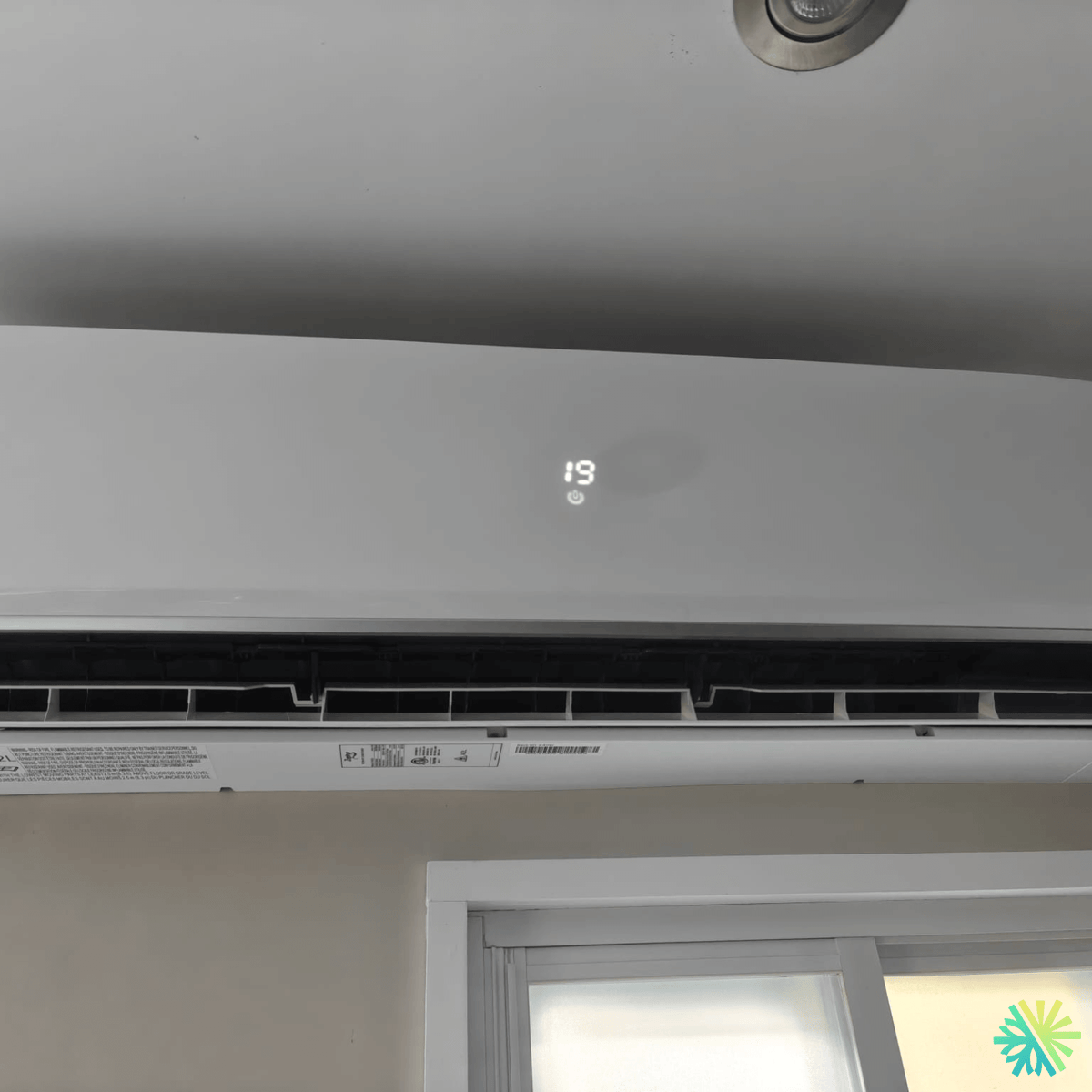
In a condo in Ville-Marie , every detail counts: aesthetics, quiet, space… and above all, comfort in every season. It was precisely with this in mind that we installed a Zephyr wall-mounted heat pump ( residential mini-split type) in a light-filled main room, with the indoor unit strategically positioned above a window to maximize airflow without cluttering the space.
At AirGreen , we love these kinds of projects: they require clean execution, careful consideration of airflow, and impeccable installation to guarantee both performance and discretion on a daily basis.
A Zephyr wall system: an ideal solution for condos in Montreal
Condos in downtown Montreal have very specific needs. They want:
-
a stable temperature without unpleasant fluctuations
-
quiet operation (especially in the evening),
-
an installation that remains beautiful, clean, and "integrated",
-
and a solution that works equally well for summer air conditioning and heating during the cold seasons.
The Zephyr wall-mounted heat pump perfectly meets these specifications. In this project, the choice naturally fell on a high-efficiency wall unit (exact model not visible in the photo), in a format perfectly suited to a modern residential space.
Type of machine installed: wall-mounted heat pump (mini-split / wall unit)
The photo clearly shows a wall-mounted indoor unit : horizontal format, high position on the wall, air distribution flap at the bottom, discreet display, and minimalist design. This is a typical example of a mini-split system, very popular in Montreal for condos and houses that want excellent performance without major ductwork work.
Why is this type of system so popular?
-
Excellent performance/consumption ratio
-
More stable temperature and gentler comfort than conventional electric heating
-
Efficient air conditioning in summer (even during heat waves)
-
Quick and minimally invasive installation
-
Precise control (remote control, modes, programming)
Location choice: above the window, for optimal air circulation
In this Ville-Marie condo, the indoor unit was installed above a window , a common choice when:
-
We want to avoid a location that cuts through a main wall.
-
We want an air distribution system that "sweeps" the room.
-
and we want to limit the visual impact, by keeping the device high up, centered, and clean.
What we systematically check in this type of configuration
Even if the location seems "obvious", there are several essential technical points:
-
Manufacturer's recommended clearances (top, sides, front)
-
Airflow trajectory (avoid blowing directly onto a sofa or bed)
-
Future access for maintenance (filters, cleaning, service)
-
Realistic routing for refrigerant lines and condensation drain
-
Quality of anchoring in the structure (especially in some condo walls)
The result: a unit that integrates visually, while working efficiently.
Clean installation: discreet, finished and reliable
In a condo, the goal is not just that it works: it has to be clean and sustainable.
1) Neat connections and finishing
We pay particular attention to the integration of connections (piping, cables, drain). A well-thought-out finish allows for:
-
an aesthetically pleasing result (without any apparent "DIY" work),
-
increased protection against wear and tear,
-
and fewer long-term risks (vibrations, friction, leaks).
2) Condensation drainage management
In cooling mode (and sometimes in heating mode depending on the humidity), the indoor unit produces condensation. Proper drainage management, with adequate slope and reliable connections, prevents:
-
the drops,
-
bad smells,
-
and the invisible damage behind the walls.
3) Commissioning and checks
A wall-mounted heat pump installation isn't finished when the unit is hung. At AirGreen, we do the checks that matter:
-
Circuit leak testing (pressure test / fitting check),
-
vacuum sealing (removal of moisture and air),
-
validation of operation in heating/cooling modes,
-
Calibration of settings and usage tips.
Everyday comfort: silence, stability and efficiency
In an urban area like Ville-Marie, people often want an appliance that blends in. A properly installed Zephyr wall-mounted heat pump offers this:
-
quiet operation (particularly appreciated in the evening)
-
a stable temperature (fewer fluctuations),
-
a feeling of comfort that is “gentler” than traditional electric heating,
-
and fast, efficient air conditioning during the summer.
Heating for the Montreal winter
Without making unrealistic promises, a good modern wall-mounted heat pump can generally cover a large portion of heating needs during the colder seasons, especially during the shoulder seasons and less extreme periods. And when everything is properly sized and installed, the difference in comfort (and often in the energy bill) is noticeable.
Why have your Zephyr wall-mounted heat pump installed by AirGreen?
A heat pump is not just a brand: it's an installation . And that's often where true performance lies.
At AirGreen , we focus on:
-
a rigorous approach (no improvisation on the piping, drain or location),
-
a clean and aesthetically pleasing installation
-
a complete commissioning,
-
and special attention to actual comfort in the room (not just “it starts up, so it’s okay”).
Whether in Ville-Marie , Plateau , Rosemont , Verdun , Laval or on the South Shore , we adapt each project to the building, the constraints and the objective of the client: comfort, silence, efficiency and finish.
Key takeaways from this project in Ville-Marie
In this bright condo, the installation of a Zephyr wall-mounted heat pump was designed to:
-
preserve the aesthetics,
-
maximize air diffusion,
-
to ensure reliable drainage and connections,
-
and offer four-season comfort perfectly suited to the pace of urban life.
If you are considering a wall-mounted heat pump installation in Montreal , we can offer you a clear, well-sized solution, installed with the level of finish that a condo requires.
The big day, step by step
The main steps of this kind of job at AirGreen. Every house has its quirks: the estimate brings them out.
We look at the room, the outside wall, the line route and where the outdoor unit will go. That is where the capacity gets chosen.
Model, capacity and price, in writing. We also check whether the model qualifies for assistance programs.
Floors and furniture protected, wall plate position marked level, wall opening located.
A single opening, with the slope the drain needs to flow outside.
Set on a stand raised above the snow, with the clearances the manufacturer requires.
Connected, insulated and protected. The opening is then sealed against water, cold air and insects.
A dedicated circuit and an accessible disconnect near the outdoor unit.
Leak test, vacuum, then start-up and a check of heating and cooling.
Remote, modes, filters: we show you the essentials before we leave.
- The on-site estimateWe look at the room, the outside wall, the line route and where the outdoor unit will go. That is where the capacity gets chosen.
- The quoteModel, capacity and price, in writing. We also check whether the model qualifies for assistance programs.
- Getting readyFloors and furniture protected, wall plate position marked level, wall opening located.
- The wall openingA single opening, with the slope the drain needs to flow outside.
- The outdoor unitSet on a stand raised above the snow, with the clearances the manufacturer requires.
- Lines, cable and drainConnected, insulated and protected. The opening is then sealed against water, cold air and insects.
- The electrical workA dedicated circuit and an accessible disconnect near the outdoor unit.
- Tests and start-upLeak test, vacuum, then start-up and a check of heating and cooling.
- The walkthroughRemote, modes, filters: we show you the essentials before we leave.
What would it look like at your place?
Two quick checks with real numbers: what heat costs, and what your current heaters add up to in BTU/h.
Conversion: 1 W = 3.412 BTU/h. An indication, not a load calculation: baseboards and furnaces are often stronger than the real need, and they can stay as backup. AirGreen confirms the capacity on site.
Four mistakes we do not make
Flip each card to see what we do instead.
Your own project, step by step
What to do, season by season
Three habits per season for this unit. They take a few minutes and prevent many calls.
- Clean the indoor unit's filters.
- Clear leaves and debris left on the outdoor unit by winter.
- Test cooling before the first hot days.
- Clean the filters more often when the unit runs a lot.
- Keep plants away from the outdoor unit.
- Check that no water drips from the indoor unit.
- Rake the leaves around the outdoor unit.
- Test heating before the first cold days.
- Book periodic maintenance before winter.
- Keep snow away from the stand and the front of the unit.
- Let the unit defrost: it is normal.
- Never hit the ice on the fins; call us if the unit stays iced up.
Is your home ready?
Check what applies at your place. A "no" is not a refusal: it is what we sort out during the estimate.
Four statements: true or false?
It all comes down to details you have just seen.
1. In heating mode, the outdoor unit can produce water.
During defrost cycles. That water must drain away without forming ice.
2. You pick the capacity with a simple square-footage rule.
Windows, insulation, orientation and how the room is used all count. Capacity is chosen on site.
3. A multi-zone connects several indoor heads to a single condenser.
One head per room, all on the same condenser. Each room keeps its own temperature.
4. The disconnect can sit behind the patio furniture.
It must stay accessible: it is what shuts the unit off for service.
0 / 4 right answers
What people ask us about this kind of work
Does a wall-mounted heat pump heat in winter?
Wall-mounted or multi-zone: how do I choose?
Where does the outdoor unit go?
Are there grants?
Do I need a permit?
How cold can it heat?
How much can I save?
How is the LogisVert assistance calculated?
Is it noisy?
The outdoor unit is covered in ice: is that normal?
Does AirGreen hold the required licences?
Is the estimate free?
No question matches. Write to us: we answer.
More jobs to see, near you
By town, by equipment or by region: browse more than 4,700 published projects.
Each dot: a town where AirGreen has published projects. The glowing dot: this job.
Every house has its constraints. We see them before we install.
The on-site estimate is free and the quote follows within 24 hours.
Text and photo: a real AirGreen Climatisation & Chauffage job. The diagrams are generic illustrations of the type of installation, not a survey of this job site. Sources of the added figures: airgreen.ca product pages (NEEP / AHRI performance), Hydro-Québec (Heat pumps page, LogisVert, read on 13 October 2026), Régie de l’énergie (rate D as of 1 April 2026).