
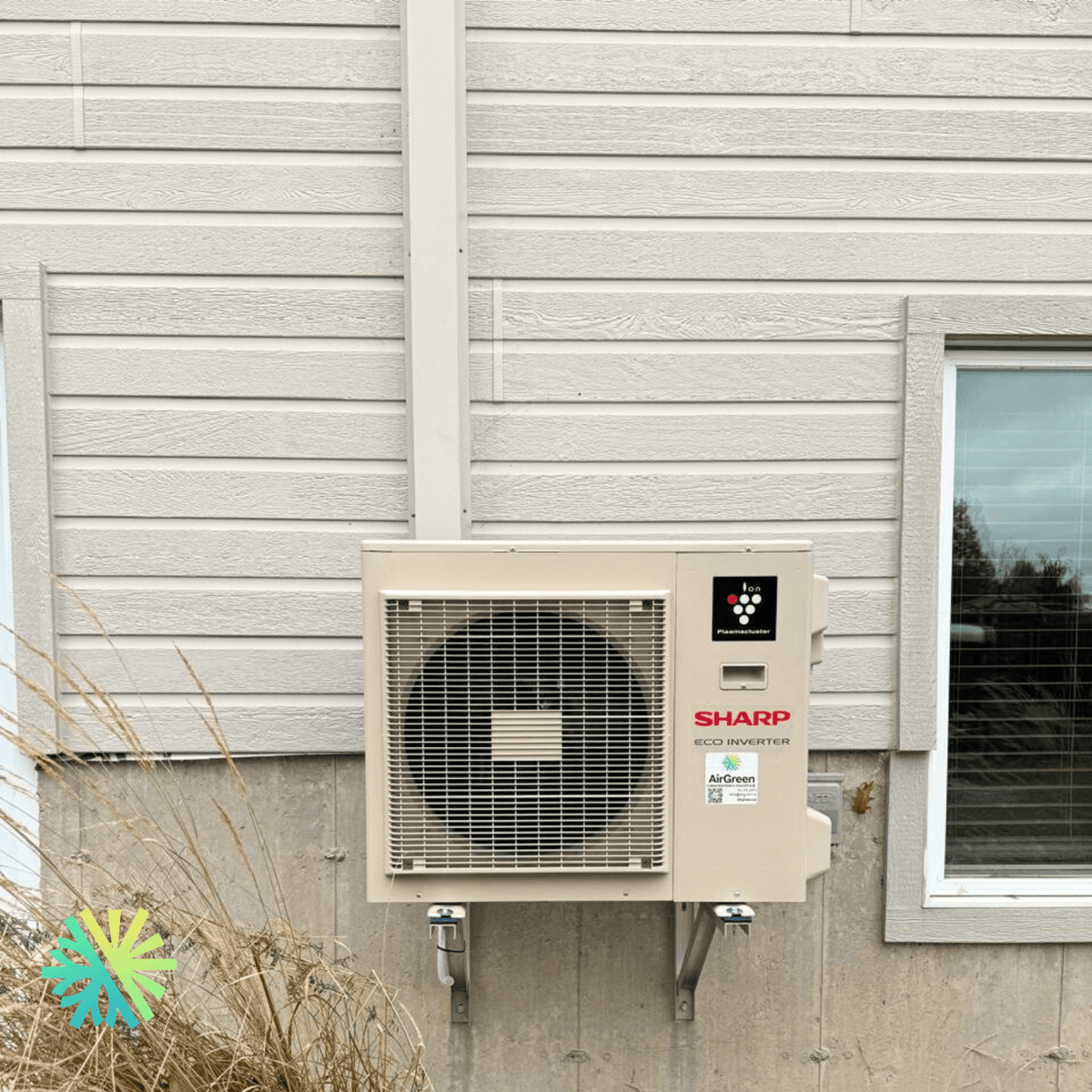
SHARP BU dual-zone
Outdoor AE-X3M24BU · heads AY-XPC12BU ×2
AHRI 213927543 · NEEP 507394

514-316-2973
sales@airgreen.ca
The SHARP BU job in Blainville (two 12,000 BTU heads, split-level house) and the 24,000 BTU GREE MULTI R32: combinations, NEEP, extreme cold, cost.
The range as published on airgreen.ca: pick a size to see its capacity in deep cold.
| Size | Heating at −8 °C | Heating at −15 °C | Coldest certified point | COP at −15 °C | SEER | HSPF | Indicative LogisVert aid |
|---|---|---|---|---|---|---|---|
| Sharp BU 24 0002 Zones (Dual Zone) | 25,000 | 21,200 | −27 °C: 14,600 | 2.3 | 24.0 | 11.5 | $3,000 |
| Sharp BU 24 0003 Zones (Triple Zone) | 25,000 | 21,200 | −27 °C: 14,600 | 2.3 | 24.0 | 11.5 | $3,000 |
Among the year’s most efficient according to ENERGY STAR, on top of its cold-climate certification.
Minimum certified capacity (NEEP): it slows down instead of stopping when a single room calls.
NEEP still lists 14,600 BTU/h at a COP of 1.84 at −17 °F.
Global warming potential of R-32, versus 2,088 for R-410A (ENERGY STAR).
Data read live from the airgreen.ca page of each size (NEEP / AHRI certified performance). When the title names the installed size, it is highlighted; otherwise the whole range is shown. The aid shown is today’s, using Hydro-Québec’s rule ($120 per 1,000 BTU/h at −8 °C); amounts quoted in the article date from its publication. Only Hydro-Québec confirms the assistance granted.
In Blainville, AirGreen installed a SHARP BU heat pump in a split-level house: a 24,000 BTU/h outdoor unit and two 12,000 BTU wall units, one per level. Here is that job, then the 24,000 BTU/h GREE MULTI R32 sold by AirGreen, published value by published value. In a split-level house, the question keeps coming back: which heads, and how many, does each outdoor unit accept? No ranking.
Outdoor AE-X3M24BU · heads AY-XPC12BU ×2
AHRI 213927543 · NEEP 507394

Outdoor MUL24HP230V1R32AO
AHRI 215218914 · NEEP 392051
Both AHRI certificates cover a multi-zone system with non-ducted indoor units; certified values belong to the whole system. Also sold as GREE FREEMATCH R32 GWHD(24)ND6MO: same NEEP certified values (record 392111).
AirGreen estimate for a Blainville split-level house whose heat loss reaches 24,000 BTU/h, at Hydro-Québec’s Rate D, taxes included. Both heat pumps are calculated the same way, with the same method as on all our comparison pages, at the common size of 24,000 BTU/h; only their certified efficiencies change. Since both calculation houses are identical, the difference comes from HSPF2 Region V (9.0 and 8.0) in winter and from SEER2 (24.0 and 21.0) in summer. Degree-days are Montréal’s, the nearest reference station published by Natural Resources Canada. Electric baseboards serve as the point of reference.
AirGreen method v1.1, November 9, 2026. An estimate is for comparing units under the same conditions. The actual bill depends on the house, the insulation, the settings and the use; this amount is not a promise.
In a split-level house, each level has its own heat: bedrooms up top, living space in the middle, the basement lower down. In Blainville, a 12,000 BTU head heats and cools each of the two main levels. Pick a head for each level, or none: the page says, for each outdoor unit, what its manufacturer publishes.
Diagram of a split-level house, not to scale. The heads offered are those of AirGreen’s product pages: AY-XPC9BU, 12BU and 18BU at SHARP; 9,000, 12,000 and 18,000 BTU wall units at GREE.
Why the total can exceed 24,000. The heads almost never ask for full output all at the same time. Manufacturers therefore publish combinations whose nominal total exceeds the size of the outdoor unit; when all the heads call together, the compressor shares its capacity between them.
What the page does not say. GREE’s detailed combination table was not consulted: for the GREE MULTI R32, the page sticks to the number of zones printed in the brochure. Before a quote, the exact combination is checked in each manufacturer’s table.
At −15 °C, both certificates give a value at the same temperature: 21,200 BTU/h for the SHARP, 21,600 for the GREE. Further down, NEEP publishes each system’s coldest point: −27.2 °C for the SHARP, −30 °C for the GREE. The SHARP brochure also prints a maximum capacity at −20 and −25 °C.
Only what the documents consulted name: the SHARP 2025 brochure and the GREE MULTI R32 brochure (031425), plus the NEEP records.
SHARP 2 or 3 heads, per the AE-X3M24BU combination table.
GREE 2 to 3 zones for the MUL24, per the brochure.
SHARP Heating range advertised down to −27 °C.
GREE Heating range advertised down to −30 °C (−22 °F).
SHARP Not stated in the brochure; the NEEP field is blank.
GREE Not recorded in the brochure consulted.
SHARP Wi-Fi built into all units, per the SHARP 2025 brochure.
GREE Not recorded in the brochure consulted; AirGreen’s product page lists it.
SHARP Yes, after a power outage (brochure).
GREE Not recorded in the brochure consulted.
SHARP Type not stated in the brochure.
GREE G20 twin-cylinder rotary, per the series brochure.
“Not recorded” means the document consulted does not mention it, not that the feature is absent.
How to read these numbers. The lower the number, the quieter the unit. SHARP publishes one value in cooling and one in heating; GREE publishes a single sound pressure value for the MUL24.
Why this is not a ranking. Different method, not comparable: measuring distance and conditions not stated. Indoors, SHARP publishes 23 to 43 dB(A) for the 12BU head.
Values published by each manufacturer, by its own method: they read side by side, without ranking.
| Item | SHARP BU | GREE MULTI R32 |
|---|---|---|
| Maximum piping length | 230 ft (70 m) in totalSHARP 2025 brochure; length per head not stated | 10 to 197 ft in total; 66 ft to the furthest headGREE MULTI R32 brochure (031425) |
| Precharged length | Not stated in the brochure | 98 ft; 0.2 oz/ft beyondGREE MULTI R32 brochure |
| Maximum height difference | 33 ft (10 m)SHARP 2025 brochure | 49 ftGREE MULTI R32 brochure |
| Liquid – gas diameters | 1/4 – 3/8 in, ports A, B, CSHARP 2025 brochure | 1/4 – 3/8 in, ports A, B, CGREE MULTI R32 brochure |
| Connectable indoor units | 2 or 3SHARP 2025 brochure | 2 to 3GREE MULTI R32 brochure |
| Outdoor unit W × H × D, weight | 33 15/32 × 27 15/16 × 13 in, 115 lbSHARP 2025 brochure | 37 61/64 × 25 63/64 × 15 53/64 in, 112.5 lbGREE MULTI R32 brochure |
| Electrical protection | 208-230 V; max. fuse 25 ASHARP 2025 brochure | MCA 19.5 A; MOCP 25 AGREE MULTI R32 brochure |
| Advertised heating / cooling range | −27 to 24 °C / −10 to 46 °CSHARP 2025 brochure | −30 to 24 °C / −30 to 48 °CGREE MULTI R32 brochure (−22 to 75 °F / −22 to 118 °F) |
| Refrigerant | R-32 · GWP 675 (IPCC AR4) · class A2L | R-32 · GWP 675 (IPCC AR4) · class A2L |
In a split-level house, the lines often pass from one level to another: the length to the furthest head and the height difference matter as much as the total length. They are confirmed in the installation manual before the work.
Both are 24,000 BTU/h multi-zone systems on R-32, certified with non-ducted wall units, ENERGY STAR and cold climate per NEEP, and sold by AirGreen. The page makes no ranking.
For the 24,000 BTU/h size, NEEP publishes the same certified values for the MUL24HP230V1R32AO and the GWHD(24)ND6MO. Each name has its own brochure; the page cites the MULTI R32 one.
Both outdoor units accept up to three indoor units per their brochure. At SHARP, the brochure lists the three-head combinations (9/9/9, 9/9/12, 9/12/12 and 12/12/12). At GREE, the exact combination is checked in the manufacturer’s table. A free port and the line route are planned from the installation.
At −15 °C, NEEP certifies 21,200 BTU/h for the SHARP BU and 21,600 BTU/h for the GREE MULTI R32. Further down, the published points are at different temperatures (−27.2 °C and −30 °C): the Extreme cold section shows them with their source.
Eligibility is checked with the AHRI number in the program’s current official list (for example Hydro-Québec’s LogisVert), which can change. The numbers are 213927543 for the SHARP BU and 215218914 for the GREE MULTI R32. This page announces no amount.
The page does not compare warranties. Each manufacturer’s warranty documents come with the quote.
| Value (NEEP, read Nov. 17, 2026) | SHARP BU | GREE MULTI R32 |
|---|---|---|
| Seasonal efficiency | ||
| SEER2 | 24,0 | 21,0 |
| EER2 | 14,0 | 13,3 |
| HSPF2 Region IV | 11,5 | 10,0 |
| HSPF2 Region V | 9,0 | 8,0 |
| Rated capacity at 35 °C (cooling) | 24 000 BTU/h | 24 000 BTU/h |
| Heating, min. / rated / max. | ||
| Capacity min. / rated / max. at 8.3 °C | 8 800 / 26 000 / 30 000 BTU/h | 7 500 / 24 000 / 28 800 BTU/h |
| COP min. / rated / max. at 8.3 °C | 4,69 / 4,35 / 4,19 | 3,93 / 3,91 / 3,22 |
| Capacity min. / rated / max. at −8.3 °C | 7 600 / 25 000 / 25 000 BTU/h | 8 200 / 23 600 / 26 600 BTU/h |
| COP min. / rated / max. at −8.3 °C | 2,93 / 2,53 / 2,53 | 3,20 / 2,45 / 2,30 |
| Capacity min. / rated / max. at −15 °C | 8 400 / 21 200 / 21 200 BTU/h | 8 200 / 21 600 / 21 600 BTU/h |
| COP min. / rated / max. at −15 °C | 2,46 / 2,30 / 2,30 | 2,50 / 2,00 / 2,00 |
| Coldest published point (different temperatures) | ||
| Test temperature | −27,2 °C (−17 °F) | −30 °C (−22 °F) |
| Capacity min. / max. | 5 100 / 14 600 BTU/h | 7 000 / 17 400 BTU/h |
| COP at min. / at max. | 1,74 / 1,84 | 1,51 / 1,50 |
| Certification | ||
| ENERGY STAR | Yes | Yes |
| ENERGY STAR cold climate | Yes | Yes |
| AHRI certificate · NEEP record | 213927543 · 507394 | 215218914 · 392051 |
| Refrigerant | R-32 | R-32 |
“higher” marks the higher value of the same measure under the same conditions. It is not a recommendation. The GREE brochure prints a cooling range of 8,704 to 26,400 BTU/h; the page follows the NEEP certificate.
An estimate visit lets you choose the heads level by level and the line route between floors.
Data verified on November 17, 2026. Certified values come from the AHRI certificates published by NEEP; the others come from the manufacturers’ documents, named under each value. When two sources differ, the page follows the certificate.
The SHARP and GREE marks belong to their owners. Logos and images identify the products. AirGreen is a dealer; this article is not produced, sponsored or approved by the manufacturers. Photos: AirGreen and manufacturers, for identification.
Does a value look wrong? Write to us at sales@airgreen.ca.
Two quick checks with real numbers: what heat costs, and what your current heaters add up to in BTU/h.
Baseboards and electric furnaces turn 1 kWh of electricity into 1 kWh of heat. A heat pump delivers more: that is its COP. At Hydro-Québec’s rate D (11.142¢/kWh above 40 kWh a day, since 1 April 2026):
Hydro-Québec: a heat pump can be up to three times more efficient than baseboards for heating in the colder months.
Estimate per kWh of heat, at the chosen temperature, using the certified COP from the product page. Taxes, access charge and backup heat not included.
Conversion: 1 W = 3.412 BTU/h. An indication, not a load calculation: baseboards and furnaces are often stronger than the real need, and they can stay as backup. AirGreen confirms the capacity on site.
The main steps of this kind of job at AirGreen. Every house has its quirks: the estimate brings them out.
We look at the room, the outside wall, the line route and where the outdoor unit will go. That is where the capacity gets chosen.
Model, capacity and price, in writing. We also check whether the model qualifies for assistance programs.
Floors and furniture protected, wall plate position marked level, wall opening located.
A single opening, with the slope the drain needs to flow outside.
Set on a stand raised above the snow, with the clearances the manufacturer requires.
Connected, insulated and protected. The opening is then sealed against water, cold air and insects.
A dedicated circuit and an accessible disconnect near the outdoor unit.
Leak test, vacuum, then start-up and a check of heating and cooling.
Remote, modes, filters: we show you the essentials before we leave.
Each number is a point we check on site. Switch between summer and winter to watch air and heat move.
In summer, the outdoor unit rejects the house's heat outside.
Generic illustration of this type of installation, not a survey of this job site. Tap a number.
Mounted level on a wall plate, high enough for the air to reach the whole room, with enough space around it to slide the filters out easily.
The refrigerant lines, the communication cable and the drain go through the wall in a single opening, sealed against water, cold air and insects.
Two insulated copper pipes connect the two units. Outside, a line cover can protect them from sun, knocks and weather.
A shut-off switch near the outdoor unit isolates it safely for service. It must stay accessible at all times.
The compressor and the fan. In heating mode it captures heat from the outdoor air, even in winter, and moves it inside.
On the ground or on the wall, it keeps the unit above accumulated snow. The unit stays clear and defrost water can drain away.
The fan needs to blow freely. Storage, a fence or a wall too close, and efficiency drops while noise goes up.
Check what applies at your place. A "no" is not a refusal: it is what we sort out during the estimate.
Six simple habits that keep the unit going. Your list stays on this device.
Three habits per season for this unit. They take a few minutes and prevent many calls.
It all comes down to details you have just seen.
1. In heating mode, the outdoor unit can produce water.
During defrost cycles. That water must drain away without forming ice.
2. You pick the capacity with a simple square-footage rule.
Windows, insulation, orientation and how the room is used all count. Capacity is chosen on site.
3. A multi-zone connects several indoor heads to a single condenser.
One head per room, all on the same condenser. Each room keeps its own temperature.
4. The disconnect can sit behind the patio furniture.
It must stay accessible: it is what shuts the unit off for service.
0 / 4 right answers
No question matches. Write to us: we answer.
By town, by equipment or by region: browse more than 4,700 published projects.
Each dot: a town where AirGreen has published projects. The glowing dot: this job.
The on-site estimate is free and the quote follows within 24 hours.
Text and photo: a real AirGreen Climatisation & Chauffage job. The diagrams are generic illustrations of the type of installation, not a survey of this job site. Sources of the added figures: airgreen.ca product pages (NEEP / AHRI performance), Hydro-Québec (Heat pumps page, LogisVert, read on 13 October 2026), Régie de l’énergie (rate D as of 1 April 2026).