
Installation of a Fujitsu Aquila XLTH three-zone heat pump in Saint-Robert
AirGreen installation of a Fujitsu Aquila XLTH triple-zone heat pump in Saint-Robert: individual zoning, outdoor unit on a wall bracket, and an HVAC design adapted to Quebec’s climate.
Take a tour of the installation
Each number is a point we check on site. Switch between summer and winter to watch air and heat move.
In summer, the outdoor unit rejects the house's heat outside.
Generic illustration of this type of installation, not a survey of this job site. Tap a number.
Mounted level on a wall plate, high enough for the air to reach the whole room, with enough space around it to slide the filters out easily.
The refrigerant lines, the communication cable and the drain go through the wall in a single opening, sealed against water, cold air and insects.
Two insulated copper pipes connect the two units. Outside, a line cover can protect them from sun, knocks and weather.
A shut-off switch near the outdoor unit isolates it safely for service. It must stay accessible at all times.
The compressor and the fan. In heating mode it captures heat from the outdoor air, even in winter, and moves it inside.
On the ground or on the wall, it keeps the unit above accumulated snow. The unit stays clear and defrost water can drain away.
The fan needs to blow freely. Storage, a fence or a wall too close, and efficiency drops while noise goes up.
In Saint-Robert, a multi-zone installation designed to heat three spaces with a single outdoor unit
A triple-zone heat pump makes perfect sense when a residence has several areas with different heating and cooling needs. In Saint-Robert, our AirGreen team completed an installation centered around a Fujitsu AIRSTAGE Aquila XLTH system, a configuration that can serve several indoor zones from a single outdoor unit while maintaining individual temperature control in each space.
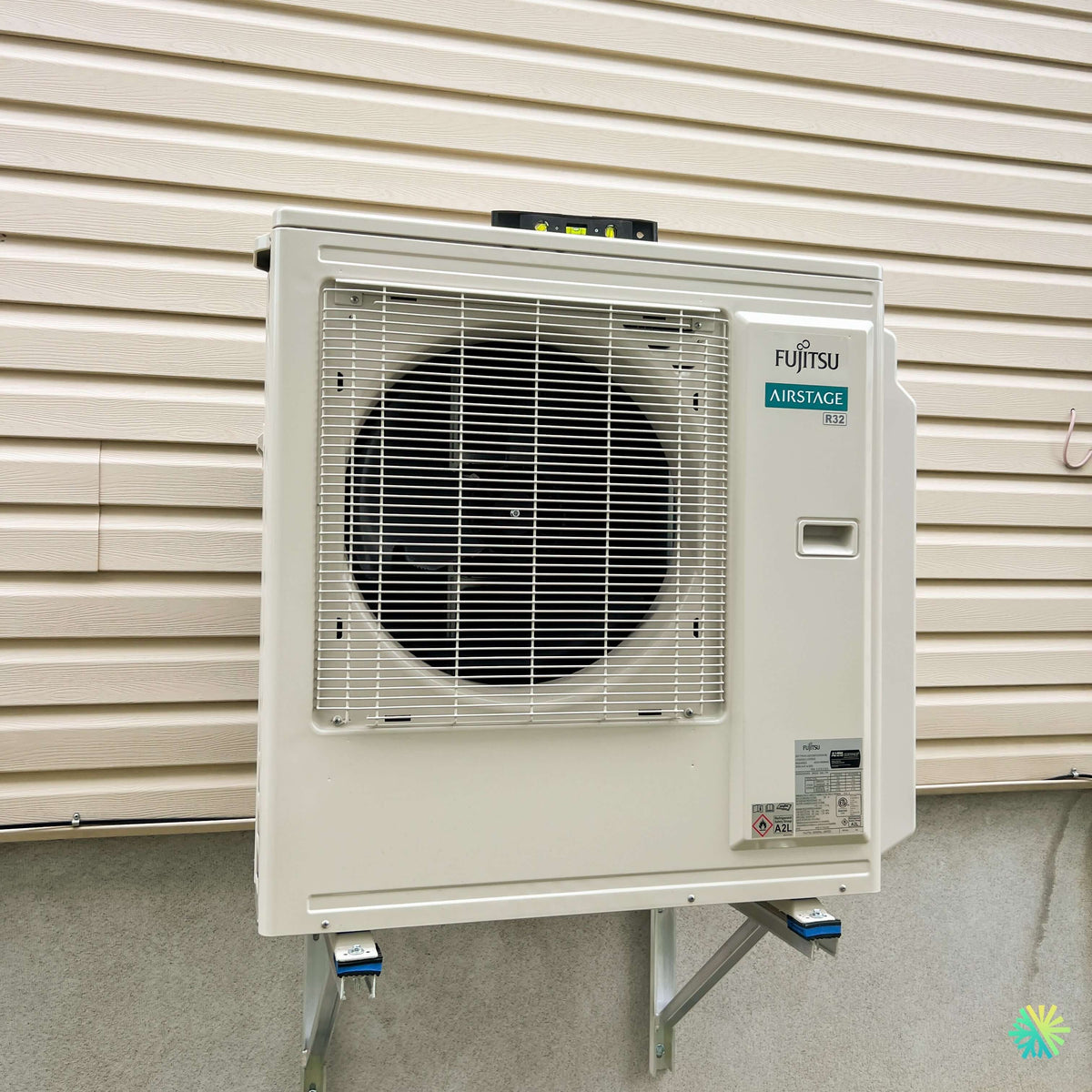
In the photo of this installation, one detail immediately draws attention: the Fujitsu outdoor unit is installed on a metal wall bracket, above ground level, rather than directly on a slab. This choice is not merely aesthetic. In Quebec, snow, ice, water accumulation, and repeated freeze-thaw cycles directly influence how we plan the location of a heat pump in Saint-Robert.
This project therefore provides a good illustration of what a multi-zone installation should be: equipment suited to the climate, a properly cleared outdoor unit, and a mechanical installation designed to ensure stability, drainage, and airflow.
Why a Fujitsu triple-zone heat pump was a good fit for this residence
A triple-zone installation is not simply a matter of connecting three wall-mounted units to the same condenser. The design must take into account the actual heating load of each room, its area, sun exposure, insulation, number of windows, floor level, and how occupants use each space.
The Fujitsu documentation provided for the AIRSTAGE H Series Aquila and Aquila CTEB multi-zone systems confirms that different outdoor unit capacities can be combined with wall-mounted, Slim Duct, compact cassette, or Mid Static Duct concealed units. The 24,000 BTU/h outdoor model, for example, is designed to allow connection of up to three indoor units, while higher-capacity platforms can accommodate more zones.
This flexibility is particularly interesting in homes where you want to condition, for example:
- a living room or a main open-concept area;
- a bedroom or a floor;
- a basement, an office, or another room with different thermal characteristics.
Each zone can therefore have its own indoor unit and its own temperature setting.
Three zones do not necessarily mean three units of the same capacity
This is an important distinction when comparing a Fujitsu multi-zone heat pump with three independent units.
The indoor units do not automatically have to be the same capacity. Fujitsu documentation shows many possible capacity combinations, such as 7,000, 9,000, 12,000, 15,000, 18,000, or 24,000 BTU/h, depending on the outdoor unit and the type of evaporator selected.
That is precisely why we avoid sizing an HVAC installation simply based on the home’s total square footage.
A small, very well-insulated bedroom does not necessarily need the same capacity as a large open-concept area with a high ceiling and several windows. Installing too many BTUs in a small room can result in excessively short cycles, less uniform temperatures, and less effective dehumidification in summer. Conversely, undersizing a highly exposed zone can lead to insufficient capacity during periods of extreme heat or cold.
Fujitsu also specifies in its tables that they are used to determine approved combinations, not to perform the final capacity selection. The manufacturer recommends its Design Simulator software for properly selecting AIRSTAGE H Series equipment.
Here is an essential technical distinction: a compatible combination is not automatically a properly sized combination for the home.
An elevated outdoor unit for better performance during Quebec winters
The project photograph in Saint-Robert clearly shows the outdoor unit installed on metal brackets anchored to the building.
We also provide plenty of ground clearance beneath the unit. For a heat pump intended to operate in heating mode during the winter, this space is important.
During the heating cycle, the outdoor coil becomes cold and may accumulate frost. The system periodically runs a defrost cycle, which produces water. When the outdoor temperature is below freezing, this water can then form ice beneath the unit.
A heat pump installed too low may eventually become surrounded by accumulated snow or ice. This can reduce airflow or make it more difficult for water to drain.
On this installation, the wall bracket therefore helps keep the unit clear of the ground surface.
Visible anti-vibration mounts beneath the unit
Another interesting element is visible directly in the photo: between the unit’s feet and the metal support are support elements designed to create mechanical separation between the appliance and the structure.
This attention is particularly relevant when a condenser is mounted on the wall of a residence.
A modern heat pump with an inverter compressor generally operates progressively, but it still contains a compressor and a moving fan. If the installation is done poorly, certain vibration frequencies can be transmitted to the building.
We therefore pay attention to several points:
the rigidity of the support, the quality of the anchors, leveling the unit, clearance around the condenser, and reducing vibration transmission.
The photo also shows a level placed on top of the unit during the work. It is a small detail, but it reflects an important step: an outdoor unit must be installed correctly and stably rather than simply being mounted “roughly level.”
Why clearance around the Fujitsu is so important
The rear and front of the outdoor unit must be able to exchange a large amount of air.
The front-facing fan visible in the photo moves air through the heat exchanger. The unit must therefore not be placed in an overly confined area, and obstacles must not be allowed to restrict air intake or discharge.
In this Fujitsu heat pump installation in Saint-Robert, the unit is installed against an exterior wall with enough space to allow for operation and maintenance.
We also think about future access. An installation that works perfectly today must remain accessible several years from now for:
- coil cleaning;
- electrical inspections;
- fan inspection;
- diagnostics;
- any work that may be required on the refrigeration circuit;
- periodic HVAC maintenance.
Installing a heat pump in an almost inaccessible location can make every future service call unnecessarily complicated.
An AIRSTAGE platform designed for individual zoning
One of the major advantages of this configuration is the ability to adjust the indoor units individually.
According to the Fujitsu documentation provided, each indoor unit in an AIRSTAGE multi-zone system can be controlled separately. A single outdoor unit can power several indoor units simultaneously.
In practical terms, a family can therefore maintain a higher temperature in the living room while setting a different temperature in a bedroom.
This zoning also avoids treating the entire home as one homogeneous space, which rarely reflects reality.
A south-facing room may receive a lot of sunlight in the afternoon while a bedroom on the opposite side remains cool. A basement may call for heat while the upper floor is already comfortable.
With a triple-zone heat pump, the system provides much greater flexibility.
An important limitation to understand with multizone systems
The zones are independent in terms of their temperature settings, but they remain connected to the same outdoor system.
Fujitsu indicates that the system can provide heating or cooling, but not both simultaneously.
In other words, a multizone heat pump should not be selected with the expectation that one bedroom can be actively cooled while another zone is simultaneously calling for heat.
This is a normal characteristic of residential multizone systems of this type and a point we prefer to explain clearly before installation.
A connection capacity that requires careful design consideration
The H series documentation also mentions a connection capacity of up to 130% for the multizone outdoor unit. However, it specifies that exceeding 100% of the combined rated capacity of the indoor units does not increase the maximum capacity produced by the outdoor system.
This is extremely important.
Let’s consider a simplified principle: connecting several indoor units whose combined rated capacities exceed that of the outdoor unit does not automatically turn the outdoor unit into a larger machine.
This flexibility exists because the different zones in a home do not always require their maximum capacity at exactly the same time.
This is where the experience of an HVAC installation contractor becomes important: the combination must match the building’s actual behavior, not simply comply with a line in a table.
This Fujitsu project in Saint-Robert illustrates our approach to a multizone HVAC installation
A heat pump designed for our climate must also be installed for our climate
The Fujitsu document identifies the Aquila CTEB family as a cold-climate heating solution capable of heating down to -26 °C, with cooling capable of operating up to 50 °C for the CTEB versions mentioned.
In Quebec, this ability to maintain operation at low temperatures is obviously important, but laboratory data and manufacturer specifications represent only part of the final result.
Installation quality also plays a major role.
A high-end heat pump that is poorly positioned, inadequately secured, or connected according to a combination that is not well suited to the building will not deliver the same results as a system selected and installed methodically.
What we check before a triple-zone installation
For our installations in Montreal, Laval, Longueuil, the North Shore, the South Shore, and municipalities such as Saint-Robert, we assess the project as a whole.
The selection takes into account the layout of the rooms, possible locations for wall-mounted units, the route of the refrigerant lines, condensate drainage, the electrical supply, and the outdoor location.
With three zones, this planning becomes even more important.
Poor placement of the indoor units can create very comfortable hallways but poorly served bedrooms. A unit installed too close to a ceiling or aimed directly at a bed can also compromise comfort, even when its capacity is appropriate.
Our goal, therefore, is to achieve natural air distribution in each zone.
Mistakes we seek to avoid with a multi-zone heat pump
Our experience with HVAC projects has led us to pay particular attention to several recurring mistakes.
Choosing all indoor units with the same capacity for convenience is rarely a good approach.
Simply adding up the BTUs of the indoor units without analyzing the outdoor unit’s actual capacity can also lead to a misleading assessment of the system.
Installing the outdoor unit too close to the ground in an area where snow accumulates can become problematic in winter.
Neglecting vibrations from a wall-mounted bracket can make an installation technically functional but unpleasant for occupants.
Forgetting to provide service access unnecessarily complicates maintenance and repairs.
Finally, it is important not to assume that a multi-zone installation means all zones can simultaneously request their maximum rated capacity without affecting one another. Power distribution remains tied to the outdoor unit’s available capacity.
A single condenser instead of three outdoor units
For some homeowners, the most noticeable benefit of a triple-zone solution is simply the appearance of the outside of the house.
Three single-zone systems would normally require three outdoor units. A multi-zone configuration can reduce that number to a single outdoor unit.
This can be particularly useful when space around the building is limited or when the homeowner wants to preserve a cleaner façade.
In the installation photographed in Saint-Robert, the Fujitsu condenser forms a compact outdoor assembly powering the multi-zone system, rather than several units arranged along the foundation.
The Inverter compressor at the heart of the system
Fujitsu specifies that AIRSTAGE Aquila systems use an inverter-driven compressor, or Inverter technology.
Unlike a machine designed primarily to operate only in an on-or-off mode, an Inverter system can modulate its operation according to demand.
In a three-zone installation, this modulation capability is particularly logical because needs are constantly changing.
At certain times, a single zone may require substantial heating. Later, two or three units may operate. The total load therefore varies throughout the day.
This modulation helps maintain a more stable temperature and allows the system to adapt better to these variations.
A coil design built to last
Fujitsu documentation also mentions an outdoor heat exchanger with blue cooling fins, designed to improve corrosion resistance and coil longevity.
This obviously does not mean that a condenser can be left without maintenance for years.
Dust, pollen, leaves, and debris can gradually reduce airflow through the heat exchanger. Proper cleaning therefore remains important for maintaining good heat-exchange conditions.
After installation: what the homeowner should monitor
A properly installed heat pump requires relatively little daily attention, but certain habits help preserve its performance.
Inside, the filters should be cleaned regularly. The frequency varies depending on the presence of pets, dust levels, and how the home is used.
Outside, leaves, compacted snow, and other obstructions must be kept from blocking the heat exchanger.
For a unit installed on a wall bracket like the one in this project, we also recommend occasionally monitoring ice buildup beneath the unit during the winter. Defrost cycles produce water; this is normal. What is not normal is allowing a mass of ice to gradually reach the underside of the unit.
An installation that must be assessed as a complete system
The real value of the Saint-Robert project therefore lies not solely in the presence of a Fujitsu AIRSTAGE Aquila XLTH.
What matters is the overall system:
three zones adapted to different spaces, a single outdoor unit, a stable wall bracket, appropriate clearances, precise leveling, and a well-coordinated multizone selection.
This comprehensive approach guides our installations at AirGreen.
Whether it involves a triple-zone heat pump in Saint-Robert, a system replacement in Montreal, a multizone installation in Laval, a project in Longueuil, or a residence located on the North Shore or South Shore, we aim to select the system based on the actual building rather than limiting ourselves to a BTU rating printed on a box.
Why this type of project deserves an accurate estimate
Two homes of identical size may require very different multizone configurations.
The first may have a large open-concept area and two small bedrooms. The second may have three levels with a significant temperature difference between the basement and the upper floor.
In either case, writing “three zones” on a quote is not enough.
We must determine which indoor capacities are suitable, which combinations are authorized by Fujitsu, and how to distribute the outdoor capacity efficiently.
For homeowners currently comparing multizone heat pumps in Quebec, our advice is therefore simple: compare the model, but above all, compare the proposed design.
Ask what capacities will be installed in each room. Find out why those capacities were selected. Ask where the condenser will be placed and how it will be protected from winter snow accumulation. Also check how the lines and drains will be routed.
A good HVAC installation begins well before the first hole is drilled.
AirGreen and Fujitsu installations in Greater Montreal
At AirGreen, we install and service heating and air conditioning systems, including wall-mounted, multizone, and central heat pumps, throughout Greater Montreal.
Our projects regularly take us into very different buildings: single-family homes, condos, multiplexes, and properties with multiple floors or zones whose heating and cooling needs differ.
The installation completed in Saint-Robert clearly shows why Fujitsu multizone systems are appealing when properly sized: they make it possible to create several comfort zones while retaining a single outdoor unit and a relatively discreet HVAC configuration.
The desired outcome is not simply to have three units blowing air.
We want each zone to receive the appropriate capacity, the outdoor unit to operate under proper conditions, and the entire installation to remain accessible, stable, and durable throughout Quebec winters.
The big day, step by step
The main steps of this kind of job at AirGreen. Every house has its quirks: the estimate brings them out.
We look at the room, the outside wall, the line route and where the outdoor unit will go. That is where the capacity gets chosen.
Model, capacity and price, in writing. We also check whether the model qualifies for assistance programs.
Floors and furniture protected, wall plate position marked level, wall opening located.
A single opening, with the slope the drain needs to flow outside.
Set on a stand raised above the snow, with the clearances the manufacturer requires.
Connected, insulated and protected. The opening is then sealed against water, cold air and insects.
A dedicated circuit and an accessible disconnect near the outdoor unit.
Leak test, vacuum, then start-up and a check of heating and cooling.
Remote, modes, filters: we show you the essentials before we leave.
- The on-site estimateWe look at the room, the outside wall, the line route and where the outdoor unit will go. That is where the capacity gets chosen.
- The quoteModel, capacity and price, in writing. We also check whether the model qualifies for assistance programs.
- Getting readyFloors and furniture protected, wall plate position marked level, wall opening located.
- The wall openingA single opening, with the slope the drain needs to flow outside.
- The outdoor unitSet on a stand raised above the snow, with the clearances the manufacturer requires.
- Lines, cable and drainConnected, insulated and protected. The opening is then sealed against water, cold air and insects.
- The electrical workA dedicated circuit and an accessible disconnect near the outdoor unit.
- Tests and start-upLeak test, vacuum, then start-up and a check of heating and cooling.
- The walkthroughRemote, modes, filters: we show you the essentials before we leave.
What would it look like at your place?
Two quick checks with real numbers: what heat costs, and what your current heaters add up to in BTU/h.
Conversion: 1 W = 3.412 BTU/h. An indication, not a load calculation: baseboards and furnaces are often stronger than the real need, and they can stay as backup. AirGreen confirms the capacity on site.
Four mistakes we do not make
Flip each card to see what we do instead.
Your own project, step by step
What to do, season by season
Three habits per season for this unit. They take a few minutes and prevent many calls.
- Clean the indoor unit's filters.
- Clear leaves and debris left on the outdoor unit by winter.
- Test cooling before the first hot days.
- Clean the filters more often when the unit runs a lot.
- Keep plants away from the outdoor unit.
- Check that no water drips from the indoor unit.
- Rake the leaves around the outdoor unit.
- Test heating before the first cold days.
- Book periodic maintenance before winter.
- Keep snow away from the stand and the front of the unit.
- Let the unit defrost: it is normal.
- Never hit the ice on the fins; call us if the unit stays iced up.
Is your home ready?
Check what applies at your place. A "no" is not a refusal: it is what we sort out during the estimate.
Four statements: true or false?
It all comes down to details you have just seen.
1. In heating mode, the outdoor unit can produce water.
During defrost cycles. That water must drain away without forming ice.
2. You pick the capacity with a simple square-footage rule.
Windows, insulation, orientation and how the room is used all count. Capacity is chosen on site.
3. A multi-zone connects several indoor heads to a single condenser.
One head per room, all on the same condenser. Each room keeps its own temperature.
4. The disconnect can sit behind the patio furniture.
It must stay accessible: it is what shuts the unit off for service.
0 / 4 right answers
What people ask us about this kind of work
Does a wall-mounted heat pump heat in winter?
Wall-mounted or multi-zone: how do I choose?
Where does the outdoor unit go?
Are there grants?
Do I need a permit?
How cold can it heat?
How much can I save?
How is the LogisVert assistance calculated?
Is it noisy?
The outdoor unit is covered in ice: is that normal?
Does AirGreen hold the required licences?
Is the estimate free?
No question matches. Write to us: we answer.
More jobs to see, near you
By town, by equipment or by region: browse more than 4,700 published projects.
Each dot: a town where AirGreen has published projects. The glowing dot: this job.
Every house has its constraints. We see them before we install.
The on-site estimate is free and the quote follows within 24 hours.
Text and photo: a real AirGreen Climatisation & Chauffage job. The diagrams are generic illustrations of the type of installation, not a survey of this job site. Sources of the added figures: airgreen.ca product pages (NEEP / AHRI performance), Hydro-Québec (Heat pumps page, LogisVert, read on 13 October 2026), Régie de l’énergie (rate D as of 1 April 2026).