
Installation of a MIDEA 28 triple-zone heat pump in Henryville, Montérégie
Installation of a MIDEA 28 triple-zone heat pump in Henryville: three comfort zones, carefully executed technical setup, sizing advice, and information about LogisVert rebates.
In summer, the outdoor unit rejects the house's heat outside.
Generic illustration of this type of installation, not a survey of this job site. Tap a number.
Mounted level on a wall plate, high enough for the air to reach the whole room, with enough space around it to slide the filters out easily.
The refrigerant lines, the communication cable and the drain go through the wall in a single opening, sealed against water, cold air and insects.
Two insulated copper pipes connect the two units. Outside, a line cover can protect them from sun, knocks and weather.
A shut-off switch near the outdoor unit isolates it safely for service. It must stay accessible at all times.
The compressor and the fan. In heating mode it captures heat from the outdoor air, even in winter, and moves it inside.
On the ground or on the wall, it keeps the unit above accumulated snow. The unit stays clear and defrost water can drain away.
The fan needs to blow freely. Storage, a fence or a wall too close, and efficiency drops while noise goes up.
Three zones, a single outdoor unit: a MIDEA 28 installation where indoor positioning mattered just as much as performance
In Henryville, in Montérégie, we completed an installation that clearly demonstrates the benefits of a triple-zone heat pump when a residence has several rooms with different needs. Rather than multiplying the number of outdoor units, the chosen solution is based on a MIDEA 28 multi-zonecapable of powering multiple indoor units from a single condenser.
The logic of a multi-zone system is simple, but its installation is not: a single outdoor unit serves multiple indoor units, and each indoor unit can be adjusted individually according to the desired temperature in the room. This is precisely the principle presented by Midea in its technical documentation.
In a home where bedrooms, common areas, and more secluded rooms do not respond in the same way to sunlight, wind, or temperature changes, this zone control prevents us from treating the entire residence as one large room.
What the photo from the Henryville job really shows us
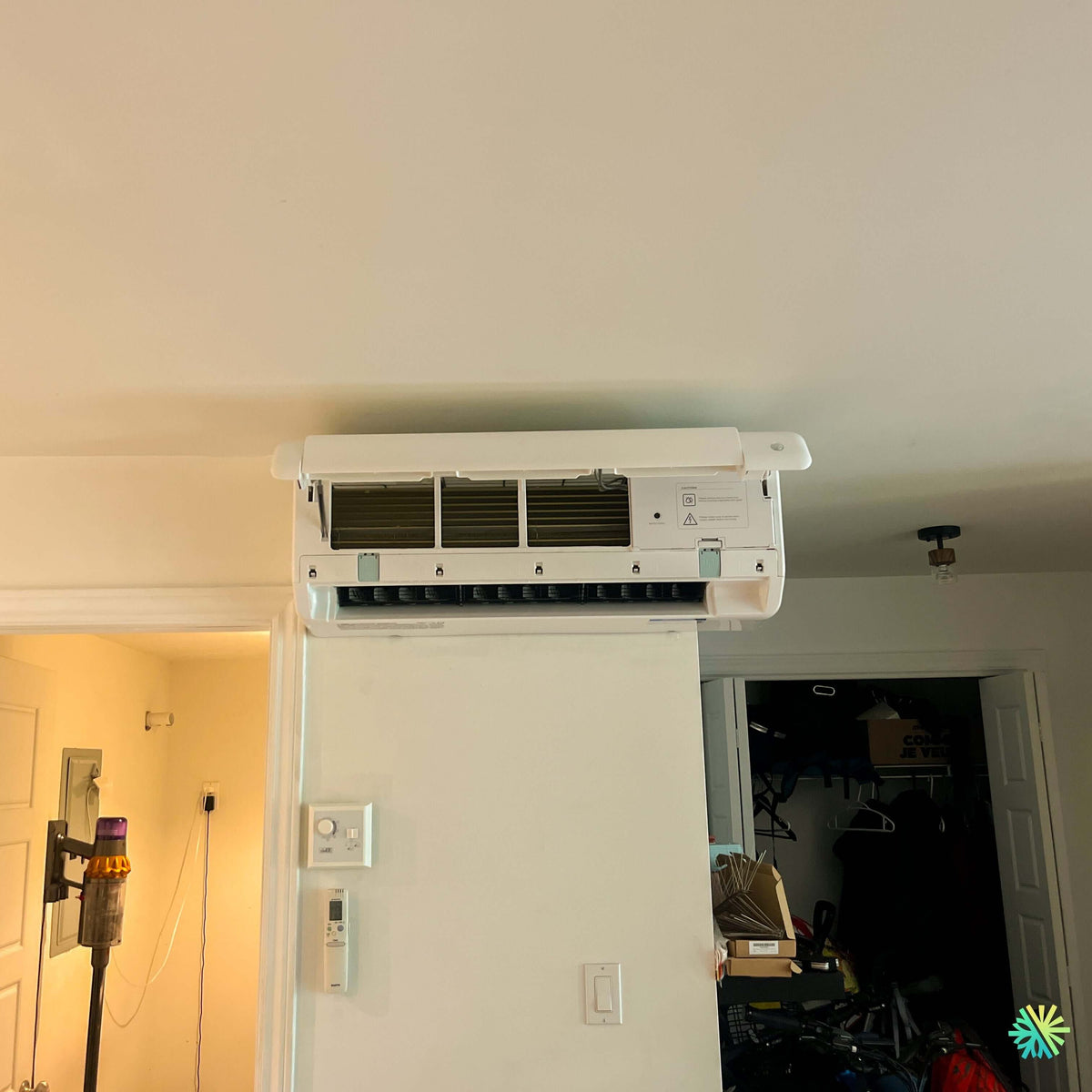
The photo taken during our work provides a particularly interesting detail about how we approach a wall-mounted heat pump installation.
The Midea indoor unit is positioned very high on the wall, near the ceiling, between a passageway and a storage area. The front panel is raised, providing a direct view of the coil and filters during inspections.
This detail matters much more than it may seem.
When a wall-mounted head is installed in an area where available space is limited, we must simultaneously consider:
- air circulation in front of the unit;
- the distance from the ceiling and adjacent walls;
- full opening of the front panel;
- access to the filters forHVAC maintenance;
- future access to the components during diagnostics;
- the direction of the airflow;
- the routing of the refrigerant lines;
- condensate drainage;
- the visual impact in the room.
A head installed a few centimeters too close to an obstacle may seem acceptable on the day of installation while becoming problematic a few years later when a technician needs to access the evaporator, fan motor, or condensate pan.
On this job Henryvillethe placement visible in the photo leaves the necessary access to the front panel while making efficient use of wall space near the ceiling.
Why a three-zone heat pump was appropriate here
A MIDEA 28 three-zone heat pump should never be considered simply “three air conditioners connected to a single compressor.”
Instead, we size the system as a whole.
Each zone has a different heat load. A relatively small bedroom does not have the same needs as an open-plan area with several windows. A south-facing room may also require much more cooling in the afternoon than a room on the north side.
Midea also offers a wide variety of indoor units: wall-mounted units, consoles, cassettes, ducted units, and air handlers. The range is designed to allow configurations adapted to different rooms rather than imposing the same format everywhere.
In a residential three-zone configuration, our job is therefore to determine where the capacity is actually needed, rather than arbitrarily installing three units with the same capacity.
The classic trap: adding BTUs without considering the condenser
One of the most common mistakes when selecting a multi-zone system is adding the rated capacities listed on the three indoor units and automatically treating that total as the capacity available simultaneously.
That is not how a multi-split system operates.
Midea documentation specifies that when the total load of the indoor units exceeds the outdoor unit’s rated capacity, the actual output available to each unit may be reduced, a phenomenon that is particularly noticeable in heating mode.
That is why we always verify the manufacturer combination rules before proposing an assembly.
A system with three heads must be designed as a complete refrigeration network: outdoor capacity, indoor capacities, line length, elevation difference, room locations, and the likelihood that all zones will require full output at the same time must be considered together.
The technical characteristics that distinguish Midea’s multi-zone range
The documentation provided for this Midea family helps put the performance into perspective.
For technical reference, the combination three-zone Extreme Heat is associated in Midea’s table with the condenser MO3HX-H18B-2A, with the number AHRI 215471457.
For this reference combination, Midea indicates in particular:
- alimentation 208/230 V, monophasée, 60 Hz;
- capacité nominale d’environ 19 000 BTU/h en climatisation et 20 000 BTU/h en chauffage;
- SEER2 de 25;
- EER2 de 15;
- indice de performance saisonnière en chauffage indiqué à 10,4;
- niveau sonore extérieur indiqué à 62 dB(A) for this configuration;
- approximate outdoor dimensions of 37 1/4 in. wide, 16 1/8 in. deep, and 31 7/8 in. high.
The exact capacity and AHRI number of the Henryville installation must, however, always be associated with the actual combination of indoor units and the installed condenser. The MIDEA 28 commercial name does not replace checking the model numbers when confirming performance, an approved combination, or a rebate.
This is an important distinction when we prepare a detailed quote.
A concrete advantage of a multizone system: use only the rooms that need it
A house almost never has a uniform thermal load.
The bedroom may already have reached 21 °C while the living room, heated by the sun, requires more. Conversely, a seldom-used room does not necessarily need to be maintained at the same setpoint as a space occupied all day.
Midea specifically highlights this advantage: individual control of each unit makes it possible to heat or cool the rooms being used rather than imposing the same demand on the entire residence.
This flexibility is particularly valuable in residences in Henryville and the Montérégie region, where homes with additions, bedrooms spread across several façades, finished basements, or spaces with widely varying solar exposure are frequently found.
However, it is important to remember that a conventional residential multizone system is not a commercial heat-recovery system: the operating strategy must be designed so that the different zones work coherently.
Routing the lines: the part the homeowner rarely sees
An attractive wall-mounted head does not guarantee a good HVAC installation.
A significant portion of the work that determines the system’s service life is behind the walls, in the lines, and around the outdoor unit.
For each of the three zones, we must plan for, among other things:
- refrigerant lines;
- required communication and power cables;
- condensate drainage;
- mechanical protection for the lines;
- penetrations through the building envelope;
- proper line insulation;
- future accessibility.
Drainage deserves particular attention. A wall-mounted unit produces water in cooling mode. When the configuration allows for gravity drainage, we aim to maintain a continuous, reliable slope. An improper slope, reverse slope, or crushed pipe can cause overflows long after an installation that initially appeared to be working properly.
SynchroConnect: a technical aid, not an excuse to neglect the connections
The Midea range presented in the documentation also includes the technology SynchroConnect.
According to Midea, the system can diagnose the connections between the indoor units and the condenser and synchronize the refrigerant lines with the electrical connections in certain connection configurations.
For an installer, this feature is useful on systems with multiple pairs of lines and multiple cables.
However, this does not change our work method: every line is identified, every connection is checked, and every circuit is followed methodically. Diagnostic technology should remain an additional safeguard, not become an installation method.
Commissioning determines much of the final result
A MIDEA heat pump may have excellent specifications on paper and still perform poorly if its commissioning is done carelessly.
We therefore pay particular attention to the finishing steps after the mechanical and electrical connections:
- refrigerant connection inspection;
- leak-tightness check;
- proper evacuation of the system;
- drain inspection;
- startup of the different zones;
- validation of communication between units;
- heating and cooling check;
- airflow verification;
- explanation of the controls to the homeowner.
The photo from Henryville showing the front of the open unit fits precisely into this approach to accessibility and verification: we want the equipment to be not only functional on startup day, but also practical to clean and maintain.
What this Henryville installation can teach a homeowner before purchasing a multi-zone heat pump
Do not choose the capacity of an indoor unit based solely on the floor area
The rule of thumb of “so many BTUs per square foot” can be useful as a first approximation, but it never replaces a proper analysis.
Two 150-square-foot bedrooms can have very different needs if one has two large south-facing windows and the other has one small north-facing window.
We examine in particular:
- the insulation;
- the windows;
- the orientation;
- the room’s level;
- ceiling height;
- air circulation;
- internal heat sources;
- the overall configuration of the house.
The sizing a triple-zone heat pump must then comply with the combinations accepted by Midea.
Do not position the heads based solely on aesthetics
A very discreet unit that cannot distribute air properly throughout the room is not a good installation.
We look for a precise balance between aesthetics, airflow, and maintenance. The Henryville project is a good example: the head visible in the photo occupies a relatively constrained section of wall, but its front panel remains accessible.
You should also avoid directing cold air straight toward a bed, sofa, or workstation when the room layout offers a better option.
Plan for maintenance from the day of installation
The filters will need to be removed regularly. Over time, the heat exchanger and blower may also require more thorough cleaning.
An installation that leaves virtually no clearance around the unit turns every heat pump maintenance into an unnecessarily complex service call.
We prefer to settle this issue before drilling the first hole.
Check the AHRI number before calculating a subsidy
In Quebec, this step has become particularly important.
In 2026, Hydro-Québec indicates that heat pumps installed since November 26, 2025, must in particular be certified ENERGY STAR to be eligible for the LogisVert program. The program currently requires $50 per 1,000 BTU/h at -8 °C for an eligible ENERGY STAR heat pump and $120 per 1,000 BTU/h at -8 °C when it meets the cold-climate category.
The amount is therefore not calculated simply from the rated capacity advertised on the box.
It is based on the recognized heating capacity at -8 °C for the eligible combination.
For example, Hydro-Québec listed the Midea system MO3HX-H18B-2A / AHRI 215471457 with a heating capacity of 17,600 BTU/h at -8 °C. With a cold-climate rate of $120 per 1,000 BTU/h, a capacity of this value would correspond to 2 112 $ financial assistance program if the specific combination and installation meet all applicable conditions at the time of application.
We always recommend confirming eligibility with the exact AHRI number before presenting a subsidy amount as definitive.
Why the MIDEA 28 is well suited to multi-zone projects
The strength of this architecture is its flexibility.
Midea offers wall-mounted units, consoles, cassettes, and ducted units in this family. In some configurations of its multi-zone range, the manufacturer even allows ducted and ductless solutions to be combined around the same outdoor unit.
For a renovation, this opens up interesting possibilities.
For example, a home may require a wall-mounted head in a bedroom, another in an open-plan area, and a different solution in an area where the architecture makes a wall-mounted unit less practical. Nevertheless, each project must be validated against the manufacturer's combination tables.
The mistakes we aim to eliminate before they become service calls
In our installations of heat pumps in Montreal, Laval, Longueuil, on the South Shore, and on the North Shore, the problems we want to prevent are often the same:
- an oversized unit that reaches its setpoint too quickly;
- a head placed in an unsuitable airflow path;
- a combination of indoor units poorly matched to the condenser;
- a drain that is difficult to maintain;
- unnecessarily long lines;
- an outdoor unit poorly located for Quebec winters;
- insufficient service access;
- an incentive estimate based on the wrong AHRI number.
The Henryville reminds us that a good installation is never limited to choosing the brand. The final quality comes from the consistency between the equipment, the building, and how each component is installed.
A triple-zone system designed as a single HVAC system
At AirGreen, we consider a multi-zone installation to be a complete system.
The condenser, the three indoor units, the drains, the refrigerant lines, the controls, and the electrical supply must work together. This approach makes it possible to achieve stable comfort and truly take advantage of the capabilities of a MIDEA 28 heat pump.
In Henryville, the wall-mounted unit shown in the photograph illustrates this attention to detail well: a high, clean installation, front access preserved for maintenance, and discreet integration in an area where doors, the ceiling, and storage naturally limited the available space.
For a homeowner currently comparing a single-zone, dual-zone, or triple-zone heat pump, so the number of units is only the starting point. The real questions concern BTU distribution, winter capacity, the AHRI combination, indoor unit locations, drainage, line routing, and ease of maintenance.
This is precisely where these details professional HVAC installation stands out after several seasons of use.
How it goes, from the first call to the end
The main steps of this kind of job at AirGreen. Every house has its quirks: the estimate brings them out.
We look at the room, the outside wall, the line route and where the outdoor unit will go. That is where the capacity gets chosen.
Model, capacity and price, in writing. We also check whether the model qualifies for assistance programs.
Floors and furniture protected, wall plate position marked level, wall opening located.
A single opening, with the slope the drain needs to flow outside.
Set on a stand raised above the snow, with the clearances the manufacturer requires.
Connected, insulated and protected. The opening is then sealed against water, cold air and insects.
A dedicated circuit and an accessible disconnect near the outdoor unit.
Leak test, vacuum, then start-up and a check of heating and cooling.
Remote, modes, filters: we show you the essentials before we leave.
- The on-site estimateWe look at the room, the outside wall, the line route and where the outdoor unit will go. That is where the capacity gets chosen.
- The quoteModel, capacity and price, in writing. We also check whether the model qualifies for assistance programs.
- Getting readyFloors and furniture protected, wall plate position marked level, wall opening located.
- The wall openingA single opening, with the slope the drain needs to flow outside.
- The outdoor unitSet on a stand raised above the snow, with the clearances the manufacturer requires.
- Lines, cable and drainConnected, insulated and protected. The opening is then sealed against water, cold air and insects.
- The electrical workA dedicated circuit and an accessible disconnect near the outdoor unit.
- Tests and start-upLeak test, vacuum, then start-up and a check of heating and cooling.
- The walkthroughRemote, modes, filters: we show you the essentials before we leave.
And at your place?
Two quick checks with real numbers: what heat costs, and what your current heaters add up to in BTU/h.
Conversion: 1 W = 3.412 BTU/h. An indication, not a load calculation: baseboards and furnaces are often stronger than the real need, and they can stay as backup. AirGreen confirms the capacity on site.
What to do, season by season
Three habits per season for this unit. They take a few minutes and prevent many calls.
- Clean the indoor unit's filters.
- Clear leaves and debris left on the outdoor unit by winter.
- Test cooling before the first hot days.
- Clean the filters more often when the unit runs a lot.
- Keep plants away from the outdoor unit.
- Check that no water drips from the indoor unit.
- Rake the leaves around the outdoor unit.
- Test heating before the first cold days.
- Book periodic maintenance before winter.
- Keep snow away from the stand and the front of the unit.
- Let the unit defrost: it is normal.
- Never hit the ice on the fins; call us if the unit stays iced up.
Which type of equipment for your project?
Pick what looks like your need.
Four mistakes we do not make
Flip each card to see what we do instead.
What people ask us about this kind of work
Does a wall-mounted heat pump heat in winter?
Wall-mounted or multi-zone: how do I choose?
Where does the outdoor unit go?
Are there grants?
Do I need a permit?
How cold can it heat?
How much can I save?
How is the LogisVert assistance calculated?
Is it noisy?
The outdoor unit is covered in ice: is that normal?
Does AirGreen hold the required licences?
Is the estimate free?
No question matches. Write to us: we answer.
Useful pages for what comes next
More jobs to see, near you
By town, by equipment or by region: browse more than 4,700 published projects.
Each dot: a town where AirGreen has published projects. The glowing dot: this job.
Tell us about your house. We come and see it for free.
The on-site estimate is free and the quote follows within 24 hours.
Text and photo: a real AirGreen Climatisation & Chauffage job. The diagrams are generic illustrations of the type of installation, not a survey of this job site. Sources of the added figures: airgreen.ca product pages (NEEP / AHRI performance), Hydro-Québec (Heat pumps page, LogisVert, read on 13 October 2026), Régie de l’énergie (rate D as of 1 April 2026).