
Installation of a Zephyr wall-mounted heat pump in Villeray
Zephyr wall-mounted heat pump installation in Villeray: in-wall installation, gravity drain, invisible finishes and meticulous commissioning. AirGreen, HVAC reference in Montreal, Laval, Longueuil, North Shore, South Shore.
Take a tour of the installation
Each number is a point we check on site. Switch between summer and winter to watch air and heat move.
In summer, the outdoor unit rejects the house's heat outside.
Generic illustration of this type of installation, not a survey of this job site. Tap a number.
Mounted level on a wall plate, high enough for the air to reach the whole room, with enough space around it to slide the filters out easily.
The refrigerant lines, the communication cable and the drain go through the wall in a single opening, sealed against water, cold air and insects.
Two insulated copper pipes connect the two units. Outside, a line cover can protect them from sun, knocks and weather.
A shut-off switch near the outdoor unit isolates it safely for service. It must stay accessible at all times.
The compressor and the fan. In heating mode it captures heat from the outdoor air, even in winter, and moves it inside.
On the ground or on the wall, it keeps the unit above accumulated snow. The unit stays clear and defrost water can drain away.
The fan needs to blow freely. Storage, a fence or a wall too close, and efficiency drops while noise goes up.
Clean in-wall integration for four-season comfort in a Montreal plex
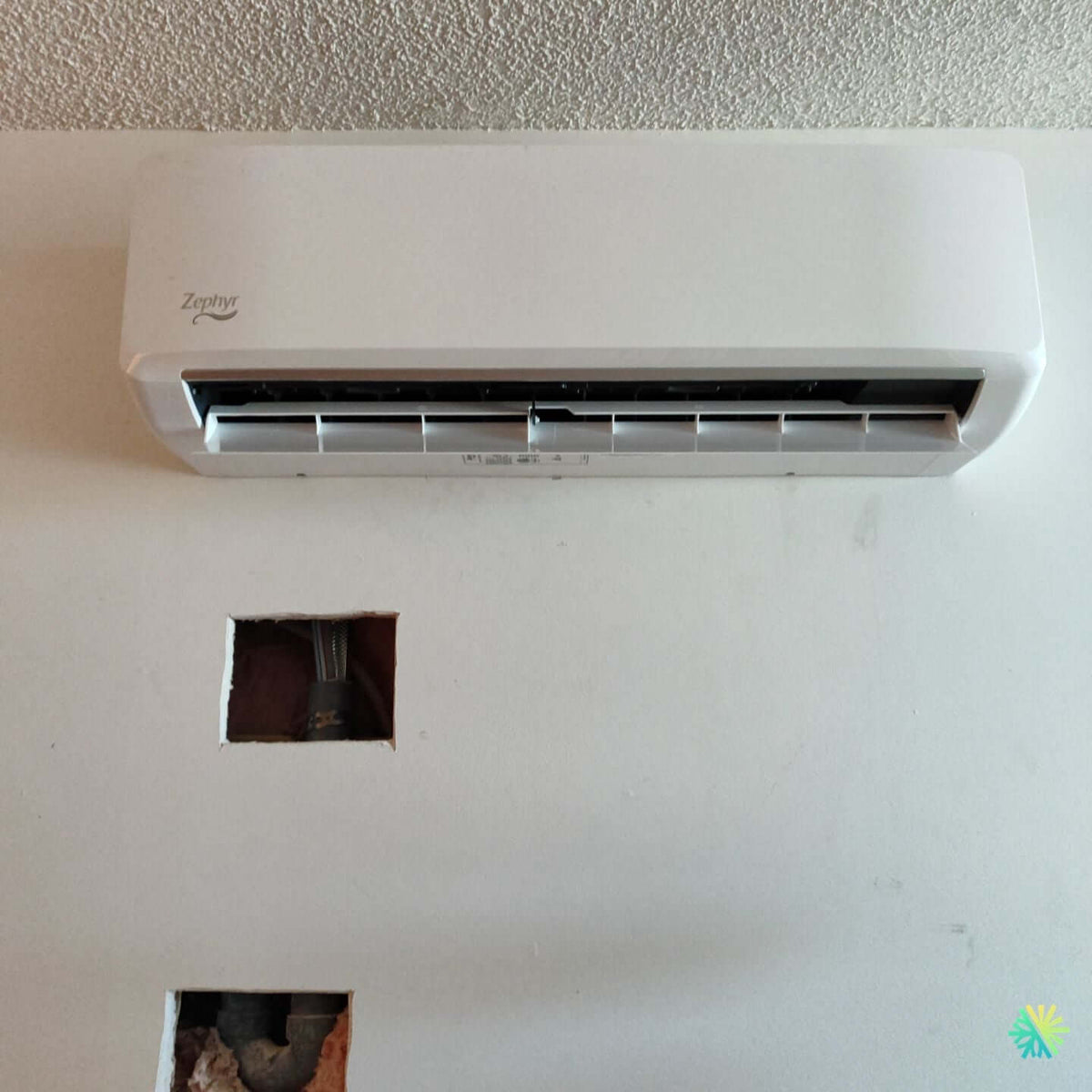
In the heart of Villeray , AirGreen is carrying out the HVAC installation of a Zephyr wall-mounted heat pump intended to air condition and heat the main living area of a plex dwelling. The occupants' objective is clear: to obtain stable comfort all year round without weighing down the interior aesthetics. To achieve this, we favor an invisible integration of the connections inside the load-bearing wall; only two working windows – carefully cut and then closed – bear witness to the passage of our technicians during the finishing phase.
Context and customer expectations
The home features a popcorn-textured ceiling and a solid wall with no exposed cable ducts. The clients wanted to maintain clean surfaces and benefit from quiet operation , especially at night. We offer a 12,000 BTU Zephyr to cover the living room and adjoining dining room, with the option to expand the solution later to a second room if usage requires it.
Our technical approach: concealing connections without compromising on maintenance
Choosing the position of the inner head
-
Optimized height : the head is placed a few centimeters from the ceiling to maximize air stratification and improve the blowing range towards the center of the room.
-
Structural anchors : We locate the uprights and secure the support to solid points to avoid any vibration. A laser level check ensures the alignment of the casing and the shutter.
In-wall routing of refrigeration lines and cabling
-
Service openings : the two cutouts visible during the work allow:
-
the refrigeration connection and the communication/power cable in the upper part;
-
the clean descent of the gravity drain and, where appropriate, the addition of a compact condensate pump if the minimum slope is not guaranteed.
-
-
Insulated ducts : the connections are slid into continuous insulating ducts to avoid dew points in the partition. The crossings are ringed (partition passes) to eliminate any risk of parasitic noise .
-
Airtightness : we seal each hole with an acrylic or silicone-based fire-resistant sealant , depending on the surface, then we install a local vapor barrier to protect the building envelope.
Condensate management
-
Gravity priority : the wall's configuration allows for a regular slope toward a nearby drainage column. We install an odor trap and a valve to block rising air.
-
Silent pump option : when the layout requires it (long length, reverse slope), we integrate an encapsulated mini-pump with an inspection tank accessible through a painted hatch, in order to preserve the aesthetics of the wall.
Interior finish
-
Closing the hatches : after pressure and vacuum tests, the openings are closed with screwed gypsum boards , fiber joints, coating, sanding and tone-on-tone painting for a finish without visible capping .
-
Sealing : a discreet peripheral seal absorbs expansion and prevents air whistling.
Rigorous commissioning: performance and longevity
Tests and vacuum drawing
-
Nitrogen pressurization (in stages) to check the tightness of flares and fittings.
-
High vacuum up to a stable micron threshold, proof of satisfactory dehydration of the circuit.
-
Load adjusted according to the actual length of the lines, in accordance with the technical data sheet.
Functional checks
-
Temperature measurements : supply/return at different fan speeds to confirm the expected ΔT .
-
Electrical control : compressor intensity, earth continuity, terminal tightening, and dedicated two-pole circuit breaker .
-
Acoustics : validation of the sound level at the listening point of the living room; elimination of any whistling noise by micro-adjustment of the fairing and the flap.
Why the Zephyr for a Villeray plex?
Modulation and stability
Inverter technology adapts power to actual needs: longer cycles, consistent temperature, controlled consumption . In a Montreal apartment, this translates into fewer variations and constant comfort .
Seasonal yield
Depending on the capacity selected, the Zephyr series offers high seasonal coefficients and effective heating down to low temperatures. For Villeray, Ahuntsic , Rosemont or Le Sud-Ouest , this is an asset during the off-season and during intense cold weather.
Silence and air quality
The indoor unit features a balanced fan and easy-access filters. Regular maintenance keeps noise levels low and maintains stable air quality in the living area.
Neat aesthetics
By concealing the connections, we maintain a clean interior facade ; this approach enhances the surfaces and respects the decorative choices of the occupants.
Construction site challenges and AirGreen solutions
1) Dense partition and obstacles
Plexiglas from before 1980 contain reinforcements , furring strips, and even old ducts. We explore the cavity with an inspection camera and bypass obstacles with large radius elbows so as not to penalize the refrigerant flow.
2) Popcorn textured ceiling
Installing close to the ceiling requires meticulous protection against dust. We cover the wall, vacuum during cutting, and retexture if necessary for a discreet fit.
3) Reliable drainage
We favor a minimum slope of 2% . When the gravity axis crosses cold areas (crawl space, peripheral wall), we insulate the tube to prevent condensation and avoid any stagnation.
4) Noise and vibrations
Anti-vibration pads under the head and tightening torque in accordance with the flares eliminate rattling. The cable sheath is separated from the bulkhead to prevent resonances.
Result: immediate comfort and simplified maintenance
From the first time it is switched on, the long-range laminar airflow effectively cools the room. In heating mode, the airflow remains warm and continuous , without the sensation of a cold draft. The washable filters can be removed in seconds, access to the condensate tray is easy for annual cleaning, and the front remains perfectly smooth .
Maintenance and recommended best practices
HVAC Maintenance Schedule
-
Cleaning the filters : every 4 to 8 weeks during periods of use.
-
Annual inspection : cleaning of exchangers, temperature control and tightening of connections.
-
Hygiene : gentle treatment of the tank and the exchanger limits biofilms and maintains performance.
Daily use
-
Keep interior doors open to allow circulation to adjacent rooms.
-
Program stable settings ; avoid significant temperature variations between day and night.
-
Head clearance: maintain at least 30 cm laterally for optimal sweeping.
Grants and support
Several Zephyr configurations are eligible – depending on capacity and performance – for current grant programs . We support our clients in Greater Montreal (Montreal, Laval , Longueuil , North Shore , South Shore ) to validate eligibility, gather evidence (photos, AHRI numbers, detailed invoice) and maximize return on investment .
Why choose AirGreen in Villeray and throughout Greater Montreal?
Our team is familiar with the specific constraints of plexes: load-bearing walls , textured ceilings, narrow technical routes, and high aesthetic requirements. We deliver clean , tested and documented installations, with measured commissioning and clear operating advice. The discreet connections and reliable installation are the AirGreen signature.
Summary intervention sheet
-
Equipment : Zephyr wall-mounted heat pump , approx. 12,000 BTU .
-
Interior layout : top of wall, near ceiling, in-wall route .
-
Lines : insulated copper in continuous sheath, controlled connections, fire-resistant sealing .
-
Condensates : priority to gravity drain , silent mini-pump option.
-
Electrical : dedicated circuit breaker , shielded communication cable, clear marking.
-
Commissioning : nitrogen, high vacuum , adjusted load, ΔT measurements, validated acoustics.
The big day, step by step
The main steps of this kind of job at AirGreen. Every house has its quirks: the estimate brings them out.
We look at the room, the outside wall, the line route and where the outdoor unit will go. That is where the capacity gets chosen.
Model, capacity and price, in writing. We also check whether the model qualifies for assistance programs.
Floors and furniture protected, wall plate position marked level, wall opening located.
A single opening, with the slope the drain needs to flow outside.
Set on a stand raised above the snow, with the clearances the manufacturer requires.
Connected, insulated and protected. The opening is then sealed against water, cold air and insects.
A dedicated circuit and an accessible disconnect near the outdoor unit.
Leak test, vacuum, then start-up and a check of heating and cooling.
Remote, modes, filters: we show you the essentials before we leave.
- The on-site estimateWe look at the room, the outside wall, the line route and where the outdoor unit will go. That is where the capacity gets chosen.
- The quoteModel, capacity and price, in writing. We also check whether the model qualifies for assistance programs.
- Getting readyFloors and furniture protected, wall plate position marked level, wall opening located.
- The wall openingA single opening, with the slope the drain needs to flow outside.
- The outdoor unitSet on a stand raised above the snow, with the clearances the manufacturer requires.
- Lines, cable and drainConnected, insulated and protected. The opening is then sealed against water, cold air and insects.
- The electrical workA dedicated circuit and an accessible disconnect near the outdoor unit.
- Tests and start-upLeak test, vacuum, then start-up and a check of heating and cooling.
- The walkthroughRemote, modes, filters: we show you the essentials before we leave.
What would it look like at your place?
Two quick checks with real numbers: what heat costs, and what your current heaters add up to in BTU/h.
Conversion: 1 W = 3.412 BTU/h. An indication, not a load calculation: baseboards and furnaces are often stronger than the real need, and they can stay as backup. AirGreen confirms the capacity on site.
Four mistakes we do not make
Flip each card to see what we do instead.
Your own project, step by step
What to do, season by season
Three habits per season for this unit. They take a few minutes and prevent many calls.
- Clean the indoor unit's filters.
- Clear leaves and debris left on the outdoor unit by winter.
- Test cooling before the first hot days.
- Clean the filters more often when the unit runs a lot.
- Keep plants away from the outdoor unit.
- Check that no water drips from the indoor unit.
- Rake the leaves around the outdoor unit.
- Test heating before the first cold days.
- Book periodic maintenance before winter.
- Keep snow away from the stand and the front of the unit.
- Let the unit defrost: it is normal.
- Never hit the ice on the fins; call us if the unit stays iced up.
Is your home ready?
Check what applies at your place. A "no" is not a refusal: it is what we sort out during the estimate.
Four statements: true or false?
It all comes down to details you have just seen.
1. In heating mode, the outdoor unit can produce water.
During defrost cycles. That water must drain away without forming ice.
2. You pick the capacity with a simple square-footage rule.
Windows, insulation, orientation and how the room is used all count. Capacity is chosen on site.
3. A multi-zone connects several indoor heads to a single condenser.
One head per room, all on the same condenser. Each room keeps its own temperature.
4. The disconnect can sit behind the patio furniture.
It must stay accessible: it is what shuts the unit off for service.
0 / 4 right answers
What people ask us about this kind of work
Does a wall-mounted heat pump heat in winter?
Wall-mounted or multi-zone: how do I choose?
Where does the outdoor unit go?
Are there grants?
Do I need a permit?
How cold can it heat?
How much can I save?
How is the LogisVert assistance calculated?
Is it noisy?
The outdoor unit is covered in ice: is that normal?
Does AirGreen hold the required licences?
Is the estimate free?
No question matches. Write to us: we answer.
More jobs to see, near you
By town, by equipment or by region: browse more than 4,700 published projects.
Each dot: a town where AirGreen has published projects. The glowing dot: this job.
Every house has its constraints. We see them before we install.
The on-site estimate is free and the quote follows within 24 hours.
Text and photo: a real AirGreen Climatisation & Chauffage job. The diagrams are generic illustrations of the type of installation, not a survey of this job site. Sources of the added figures: airgreen.ca product pages (NEEP / AHRI performance), Hydro-Québec (Heat pumps page, LogisVert, read on 13 October 2026), Régie de l’énergie (rate D as of 1 April 2026).