
Installation of MIDEA EVOX G3 central heat pumps in Montréal-Nord
In Montréal-Nord, AirGreen installs two large MIDEA EVOX G3 central heat pumps side by side on elevated supports, with a layout designed for snow, defrosting, airflow, and HVAC servicing.
Take a tour of the installation
Each number is a point we check on site. Switch between summer and winter to watch air and heat move.
In summer, the outdoor unit rejects the house's heat outside.
Generic illustration of this type of installation, not a survey of this job site. Tap a number.
It captures or rejects heat outside. It sits on a level base, above the snow, with free space all around.
The insulated refrigerant lines enter the house through a sealed opening and run to the indoor coil.
A shut-off switch near the outdoor unit isolates it safely for service.
Sitting on the indoor module, it moves heat between the house air and the refrigerant.
Electric furnace or air handler: its fan pushes air through the ducts. The electric backup takes over in extreme cold.
Supply ducts bring air to the rooms; returns bring it back to the unit. Their condition matters as much as the unit's.
It protects the coil and the fan. A dirty filter cuts airflow, so it gets checked regularly.
It runs the heat pump and the backup heat. It must be compatible with the installed system.
In Montréal-Nord, a dual installation with two elevated EVOX G3 outdoor units in a restricted side space
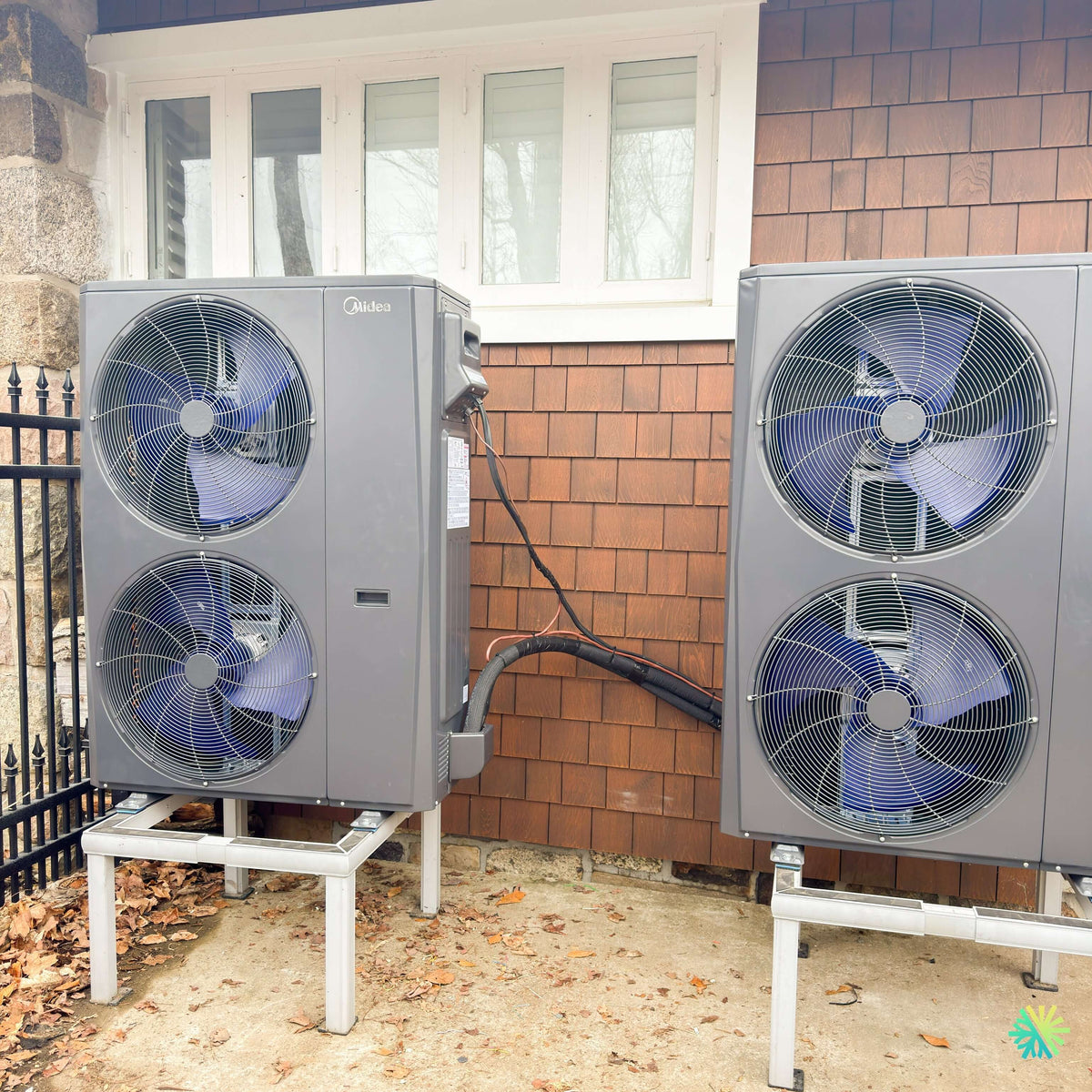
This MIDEA EVOX G3 central heat pump installation in Montréal-Nord immediately stands out for a rare feature in a standard residential installation: here, we have two large Midea outdoor units installed side by side, each equipped with two front fans and each placed on its own elevated metal structure.
The jobsite photo perfectly summarizes the challenge. The available space is along a residential façade made of stone and architectural shingles, in front of a large window and very close to a metal fence. The two units occupy a relatively compact technical area. We therefore had to organize their placement precisely to preserve clearances, maintain reasonable access to the components, and allow each unit to move its air volume properly.
This is exactly the kind of project where HVAC installation matters just as much as the technical specifications.
A high-performance central heat pump may deliver excellent laboratory data, but two large condensers placed too close to each other, too low in the snow, or without adequate service access could lose some of the benefits sought. Our job is therefore to integrate the equipment into the actual building.
Midea documentation presents the EVOX G3 as a range of Inverter ducted central systems designed in particular to facilitate the modernization of residential heating systems.
Two large-format units: why positioning becomes even more important
When a single heat pump is installed against a building, we must already take into account air intake, front discharge, defrosting, and maintenance.
With two outdoor units side by side, planning takes on an additional dimension.
In particular, the following should be avoided:
- interfere with each other's airflow;
- are positioned in a way that makes a panel inaccessible;
- create an overly confined area against the façade;
- occupy the entire passage unnecessarily;
- end up too close to the ground for the winter;
- make the future replacement of a single unit unnecessarily complicated.
In the Montréal-Nord photo, the two condensers are oriented in the same direction, with their large fans facing an open area. This arrangement is particularly logical for a horizontal-discharge platform like the EVOX G3.
Midea explains that its outdoor unit uses a horizontal-blow fan with a vertical heat exchanger to promote more uniform airflow across the heat exchanger. The manufacturer associates this design with better heat exchange efficiency as the outdoor temperature drops.
Elevated metal supports for the two condensers
The two outdoor units rest on independent metal supports, each with several feet.
Choosing an elevated support is particularly relevant in Montréal-Nord.
During the winter, snow accumulation can become significant around foundations. A heat pump operating in heating mode must continue to draw in and discharge air freely despite these conditions.
By keeping the units well above ground level, we create more space beneath the appliances.
This height helps in particular with managing:
- accumulated snow;
- water from defrost cycles;
- possible ice formation;
- access beneath the condenser;
- seasonal leaves and debris;
- the inspection of the supports.
The photo also shows leaves on the ground around the installation, highlighting another practical consideration: in the fall, this area must be kept clean to prevent excessive debris from accumulating beneath the appliances.
Why defrosting is even more important with two units installed in the same location
A central heat pump used for heating can accumulate frost on its outdoor heat exchanger when the temperature and humidity are conducive to this phenomenon.
The system then initiates a defrost cycle.
The resulting water must be able to leave the unit. When two appliances operate in the same outdoor area, we must therefore ensure that this water has enough space to drain without creating a mass of ice beneath the machines too quickly.
The elevated mounting visible in Montréal-Nord leaves significant clearance between the bottom of the condensers and the ground.
For the homeowner, this does not eliminate winter maintenance. Ice buildup must still be monitored, and snow must be cleared when necessary.
A residential façade where aesthetics and mechanical systems had to coexist
The installation is located in front of a façade featuring several materials: stone on the left side, shingle-style siding in the central section, and a large window above.
We are therefore dealing with a highly visible area.
Placing two large central units in such an environment requires aligning them neatly rather than creating two independent installations with no cohesion.
In the photo, the units are positioned parallel to the façade, and the supports are organized in the same orientation.
The result forms a genuinely structured mechanical area.
For us, this aspect is important. A heat pump installation in Montréal should be functional, but it should not look as though it was added to the building without any thought.
Refrigerant lines: a critical point in a dual installation
Between the two units, the refrigerant and electrical lines can be seen running back toward the property.
In an installation with multiple systems, identifying and organizing the circuits becomes even more important.
We must be able to clearly distinguish which set of lines belongs to which heat pump. This simplifies:
- commissioning;
- pressure and temperature measurements;
- a future diagnosis;
- maintenance;
- a possible component replacement.
Poorly organized lines can turn a relatively simple service call into an unnecessarily lengthy search.
MIDEA EVOX G3: advertised operation down to -30 °C
The outdoor design would have little meaning, however, if the unit were not suited to winter heating.
Midea advertises continuous operation down to -30 °C for the EVOX G3 Extreme Heat. In the cited test results for a three-ton configuration, the manufacturer also mentions up to 100% heating capacity at -25 °C, with a COP reaching approximately 1.9.
The compressor technology described by Midea uses, when conditions become extremely cold, an intermediate-temperature vapor injection to increase the flow of compressed refrigerant and maintain more heating capacity.
For a building in Montréal-Nord, this low-temperature performance is particularly relevant.
Two large cabinets do not allow their capacity to be determined with certainty
The units visible in the photo each use a cabinet with two stacked fans, which clearly indicates a high-capacity format within the product family.
However, we cannot read the nameplates in the photo reliably enough to state an exact capacity.
We therefore avoid claiming that they are 48,000 or 54,000 BTU/h solely based on their appearance.
The EVOX G3 documentation covers central systems from 18,000 to 54,000 BTU/h.
The technical table includes, among others, the following capacities:
- 18,000 BTU/h;
- 24,000 BTU/h;
- 30,000 BTU/h;
- 36,000 BTU/h;
- 48,000 BTU/h;
- 54,000 BTU/h.
To identify the performance of each of the two machines installed in Montréal-Nord, the exact model number and its combination with the corresponding indoor unit must be used.
What the larger EVOX G3 models can offer according to the brochure
The technical documentation nevertheless helps explain the performance of the series' higher capacities.
For the 48,000 BTU/h combination, Midea publishes, among other specifications:
- 48,000 BTU/h cooling;
- 48,000 BTU/h nominal heating;
- 17.5 SEER2;
- 12 EER2;
- 9.5 HSPF2;
- approximately 48,000 BTU/h of heating at -15 °C;
- COP of 2.0 under this reference condition.
For the higher configuration, the brochure indicates a cooling capacity of 54,000 BTU/h and a nominal heating capacity of 55,000 BTU/h, with 17.5 SEER2, 12 EER2 and 9.5 HSPF2.
These values mainly show one thing: the nominal capacity and efficiency must be associated with the exact indoor-outdoor combination, never solely with the appearance of the condenser.
Indoors, two central systems require particular attention to ductwork, airflow and controls
What we see in the photo represents the outdoor part of the project. However, with a central heat pump, performance depends just as much on what happens indoors.
Each system must work with its air handler, ductwork, air returns, controls and, when provided, auxiliary heating.
Airflow becomes critical at higher capacities
The greater the capacity of a central heat pump, the more capable the ductwork must be of carrying the required volume of air without creating excessive pressure.
The EVOX G3 range incorporates Computational Constant Airflow 2.0 technology.
Midea indicates that the fan can adjust its output and speed to adapt to the conditions of the network and filtration. In the examples presented, the platform can handle up to 1.2 in. of water column static pressure.
The documentation also indicates up to 60 airflow setting levels.
This flexibility facilitates commissioning, particularly when new equipment must be integrated into an existing network.
However, it does not replace a properly sized network.
An overly restrictive network can limit an excellent system
During our central installations, we specifically check:
- the air return;
- the plenum dimensions;
- the main branches;
- the transitions;
- the filtration;
- the registers;
- airflows to the different rooms.
Installing a large heat pump on a network unable to carry its rated airflow can lead to noise, excessive pressure, and unsatisfactory air distribution.
On a project involving two large units like this one, this verification becomes even more important.
A modular indoor unit to simplify certain replacements
The EVOX G3 uses a design called Block N Lock.
According to the brochure, the indoor unit can be configured in six orientations: upflow, downflow, right horizontal, left horizontal, and various compact low-boy configurations.
This modularity is particularly interesting in existing Montréal-Nord properties, where mechanical rooms are not always suited to the dimensions of new equipment.
Formats designed to facilitate furnace replacement
Midea also indicates cabinet widths of approximately 14.5 to 21.5 inches, comparable to several central residential furnaces.
This dimensional compatibility can reduce some ductwork modifications during a retrofit.
We must nevertheless check each plenum and each air return. No conversion should be considered “direct” simply because the widths appear close.
Auxiliary heating: up to 25 kW, but not automatically
The EVOX G3 accepts three-stage auxiliary electric heating kits of up to 25 kW. Midea indicates that these elements can be activated and modulated according to temperature needs.
In an installation where two central systems are present, the total electrical load deserves even more attention.
We must consider:
- the capacity of the panel or panels;
- the building’s electrical service;
- the current required by each heat pump;
- the auxiliary heating of each system;
- the other major electrical loads.
Electrical sizing is therefore an integral part of HVAC installation.
485, 24 V control and thermostat flexibility
Midea provides compatibility with 485 communications as well as 24 V controls, including certain third-party thermostats. The documentation also specifies that the platform can automatically identify the control mode being used.
In certain configurations, Sub-1 GHz communication can reduce the communication wiring required between the outdoor unit, indoor unit, and thermostat.
This flexibility can be particularly useful during a renovation when the building is already fully finished.
MERV 13 filtration for a well-balanced central system
The EVOX G3 documentation also provides options for 1-, 2-, or 4-inch MERV 13 filters. Midea indicates that these filters can capture more dust, pollen, particles, and dander while helping keep the indoor coil cleaner.
For large systems, the filtration surface area becomes particularly important.
A high-efficiency filter that creates too much restriction can impair airflow. We therefore always seek a balance between filtration quality and static pressure.
R-454B and this new generation of central systems
Midea chose R-454B for the EVOX range in question. The documentation indicates a global warming potential of 466 for this A2L refrigerant.
This transition directly affects installation practices.
For us, this means using procedures, tools, and commissioning methods suited to the equipment’s specific refrigerant.
LogisVert: two units do not automatically mean two identical rebates
The brochure indicates that the EVOX range presented exceeds the ENERGY STAR Most Efficient specifications mentioned by Midea.
However, this is not enough to determine the exact amount of financial assistance in Quebec.
With an installation comprising two systems, each combination must be checked separately according to:
- its outdoor unit;
- its indoor unit;
- its AHRI number;
- its certified capacity;
- the LogisVert rules applicable at the time of installation.
We therefore avoid announcing an amount simply by multiplying a theoretical figure by two.
Mistakes to avoid when installing two large heat pumps side by side
This Montréal-Nord project highlights several mistakes that could reduce the quality of a project of this scale:
- placing the two units too close to each other;
- pointing one fan toward the other condenser;
- installing the units too close to the ground;
- overlooking the space required for defrosting;
- crossing or incorrectly identifying the refrigerant lines;
- failing to plan access to the service panels;
- sizing the systems without checking the duct network;
- forgetting the combined electrical load of the auxiliary heaters;
- overlooking leaves and debris that can accumulate beneath the supports;
- announcing performance or a subsidy without checking every AHRI combination.
An installation that shows the difference between “installing two machines” and designing a real mechanical area
The visible result at this Montréal-Nord property is much more than a pair of condensers.
Here, we have two large-capacity outdoor units installed on two robust structures, aligned against a façade that imposes several architectural constraints.
Each unit has its own space, connections, and access.
This organization is essential to ensure that the installation remains practical five, ten, or fifteen years from now, when a technician needs to perform HVAC maintenance, diagnostics, or repairs.
At AirGreen, this is precisely the long-term vision we apply to our central heat pump installations in Montréal, Laval, Longueuil, the North Shore, and the South Shore.
The MIDEA EVOX G3 features an interesting Inverter platform, operation at very low temperatures, a modular indoor unit, and advanced airflow management. But all these features only realize their true value when the equipment is properly sized and installed.
In Montréal-Nord, the particular challenge was clear: integrating two large central units in the same outdoor space without compromising their airflow, winter operation, or future access.
It is this combination of design, technical expertise, and building realities that transforms high-performance equipment into a truly high-performance HVAC system.
The unit on this job, in figures
The range as published on airgreen.ca: pick a size to see its capacity in deep cold.
| Size | Heating at −8 °C | Heating at −15 °C | Coldest certified point | COP at −15 °C | SEER | HSPF | Indicative LogisVert aid |
|---|---|---|---|---|---|---|---|
| Midea EVOX G3 · 1.5 tons | 14,700 | 18,600 | −30 °C: 11,800 | 2.12 | 19.0 | 10.1 | $1,764 |
| Midea EVOX G3 · 2 tons | 20,800 | 20,600 | −30 °C: 12,100 | 2.14 | 18.6 | 10.0 | $2,496 |
| Midea EVOX G3 · 2.5 tons | 24,000 | 33,200 | −30 °C: 17,900 | 1.97 | 17.2 | 10.8 | $2,880 |
| Midea EVOX G3 · 3 tons | 33,000 | 37,400 | −30 °C: 27,600 | 1.9 | 18.0 | 10.0 | $3,960 |
| Midea EVOX G3 · 4 tons | 39,500 | 48,000 | −30 °C: 27,200 | 2.0 | 17.5 | 9.5 | $4,740 |
| Midea EVOX G3 · 5 tons | 45,000 | 54,000 | −30 °C: 37,300 | 1.9 | 17.5 | 9.5 | $5,400 |
Data read live from the airgreen.ca page of each size (NEEP / AHRI certified performance). When the title names the installed size, it is highlighted; otherwise the whole range is shown. The aid shown is today’s, using Hydro-Québec’s rule ($120 per 1,000 BTU/h at −8 °C); amounts quoted in the article date from its publication. Only Hydro-Québec confirms the assistance granted.
The big day, step by step
The main steps of this kind of job at AirGreen. Every house has its quirks: the estimate brings them out.
We look at the ducts, the current indoor module, the electrical panel and the planned spot for the outdoor unit.
The equipment combination, capacity and price, in writing. We check whether the combination qualifies for assistance programs.
Access protected, old unit disconnected and removed when it is being replaced.
Electric furnace or air handler, with its coil, connected to the supply and return ducts.
On a level base, raised above the snow, with free space all around.
Insulated, they enter through a sealed opening and run to the indoor coil.
Dedicated circuits, accessible disconnect, a thermostat that works with the heat pump and the backup heat.
Leak test, vacuum, start-up, airflow check and a test of both modes.
Filter, thermostat, backup heat in extreme cold: what to know before winter.
- The on-site estimateWe look at the ducts, the current indoor module, the electrical panel and the planned spot for the outdoor unit.
- The quoteThe equipment combination, capacity and price, in writing. We check whether the combination qualifies for assistance programs.
- Getting readyAccess protected, old unit disconnected and removed when it is being replaced.
- The indoor moduleElectric furnace or air handler, with its coil, connected to the supply and return ducts.
- The outdoor unitOn a level base, raised above the snow, with free space all around.
- The refrigerant linesInsulated, they enter through a sealed opening and run to the indoor coil.
- Electrical and thermostatDedicated circuits, accessible disconnect, a thermostat that works with the heat pump and the backup heat.
- Tests and start-upLeak test, vacuum, start-up, airflow check and a test of both modes.
- The walkthroughFilter, thermostat, backup heat in extreme cold: what to know before winter.
What would it look like at your place?
Two quick checks with real numbers: what heat costs, and what your current heaters add up to in BTU/h.
Baseboards and electric furnaces turn 1 kWh of electricity into 1 kWh of heat. A heat pump delivers more: that is its COP. At Hydro-Québec’s rate D (11.142¢/kWh above 40 kWh a day, since 1 April 2026):
Hydro-Québec: a heat pump can be up to three times more efficient than baseboards for heating in the colder months.
Estimate per kWh of heat, at the chosen temperature, using the certified COP from the product page. Taxes, access charge and backup heat not included.
Conversion: 1 W = 3.412 BTU/h. An indication, not a load calculation: baseboards and furnaces are often stronger than the real need, and they can stay as backup. AirGreen confirms the capacity on site.
Four mistakes we do not make
Flip each card to see what we do instead.
Your own project, step by step
What to do, season by season
Three habits per season for this unit. They take a few minutes and prevent many calls.
- Check the indoor module's filter.
- Clear winter debris from the outdoor unit.
- Test cooling before the heat arrives.
- Check the filter more often in peak season.
- Keep registers and returns clear.
- Watch condensate drainage near the coil.
- Change or clean the filter.
- Test heating and backup heat before the cold.
- Book periodic maintenance.
- Clear snow around the outdoor unit.
- Store nothing in front of the indoor module.
- Note any unusual noise or smell and call us.
Is your home ready?
Check what applies at your place. A "no" is not a refusal: it is what we sort out during the estimate.
Four statements: true or false?
It all comes down to details you have just seen.
1. A central heat pump uses the house's ducts.
It connects to the existing ducts to heat and cool everywhere.
2. In extreme cold, electric backup heat can take over.
The indoor module (furnace or air handler) works with the heat pump and takes over in extreme cold.
3. The filter only gets changed when the unit breaks down.
A dirty filter cuts airflow. It gets checked regularly.
4. You can reuse the old unit's size without checking.
The house may have changed: insulation, windows, added rooms. Capacity is confirmed on site.
0 / 4 right answers
What people ask us about this kind of work
Can I keep my current ducts?
What happens in extreme cold?
Furnace, air handler, ducted: what is the difference?
Are there grants?
Do I need a permit?
How much can I save?
How is the LogisVert assistance calculated?
Will my current thermostat work?
Central or wall units: which one?
Does AirGreen hold the required licences?
Is the estimate free?
No question matches. Write to us: we answer.
More jobs to see, near you
By town, by equipment or by region: browse more than 4,700 published projects.
Each dot: a town where AirGreen has published projects. The glowing dot: this job.
Every house has its constraints. We see them before we install.
The on-site estimate is free and the quote follows within 24 hours.
Text and photo: a real AirGreen Climatisation & Chauffage job. The diagrams are generic illustrations of the type of installation, not a survey of this job site. Sources of the added figures: airgreen.ca product pages (NEEP / AHRI performance), Hydro-Québec (Heat pumps page, LogisVert, read on 13 October 2026), Régie de l’énergie (rate D as of 1 April 2026).