
Installation of a Broan-NuTone AI Series V130H65RS air exchanger in Très-Saint-Rédempteur
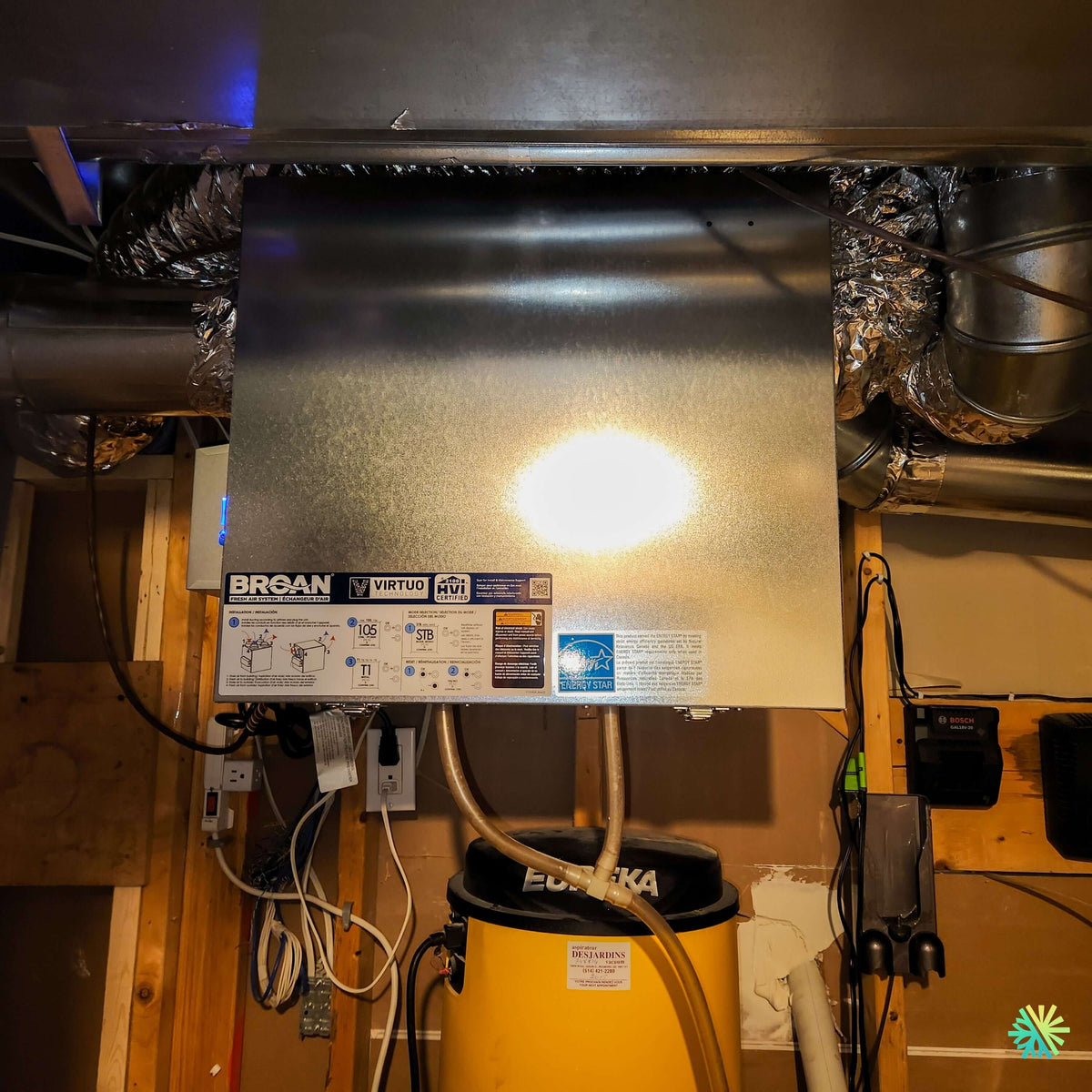
Side nozzles or top nozzles: the decision must be made before ordering. Here’s how we integrated a Broan-NuTone V130H65RS beneath the main trunk of an already crowded basement in Très-Saint-Rédempteur.
Generic illustration of this type of installation, not a survey of this job site. Tap a number.
It removes stale air and brings in fresh air. The two airflows cross in the core without mixing.
It recovers part of the heat from the outgoing air to temper the incoming air. Depending on the model, it also manages humidity.
An outdoor hood, kept away from the exhaust so the house does not pull back the air it just removed.
Humid, stale air leaves through its own hood, fitted with a damper.
The ducts that connect to the outside are insulated to prevent condensation inside the house.
Stale air is drawn from humid rooms and fresh air is sent to living areas. The airflows are balanced.
It sets the mode and speed. You use it more when the house is humid or full of people.
Depending on the model and the season, the core produces condensation, removed through a drain with its loop.
Side ports or top ports: the decision to make before you even order the unit
Most homeowners learn about this distinction on the day the installer discovers that the delivered unit cannot be connected. An air exchanger in the AI Series comes in two physical configurations: top ports or side ports. Everything else about the model is identical—the same core, the same efficiency, the same power consumption. Only the duct outlet location changes.
At Très-Saint-Rédempteur, in the rural Vaudreuil-Soulanges area, this distinction determined everything else about the project. We installed a Broan-NuTone AI Series V130H65RS air exchanger there—the side-port version—in a basement mechanical area that was already largely occupied.
The context: a rural home and a crowded basement
The Très-Saint-Rédempteur area and the surrounding hills are made up primarily of detached single-family homes supplied by wells, served by septic systems, with basements that simultaneously function as mechanical rooms, storage areas, and workshops.
Specifically, this home's mechanical area already contained: a rectangular sheet-metal main trunk running through the ceiling from one end to the other, a central vacuum with its tank and rigid piping, the electrical panel, several exposed circuits, and a network of insulated rigid and flexible round ducts.
Finding space for a 21-inch-square unit in this setup is not an exercise in brute force. It is an exercise in sequencing.
Why choose the side-port version
What the location of the ports really changes
A unit with top ports requires clear space above the cabinet: the height of the collars, plus the bend radius of the first elbow, plus the working space needed to tighten the clamps. In practice, you need to allow a good ten inches above the unit before the connection becomes comfortable to install.
A unit with side ports shifts this requirement to the sides. It can therefore fit directly beneath a main trunk, a low ceiling, or a beam, reclaiming the lost height.
In this house, the only available position was directly beneath the rectangular trunk. A model with top ports would have been physically impossible to connect correctly in this location—or would have required crushed elbows right at the outlet, along with the resulting loss of airflow.
The clearances nobody measures before buying
Before ordering an air exchanger, four measurements should be taken on site:
- Clearance above the proposed location, up to the lowest obstruction.
- Clearance in front of the unit, needed to open the door, remove the filters, and extract the core. The manufacturer requires approximately 3 inches for repairs and a dozen inches for routine maintenance.
- Side clearance, if the ports exit through the sides.
- The distance to an electrical outlet and to the nearest drain return.
These four digits determine the configuration to order. Taking them after delivery is already too late.
The unit: Broan-NuTone AI Series V130H65RS
The specifications selected for this home:
- Airflow range of 35 to 130 CFM (17 to 61 L/s), adjustable on the built-in LCD screen.
- Sensible recovery efficiency of 68% at 0°C and 60% at -25°C (at 64 CFM), with an apparent sensible efficiency of 72% at 0°C.
- ENERGY STAR certified and HVI certified.
- PMSM ECM motors: 120 V, 60 Hz, 2.4 A, 110 W maximum.
- 5-inch side ports, includes a washable MERV 8 filter, with MERV 13 and HEPA options.
- Recirculation defrost, activating at around -5°C.
- Approximately 35 lb (15.9 kg), mounted on the supplied wall brackets.
- Novoclimat compliance when the unit is paired with an advanced wall control.
The 60% recovery at -25°C exceeds the 54% minimum required by the Québec Construction Code in applicable dwellings.
A useful note about your unit’s label
The door of these units features an illustrated installation decal showing a display with an airflow value, a mode code, and a configuration code.
These values are printed examples, not your unit’s settings. They show the installer what each programming step looks like. Two units installed in two different homes have exactly the same decal, with the same numbers.
To find out your air exchanger's actual settings, you need to read the unit's LCD screen or wall control. We clarify this point because several homeowners show us the label, thinking it displays their configuration.
Coexisting with the central vacuum, main trunk, and panel
The order of work in a dense mechanical area
In an already occupied space, the order of operations avoids having to undo:
- Complete survey of fixed obstacles: main trunk, beams, pipes, electrical panel.
- Positioning the unit based on service clearances, not on the easiest place to drill.
- Routing the ducts before drilling anything, reserving the most direct paths for the longest runs.
- Securing the unit.
- Connecting the ducts, from rigid to flexible.
- Drain with a siphon-forming loop.
- Electrical supply.
- Measured commissioning.
The costliest mistake is to mount the unit first because the spot seemed available, then discover that the central vacuum canister occupies precisely the space needed to extract the core once a year.
Electrical supply
The unit plugs into a 120 V outlet within reach of its cord. Two checks we systematically make in workshop basements: that the outlet is not shared with a circuit subject to heavy-startup loads, and that it is not controlled by a wall switch that someone will someday turn off without knowing what they are shutting down. An air exchanger unplugged for six months does not announce itself.
Rigid and flexible: what a well-built network looks like
A well-designed network combines both materials according to their strengths:
- Rigid duct for the main runs and long spans. It offers much less resistance to airflow, does not sag, and can be cleaned.
- Insulated flexible duct for short connections, constrained changes of direction, and anywhere the unit must be mechanically decoupled from the network to prevent vibration transmission.
What distinguishes good work from sloppy work is not the choice of material, but the tension of the flexible duct and the generous radius of the bends. A taut flexible duct, with bends started a few inches from the nozzle, performs very well. The same duct left slack along its entire length can cost more than half the airflow through that section.
Radon: what an air exchanger does, and what it does not do
The question comes up regularly in rural areas, where homes often sit on soils and rock formations that may release radon.
The honest answer has two parts.
What an air exchanger provides: by continuously renewing the air and maintaining balanced airflow rates, it dilutes gaseous contaminants present in indoor air, which may help lower a radon concentration. It also prevents the house from becoming depressurized, a condition that encourages soil gases to be drawn in through cracks in the slab.
What it does not replace: when a test reveals a high concentration, the method recognized by Health Canada remains active sub-slab depressurization, performed by a professional certified in radon mitigation. Ventilation alone is not a mitigation solution for a confirmed case.
Our position: a properly balanced HRV is part of a healthy home, but it does not replace radon testing. The test is inexpensive and is conducted over several months during the heating season.
What we check during commissioning
- Actual airflow rates measured on both circuits, with doors and windows closed and the network sealed.
- Identification of the limiting side, and correction if the deviation from the design is significant.
- Installation configuration programmed in accordance with the network actually built.
- Drain loop in place, continuous slope, no low points.
- Exterior hoods: at least 6 feet of separation between intake and exhaust, positioned higher than the expected snow accumulation, and at least 10 feet away from any dryer outlet, chimney, or vent.
- Demonstrating maintenance to the homeowner, filters in hand.
AirGreen: from Très-Saint-Rédempteur to Montréal's central neighbourhoods
A properly installed air exchanger is a unit the homeowner never hears about, except four times a year when they wash the filters. Achieving this requires measurements beforehand, a designed duct network, a configuration ordered with full understanding of the requirements, and commissioning that produces figures.
We carry out this work in rural homes in Très-Saint-Rédempteur, Rigaud, and Sainte-Marthe, in homes in Vaudreuil-Dorion and Hudson, in plexes and condos in Montréal, in cottages in Laval and on the North Shore, as well as in developments in Longueuil and on the South Shore.
Every HVAC ventilation installation we deliver includes airflow calculations in accordance with CSA F326, a record of the measured airflow rates, an explanation of the programmed configuration, and training for the homeowner on routine HVAC maintenance.
If your basement is already packed and you think there is no room left for an air exchanger, write to us. In most cases, there is—provided you choose the right configuration before ordering.
How it goes, from the first call to the end
The main steps of this kind of job at AirGreen. Every house has its quirks: the estimate brings them out.
We locate the wall for the two outdoor hoods, the unit's spot, service access and the drain.
The unit, its location and the price, in writing.
Hung or set level, with clear access to the filters and the core.
Fresh air intake and exhaust, kept apart and sealed.
The ones connected to the outside are insulated to prevent condensation inside the house.
Connected with its loop, when the unit needs one.
Installed where you will see it and use it.
Incoming and outgoing airflows are adjusted so the house is neither pressurized nor depressurized.
Speeds, filters, core: how to use it through the seasons.
- The on-site estimateWe locate the wall for the two outdoor hoods, the unit's spot, service access and the drain.
- The quoteThe unit, its location and the price, in writing.
- The unitHung or set level, with clear access to the filters and the core.
- The outdoor hoodsFresh air intake and exhaust, kept apart and sealed.
- The ductsThe ones connected to the outside are insulated to prevent condensation inside the house.
- The drainConnected with its loop, when the unit needs one.
- The wall controlInstalled where you will see it and use it.
- BalancingIncoming and outgoing airflows are adjusted so the house is neither pressurized nor depressurized.
- The walkthroughSpeeds, filters, core: how to use it through the seasons.
What to do, season by season
Three habits per season for this unit. They take a few minutes and prevent many calls.
- Clean the filters and core as the manufacturer specifies.
- Check the outdoor hoods: nests, debris, dampers.
- Lower the speed if the outdoor air gets humid.
- Adjust the speed to the humidity in the house.
- Check that the drain flows.
- Keep the outdoor hoods clear.
- Clean the filters before the closed-house season.
- Check the exhaust damper.
- Book a full cleaning if the unit has not had one in a long time.
- Clear snow from both outdoor hoods.
- Raise the speed if condensation appears on windows.
- Let the unit run: with the house closed, humidity builds up.
Which type of equipment for your project?
Pick what looks like your need.
Four mistakes we do not make
Flip each card to see what we do instead.
What people ask us about this kind of work
What does an air exchanger do?
Does fresh air cool the house in winter?
What speed should it run at?
Does an exchanger need cleaning?
What are the signs of poor ventilation?
HRV or ERV: what is the difference?
Should it run in winter?
Does AirGreen hold the required licences?
Is the estimate free?
No question matches. Write to us: we answer.
Useful pages for what comes next
More jobs to see, near you
By town, by equipment or by region: browse more than 4,700 published projects.
Each dot: a town where AirGreen has published projects. The glowing dot: this job.
Tell us about your house. We come and see it for free.
The on-site estimate is free and the quote follows within 24 hours.
Text and photo: a real AirGreen Climatisation & Chauffage job. The diagrams are generic illustrations of the type of installation, not a survey of this job site. Sources of the added figures: airgreen.ca product pages (NEEP / AHRI performance), Hydro-Québec (Heat pumps page, LogisVert, read on 13 October 2026), Régie de l’énergie (rate D as of 1 April 2026).