
Installation of a Broan-NuTone Virtuo Technology air exchanger set to 105 CFM in Sainte-Marthe, in Vaudreuil-Soulanges
An American calculator gave 49 CFM for this house. The CSA F326 standard required 106. Installation of a Broan-NuTone Virtuo Technology air exchanger set to 105 CFM in Sainte-Marthe, connected to the existing furnace plenum, with the three pitfalls to avoid.
Take a tour of the installation
Each number is a point we check on site. Switch between summer and winter to watch air and heat move.
Generic illustration of this type of installation, not a survey of this job site. Tap a number.
It removes stale air and brings in fresh air. The two airflows cross in the core without mixing.
It recovers part of the heat from the outgoing air to temper the incoming air. Depending on the model, it also manages humidity.
An outdoor hood, kept away from the exhaust so the house does not pull back the air it just removed.
Humid, stale air leaves through its own hood, fitted with a damper.
The ducts that connect to the outside are insulated to prevent condensation inside the house.
Stale air is drawn from humid rooms and fresh air is sent to living areas. The airflows are balanced.
It sets the mode and speed. You use it more when the house is humid or full of people.
Depending on the model and the season, the core produces condensation, removed through a drain with its loop.
The number 105 printed on the front is not a model number
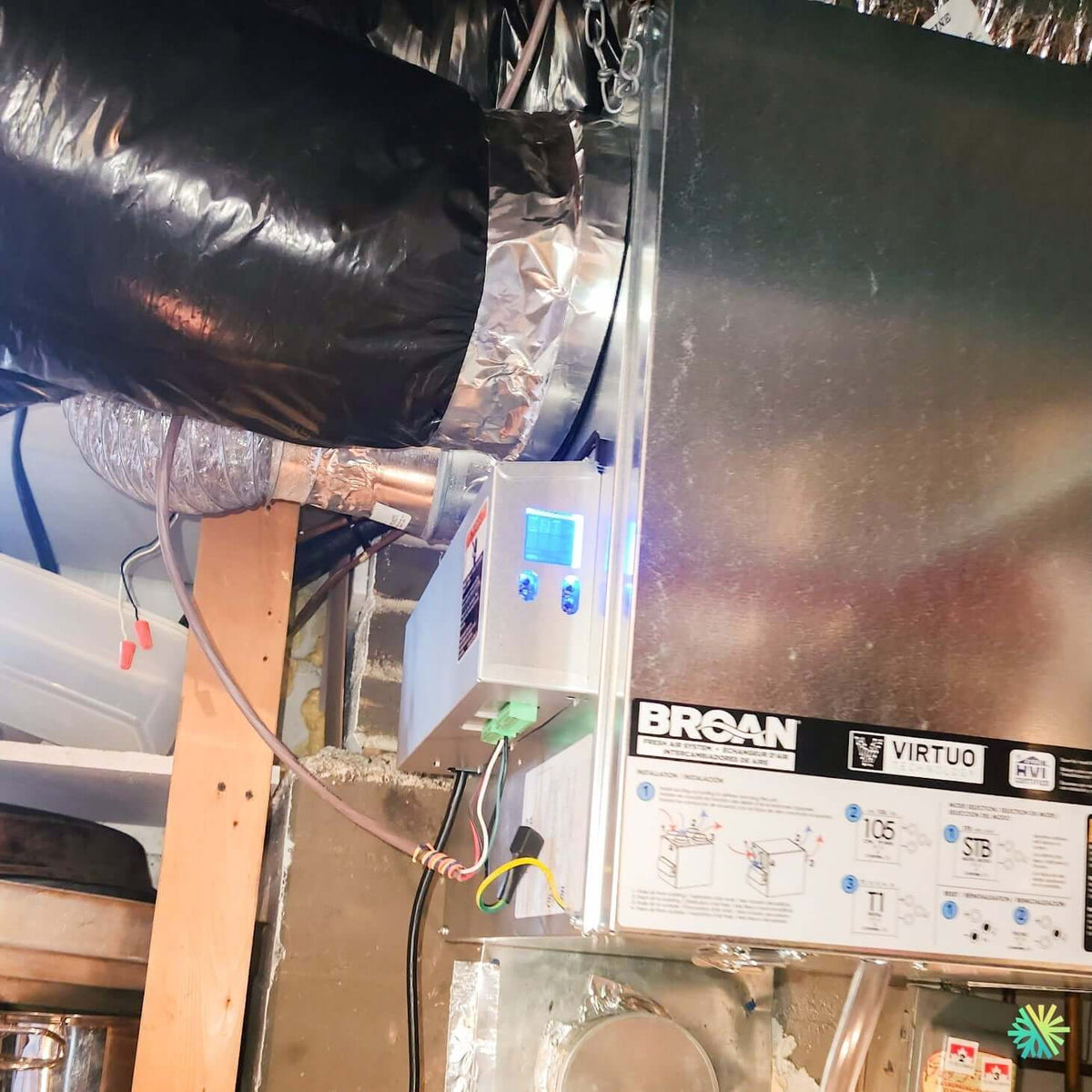
In the photo from this Sainte-Marthe job, the unit's label displays three configuration boxes. The second contains a large 105, followed by the designation CFM / PCM, with rotary selector icons.
This is not a fixed product characteristic. It is a setting that the installer selects and sets himself, directly on the unit, during commissioning. The same housing could have been configured to 60, 80, or 130 CFM.
In other words, two neighboring homes can receive exactly the same unit and end up with completely different ventilation performance, depending on the figure set by the installer. No one mentions it in a quote, yet it is the parameter that determines whether the home will be properly ventilated for the next twenty years.
At AirGreen, we offer complete HVAC solutions throughout Greater Montreal, and we record this figure on the commissioning sheet provided to the customer. Here is how we arrived at 105 CFM in this home, and why this number is higher than what most online calculators would give you.
The unit: Broan Virtuo Technology, HVI certified
The job-site label bears three distinct marks, and it is worth distinguishing between them:
- BROAN — Fresh Air System / Air Exchanger, the unit's brand.
- Virtuo Technology, the technical platform developed by the Broan-NuTone group, whose factory is located in Quebec. It is found on units branded Broan as well as on units branded Venmar or vänEE, which belong to the same group.
- HVI Certified, the certification from the Home Ventilating Institute, the independent organization that validates the advertised airflow rates, efficiencies, and sound levels in a laboratory.
This last certification is the one we systematically require. An air exchanger without HVI certification publishes figures that no one has verified. We refuse to offer this type of unit, whether in Sainte-Marthe, Montreal, or on the North Shore.
The appliance is configured directly on its front panel: airflow selection in CFM, operating-mode selection, and a test sequence after reinstallation. These settings are entered once, during commissioning, and they determine the system's entire subsequent operation.
Why 105 CFM when American calculators say 49
This is the technical core of the project, and the part that almost no French-language content covers correctly.
The home in Sainte-Marthe has 1,900 sq. ft. of living space, with three bedrooms, a living room, a dining room, a kitchen, a basement family room, an office, and a laundry room.
The American method: ASHRAE 62.2
The formula found in most manufacturers' documentation and online calculators comes from ASHRAE 62.2-2010:
CFM = 0.01 × area (sq. ft.) + 7.5 × (number of bedrooms + 1)
For this home: 0.01 × 1,900 = 19, plus 7.5 × 4 = 30, for a total of 49 CFM.
The Quebec method: CSA F326 and Article 9.32
Quebec does not work this way. Section 9.32 of the Building Code refers to CSA F326, whose logic is completely different: the calculation does not start with the total area, but with the number and type of rooms. Each room is assigned an airflow, and the system's total capacity is the sum of these airflows.
The usual allocation looks like this:
| Room | Assigned airflow | Equivalent |
|---|---|---|
| Primary bedroom | 10 L/s | 21 CFM |
| Each additional bedroom | 5 L/s | 10.6 CFM |
| Living room | 5 L/s | 10.6 CFM |
| Dining room | 5 L/s | 10.6 CFM |
| Kitchen | 5 L/s | 10.6 CFM |
| Family room | 5 L/s | 10.6 CFM |
| Office | 5 L/s | 10.6 CFM |
| Laundry room | 5 L/s | 10.6 CFM |
For this home: 10 + (2 × 5) + 5 + 5 + 5 + 5 + 5 + 5 = 50 L/s, or 105.9 CFM.
Hence the 105 mounted on the front of the appliance.
Why the difference is more than double
The ASHRAE formula treats the home as a single volume to be renewed. CSA F326 treats it as a collection of rooms, each of which must receive fresh air or exhaust stale air.
A compact home with many rooms therefore gets a significantly higher result in Quebec than in the United States. A 1,900 sq. ft. bungalow divided into eight rooms goes from 49 to 106 CFM.
The practical consequences are direct:
- An appliance sized according to the American formula will systematically be too small for a Quebec home. It will run at full capacity constantly, noisy and prematurely worn, without ever reaching the capacity required by the code.
- An online calculator found on an American website has no validity for a home in Sainte-Marthe, Laval, or Longueuil.
- A quote that mentions no calculations tells you nothing about the compliance of the proposed installation.
We apply both methods to every project and systematically use the more stringent of the two, which is almost always CSA F326. The detailed calculation is attached to the quotation.
Four ways to connect an air exchanger, and why we selected only one here
The photo shows a second determining element: beneath the unit, a large galvanized sheet-metal plenum with a round collar is visible. This is the home's existing forced-air system plenum.
This Sainte-Marthe home already had a forced-air furnace with a complete duct network. This detail completely changes the installation strategy.
The four possible configurations
Fully ducted system
The air exchanger has its own complete network: exhaust ducts to the bathrooms, kitchen, and laundry room, and supply ducts to each bedroom and living area.
This is the highest-performing and most expensive configuration. It is required in homes without a forced-air system: electric baseboard heating, radiant floors, or hot-water heating. This is what we install in most older Montreal homes heated with baseboards.
Simplified connection
The air exchanger is connected to the existing duct network of the furnace or fan-coil unit. Stale air is drawn from the return duct, fresh air is injected into that same return, and the furnace fan distributes it throughout the house.
This is the configuration selected in Sainte-Marthe. It significantly reduces installation cost and time when a network already exists, and avoids cutting into a finished ceiling to run eight new ducts.
Ducted exhaust
Hybrid configuration: the exhaust has its own dedicated ducts to the wet rooms, allowing moisture and odors to be captured at the source, while the fresh-air supply passes through the furnace network.
This is the compromise we recommend when the budget does not allow for a fully ducted system, but the bathrooms absolutely must be served directly.
Attic installation
Technically possible in regions where the attic temperature remains above 10 °C at all times. This configuration is not applicable in Quebec. An air exchanger installed in an unheated attic will freeze, condense, and be destroyed within one winter. We refuse this type of request.
The three conditions for a successful simplified connection
The simplified connection is economical, but it is also the easiest to get wrong. Three points determine it.
Interlocking with the furnace fan
Without distribution, fresh air accumulates in the return plenum and goes nowhere. The air exchanger must therefore control the furnace fan to start whenever it operates, by connecting to the heating appliance's control circuit.
An installation where this interlock was omitted produces a house that ventilates its basement and nothing else. We correct several of these every year, on the South Shore as well as the North Shore.
The distance between the intake point and the injection point
If fresh air is injected into the return too close to where the air exchanger draws stale air, the unit immediately draws back in the air it has just introduced. It runs, consumes energy, and ventilates nothing. This is an air short circuit, and it is invisible without measurement.
We maintain a minimum distance of three feet between the two connections on the plenum, and we verify the result with a manometer rather than relying on the plan.
The airflow direction in the return duct
The two connections must be positioned with the airflow direction in the return duct in mind, so that fresh air is carried toward the furnace rather than pushed back toward the air exchanger intake.
The duct with the black jacket, and why it is black
The large duct visible at the top of the photo has a black outer jacket. This is not an aesthetic choice: it is an insulated flexible duct with a vapor barrier.
The two ducts connecting the air exchanger to the outdoors carry air at outdoor temperatures. In January, an uninsulated fresh-air duct becomes covered in condensation along its entire length. Water drips into the ceiling insulation, soaks the insulation, and the problem becomes apparent two years later as mold or a stain on the ground-floor ceiling.
Insulation alone is not enough. There must be a continuous, sealed vapor barrier; otherwise, moisture from the surrounding air passes through the insulation and condenses against the cold wall of the duct, inside the insulation, where no one can see it.
On this job, every collar is sealed with aluminum tape, as visible in the photo. We never use fabric duct tape: it dries out, hardens, and peels off within three winters.
The plenum connection mistakes we correct
- Collar installed without sealant or aluminum tape. Air leaks into the mechanical room instead of circulating through the duct system.
- Interlock missing, as described above.
- Connection to the supply duct instead of the return duct. The fresh air is then pushed against the airflow and the fan pressure.
- Two connections too close together, causing air short-circuiting.
- No measurement after connection. A simplified connection must be checked with a manometer, with the furnace blower running and stopped, to confirm that the actual airflow matches the 105 CFM selected on the front panel.
The integrated control panel
The photo also shows the control module mounted on the side of the unit: a small backlit screen, two illuminated buttons, and a green low-voltage connector with its conductors connected.
This module manages the unit's configuration and receives the cable from the wall control installed in the living area. Three rules apply to the low-voltage wiring:
- It never shares a hole, duct, or box with 120 V wiring.
- The conductors are inserted fully into the terminal block, with no protruding strand that could touch the neighboring terminal.
- The excess length is coiled and secured, never left hanging over a sheet-metal edge.
Sainte-Marthe: What the agricultural environment requires
Sainte-Marthe is an agricultural municipality surrounded by cultivated land and greenhouses. Two adjustments follow directly from this context:
- Filters become clogged more quickly. Tillage dust in spring, harvest dust in fall, and pollen in between. We recommend checking them every two months rather than every three months in agricultural areas.
- Recirculation mode becomes useful. During spreading periods, it allows indoor air to circulate without introducing outdoor air until the odor dissipates.
We also position the fresh-air intake on the side of the house least exposed to the prevailing winds coming from the fields, rather than at the most convenient point for drilling.
Our air exchanger installations in Vaudreuil-Soulanges and Greater Montreal
We install, configure, and maintain HRVs and ERVs in Sainte-Marthe, Rigaud, Saint-Clet, Les Cèdres, Vaudreuil-Dorion, Saint-Lazare, and Hudson, as well as throughout Montreal, Laval, Longueuil, the North Shore, and the South Shore.
Every HVAC installation ends with the same sheet provided to the customer: airflow calculation according to CSA F326, airflow selected on the unit, chosen configuration, airflow measured during balancing, and commissioning date.
If your air exchanger quote mentions neither the airflow calculation, the connection type, nor the value programmed on the unit, it does not describe the installation you will receive. Contact AirGreen for a documented assessment.
The big day, step by step
The main steps of this kind of job at AirGreen. Every house has its quirks: the estimate brings them out.
We locate the wall for the two outdoor hoods, the unit's spot, service access and the drain.
The unit, its location and the price, in writing.
Hung or set level, with clear access to the filters and the core.
Fresh air intake and exhaust, kept apart and sealed.
The ones connected to the outside are insulated to prevent condensation inside the house.
Connected with its loop, when the unit needs one.
Installed where you will see it and use it.
Incoming and outgoing airflows are adjusted so the house is neither pressurized nor depressurized.
Speeds, filters, core: how to use it through the seasons.
- The on-site estimateWe locate the wall for the two outdoor hoods, the unit's spot, service access and the drain.
- The quoteThe unit, its location and the price, in writing.
- The unitHung or set level, with clear access to the filters and the core.
- The outdoor hoodsFresh air intake and exhaust, kept apart and sealed.
- The ductsThe ones connected to the outside are insulated to prevent condensation inside the house.
- The drainConnected with its loop, when the unit needs one.
- The wall controlInstalled where you will see it and use it.
- BalancingIncoming and outgoing airflows are adjusted so the house is neither pressurized nor depressurized.
- The walkthroughSpeeds, filters, core: how to use it through the seasons.
Four mistakes we do not make
Flip each card to see what we do instead.
Your own project, step by step
What to do, season by season
Three habits per season for this unit. They take a few minutes and prevent many calls.
- Clean the filters and core as the manufacturer specifies.
- Check the outdoor hoods: nests, debris, dampers.
- Lower the speed if the outdoor air gets humid.
- Adjust the speed to the humidity in the house.
- Check that the drain flows.
- Keep the outdoor hoods clear.
- Clean the filters before the closed-house season.
- Check the exhaust damper.
- Book a full cleaning if the unit has not had one in a long time.
- Clear snow from both outdoor hoods.
- Raise the speed if condensation appears on windows.
- Let the unit run: with the house closed, humidity builds up.
Is your home ready?
Check what applies at your place. A "no" is not a refusal: it is what we sort out during the estimate.
Four statements: true or false?
It all comes down to details you have just seen.
1. In an air exchanger, fresh air and stale air mix.
The two airflows cross in the core without mixing.
2. The two outdoor hoods must be kept apart.
Otherwise the exchanger pulls back the air it just removed.
3. An air exchanger can help with condensation on windows.
It renews the air and helps keep humidity in the right range.
4. An exchanger never needs maintenance.
Filters and core get dirty and need regular cleaning.
0 / 4 right answers
What people ask us about this kind of work
What does an air exchanger do?
Does fresh air cool the house in winter?
What speed should it run at?
Does an exchanger need cleaning?
What are the signs of poor ventilation?
HRV or ERV: what is the difference?
Should it run in winter?
Does AirGreen hold the required licences?
Is the estimate free?
No question matches. Write to us: we answer.
More jobs to see, near you
By town, by equipment or by region: browse more than 4,700 published projects.
Each dot: a town where AirGreen has published projects. The glowing dot: this job.
Every house has its constraints. We see them before we install.
The on-site estimate is free and the quote follows within 24 hours.
Text and photo: a real AirGreen Climatisation & Chauffage job. The diagrams are generic illustrations of the type of installation, not a survey of this job site. Sources of the added figures: airgreen.ca product pages (NEEP / AHRI performance), Hydro-Québec (Heat pumps page, LogisVert, read on 13 October 2026), Régie de l’énergie (rate D as of 1 April 2026).