
Installation of a Fujitsu AIRSTAGE Aquila XLTH dual-zone heat pump in Westmount, Montreal
In Westmount, we integrated a Fujitsu AIRSTAGE Aquila XLTH dual-zone heat pump into a narrow room with a low ceiling and pendant light, optimizing airflow, access, and the interior finish.
Take a tour of the installation
Each number is a point we check on site. Switch between summer and winter to watch air and heat move.
In summer, the outdoor unit rejects the house's heat outside.
Generic illustration of this type of installation, not a survey of this job site. Tap a number.
Mounted level on a wall plate, high enough for the air to reach the whole room, with enough space around it to slide the filters out easily.
The refrigerant lines, the communication cable and the drain go through the wall in a single opening, sealed against water, cold air and insects.
Two insulated copper pipes connect the two units. Outside, a line cover can protect them from sun, knocks and weather.
A shut-off switch near the outdoor unit isolates it safely for service. It must stay accessible at all times.
The compressor and the fan. In heating mode it captures heat from the outdoor air, even in winter, and moves it inside.
On the ground or on the wall, it keeps the unit above accumulated snow. The unit stays clear and defrost water can drain away.
The fan needs to blow freely. Storage, a fence or a wall too close, and efficiency drops while noise goes up.
A wall-mounted installation adapted to a narrow, colorful and highly structured room
At Westmount, installing a wall-mounted heat pump often requires more than simply choosing the right capacity. Properties in the area frequently feature detailed ceilings, older walls, architectural niches, pendant lights and spaces where every available inch must be used precisely. For this project, we installed a Fujitsu AIRSTAGE Aquila XLTH dual-zone heat pump, with two indoor units connected to a single outdoor unit.
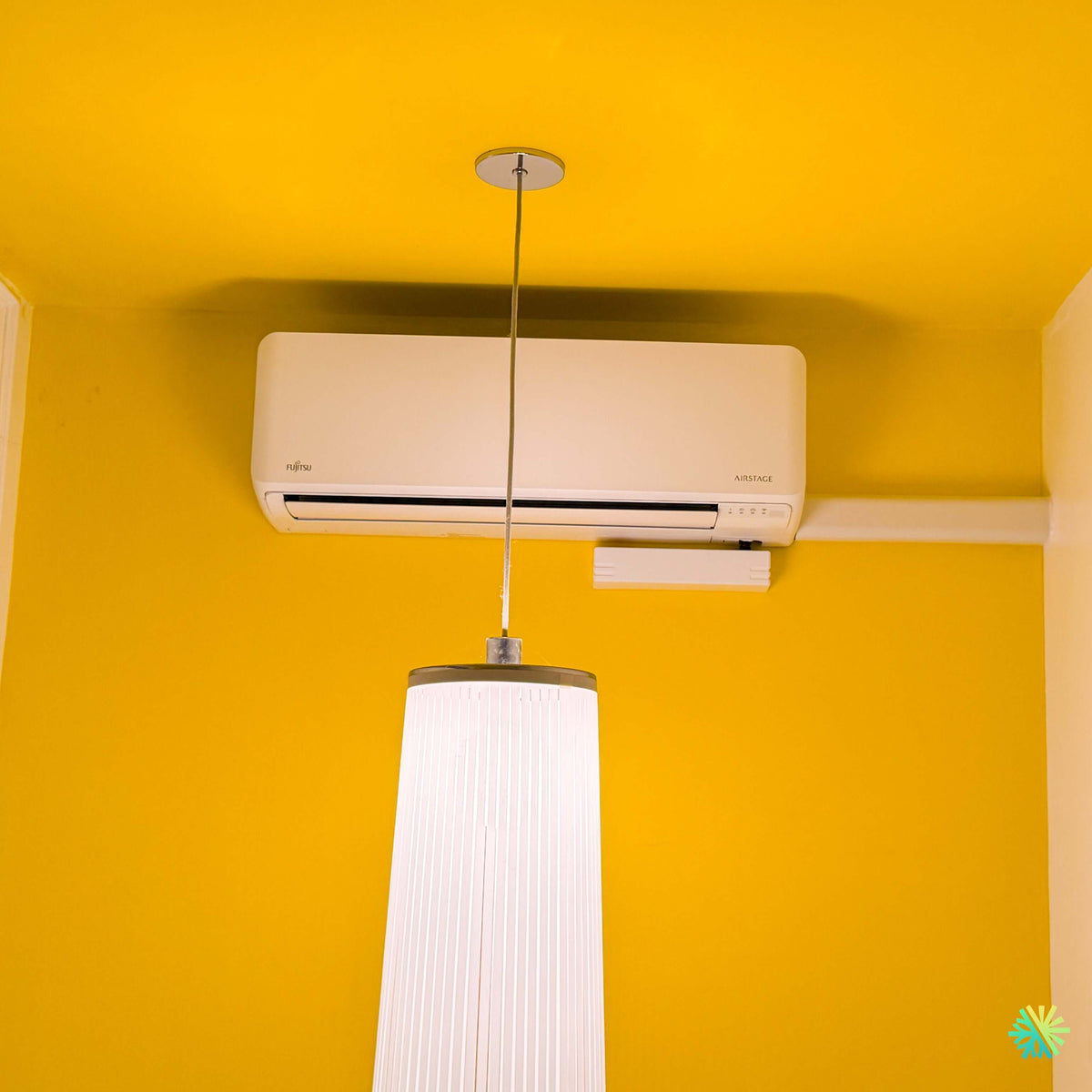
The photo shows one of the Fujitsu wall-mounted units integrated into a room with a well-defined character. The bright yellow wall, matching ceiling, white returns on the sides and pendant light create a visually busy environment. Our goal was therefore twofold: to install the unit in the most functional position possible while preserving the existing layout of the room without undertaking disproportionate interior modifications.
The unit was placed very high on the wall, in a section framed by two vertical returns. This positioning makes use of a space that would otherwise have been difficult to use. It also helps keep the lower part of the wall clear for furniture, circulation and other decorative elements.
Why a dual-zone heat pump was the right fit for this Westmount property
A dual-zone heat pump can heat and cool two spaces with a single outdoor compressor. This configuration can meet several types of needs:
- a main living area and a bedroom;
- two floors with different temperatures;
- an extension and the original part of the house;
- a room with extensive glazing and a less exposed interior space;
- a home office occupied during the day and a bedroom used at night.
In Westmount, homes are rarely uniform from one room to another. Some have massive masonry walls, others have been expanded or renovated, and many combine older sections with more recent renovations. The result is often uneven heating and cooling distribution.
With a dual-zone configuration, each indoor unit has its own controller. Occupants can therefore adjust the temperature of each space separately, even though both units share the same outdoor unit.
Fujitsu documentation indicates that AIRSTAGE H Series multizone systems can power multiple indoor units and that each unit can be controlled independently. It also specifies that the range supports various unit styles, including wall-mounted units, Slim Duct units, compact cassettes, and medium-static-pressure units.
A unit placed in a narrow niche
The installation shown in the photo is distinguished by the limited width of the available wall. The unit is installed between two white returns, beneath a relatively low ceiling. This type of configuration requires a precise inspection even before the wall plate is secured.
We must confirm:
- the exact width between the two sides;
- clearance around the cabinet;
- the space required to open the front panel;
- access to the filters;
- the full movement of the lower louver;
- the drain location;
- the possibility of routing the lines;
- the presence of studs, bricks, or other elements behind the wall;
- the path of the airflow through the room.
A unit that is too wide for the available section could complicate maintenance or limit the panel’s opening. A unit installed too close to the ceiling could also reduce air intake from above.
In this project, the unit occupies almost the entire width of the wall section but remains centered and aligned. This detail is important because, on a brightly colored wall, the slightest misalignment immediately becomes noticeable.
The pendant light fixture: an obstacle to consider before installation
The light fixture is directly in front of the unit, aligned with the center of the room. It does not touch the appliance, but its presence affects airflow and access to the system.
Before installation, we must consider several factors:
- distance between the light fixture and the air outlet louver;
- possible movement of the lampshade;
- air direction in heating and cooling mode;
- accessibility for opening the unit;
- possibility of cleaning the filters without hitting the light fixture;
- risk of vibration or swaying caused by a direct airflow.
The installer’s role is not limited to finding a space where the unit will fit. It is also necessary to determine whether the environment will allow comfortable operation after commissioning.
In this case, the unit was positioned high enough to clear the main light fixture. The lower louver remains free to open and direct the airflow. Depending on the operating mode, the user can adjust the louvers to prevent a draft from being directed constantly toward the lampshade or an occupied area.
A visible interior finish beneath the unit
Below the unit, there is an elongated white box. This component may be related to the installation's technical routing, such as a line-set cover, a drainage element, or a component required when gravity drainage is not possible. The photo alone does not make it possible to identify its exact function with certainty.
However, its presence illustrates a common reality in wall-mounted heat pump installations in Westmount: the most direct route to the outdoors is not always available.
In an older home, constraints may include:
- a shared wall;
- a facade where the lines cannot exit;
- a corridor behind the unit;
- a finished floor or ceiling;
- a thick masonry wall;
- insufficient drain slope;
- a structure that must be worked around.
When the installation requires a visible component, we try to position it in an orderly and accessible manner. A concealed technical component that cannot be inspected can complicate future maintenance.
Capacity selection: a separate step from location selection
The exact capacity of the indoor unit cannot be determined from the photo. The visible Fujitsu AIRSTAGE cabinet may correspond to several capacities, depending on the model selected.
It would therefore be incorrect to assign a specific number of BTUs simply by looking at the exterior dimensions.
To select the capacity for each zone, we analyze:
- floor area;
- ceiling height;
- the amount of glazing;
- sun exposure;
- the quality of the insulation;
- the floor;
- the presence of exterior walls;
- heat loss;
- the number of occupants;
- how the room is used;
- internal heat sources.
In a narrow room, an oversized unit can create excessive airflow and short cycling. In a highly exposed or poorly insulated room, an undersized unit may run continuously without reaching the desired temperature.
Approved combinations for the Fujitsu Aquila series
Fujitsu documentation presents several multi-zone outdoor units, including 18,000, 24,000, 36,000, and 45,000 BTU/h models. Depending on the model, the system can support two to five indoor units.
For the 18,000 BTU/h outdoor unit designed for two zones, the permitted wall-mounted combinations include, among others:
- 7,000 + 7,000 BTU/h;
- 7,000 + 9,000 BTU/h;
- 7,000 + 12,000 BTU/h;
- 7,000 + 15,000 BTU/h;
- 9,000 + 9,000 BTU/h;
- 9,000 + 12,000 BTU/h;
- 9,000 + 15,000 BTU/h;
- 12,000 + 12,000 BTU/h.
These values represent permitted combinations, not an automatic recommendation for a particular building.
Fujitsu also points out that its tables should not be used as the sole tool for capacity selection. The manufacturer recommends using its Design Simulator software to select AIRSTAGE H Series equipment.
Why the indoor capacities can exceed that of the outdoor unit
In a multi-zone system, the sum of the indoor units’ nominal capacities may sometimes exceed the nominal capacity of the outdoor compressor.
This configuration is possible because the two zones do not always demand their full capacity at the same time. One room may receive more sunlight in the afternoon, while another becomes the priority in the evening.
Fujitsu’s documentation mentions a connection capacity of up to 130%, depending on the configuration. However, it specifies that exceeding 100% does not increase the system’s total output capacity.
Let’s take an 18,000 BTU/h outdoor unit connected to two indoor units with a combined nominal capacity of 21,000 or 24,000 BTU/h. This combination may be permitted, but the outdoor unit does not thereby become a 21,000 or 24,000 BTU/h unit.
When both zones call for their maximum capacity simultaneously, the available power is distributed between them. This principle must be considered during system design, especially if both rooms experience significant heat losses during the same periods.
Heating operation in cold weather
The Fujitsu Aquila cold-climate series is designed to continue operating when the outdoor temperature drops significantly. According to the documentation, CTEB units can operate in heating mode down to -26 °C and in cooling mode up to 50 °C.
This temperature represents an operating limit, not a guarantee that the unit will maintain its full rated capacity at -26 °C. As with any heat pump, capacity and efficiency vary according to outdoor conditions.
Therefore, for a property in Westmount, we must consider:
- actual heat losses;
- the quality of the windows;
- the condition of the insulation;
- the building’s airtightness;
- available capacity at low temperatures;
- the existing auxiliary heating;
- the desired indoor temperature.
A low-temperature heat pump can significantly reduce the demand placed on electric baseboards or another heating system. However, it must be sized in the context of the entire home.
Individual control of the two zones
The two indoor units can have separate settings. The owner can adjust the following independently:
- the temperature;
- the fan speed;
- the louver orientation;
- the operating time;
- turning each unit on or off.
However, most multi-zone systems have one inherent limitation: the indoor units cannot operate simultaneously in opposing modes.
Fujitsu’s documentation specifies that the system provides heating and cooling, but not both at the same time.
It is therefore possible to choose two different temperatures in heating mode, or two different temperatures in cooling mode, but not to heat one room while the other is actively being cooled.
A technical execution designed for reliability and everyday comfort
Air distribution in a room with a low ceiling
In the visible installation, the unit occupies the upper part of the wall, and its louver blows air below the cabinet. The limited ceiling height makes the louver’s orientation particularly important.
In cooling mode, we generally aim to circulate cool air along the length of the room. In heating mode, the air should be directed more downward so it does not remain concentrated at the ceiling.
The light fixture located in front of the unit may slightly alter the path of the airflow. During commissioning, we therefore check the different louver positions and how the air moves around obstacles.
Poor orientation can cause:
- a direct draft toward the occupants;
- uneven distribution;
- an area that is too warm near the ceiling;
- a light fixture oscillation;
- a less representative temperature reading.
Condensate drainage
In cooling mode, the unit removes moisture from the air. This water must be discharged through a drain.
When the layout allows for a natural slope, gravity drainage is generally the simplest solution. When this slope is not possible, another drainage method may be necessary.
The drainage must be checked before the work is completed. We check, in particular:
- the slope;
- the pipe’s attachment;
- the absence of kinks;
- the tightness of the connections;
- actual drainage;
- the level of the drain pan;
- any unusual noise.
A small drainage error can cause a leak on an interior wall. In this room painted yellow, a water stain or deterioration of the paint would be immediately visible.
Refrigerant lines
Each indoor unit in a dual-zone system has its own circuit to the outdoor unit. This circuit generally includes two copper lines, insulation, a communication cable, and a drain.
Refrigerant connections must be prepared precisely. A gradual leak can lead to:
- loss of capacity;
- extended cycles;
- ice formation;
- increased consumption;
- poor heating;
- error codes;
- potential compressor damage.
We therefore perform the leak-tightness and evacuation steps before commissioning. The fact that a unit starts up is not, by itself, proof that the refrigeration installation is correct.
Compressor modulation
The Fujitsu system uses a variable-speed compressor. It can adjust its speed according to the combined demand of the two zones.
When the indoor temperature approaches the setpoint, the unit can reduce its output instead of constantly operating at full capacity. This modulation helps to:
- stabilize the temperature;
- limit frequent starts;
- reduce comfort fluctuations;
- adjust consumption to demand;
- improve part-load performance.
Fujitsu documentation also mentions a blue-fin heat exchanger to improve corrosion resistance, as well as built-in protection for the circuits, fan motor, and compressor.
Mistakes to avoid in a similar installation
Choosing the location solely because the unit fits there
The space must also allow for air intake, air discharge, panel opening, and filter cleaning.
Ignoring the suspended light fixture
Even without physical contact, a light fixture can disrupt the airflow or complicate access.
Installing the unit too close to the ceiling
Insufficient clearance can reduce air intake and increase noise.
Hiding a technical component without providing access
A pump, fitting, or pipe passage must remain accessible for inspection when maintenance may be required.
Selecting BTUs based on floor area alone
Glazing, insulation, exposure, and heat loss directly influence the required capacity.
Confusing connection capacity with output capacity
A combination totaling more BTUs on the indoor side does not turn the outdoor unit into a higher-capacity system.
Indoor unit maintenance
The visible unit is installed high up, behind a light fixture. The homeowner must therefore plan a stable and safe access method for cleaning the filters.
Basic maintenance includes:
- cleaning the filters;
- checking the airflow;
- checking the drain;
- the clearance above the unit;
- monitoring unusual noises.
Professional HVAC maintenance also makes it possible to clean the coil, blower wheel, condensate pan, and drain. Even when the filters are maintained, dust can accumulate on internal surfaces.
A dirty blower wheel can reduce airflow and cause vibrations. The system may then seem less efficient, even though the actual cause is mechanical and maintenance-related.
Subsidy eligibility
The Fujitsu Aquila XLTH name alone is not enough to confirm eligibility for a financial assistance program. The exact combination must be verified.
The required documents may include:
- the complete outdoor unit model;
- the models of both indoor units;
- the AHRI number;
- the recognized capacity at the required temperature;
- the invoice;
- proof of installation;
- the building information.
Since the capacity of the visible unit cannot be read from the photo, no precise subsidy amount can be assigned based on the image alone.
An installation that respects the character of the room
This Westmount project shows how a heat pump installation can blend into a very distinctive interior environment.
The room had a narrow wall, a low ceiling, a pendant light directly in front of the installation area, and a bold color palette. We positioned the Fujitsu AIRSTAGE unit in the available upper section while maintaining functional clearance and a clean visual arrangement.
The homeowner now benefits from a Fujitsu Aquila XLTH dual-zone heat pump capable of serving two spaces with a single outdoor unit. This configuration provides separate zone control, demand-based modulation, and a heating and cooling solution compatible with the constraints of a Montreal residential building.
At AirGreen, we install wall-mounted heat pumps, multi-zone systems, and HVAC solutions in Montreal, Laval, Longueuil, the North Shore, and the South Shore. Each project is planned according to the available space, heat load, piping route, future maintenance, and the actual use of the rooms.
The big day, step by step
The main steps of this kind of job at AirGreen. Every house has its quirks: the estimate brings them out.
We look at the room, the outside wall, the line route and where the outdoor unit will go. That is where the capacity gets chosen.
Model, capacity and price, in writing. We also check whether the model qualifies for assistance programs.
Floors and furniture protected, wall plate position marked level, wall opening located.
A single opening, with the slope the drain needs to flow outside.
Set on a stand raised above the snow, with the clearances the manufacturer requires.
Connected, insulated and protected. The opening is then sealed against water, cold air and insects.
A dedicated circuit and an accessible disconnect near the outdoor unit.
Leak test, vacuum, then start-up and a check of heating and cooling.
Remote, modes, filters: we show you the essentials before we leave.
- The on-site estimateWe look at the room, the outside wall, the line route and where the outdoor unit will go. That is where the capacity gets chosen.
- The quoteModel, capacity and price, in writing. We also check whether the model qualifies for assistance programs.
- Getting readyFloors and furniture protected, wall plate position marked level, wall opening located.
- The wall openingA single opening, with the slope the drain needs to flow outside.
- The outdoor unitSet on a stand raised above the snow, with the clearances the manufacturer requires.
- Lines, cable and drainConnected, insulated and protected. The opening is then sealed against water, cold air and insects.
- The electrical workA dedicated circuit and an accessible disconnect near the outdoor unit.
- Tests and start-upLeak test, vacuum, then start-up and a check of heating and cooling.
- The walkthroughRemote, modes, filters: we show you the essentials before we leave.
What would it look like at your place?
Two quick checks with real numbers: what heat costs, and what your current heaters add up to in BTU/h.
Conversion: 1 W = 3.412 BTU/h. An indication, not a load calculation: baseboards and furnaces are often stronger than the real need, and they can stay as backup. AirGreen confirms the capacity on site.
Four mistakes we do not make
Flip each card to see what we do instead.
Your own project, step by step
What to do, season by season
Three habits per season for this unit. They take a few minutes and prevent many calls.
- Clean the indoor unit's filters.
- Clear leaves and debris left on the outdoor unit by winter.
- Test cooling before the first hot days.
- Clean the filters more often when the unit runs a lot.
- Keep plants away from the outdoor unit.
- Check that no water drips from the indoor unit.
- Rake the leaves around the outdoor unit.
- Test heating before the first cold days.
- Book periodic maintenance before winter.
- Keep snow away from the stand and the front of the unit.
- Let the unit defrost: it is normal.
- Never hit the ice on the fins; call us if the unit stays iced up.
Is your home ready?
Check what applies at your place. A "no" is not a refusal: it is what we sort out during the estimate.
Four statements: true or false?
It all comes down to details you have just seen.
1. In heating mode, the outdoor unit can produce water.
During defrost cycles. That water must drain away without forming ice.
2. You pick the capacity with a simple square-footage rule.
Windows, insulation, orientation and how the room is used all count. Capacity is chosen on site.
3. A multi-zone connects several indoor heads to a single condenser.
One head per room, all on the same condenser. Each room keeps its own temperature.
4. The disconnect can sit behind the patio furniture.
It must stay accessible: it is what shuts the unit off for service.
0 / 4 right answers
What people ask us about this kind of work
Does a wall-mounted heat pump heat in winter?
Wall-mounted or multi-zone: how do I choose?
Where does the outdoor unit go?
Are there grants?
Do I need a permit?
How cold can it heat?
How much can I save?
How is the LogisVert assistance calculated?
Is it noisy?
The outdoor unit is covered in ice: is that normal?
Does AirGreen hold the required licences?
Is the estimate free?
No question matches. Write to us: we answer.
More jobs to see, near you
By town, by equipment or by region: browse more than 4,700 published projects.
Each dot: a town where AirGreen has published projects. The glowing dot: this job.
Every house has its constraints. We see them before we install.
The on-site estimate is free and the quote follows within 24 hours.
Text and photo: a real AirGreen Climatisation & Chauffage job. The diagrams are generic illustrations of the type of installation, not a survey of this job site. Sources of the added figures: airgreen.ca product pages (NEEP / AHRI performance), Hydro-Québec (Heat pumps page, LogisVert, read on 13 October 2026), Régie de l’énergie (rate D as of 1 April 2026).