
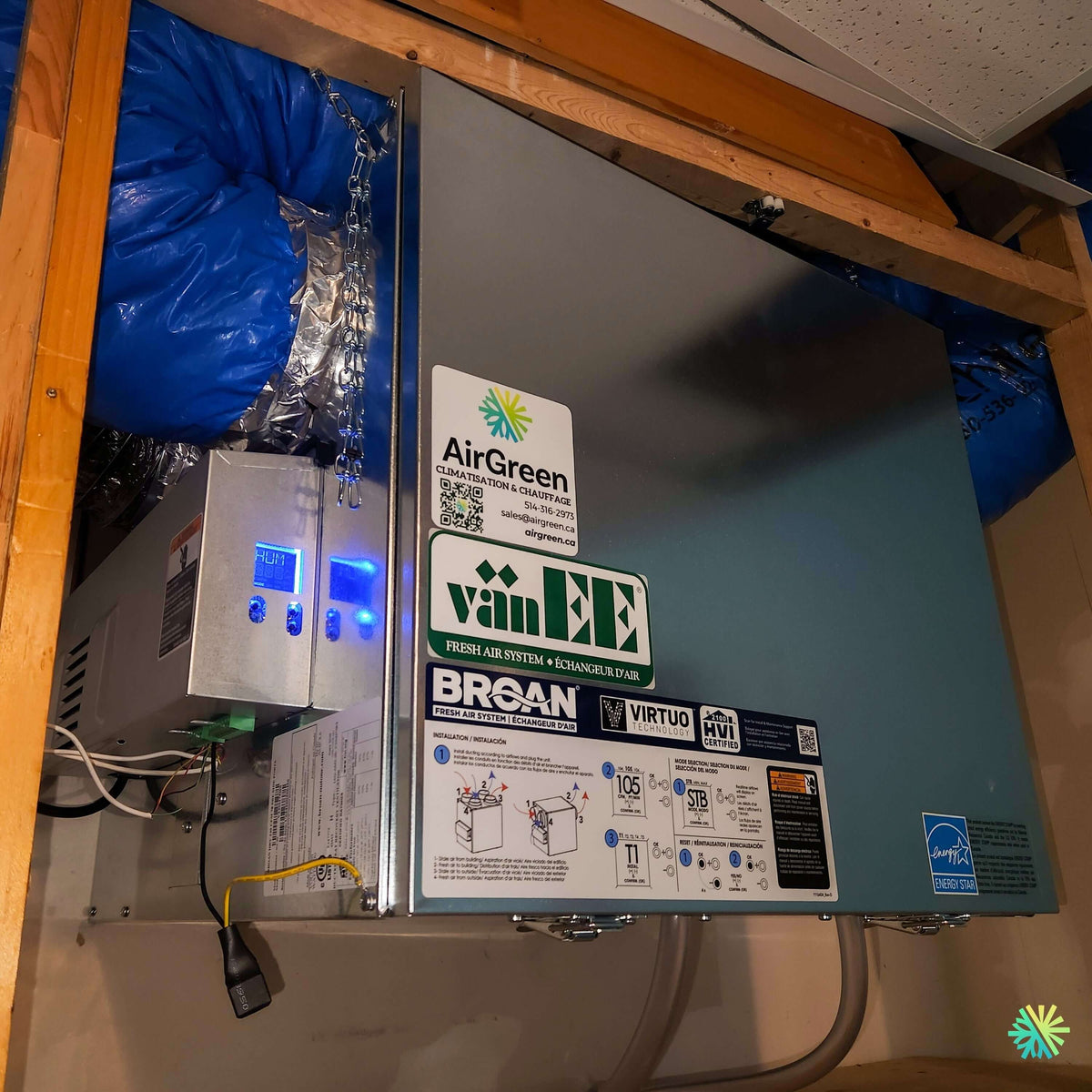
Installation of a Broan-NuTone HRV160 ECM air exchanger (HRV160TE model, HE series) in Saint-Urbain-Premier, Montérégie
Twenty years without maintenance, an opaque filter, and airflow that had fallen below one-third of the rated capacity: here’s how we replaced an air exchanger with a Broan-NuTone HRV160 ECM in Saint-Urbain-Premier. MERV 9, ECM motors, airflow calculation explained, and Rénoclimat rebate.
Generic illustration of this type of installation, not a survey of this job site. Tap a number.
It removes stale air and brings in fresh air. The two airflows cross in the core without mixing.
It recovers part of the heat from the outgoing air to temper the incoming air. Depending on the model, it also manages humidity.
An outdoor hood, kept away from the exhaust so the house does not pull back the air it just removed.
Humid, stale air leaves through its own hood, fitted with a damper.
The ducts that connect to the outside are insulated to prevent condensation inside the house.
Stale air is drawn from humid rooms and fresh air is sent to living areas. The airflows are balanced.
It sets the mode and speed. You use it more when the house is humid or full of people.
Depending on the model and the season, the core produces condensation, removed through a drain with its loop.
Twenty years without maintenance, a filter you could no longer see, and a house surrounded by fields
Saint-Urbain-Premier is an agricultural municipality in Beauharnois-Salaberry, halfway between Sainte-Martine and Howick. Field crops, machinery, threshing dust in August, and spreading operations in the spring. Most homes there are single-family residences built along rural roads, surrounded by fields on three sides.
This is a context that completely changes the conversation about ventilation. In a neighborhood of Longueuil or Laval, outdoor air is generally cleaner than indoor air, and an air exchanger improves the situation through simple dilution. Near a cultivated field, outdoor air carries a particle load for several weeks each year, making filtration just as important as air renewal.
The call: “it’s noisy and no longer serves any purpose”
The customer contacted us about the original unit, installed when the house was built about twenty years earlier. Strictly speaking, it was still working: the motors were turning. But it vibrated, whistled at high speed, and the indoor humidity no longer changed when it was turned on.
What our technician found when opening the access door:
- An indoor filter clogged to the point of being opaque, never removed since installation.
- A fouled recovery core throughout its depth, with passages partially obstructed.
- A dry condensate pan, with a trap that had long since lost its seal and traces of backflow.
- Collapsed flexible ducts between the supports, two of them uninsulated along their exterior runs.
- No clear exterior hood: the intake side was partially covered with compacted plant debris.
The measured intake airflow was less than one-third of the unit's rated value. In other words, the household was paying for the electricity to run two motors for negligible air renewal.
A core and a filter could have been replaced. But on a twenty-year-old unit with permanent-split-capacitor motors, no airflow measurement, no motorized damper, and no usable controls, the calculations clearly favored a complete replacement. We explained this with supporting figures rather than simply declaring it.
Calculating the required airflow: the method rather than guesswork
This is the step we refuse to skip, and the one the client can verify independently. Sizing an HRV is based on living area and the number of bedrooms.
The reference table
The ASHRAE 62.2-2010 standard, on which most residential ventilation requirements in North America are based, specifies required continuous airflow rates according to floor area and number of bedrooms:
| Floor area (sq. ft.) | 0–1 bedrooms | 2–3 bedrooms | 4–5 bedrooms | 6–7 bedrooms |
|---|---|---|---|---|
| Less than 1,500 | 30 | 45 | 60 | 75 |
| 1 501 – 3 000 | 45 | 60 | 75 | 90 |
| 3 001 – 4 500 | 60 | 75 | 90 | 105 |
| 4 501 – 6 000 | 75 | 90 | 105 | 120 |
Airflows expressed in CFM.
The formula, more precise than the table
A calculation-based approach gives a more precise result:
Airflow (CFM) = 0.01 × floor area (sq. ft.) + 7.5 × (number of bedrooms + 1)
For the Saint-Urbain-Premier home—approximately 2,200 sq. ft. of living space, four bedrooms:
- 0.01 × 2,200 = 22
- 7.5 × (4 + 1) = 37,5
- Total: 59.5 CFM in continuous ventilation
The table would have given 75 CFM for this category. We systematically retain the higher value from the two methods, then choose a unit whose operating range places this point in the middle of its curve, never at its maximum. A unit that has to run at full capacity to reach its target is noisy, energy-hungry, and has no reserve for days when the network becomes clogged.
The selected unit: Broan-NuTone HRV160 ECM
| Feature | Broan-NuTone HRV160 ECM |
|---|---|
| Model number | HRV160TE |
| Series | HE (high efficiency) |
| Minimum/maximum continuous airflow (at 0.2 in. w.g.) | 40 to 176 CFM |
| Minimum/maximum continuous airflow (at 0.4 in. w.g.) | 53 to 156 CFM |
| Apparent sensible efficiency at 0 °C | 83 % |
| Sensible recovery efficiency (SRE) at 0 °C | 75 % |
| Sensible recovery efficiency at -25 °C | 64 % |
| Fan efficiency at 0 °C | 2.0 CFM per watt |
| Filtration | MERV 9 |
| Replacement filter number | SV18205 |
| Certifications | ENERGY STAR, HVI certified |
| Duct position | on top |
| Duct diameter | 6 in. |
| Dimensions (H × W × D) | 24 9/16 × 23 9/16 × 14 15/16 in. |
| Weight | 52 lb |
| Core technology | Venmar Core Technology |
The ECM motor: savings you don't see on the purchase invoice
The HRV160 ECM uses electronically commutated motors (ECM). Compared with the permanent-split-capacitor motors used in previous generations, they reduce electricity consumption by approximately 67% on average.
The figure that reflects this efficiency is the fan efficiency, expressed in cubic feet per minute per watt. The HRV160 ECM reaches 2.0 CFM/W, compared with 1.2 to 1.3 for standard-range units. In practical terms, for the same delivered airflow, it uses nearly 40% less electricity—when operating continuously, 8,760 hours a year.
On an appliance that never stops, this difference pays for itself.
MERV 9: the number that matters when you live next to a field
The MERV scale measures a filter's ability to retain particles. The higher the rating, the more fine particles the filter captures.
- MERV 6: basic filtration that retains coarse particles—dust, lint, large pollen particles.
- MERV 9: retains a significant portion of particles measuring 1 to 3 microns—fine pollen, mold spores, dust from worked soil, and threshing residue.
- HEPA: captures 99.97% of particles 0.3 microns and larger, available as an option on higher-end models in the range.
The HRV160 ECM comes standard with a MERV 9 filter, making it a suitable choice for a row house in Saint-Urbain-Premier. We explained to the customer that this level of filtration does not replace an air purifier for someone with severe allergies, but that it substantially reduces the particle load introduced by the system during the weeks of agricultural work.
The filter number—SV18205—was written on the sheet given to the customer. A homeowner who knows their filter reference is a homeowner who buys and replaces it.
Choosing the right connection configuration
This is the most consequential technical choice in a ventilation installation, and the one most often made by default rather than through analysis. Four configurations are available.
1. Fully ducted system
The unit has its own complete duct network: dedicated exhaust points in the bathrooms, kitchen, and laundry room, and dedicated supply outlets in the bedrooms and living areas.
This is the highest-performing configuration, and the only option in a home heated with hot water, radiant floors, or electric baseboards, since there is no existing duct network to use.
2. Simplified system
The unit is connected to the existing network of a forced-air system: stale air is drawn from the return air duct of the furnace or central heat pump, and fresh air is reinjected there to be distributed by the main unit's fan.
It's quick, economical, and sufficient in many cases. The constraint: the main system's fan must run at the same time as the HRV; otherwise, fresh air stagnates in the plenum.
3. Ducted exhaust
Intermediate configuration: the stale-air exhaust points are dedicated—bathrooms, kitchen, laundry room, wherever moisture and odors originate—while fresh-air distribution uses the existing forced-air duct network.
It's the best compromise in a forced-air home where you want to capture pollutants at the source without rebuilding the entire duct network. This is the configuration we selected in Saint-Urbain-Premier.
4. Attic installation
Technically possible, but only when the space temperature is maintained above 10 °C at all times. In an unheated Quebec attic, this condition is not met, and we refuse this type of installation except in a finished, insulated attic above the appliance.
The project, in five points
- Independent wooden cradle. Since the basement has a suspended tile ceiling, we built a 2x4 frame anchored to the structure, with a plywood platform, rather than placing a load on the ceiling.
- Suspended by chain inside the frame. Mechanical decoupling eliminates the transmission of vibrations to adjacent rooms. Leveling was checked in both axes before final tightening.
- Insulated ducts with vapor barriers, stretched taut and sealed with aluminum tape. Since all four connections are on top, the network rises vertically before branching through the ceiling space. Supports spaced no more than 1.2 m apart.
- Accessible condensate trap, formed in a U shape beneath the appliance and mechanically connected, with a continuous slope toward the drain.
- Dedicated grounded outlet with a separate ground. No circuit controlled by a switch.
We also replaced the exterior hoods, paying particular attention to the intake side: a 6-inch anti-gust hood with fine-mesh screening, oriented away from prevailing winds and at a suitable distance from the dryer outlet, with at least 1.8 m between the intake and exhaust.
The wall control: a choice that determines what the appliance can do
The Broan lineup includes several wall controls, and they do not all provide access to the same features. It is a detail that determines the system's quality of life for twenty years.
- Minimum continuous speed: available on all controls in the lineup.
- Maximum continuous speed: available starting with the mid-range models.
- Dehumidistat — automatic activation at high speed above a humidity threshold: available starting with the VT7W.
- Recirculation and smart mode: on the VT8W and VT9W.
- Time scheduling and electronic balancing: on the VT9W.
The HRV160 ECM pairs with the VT8W and VT9W controls. We chose a control with a dehumidistat, the feature that transforms the equipment from a passive device into an active building regulator. An auxiliary VB60W-type control — a 20/40/60-minute override timer — was added in the main bathroom.
40 to 60% humidity: the Quebec distinction you need to know
North American manufacturers’ documents generally recommend maintaining indoor relative humidity between 40% and 60%. This is a reasonable target on an annual basis and across the continent.
It does not apply as is to a Québec winter. At -25 °C, a home maintained at 40% relative humidity will develop condensation on its windows, frames, and the interior of its exterior walls. The threshold must decrease as the outdoor temperature drops:
| Outdoor temperature | Relative humidity setpoint |
|---|---|
| 0 °C and above | 40 % |
| -10 °C | 30 % |
| -20 °C | 25 % |
| -30 °C | 20 % |
The 40% to 60% range becomes relevant again in spring and summer, when the goal shifts from condensation control to comfort and air quality. This is exactly the kind of nuance an installer should explain rather than leave the client to infer from a brochure.
The mistakes this project illustrates
- Never open the unit. Twenty years without changing a filter turns efficient equipment into an unnecessary electricity consumer.
- Choose the default connection configuration, without assessing whether the home has forced-air heating, baseboard heating, or radiant flooring.
- Size by eye, without calculating floor area or counting bedrooms.
- Select a unit whose setpoint is at its maximum, with no airflow reserve.
- Choose the cheapest wall control, only to end up without a dehumidistat or recirculation mode.
- Leave the outdoor ducts uninsulated and allow the flexible ducts to sag between supports.
- Connect the clothes dryer or range hood to the ventilation system. Lint and grease destroy the core. Dedicated exhaust only, without exception.
What this replacement means for other homes in Montérégie
The airflow measured after commissioning reached the calculated setpoint for both intake and exhaust. Four months later, indoor relative humidity remained within the target range, with no window condensation during the January cold snap. The client mainly noticed that the whistling at high speed had disappeared—a noise the family had become so accustomed to that they no longer heard it.
Applicable subsidies
The Québec government’s Rénoclimat program provides financial assistance of approximately $500 for installing or replacing an HRV or ERV, provided that the unit is listed in the Home Ventilating Institute (HVI) directory of certified products. The HRV160 ECM carries this certification, as well as ENERGY STAR certification—which applies when the unit is used in Canada.
The two procedural conditions to meet:
- The initial energy assessment must take place before work begins. A subsequent assessment makes the application ineligible.
- A post-work assessment is required to trigger the payment.
The amounts and criteria are reviewed periodically. We confirm eligibility when preparing the quote rather than announcing a figure that may have changed.
Maintenance: the schedule we provide in writing
- Every 3 months: check and clean or replace the interior MERV 9 filter (SV18205). In agricultural areas, the interval decreases to two months during fieldwork periods.
- Once a year: remove and rinse the recovery core, reprime the trap, and inspect the chain and cradle.
- Twice a year: clean the exterior hoods, removing plant debris, leaves, nests, and ice.
- Twice each winter: adjust the humidistat setting according to the seasonal chart.
Why entrust your installation to AirGreen
We design, install, and maintain heating, ventilation, and air conditioning systems in Greater Montreal with more than fifteen crews on the road. Our service area covers Montreal, Laval, Longueuil, the North Shore, the South Shore, and all of Montérégie, extending to the agricultural municipalities of Beauharnois-Salaberry and Haut-Saint-Laurent: Saint-Urbain-Premier, Sainte-Martine, Howick, Ormstown, Saint-Stanislas-de-Kostka, and Sainte-Barbe.
What we bring to a residential ventilation HVAC installation:
- A measured diagnosis of the existing unit before any replacement recommendation, supported by actual airflow measurements.
- Calculated sizing, using a table and formula—never estimated by eye.
- A well-founded choice of connection configuration, based on the home's heating system.
- An explained choice of wall control, with the features the customer actually needs.
- Documented commissioning, with airflow rates, settings, and filter references provided in writing.
- A team holding an RBQ licence and providing complete support with grant applications.
- HVAC maintenance and repair service in the years that follow.
If your air exchanger dates back to when your home was built, vibrates, whistles, or no longer seems to be changing your indoor air, we can assess it in a single visit. Contact AirGreen: we open the unit, measure the airflow, and tell you honestly whether it needs servicing or replacing.
How it goes, from the first call to the end
The main steps of this kind of job at AirGreen. Every house has its quirks: the estimate brings them out.
We locate the wall for the two outdoor hoods, the unit's spot, service access and the drain.
The unit, its location and the price, in writing.
Hung or set level, with clear access to the filters and the core.
Fresh air intake and exhaust, kept apart and sealed.
The ones connected to the outside are insulated to prevent condensation inside the house.
Connected with its loop, when the unit needs one.
Installed where you will see it and use it.
Incoming and outgoing airflows are adjusted so the house is neither pressurized nor depressurized.
Speeds, filters, core: how to use it through the seasons.
- The on-site estimateWe locate the wall for the two outdoor hoods, the unit's spot, service access and the drain.
- The quoteThe unit, its location and the price, in writing.
- The unitHung or set level, with clear access to the filters and the core.
- The outdoor hoodsFresh air intake and exhaust, kept apart and sealed.
- The ductsThe ones connected to the outside are insulated to prevent condensation inside the house.
- The drainConnected with its loop, when the unit needs one.
- The wall controlInstalled where you will see it and use it.
- BalancingIncoming and outgoing airflows are adjusted so the house is neither pressurized nor depressurized.
- The walkthroughSpeeds, filters, core: how to use it through the seasons.
What to do, season by season
Three habits per season for this unit. They take a few minutes and prevent many calls.
- Clean the filters and core as the manufacturer specifies.
- Check the outdoor hoods: nests, debris, dampers.
- Lower the speed if the outdoor air gets humid.
- Adjust the speed to the humidity in the house.
- Check that the drain flows.
- Keep the outdoor hoods clear.
- Clean the filters before the closed-house season.
- Check the exhaust damper.
- Book a full cleaning if the unit has not had one in a long time.
- Clear snow from both outdoor hoods.
- Raise the speed if condensation appears on windows.
- Let the unit run: with the house closed, humidity builds up.
Which type of equipment for your project?
Pick what looks like your need.
Four mistakes we do not make
Flip each card to see what we do instead.
What people ask us about this kind of work
What does an air exchanger do?
Does fresh air cool the house in winter?
What speed should it run at?
Does an exchanger need cleaning?
What are the signs of poor ventilation?
HRV or ERV: what is the difference?
Should it run in winter?
Does AirGreen hold the required licences?
Is the estimate free?
No question matches. Write to us: we answer.
Useful pages for what comes next
More jobs to see, near you
By town, by equipment or by region: browse more than 4,700 published projects.
Each dot: a town where AirGreen has published projects. The glowing dot: this job.
Tell us about your house. We come and see it for free.
The on-site estimate is free and the quote follows within 24 hours.
Text and photo: a real AirGreen Climatisation & Chauffage job. The diagrams are generic illustrations of the type of installation, not a survey of this job site. Sources of the added figures: airgreen.ca product pages (NEEP / AHRI performance), Hydro-Québec (Heat pumps page, LogisVert, read on 13 October 2026), Régie de l’énergie (rate D as of 1 April 2026).