
Installation of a vänEE V150H75NT air exchanger (AI series, Virtuo technology) in Sainte-Barbe, on the shores of Lake Saint-François (Haut-Saint-Laurent, Montérégie)
A chalet converted into a four-season home, no mechanical room, and 57% humidity: here’s how we installed a vänEE V150H75NT HRV in a closet in Sainte-Barbe. Wall-mounted, 82% SRE, insulated ducts, airflow measured at 109 CFM. Rénoclimat grant.
- City
- Region
- Equipment
- Brand
- Challenges
- Published
The job on one screen
The article, chapter by chapter
A cottage turned into a year-round home, without an inch of mechanical space
Sainte-Barbe stretches along Lake Saint-François, between Saint-Anicet and Salaberry-de-Valleyfield. The lakeside road is lined with homes that began their lives as summer cottages: small, built on piers or slabs, without basements, with walls once insulated just well enough to last from June to September.
Over the past twenty years, many of these residences have been converted into year-round homes. Insulation is added, windows are replaced, crawl spaces are sealed, and a ductless heat pump is installed. The building becomes comfortable and airtight—but retains the flaw it had from the beginning: no space designed for building mechanical systems.
That is exactly the situation we found at this client’s home in Sainte-Barbe. A single-story house facing the lake, renovated in stages, with no basement, a crawl space too low to work in, and a heat pump that heated the air very well—but never replaced it.
What the lake does to a house
Living beside Lake Saint-François has tangible mechanical consequences, and they show up on nearly all of our projects in Sainte-Barbe, Saint-Anicet and Saint-Zotique.
- Outdoor humidity is high for much of the year. Spring and fall morning fog keeps the surrounding air near saturation for hours.
- The land is low-lying and the water table is close. Crawl spaces breathe in moisture from the ground, which then migrates toward the floor.
- The wind comes off the water. On the lakeside facade, exterior hoods and grilles are hit by horizontal rain, powdery snow and, in June, swarms of mayflies that cover anything protruding from a wall.
- The building’s occupancy varies considerably: fully occupied in summer, with two people the rest of the year. The ventilation system must adjust without anyone having to think about it.
The readings taken before the work confirmed the picture: 57% indoor relative humidity in April, condensation on the north-facing window frames, and a musty smell that appeared in the hallway closet—the same one where we would eventually install the unit.
An HRV rather than an ERV, and the reason comes down to water
We recommended a heat recovery ventilator (HRV). An energy recovery ventilator (ERV) transfers some of the outgoing air's moisture to the incoming air. This is a good choice in an upper-level dwelling that is dry in winter, where indoor relative humidity drops below 25%.
Fifty meters from Lake Saint-François, the constraint is the opposite. The house gains moisture from the ground, outdoor air, and its occupants. The unit's role is to remove it, not recover a portion of it. The HRV is the tool suited to this building.
The selected unit: vänEE V150H75NT, AI series
| Feature | vänEE V150H75NT |
|---|---|
| Type | HRV (heat recovery ventilator), AI series |
| Airflow range | 35 to 150 ft³/min |
| Sensible recovery efficiency (SRE) | 82 % — the best performance in the AI series |
| Connections | 5 in, positioned on top |
| Motor | high-efficiency PMSM ECM motors |
| Dampers | integrated motorized dampers |
| Filtration | washable MERV 8 interior filters, upgradeable to MERV 13 or HEPA |
| Certifications | HVI certified, ENERGY STAR |
| Platform | Virtuo Air Technology |
| Mounting | chain suspension or wall mounting |
82% SRE: what the figure really represents
Sensible recovery efficiency measures the share of the outgoing air's heat that the unit transfers back into the incoming air. At 82%, the V150H75NT ranks at the top of the product line.
The calculation is worth spelling out. A home ventilated continuously at about 110 ft³/min replaces nearly 190 m³ of air per hour. Without recovery, heating this air from -15 °C to 21 °C requires considerable power continuously throughout the winter. With 82% recovery, the incoming air already enters at a temperature close to room temperature: the heat pump only needs to provide supplemental heat.
It is the difference between ventilation you keep running and ventilation you unplug in January because it costs too much and blows cold air.
A shared platform: vänEE, Venmar AVS, and Broan
The unit bears three labels: vänEE, Venmar AVS, and Virtuo Air Technology. This is not marketing redundancy. The three brands belong to the same group and share a common chassis, electronics, and control set across the AI series.
For the homeowner, this translates into two real advantages:
- Parts availability. Filters, cores, motors, and circuit boards are interchangeable across a broad family of units, shortening service times.
- Control compatibility. Broan, Venmar, and vänEE wall controls work interchangeably across the platform, simplifying a future replacement.
Installing an air exchanger in a closet: six constraints, six solutions
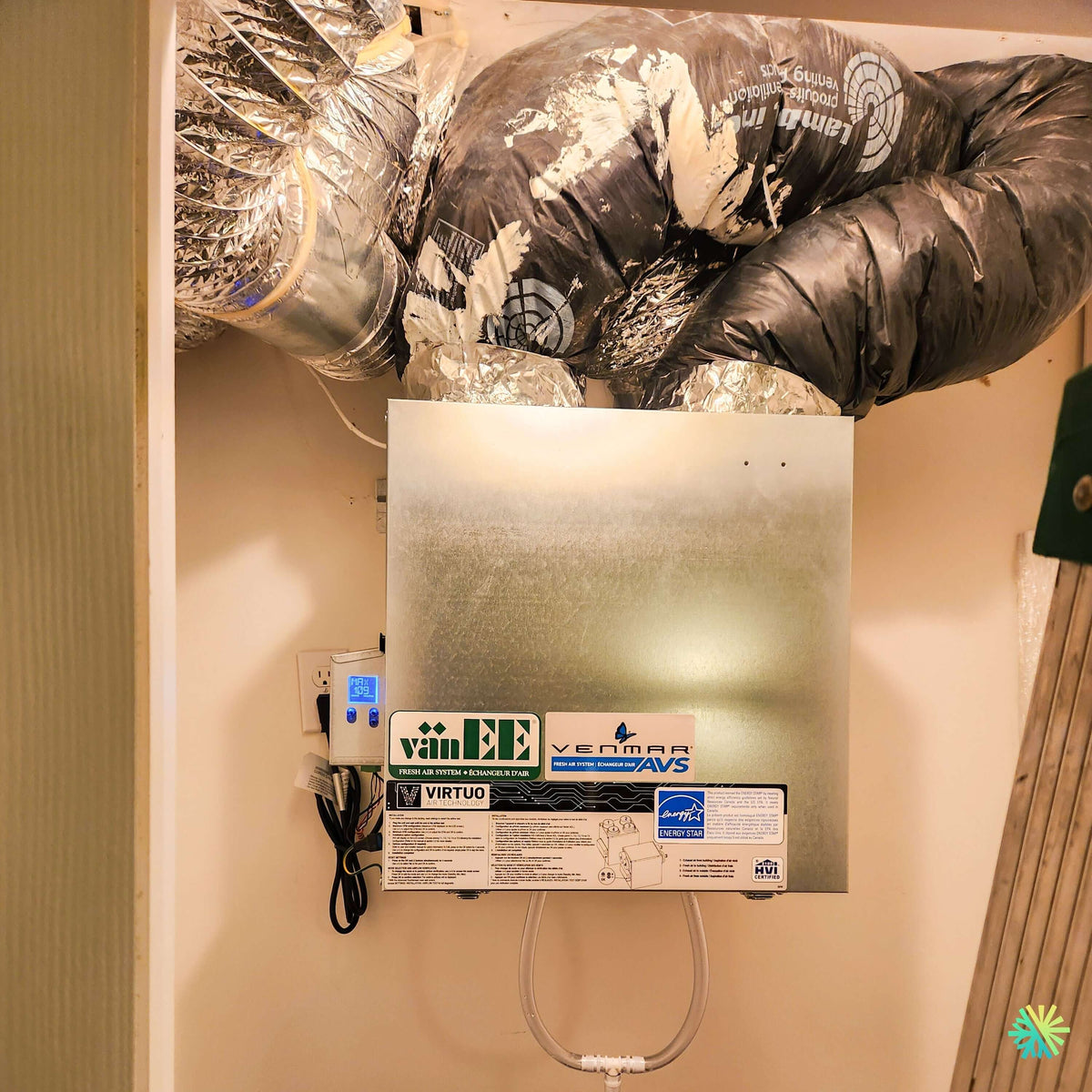
The house offered only one viable location: the hallway utility closet, adjacent to the bathroom, with a partition shared with the primary bedroom. Here is how we addressed each constraint.
1. Wall bracket rather than chain suspension
The closet has no usable overhead clearance, and the ceiling is gypsum board with no accessible joist for suspension. We therefore used the wall bracket from the AI series, secured to two studs located with a detector, using lag screws rather than drywall anchors.
Wall mounting is perfectly acceptable for this product line, provided two rules are followed: the unit must be level, and the fastening must carry the load into the wood, never into drywall alone.
2. Acoustics addressed before the client could hear it
A unit screwed to a partition shared with a bedroom transmits its vibrations directly into the adjacent room. We inserted isolating washers between the bracket and the wall, and chose the side of the closet whose partition does not touch the head of the bed.
Measured result at commissioning: at continuous speed, the unit is inaudible with the door closed and perceptible only within one meter with the door open.
3. Four ducts in a closet ceiling
With all four connections on top, the entire system converges within a space approximately thirty centimeters high. This is the tricky part of this type of installation.
Our method:
- The bend radii are respected. A tight bend in a 5-inch flexible duct causes more pressure loss than ten feet of straight duct.
- All four ducts are insulated with a vapor barrier along their entire length. Near the lake, outdoor air is humid even in summer, and an uninsulated duct will sweat inside a closed ceiling.
- Every connection is sealed with aluminum tape, then mechanically secured to the collar.
- The black ducts and silver ducts are identified and labeled: fresh-air intake, fresh-air distribution, stale-air intake, stale-air exhaust. The next technician will know what to disconnect without guessing.
4. The condensate drain, with no nearby floor drain
This is the most common constraint in homes without basements. The V150H75NT drains its condensate from the bottom, and there was no accessible drain connection in the closet.
We installed a visible U-trap beneath the unit, with a tee fitting, then routed the line to the drain in the adjacent bathroom while maintaining a continuous slope. The trap is filled during commissioning and remains accessible without tools.
Two rules we do not work around:
- Never connect directly without a trap. The unit would draw air through the drain line and lose part of its exhaust airflow.
- Never use a flat horizontal section. Standing water eventually starts to smell and then causes blockages.
When no gravity-drain outlet is accessible, we install a condensate pump with a safety switch—a solution we regularly use in condos in Montreal and Longueuil where the mechanical equipment is embedded in the slab.
5. Dedicated electrical supply
The unit is plugged into a dedicated outlet located in the closet, with separate grounding and a cord kept clear of the duct route. The low-voltage wiring for the wall control exits through the top of the closet toward the hallway.
One point we repeat to every client: this outlet must never be shared with a wall switch or a controlled circuit. An HRV accidentally switched off for three weeks cancels out the entire benefit of the installation.
6. Service clearance
The closet door opens fully, and we left enough clearance in front of the unit to remove the interior filters and heat-recovery core by hand. The client was also instructed not to stack anything in front of the unit—a mechanical closet quickly fills up with coats and boxes.
Commissioning: MAX at 109 cu. ft./min
The airflow calculation is based on the habitable area and number of bedrooms, in accordance with the residential ventilation requirements applicable in Quebec. For this converted single-story home—three bedrooms, approximately 1,300 sq. ft.—the requirement was just over 100 cu. ft./min in continuous ventilation.
The AI series electronics measures the airflow and displays it in real time. After programming and stabilizing the system, the screen displayed MAX 109: 109 cubic feet per minute delivered at high speed, in both supply and exhaust, without a manometer or paper chart.
Three modes were configured with the client:
- Continuous low-speed ventilation, the default mode, which protects the building at all times.
- Timed high speed, activated from the wall control after a shower or cooking.
- Recirculation mode, useful during periods of extreme cold or on days when the outdoor air is laden with pollen.
The measured airflow, date, and settings were recorded in writing and given to the owner. This is the reference that will make it possible to objectively determine in five years whether the system has drifted.
Exterior hoods, the waterside version
On a waterside job site, positioning the hoods requires more attention than elsewhere.
- Minimum separation of 1.8 m between the fresh-air intake and stale-air exhaust to prevent re-entrainment.
- Façade sheltered from the lake's prevailing winds, never fully exposed to the west.
- Sufficient clearance above ground level to remain unobstructed during snow accumulation and spring flooding.
- Fine-mesh screen and inspection in June. Mayflies from Lake Saint-François clog an intake grille within a few days. A blocked grille sharply reduces the fresh-air flow and throws the unit out of balance, even on a self-regulating model.
- Keeping the dryer exhaust and range hood discharge outlets far enough apart, since their air must never be reintroduced.
The mistakes we correct most often
- The unit installed in an unheated crawl space. The condensate freezes, the line becomes blocked, and the motor eventually fails.
- The wall-mounted unit installed in drywall alone, without locating the studs.
- Uninsulated exterior ducts in a closed ceiling, with condensation remaining invisible until the ceiling stain appears.
- The dryer or range hood connected to the air exchanger's ductwork. Lint and grease destroy the core. These appliances require dedicated venting.
- The drain trap is missing or dried out.
- No written record of commissioning, leaving no reference for assessing the system's condition later.
- The mechanical closet converted into storage space, until no one can open the unit anymore.
What Sainte-Barbe adds to our method throughout Greater Montreal
Four months after commissioning, indoor relative humidity ranged between 36% and 42% depending on the season, compared with 57% before the work. Condensation on the window frames stopped. The odor in the hallway closet disappeared within the first few days.
The client noticed an unexpected side effect: their wall-mounted heat pump runs more quietly in the summer. Air with less moisture is dehumidified more quickly, and the unit reaches its setpoint without working as hard.
Applicable grants in Quebec
The Rénoclimat program provides financial assistance of around $500 for installing or replacing an HRV or ERV, provided that the unit is listed in the Home Ventilating Institute (HVI) directory of certified products. HVI certification is affixed directly to the casing of the V150H75NT.
Two procedural points that determine eligibility:
- The initial energy assessment must be completed before the work. An assessment carried out after installation makes the application ineligible, without exception.
- A post-work assessment is required to trigger the payment.
The amounts and criteria are adjusted periodically by the government. We verify eligibility when preparing the quote rather than announcing a figure that may have changed by the time the work is carried out.
Maintenance in four steps
- Every 3 months: wash the MERV 8 indoor filters in warm soapy water, dry them completely, and reinstall them. Then check the displayed airflow: if it has returned to the setpoint, the ductwork is clear.
- Once a year: rinse the recovery core, reprime the trap, and inspect the wall mounting.
- Twice a year, including once in June: clean the outdoor hoods. By the lake, this early-summer inspection is not optional.
- Continuously: leave the unit running. A turned-off air exchanger protects neither occupants' health nor the building's structure.
Why entrust your installation to AirGreen
We design, install, and maintain heating, ventilation, and air conditioning systems throughout Greater Montreal, with more than fifteen teams on the road. Our service area includes Montreal, Laval, Longueuil, the North Shore, the South Shore, and all of Montérégie, extending to the waterfront municipalities of the Upper Saint Lawrence: Sainte-Barbe, Saint-Anicet, Saint-Zotique, Ormstown, Howick, and Franklin.
What we bring to a residential ventilation HVAC installation:
- A measured assessment before any recommendation: humidity, existing airflow rates, and the condition of the ductwork.
- Sizing compliant with Quebec's residential ventilation requirements.
- Installation solutions suited to buildings without a mechanical room: wall brackets, custom platforms, and condensate pumps.
- A documented commissioning, with the actual airflow rates provided to the client in writing.
- A team holding an RBQ licence, along with complete assistance for subsidy applications.
- Maintenance and repair services for your HVAC system in the years that follow, for the equipment we install as well as equipment we inherit.
If your waterfront home has a musty smell, if your windows run with condensation at the first cold snap, or if you converted a cottage into a permanent residence without revisiting its ventilation, these warning signs can be measured during one visit. Contact AirGreen: we take the readings, explain what your building needs, and provide you with a clear plan.
How the job unfolds
The main steps of this kind of job at AirGreen. Every house has its quirks: the estimate brings them out.
We locate the wall for the two outdoor hoods, the unit's spot, service access and the drain.
The unit, its location and the price, in writing.
Hung or set level, with clear access to the filters and the core.
Fresh air intake and exhaust, kept apart and sealed.
The ones connected to the outside are insulated to prevent condensation inside the house.
Connected with its loop, when the unit needs one.
Installed where you will see it and use it.
Incoming and outgoing airflows are adjusted so the house is neither pressurized nor depressurized.
Speeds, filters, core: how to use it through the seasons.
- The on-site estimateWe locate the wall for the two outdoor hoods, the unit's spot, service access and the drain.
- The quoteThe unit, its location and the price, in writing.
- The unitHung or set level, with clear access to the filters and the core.
- The outdoor hoodsFresh air intake and exhaust, kept apart and sealed.
- The ductsThe ones connected to the outside are insulated to prevent condensation inside the house.
- The drainConnected with its loop, when the unit needs one.
- The wall controlInstalled where you will see it and use it.
- BalancingIncoming and outgoing airflows are adjusted so the house is neither pressurized nor depressurized.
- The walkthroughSpeeds, filters, core: how to use it through the seasons.
What we check on a job like this one
Each number is a point we check on site. Switch between summer and winter to watch air and heat move.
Generic illustration of this type of installation, not a survey of this job site. Tap a number.
It removes stale air and brings in fresh air. The two airflows cross in the core without mixing.
It recovers part of the heat from the outgoing air to temper the incoming air. Depending on the model, it also manages humidity.
An outdoor hood, kept away from the exhaust so the house does not pull back the air it just removed.
Humid, stale air leaves through its own hood, fitted with a damper.
The ducts that connect to the outside are insulated to prevent condensation inside the house.
Stale air is drawn from humid rooms and fresh air is sent to living areas. The airflows are balanced.
It sets the mode and speed. You use it more when the house is humid or full of people.
Depending on the model and the season, the core produces condensation, removed through a drain with its loop.
Is your home ready?
Check what applies at your place. A "no" is not a refusal: it is what we sort out during the estimate.
Good habits, once the unit is in place
Six simple habits that keep the unit going. Your list stays on this device.
What to do, season by season
Three habits per season for this unit. They take a few minutes and prevent many calls.
- Clean the filters and core as the manufacturer specifies.
- Check the outdoor hoods: nests, debris, dampers.
- Lower the speed if the outdoor air gets humid.
- Adjust the speed to the humidity in the house.
- Check that the drain flows.
- Keep the outdoor hoods clear.
- Clean the filters before the closed-house season.
- Check the exhaust damper.
- Book a full cleaning if the unit has not had one in a long time.
- Clear snow from both outdoor hoods.
- Raise the speed if condensation appears on windows.
- Let the unit run: with the house closed, humidity builds up.
The right pages, at the right time
Four statements: true or false?
It all comes down to details you have just seen.
1. In an air exchanger, fresh air and stale air mix.
The two airflows cross in the core without mixing.
2. The two outdoor hoods must be kept apart.
Otherwise the exchanger pulls back the air it just removed.
3. An air exchanger can help with condensation on windows.
It renews the air and helps keep humidity in the right range.
4. An exchanger never needs maintenance.
Filters and core get dirty and need regular cleaning.
0 / 4 right answers
What people ask us about this kind of work
What does an air exchanger do?
Does fresh air cool the house in winter?
What speed should it run at?
Does an exchanger need cleaning?
What are the signs of poor ventilation?
HRV or ERV: what is the difference?
Should it run in winter?
Does AirGreen hold the required licences?
Is the estimate free?
No question matches. Write to us: we answer.
More jobs to see, near you
By town, by equipment or by region: browse more than 4,700 published projects.
Each dot: a town where AirGreen has published projects. The glowing dot: this job.
An on-site estimate, the right capacity, the right equipment.
The on-site estimate is free and the quote follows within 24 hours.
Text and photo: a real AirGreen Climatisation & Chauffage job. The diagrams are generic illustrations of the type of installation, not a survey of this job site. Sources of the added figures: airgreen.ca product pages (NEEP / AHRI performance), Hydro-Québec (Heat pumps page, LogisVert, read on 13 October 2026), Régie de l’énergie (rate D as of 1 April 2026).