
Installation of a New Air Exchanger in Pierrefonds-Roxboro, Montreal
Discover how the Fantech ATMO air exchanger transformed a Montreal home, offering quiet, efficient air quality improvements and noticeable cost savings!
- City
- Region
- Equipment
- Brand
- Challenges
- Published
The job on one screen
The article, chapter by chapter
Breathe Easy with AirGreen's Latest Upgrade
At AirGreen, we're committed to enhancing your indoor air quality and ensuring your home is a haven of comfort. Our recent installation in the picturesque Pierrefonds-Roxboro area of Montreal showcases our dedication to providing top-tier HVAC solutions tailored to our customers' unique needs.
Project Overview
Client Need:
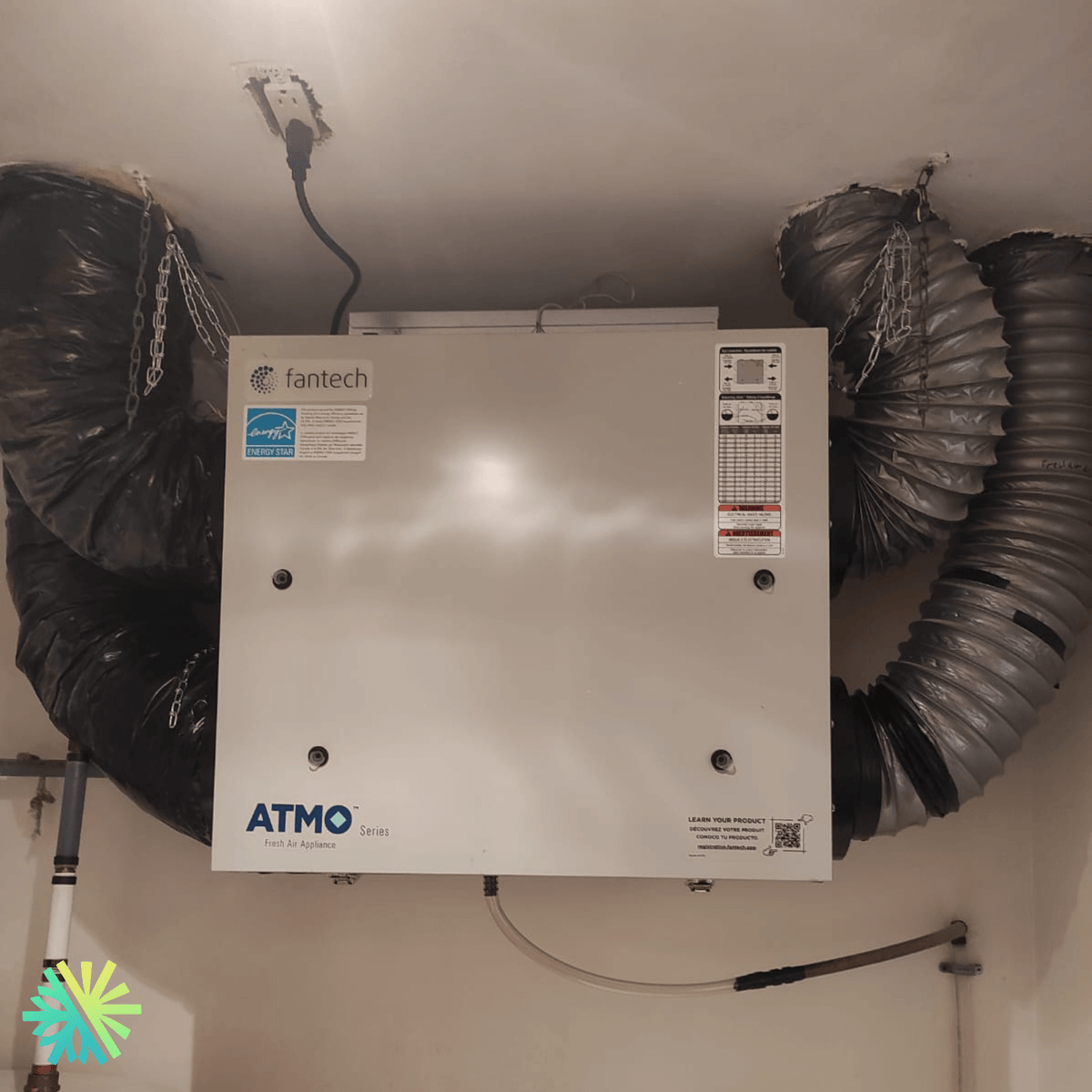
An 18-year-old air exchanger, a staple in our client's home, reached the end of its useful life, necessitating a replacement. The client was initially torn between repairing the aged system or opting for a new installation. The challenge was finding parts for the older model, which were nearly impossible to source.
Our Solution:
After a detailed assessment, it was clear that a new installation was the most prudent choice. We recommended the Fantech ATMO air exchanger—an impressive model known for its efficiency and affordability. This device promised to integrate seamlessly with the existing setup, which was still in excellent condition, sparing our client from unnecessary modifications.
Why Fantech ATMO?
State-of-the-Art Features:
- High Efficiency: The Fantech ATMO operates at peak efficiency, ensuring fresh air without hefty energy bills.
- Quiet Operation: Engineered for tranquility, it maintains a peaceful home atmosphere.
- Durability: Designed to withstand the rigors of daily use, ensuring longevity and reliability.
Customer-centric Installation:
Thanks to the simplicity of the installation process and the compatibility with the existing ductwork, we were able to offer our client a significant discount. This approach not only saved time and resources but also highlighted our commitment to providing value-driven services.
Customer Testimonial
"Our experience with AirGreen was nothing short of exceptional. From the initial consultation to the final setup, the team was professional, knowledgeable, and attentive to our needs. Opting for the Fantech ATMO air exchanger was undoubtedly the best decision for our home. The difference in air quality was noticeable immediately, and the quiet operation of the new system is remarkable. Plus, the cost savings from the easy installation and the efficient operation of the unit have been an added bonus."
Why Choose AirGreen?
Local Expertise:
As a Montreal-based company, we have a deep understanding of the local climate and its unique demands. Whether you're in Laval, Longueuil, or the North Shore, our team is ready to deliver tailored solutions that respect the local architecture and environmental conditions.
Tailored Solutions:
Every home is unique, and so are your needs. We don't just sell products; we offer customized solutions that enhance comfort and efficiency.
Commitment to Excellence:
Our installation projects are more than just transactions. They are part of our commitment to building lasting relationships with our clients, ensuring they enjoy the comfort and quality of their HVAC systems for years to come.
How the job unfolds
The main steps of this kind of job at AirGreen. Every house has its quirks: the estimate brings them out.
We locate the wall for the two outdoor hoods, the unit's spot, service access and the drain.
The unit, its location and the price, in writing.
Hung or set level, with clear access to the filters and the core.
Fresh air intake and exhaust, kept apart and sealed.
The ones connected to the outside are insulated to prevent condensation inside the house.
Connected with its loop, when the unit needs one.
Installed where you will see it and use it.
Incoming and outgoing airflows are adjusted so the house is neither pressurized nor depressurized.
Speeds, filters, core: how to use it through the seasons.
- The on-site estimateWe locate the wall for the two outdoor hoods, the unit's spot, service access and the drain.
- The quoteThe unit, its location and the price, in writing.
- The unitHung or set level, with clear access to the filters and the core.
- The outdoor hoodsFresh air intake and exhaust, kept apart and sealed.
- The ductsThe ones connected to the outside are insulated to prevent condensation inside the house.
- The drainConnected with its loop, when the unit needs one.
- The wall controlInstalled where you will see it and use it.
- BalancingIncoming and outgoing airflows are adjusted so the house is neither pressurized nor depressurized.
- The walkthroughSpeeds, filters, core: how to use it through the seasons.
What we check on a job like this one
Each number is a point we check on site. Switch between summer and winter to watch air and heat move.
Generic illustration of this type of installation, not a survey of this job site. Tap a number.
It removes stale air and brings in fresh air. The two airflows cross in the core without mixing.
It recovers part of the heat from the outgoing air to temper the incoming air. Depending on the model, it also manages humidity.
An outdoor hood, kept away from the exhaust so the house does not pull back the air it just removed.
Humid, stale air leaves through its own hood, fitted with a damper.
The ducts that connect to the outside are insulated to prevent condensation inside the house.
Stale air is drawn from humid rooms and fresh air is sent to living areas. The airflows are balanced.
It sets the mode and speed. You use it more when the house is humid or full of people.
Depending on the model and the season, the core produces condensation, removed through a drain with its loop.
Is your home ready?
Check what applies at your place. A "no" is not a refusal: it is what we sort out during the estimate.
Good habits, once the unit is in place
Six simple habits that keep the unit going. Your list stays on this device.
What to do, season by season
Three habits per season for this unit. They take a few minutes and prevent many calls.
- Clean the filters and core as the manufacturer specifies.
- Check the outdoor hoods: nests, debris, dampers.
- Lower the speed if the outdoor air gets humid.
- Adjust the speed to the humidity in the house.
- Check that the drain flows.
- Keep the outdoor hoods clear.
- Clean the filters before the closed-house season.
- Check the exhaust damper.
- Book a full cleaning if the unit has not had one in a long time.
- Clear snow from both outdoor hoods.
- Raise the speed if condensation appears on windows.
- Let the unit run: with the house closed, humidity builds up.
The right pages, at the right time
Four statements: true or false?
It all comes down to details you have just seen.
1. In an air exchanger, fresh air and stale air mix.
The two airflows cross in the core without mixing.
2. The two outdoor hoods must be kept apart.
Otherwise the exchanger pulls back the air it just removed.
3. An air exchanger can help with condensation on windows.
It renews the air and helps keep humidity in the right range.
4. An exchanger never needs maintenance.
Filters and core get dirty and need regular cleaning.
0 / 4 right answers
What people ask us about this kind of work
What does an air exchanger do?
Does fresh air cool the house in winter?
What speed should it run at?
Does an exchanger need cleaning?
What are the signs of poor ventilation?
HRV or ERV: what is the difference?
Should it run in winter?
Does AirGreen hold the required licences?
Is the estimate free?
No question matches. Write to us: we answer.
More jobs to see, near you
By town, by equipment or by region: browse more than 4,700 published projects.
Each dot: a town where AirGreen has published projects. The glowing dot: this job.
An on-site estimate, the right capacity, the right equipment.
The on-site estimate is free and the quote follows within 24 hours.
Text and photo: a real AirGreen Climatisation & Chauffage job. The diagrams are generic illustrations of the type of installation, not a survey of this job site. Sources of the added figures: airgreen.ca product pages (NEEP / AHRI performance), Hydro-Québec (Heat pumps page, LogisVert, read on 13 October 2026), Régie de l’énergie (rate D as of 1 April 2026).