
Installation of a 3-ton GREE FLEXX R32 central heat pump in La Présentation, MRC des Maskoutains
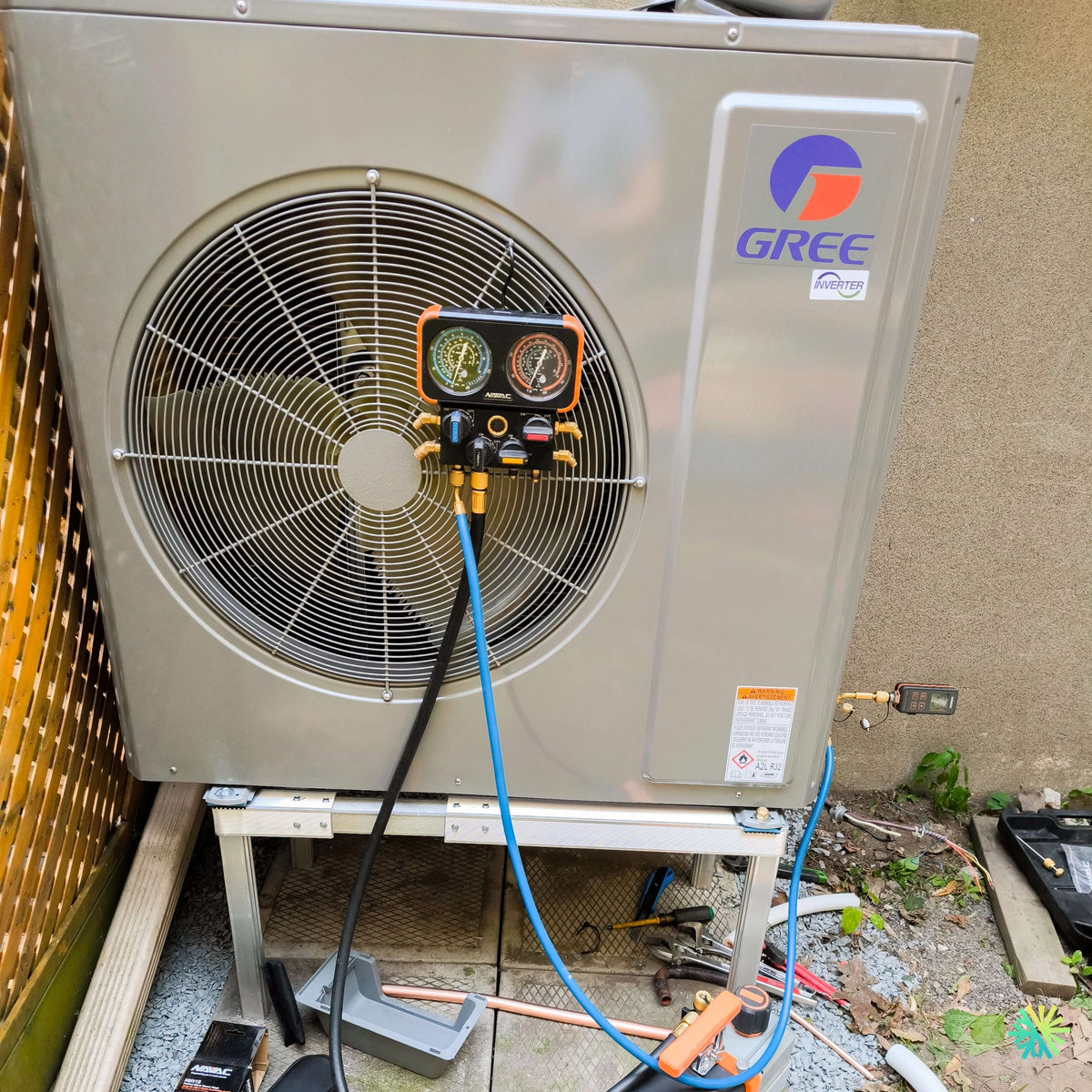
In this photo, the GREE FLEXX R32 central heat pump has been installed but is not yet operational. Nitrogen brazing, pressure testing, evacuation to below 500 microns, vacuum rise test, and weighed refrigerant charge: the unseen hours that determine a system’s service life.
- City
- Region
- Equipment
- Brand
- Challenges
- Published
The job on one screen
The article, chapter by chapter
What this photo really shows: a central heat pump installed, but not yet in service
In the image, the unit has been in place for two hours. It is level, bolted to its base, electrically connected, and will not operate for several more hours. A manifold gauge set is hanging from the fan grille, a digital vacuum gauge is screwed onto the service port, a nitrogen cylinder and torch are waiting on the floor, and the copper tubing has not even been insulated yet.
This is precisely the part of the work that separates a central heat pump that will last fifteen years from one that will begin losing capacity in its third winter. It is not visible in any final project photo, it does not appear on any itemized quote, and it accounts for a considerable portion of the day.
We installed a three-ton GREE FLEXX R32 system in La Présentation, in the Maskoutains RCM in Montérégie: GUD36W2/NhE-D(U) outdoor unit and GUD36AH2/G-D(U) indoor unit. Here is the commissioning process, step by step.
La Présentation: an agricultural village at the gates of Saint-Hyacinthe
La Présentation borders the Salvail River, northeast of Saint-Hyacinthe, at the heart of one of Quebec's most active agricultural areas. Two local realities influence our technical decisions:
- Homes are often isolated or located in small village clusters, with real travel times for a service call. A system that requires three corrective visits is costly for everyone. Doing things right the first time is not a matter of appearances; it is an economic necessity.
- Seasonal agricultural dust is carried by the air. The outdoor coil of a heat pump installed in a rural area becomes dirty faster than that of a unit in Longueuil or Laval, which changes the recommended HVAC maintenance schedule.
The installed pairing
| Data | Value |
|---|---|
| Rated cooling capacity | 34,000 BTU/h |
| Rated heating capacity | 34,000 BTU/h |
| Modulation range | 18,000–37,000 BTU/h |
| SEER2 | 18 |
| HSPF2 | 10 |
| EER2 | 12 |
| COP | 3,2 |
| AHRI number | 217120760 |
| Refrigerant | R32, 2.9 lb (102.3 oz) |
| Outdoor unit | 990 × 960 × 370 mm, 187.5 lb, 61 dB(A) |
| Electrical (outdoor) | MCA 27.7 A / MOCP 30 A |
| Factory charge / maximum length | 24.6 ft (7.5 m) / 98.4 ft (30 m) |
The hours we never bill enough for
Step 1: brazing under nitrogen
Copper heated with a torch in the presence of air produces copper oxide inside the tube. This oxide later flakes off and circulates through the system. Destination: the electronic expansion valve, the strainers, and the compressor.
The solution is simple and visible in the photo through the presence of the cylinder: a slight flow of dry nitrogen circulates through the piping throughout the brazing process. The flow must be low—enough to displace the oxygen, but not enough to cool the joint or blow away the brazing alloy.
What we regularly find when correcting previous installation work: systems brazed in open air, with blackened tube interiors. The damage is invisible and irreversible.
Step 2: nitrogen pressure testing
Once the joints are complete, the piping is pressurized with nitrogen to the value specified in the manual and left under observation.
The detail that distinguishes a serious test from a symbolic one: the ambient temperature must be recorded at the same time as the pressure. A difference of a few degrees between the beginning and end of the test can shift the pressure by several psi, which may lead you to conclude that a nonexistent leak is present—or conceal a real leak. We record the starting pressure, the starting temperature, and the same values at the end.
A nitrogen pressure test is performed before evacuation, never afterward. Searching for a leak with refrigerant in the system is both ineffective and contrary to good environmental practices.
Step 3: evacuation, and why analog gauges are not enough
The two manifold gauges visible in the photo are essential for reading operating pressures. They are incapable of measuring a vacuum accurately. Their lowest graduations stop at values that, when converted, represent thousands of microns. A system that appears to be “pegged in the red” on an analog gauge may contain enough moisture to form acids in the compressor oil.
This is the role of the small digital vacuum gauge screwed onto the side of the unit, on the right in the photo. It reads in microns, and it is the only measurement that matters.
Our rules for this step:
- Remove the Schrader cores with pressurized extraction tools. A core left in place restricts evacuation and can triple the evacuation time.
- Use large-diameter hoses that are as short as possible. Pressure loss in a standard charging hose is the most common bottleneck.
- Evacuate both sides of the circuit, liquid and gas.
- Place the vacuum gauge far from the pump, ideally at the opposite end of the system. A gauge installed at the manifold measures the pump's performance, not the system's condition.
- Pull below 500 microns, then continue for a while.
Step 4: The rise test
This is the decisive step, and also the one most often skipped for lack of time.
The pump is isolated from the system with a valve—not simply turned off—and the gauge is observed. Three possible behaviors, each telling a different story:
- The value remains stable below 500 microns. The system is dry and leak-tight. The valves can be opened.
- The value rises, then stabilizes around a higher value. Moisture remains and continues to evaporate. Continue evacuation, possibly with a dry nitrogen break to help remove the residual water.
- The value rises and never stops rising. There is a leak. Repeat the pressure test.
This reading is the true signature of a job well done. It takes time, impresses no one, and determines the compressor's service life.
Step 5: Opening the valves and weighing the charge
The three-ton FLEXX contains 2.9 lb (102.3 oz) of R32 as a factory charge, intended for 24.6 ft (7.5 m) of piping. Beyond that, add 0.32 oz per foot (30 g/m) for this configuration—a value that is not the same as on the four- and five-ton models, which regularly catches people out.
The addition is done using an electronic scale, not by estimation. The added amount is recorded on the commissioning sheet and on a label affixed to the unit. The next technician to work on this system will know exactly how much refrigerant it contains—information that would otherwise be lost forever.
Why R32 makes this rigor non-negotiable
The orange label visible on the casing bears the wording A2L R32. The R32 is a mildly flammable refrigerant, with a global warming potential significantly lower than that of R-410A. It imposes specific requirements:
- No recovery or transfer with equipment not intended for A2L. Recovery pumps, hoses, detectors: the equipment must be rated for this refrigerant.
- No drilling into pressurized piping, as explicitly stated by the warning affixed to the unit.
- Service by qualified personnel only. This is not administrative wording: recovery and charging procedures differ from those for R-410A.
- An A2L leak-detection sensor, included and factory-installed on the indoor unit, which must remain powered at all times.
Residual moisture and brazing residue have the same consequences in an R32 system as in an R-410A system. The difference is that the entire handling protocol is more strictly controlled, and a shortcut taken along the way becomes a shortcut documented by the label affixed to the unit.
The support, slabs, and fence
The unit rests on an aluminum base set on concrete slabs, in a side area bordered by a wooden lattice fence. Three checks were carried out before placing the unit:
- The stability of the slabs. A slab that rocks under 187 lb puts the piping under tension and eventually fatigues the fittings.
- Clearance from the lattice. A lattice allows air to pass through, which is a real advantage over a solid fence, but it does not eliminate the need to respect the minimum distance specified in the manual. A panel added later to “hide the unit” cancels out this benefit.
- The level, checked again after installation. Oil return to the compressor and drainage from the base pan depend on it.
What we record at the end of commissioning
Before leaving a job site, we record a series of values that become the reference for any future service:
- suction and discharge pressure and temperature;
- calculated superheat and subcooling;
- delta T return air / supply air;
- external static pressure of the ductwork;
- compressor and fan amperage, compared with the 27.7 A MCA;
- total charge, factory charge plus weighed-in addition;
- final reading of the rise test.
A client who has these figures can know, five years from now, whether their system has drifted. A client who does not have them will have to pay for a complete diagnosis to answer the same question.
What this La Présentation project reminds us
Mistakes to avoid
- Brazing without nitrogen. The damage is internal, invisible, and cannot be corrected.
- Judging a vacuum with an analog gauge. These dials do not measure microns.
- Leaving the Schrader cores in place during evacuation. The time lost encourages shortening the step.
- Placing the vacuum gauge on the manifold, next to the pump. This measures the pump, not the system.
- Stopping the pump without isolating the system for the rise test. Pump oil can migrate back into the circuit.
- Charging by estimation rather than by weight. On a variable-speed system, an approximate charge reduces efficiency without triggering an error code.
- Documenting nothing. Information lost during commissioning can never be recovered.
Rebates and eligibility
The installed combination is ENERGY STAR-certified and bears AHRI number 217120760. This number, specific to the exact combination of the indoor and outdoor units, is what government programs and local rebates verify—not the product line name. Criteria and amounts change from year to year and depend in part on the heating source being replaced, an important variable in agricultural areas where propane and heating oil are still used. We verify eligibility with the client before signing.
Our coverage
We carry out these HVAC installations in Montréal, Laval, Longueuil, the North Shore, the South Shore, and throughout Montérégie, including La Présentation, Saint-Hyacinthe, Saint-Damase, Sainte-Madeleine, and Saint-Barnabé-Sud. Every project includes documented commissioning, provided to the client—not just a simple start-up followed by a handshake.
If you are shopping for a central heat pump, ask every bidder: What vacuum level are you targeting, and will you provide me with the commissioning readings? The answer will tell you more than any brochure.
The job tools
Two quick checks with real numbers: what heat costs, and what your current heaters add up to in BTU/h.
Conversion: 1 W = 3.412 BTU/h. An indication, not a load calculation: baseboards and furnaces are often stronger than the real need, and they can stay as backup. AirGreen confirms the capacity on site.
How the job unfolds
The main steps of this kind of job at AirGreen. Every house has its quirks: the estimate brings them out.
We look at the ducts, the current indoor module, the electrical panel and the planned spot for the outdoor unit.
The equipment combination, capacity and price, in writing. We check whether the combination qualifies for assistance programs.
Access protected, old unit disconnected and removed when it is being replaced.
Electric furnace or air handler, with its coil, connected to the supply and return ducts.
On a level base, raised above the snow, with free space all around.
Insulated, they enter through a sealed opening and run to the indoor coil.
Dedicated circuits, accessible disconnect, a thermostat that works with the heat pump and the backup heat.
Leak test, vacuum, start-up, airflow check and a test of both modes.
Filter, thermostat, backup heat in extreme cold: what to know before winter.
- The on-site estimateWe look at the ducts, the current indoor module, the electrical panel and the planned spot for the outdoor unit.
- The quoteThe equipment combination, capacity and price, in writing. We check whether the combination qualifies for assistance programs.
- Getting readyAccess protected, old unit disconnected and removed when it is being replaced.
- The indoor moduleElectric furnace or air handler, with its coil, connected to the supply and return ducts.
- The outdoor unitOn a level base, raised above the snow, with free space all around.
- The refrigerant linesInsulated, they enter through a sealed opening and run to the indoor coil.
- Electrical and thermostatDedicated circuits, accessible disconnect, a thermostat that works with the heat pump and the backup heat.
- Tests and start-upLeak test, vacuum, start-up, airflow check and a test of both modes.
- The walkthroughFilter, thermostat, backup heat in extreme cold: what to know before winter.
What we check on a job like this one
Each number is a point we check on site. Switch between summer and winter to watch air and heat move.
In summer, the outdoor unit rejects the house's heat outside.
Generic illustration of this type of installation, not a survey of this job site. Tap a number.
It captures or rejects heat outside. It sits on a level base, above the snow, with free space all around.
The insulated refrigerant lines enter the house through a sealed opening and run to the indoor coil.
A shut-off switch near the outdoor unit isolates it safely for service.
Sitting on the indoor module, it moves heat between the house air and the refrigerant.
Electric furnace or air handler: its fan pushes air through the ducts. The electric backup takes over in extreme cold.
Supply ducts bring air to the rooms; returns bring it back to the unit. Their condition matters as much as the unit's.
It protects the coil and the fan. A dirty filter cuts airflow, so it gets checked regularly.
It runs the heat pump and the backup heat. It must be compatible with the installed system.
Is your home ready?
Check what applies at your place. A "no" is not a refusal: it is what we sort out during the estimate.
Good habits, once the unit is in place
Six simple habits that keep the unit going. Your list stays on this device.
What to do, season by season
Three habits per season for this unit. They take a few minutes and prevent many calls.
- Check the indoor module's filter.
- Clear winter debris from the outdoor unit.
- Test cooling before the heat arrives.
- Check the filter more often in peak season.
- Keep registers and returns clear.
- Watch condensate drainage near the coil.
- Change or clean the filter.
- Test heating and backup heat before the cold.
- Book periodic maintenance.
- Clear snow around the outdoor unit.
- Store nothing in front of the indoor module.
- Note any unusual noise or smell and call us.
The right pages, at the right time
Four statements: true or false?
It all comes down to details you have just seen.
1. A central heat pump uses the house's ducts.
It connects to the existing ducts to heat and cool everywhere.
2. In extreme cold, electric backup heat can take over.
The indoor module (furnace or air handler) works with the heat pump and takes over in extreme cold.
3. The filter only gets changed when the unit breaks down.
A dirty filter cuts airflow. It gets checked regularly.
4. You can reuse the old unit's size without checking.
The house may have changed: insulation, windows, added rooms. Capacity is confirmed on site.
0 / 4 right answers
What people ask us about this kind of work
Can I keep my current ducts?
What happens in extreme cold?
Furnace, air handler, ducted: what is the difference?
Are there grants?
Do I need a permit?
How much can I save?
How is the LogisVert assistance calculated?
Will my current thermostat work?
Central or wall units: which one?
Does AirGreen hold the required licences?
Is the estimate free?
No question matches. Write to us: we answer.
More jobs to see, near you
By town, by equipment or by region: browse more than 4,700 published projects.
Each dot: a town where AirGreen has published projects. The glowing dot: this job.
An on-site estimate, the right capacity, the right equipment.
The on-site estimate is free and the quote follows within 24 hours.
Text and photo: a real AirGreen Climatisation & Chauffage job. The diagrams are generic illustrations of the type of installation, not a survey of this job site. Sources of the added figures: airgreen.ca product pages (NEEP / AHRI performance), Hydro-Québec (Heat pumps page, LogisVert, read on 13 October 2026), Régie de l’énergie (rate D as of 1 April 2026).