
Installation of a vänEE HRV 60H air exchanger (model 41600, side ports) in Saint-Chrysostome, in Haut-Saint-Laurent
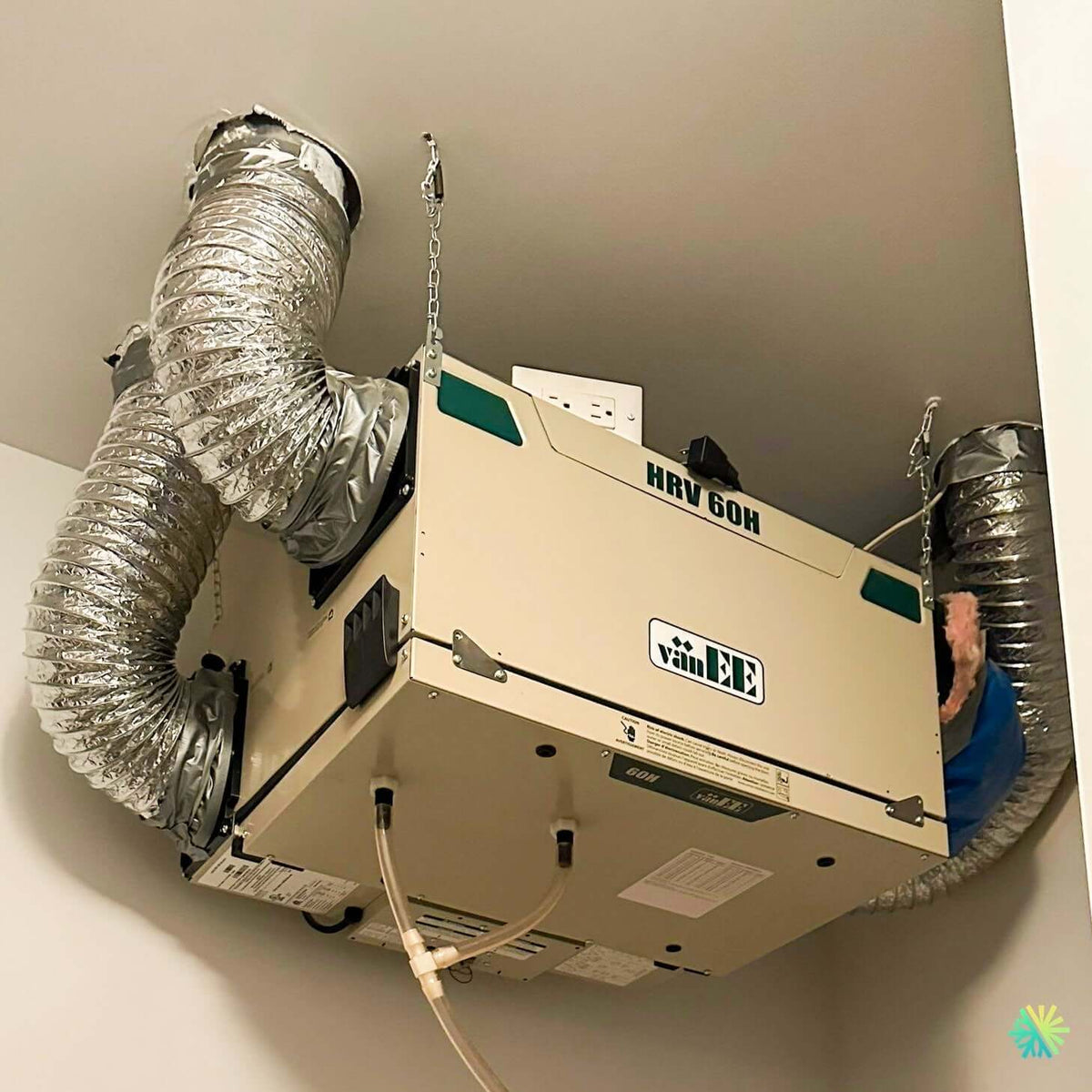
vänEE HRV 60H air exchanger installed in a dropped ceiling in Saint-Chrysostome: 5-inch side ports, suspended by chains and springs, siphoned drainage, and manual balancing with a manometer. The complete details of an AirGreen project.
- City
- Region
- Equipment
- Brand
- Challenges
- Published
The job on one screen
The article, chapter by chapter
Twelve inches of height: the unit that disappears into a dropped ceiling
The mandate in Saint-Chrysostome involved an architectural constraint, not a mechanical one. The homeowners had just finished renovating the basement. Finished ceiling, painted drywall, recessed lighting—and only one place to route a central air exchanger without opening anything back up: the dead space above a storage area, within an existing dropped ceiling with about a foot of clearance.
This available height immediately rules out most HRVs on the market. The vänEE HRV 60H fits because its side-port cabinet measures 12 3/16 in. high, 27 1/16 in. wide, and 19 13/16 in. deep. It is a format designed precisely for this situation: a dropped ceiling, utility closet, or space above a water heater. At AirGreen, we regularly use it in condos in Montreal and finished basements on the South Shore for the same reason.
What the unit actually delivers
The 60H belongs to the Bronze series from vänEE, designed for small- to medium-sized single-family homes and high-rise units where mechanical space is limited. Its nameplate data, taken from the manufacturer's documentation:
| Parameter | Value |
|---|---|
| Part number | 41600 (side ports) — model 41602 (top ports) |
| Airflow | 39 to 98 cfm at 0.4 in. w.g. (100 Pa) |
| Power consumption | 43 W at low speed |
| Apparent sensible efficiency (ASE) at 0 °C | 74 % (low speed) |
| SRE | approximately 59 to 65% at 0 °C and 55 to 60% at −25 °C, depending on the test airflow |
| Ports | oval, accepting 5 in (12.5 cm) round duct |
| Dimensions | 12 3/16 in H × 27 1/16 in W × 19 13/16 in D (31 × 68.8 × 50.3 cm) |
| Weight | 42 lb (19 kg) |
| Defrost | Homeshield system, 8/25 min cycles between −5 and −27 °C; 10/22 min below −27 °C |
| Filters | 30 ppi washable foam |
| Motors | 2, thermal protection, Class B insulation, 120 V / 60 Hz |
| Certifications | ENERGY STAR® (requirements applicable in Canada), HVI certified |
| Warranty | 2 years on parts, limited lifetime on the recovery core |
ASE and SRE: two figures that are often confused
The manufacturer's catalogue states 74% for the 60H. This figure is an apparent sensible efficiency (ASE), not a sensible recovery efficiency (SRE). The difference is not cosmetic.
- ASE measures heat transfer at the core, without subtracting the energy consumed by the fans or losses from the cabinet.
- SRE is the net measurement standardized by HVI. It is the figure used for comparisons between units and for energy-efficiency programs.
A unit rated at 74% ASE operates at around 60 to 65% SRE. Comparing one model's ASE with another's SRE completely distorts the evaluation—and that is exactly what many online product sheets do. We always bring the discussion back to SRE when a client compares two quotes.
Ceiling mounting: suspension by chains and springs
The 60H is suspended using integrated hooks, chains, and springs supplied with the unit. In a finished room, this detail becomes central: the ceiling bulkhead acts as a resonance chamber, and two motors running continuously a few inches from the drywall can be heard throughout the room if the mounting is rigid.
The anchors were screwed into the structure, never into drywall alone, and the chain lengths were adjusted to leave a slight amount of play at the spring. A fully compressed spring no longer isolates anything.
Level was checked before final tightening. On the 60H, condensate produced by the core flows toward the drain connections beneath the cabinet: a unit that tilts a few degrees backward retains water inside instead of draining it.
Drainage, in three parts
Under the unit, two drain connections receive flexible tubes that join through a plastic tee, then slope down toward the drain. The drain connection kit is a vänEE service part identified in the catalogue (ref. 03203), simplifying replacement if the connection cracks over the years.
Two rules govern this setup:
- Prime the traps by pouring water into the tubes before commissioning. An empty trap allows the exhaust fan to draw air through the drain.
- Avoid any low points along the horizontal run. A sag in the flexible tube collects water, slows drainage, and eventually forces it back into the cabinet.
Manual balancing: what the 60H requires and newer units automate
This is where this project differs from installations of newer-generation units. The 60H does not self-calibrate. It is balanced the old-fashioned way, using two tools integrated into the cabinet:
- integrated balancing dampers on the oval ports, manually adjustable;
- pressure taps connected to an inclined or digital manometer.
The procedure, carried out after all ducts have been fully connected and the exterior covers installed:
- Set the unit to high speed and let it stabilize.
- Connect the manometer to the pressure taps on the fresh-air intake circuit, read the pressure, and convert it to cu ft/min using the table in the manual.
- Repeat on the stale-air exhaust circuit.
- Gradually close the register on the stronger circuit until the two airflows match.
- Check at low speed, then record the values obtained on a label affixed near the unit.
Step 5 is the one we never skip. Balancing an HRV without documentation forces the next technician to start over and leaves the owner with no point of comparison during maintenance.
The balancing errors we correct most often
- Balancing with the registers fully open. Without adjustment, the less resistant circuit takes over, leaving the house permanently depressurized or overpressurized.
- Measuring before installing the exterior hoods. A wall hood adds real resistance. Measurements taken without it are worthless.
- Using a measuring tape instead of the manometer. The number of register turns has no value: two circuits of different lengths do not respond in the same way.
- Forgetting to retest after replacing the filter with a more restrictive model. The 60H is designed for 30 ppi washable foam; substituting a commercial pleated filter changes the unit's performance curve and invalidates the balancing.
The ducts and power supply
All four connections use 5-inch insulated flex duct, routed to the oval collars through oval-to-round transitions tightened at the collar and then sealed with aluminum tape.
On this type of duct, finishing the vapor barrier at the collar is the critical step: the insulation must be brought up to the collar and the outer jacket closed over it, then sealed. An open vapor barrier exposes the insulation to ambient air, loads it with moisture, and turns the section into a condensation bridge as soon as the first cold weather arrives.
The unit is connected to a dedicated 120 V outlet installed in the ceiling, in the immediate vicinity. We systematically refuse three connection methods: an extension cord, an outlet controlled by a wall switch, and sharing a circuit with a freezer or an appliance that starts frequently. An HRV must run continuously; any outlet that someone can accidentally switch off will eventually be switched off.
You already own a 60H: what you need to know
Thousands of homes in Quebec are equipped with this unit. Service parts remain listed in the vänEE catalog, which considerably extends its useful life:
- HRV foam filters (ref. 16032) — wash every three months and replace when they begin to crumble.
- Heat-recovery core (ref. 16034 for units manufactured before 2010, ref. 18300 for the blue core used in units manufactured from 2010 onward).
- Motorized damper / port assembly (ref. 16029) — the component responsible for the Homeshield cycle. A seized damper shows up as frost on the core in January.
- Oval ports and balancing dampers (ref. 16041), electronic control board (ref. 16038), transformer, magnetic door switch (ref. 19060).
The decision rule we apply is this: as long as the core, motors, and motorized damper are in good condition, a maintained 60H remains a suitable unit. When two of these three components fail in the same year, the calculation shifts toward replacing it with a model featuring ECM motors and automatic balancing — significantly more energy-efficient during continuous operation.
Financial assistance programs: the key nuance to remember
An air exchanger installed on its own generally does not qualify, in Quebec, as a standalone measure eligible for financial assistance. Provincial energy-efficiency programs assess the building as a whole and direct assistance toward the building envelope — insulation and air sealing — while mechanical ventilation is treated as an indoor-air-quality requirement accompanying this work. Criteria change from year to year, and we verify eligibility on a case-by-case basis when preparing the quote rather than promising an amount.
What this Saint-Chrysostome project teaches homeowners in Haut-Saint-Laurent
The value of an HVAC installation is not found on the unit's technical data sheet. It is found in the ceiling drop where the unit fits without being heard, in the primed trap that did not freeze in February, and in the two numbers written in felt-tip pen on a label affixed to the cabinet.
The vänEE HRV 60H model 41600 was suitable here for one specific reason: 12 inches high, 39 to 98 ft³/min, 43 W at low speed, integrated balancing dampers, and a lifetime-covered core. In a larger home or a new build pursuing energy certification, our recommendation would start with a higher-capacity unit equipped with ECM motors.
At AirGreen, we handle HVAC installation and HVAC maintenance for air exchangers, heat pumps, and wall-mounted air conditioners in Montreal, Laval, Longueuil, on the North Shore, on the South Shore, and in the municipalities of Haut-Saint-Laurent. Every unit we commission leaves with its airflow rates measured, recorded, and explained to the owner.
How the job unfolds
The main steps of this kind of job at AirGreen. Every house has its quirks: the estimate brings them out.
We locate the wall for the two outdoor hoods, the unit's spot, service access and the drain.
The unit, its location and the price, in writing.
Hung or set level, with clear access to the filters and the core.
Fresh air intake and exhaust, kept apart and sealed.
The ones connected to the outside are insulated to prevent condensation inside the house.
Connected with its loop, when the unit needs one.
Installed where you will see it and use it.
Incoming and outgoing airflows are adjusted so the house is neither pressurized nor depressurized.
Speeds, filters, core: how to use it through the seasons.
- The on-site estimateWe locate the wall for the two outdoor hoods, the unit's spot, service access and the drain.
- The quoteThe unit, its location and the price, in writing.
- The unitHung or set level, with clear access to the filters and the core.
- The outdoor hoodsFresh air intake and exhaust, kept apart and sealed.
- The ductsThe ones connected to the outside are insulated to prevent condensation inside the house.
- The drainConnected with its loop, when the unit needs one.
- The wall controlInstalled where you will see it and use it.
- BalancingIncoming and outgoing airflows are adjusted so the house is neither pressurized nor depressurized.
- The walkthroughSpeeds, filters, core: how to use it through the seasons.
What we check on a job like this one
Each number is a point we check on site. Switch between summer and winter to watch air and heat move.
Generic illustration of this type of installation, not a survey of this job site. Tap a number.
It removes stale air and brings in fresh air. The two airflows cross in the core without mixing.
It recovers part of the heat from the outgoing air to temper the incoming air. Depending on the model, it also manages humidity.
An outdoor hood, kept away from the exhaust so the house does not pull back the air it just removed.
Humid, stale air leaves through its own hood, fitted with a damper.
The ducts that connect to the outside are insulated to prevent condensation inside the house.
Stale air is drawn from humid rooms and fresh air is sent to living areas. The airflows are balanced.
It sets the mode and speed. You use it more when the house is humid or full of people.
Depending on the model and the season, the core produces condensation, removed through a drain with its loop.
Is your home ready?
Check what applies at your place. A "no" is not a refusal: it is what we sort out during the estimate.
Good habits, once the unit is in place
Six simple habits that keep the unit going. Your list stays on this device.
What to do, season by season
Three habits per season for this unit. They take a few minutes and prevent many calls.
- Clean the filters and core as the manufacturer specifies.
- Check the outdoor hoods: nests, debris, dampers.
- Lower the speed if the outdoor air gets humid.
- Adjust the speed to the humidity in the house.
- Check that the drain flows.
- Keep the outdoor hoods clear.
- Clean the filters before the closed-house season.
- Check the exhaust damper.
- Book a full cleaning if the unit has not had one in a long time.
- Clear snow from both outdoor hoods.
- Raise the speed if condensation appears on windows.
- Let the unit run: with the house closed, humidity builds up.
The right pages, at the right time
Four statements: true or false?
It all comes down to details you have just seen.
1. In an air exchanger, fresh air and stale air mix.
The two airflows cross in the core without mixing.
2. The two outdoor hoods must be kept apart.
Otherwise the exchanger pulls back the air it just removed.
3. An air exchanger can help with condensation on windows.
It renews the air and helps keep humidity in the right range.
4. An exchanger never needs maintenance.
Filters and core get dirty and need regular cleaning.
0 / 4 right answers
What people ask us about this kind of work
What does an air exchanger do?
Does fresh air cool the house in winter?
What speed should it run at?
Does an exchanger need cleaning?
What are the signs of poor ventilation?
HRV or ERV: what is the difference?
Should it run in winter?
Does AirGreen hold the required licences?
Is the estimate free?
No question matches. Write to us: we answer.
More jobs to see, near you
By town, by equipment or by region: browse more than 4,700 published projects.
Each dot: a town where AirGreen has published projects. The glowing dot: this job.
An on-site estimate, the right capacity, the right equipment.
The on-site estimate is free and the quote follows within 24 hours.
Text and photo: a real AirGreen Climatisation & Chauffage job. The diagrams are generic illustrations of the type of installation, not a survey of this job site. Sources of the added figures: airgreen.ca product pages (NEEP / AHRI performance), Hydro-Québec (Heat pumps page, LogisVert, read on 13 October 2026), Régie de l’énergie (rate D as of 1 April 2026).