
Installation of a 3-ton GREE FLEXX R32 central heat pump in Saint-Robert, Pierre-De Saurel RCM
Replacing a fifteen-year-old central system starts with an assessment, not a purchase order: here’s how we installed a 34,000 BTU GREE FLEXX R32 central heat pump in Saint-Robert, first correcting the existing ductwork.
Take a tour of the installation
Each number is a point we check on site. Switch between summer and winter to watch air and heat move.
In summer, the outdoor unit rejects the house's heat outside.
Generic illustration of this type of installation, not a survey of this job site. Tap a number.
It captures or rejects heat outside. It sits on a level base, above the snow, with free space all around.
The insulated refrigerant lines enter the house through a sealed opening and run to the indoor coil.
A shut-off switch near the outdoor unit isolates it safely for service.
Sitting on the indoor module, it moves heat between the house air and the refrigerant.
Electric furnace or air handler: its fan pushes air through the ducts. The electric backup takes over in extreme cold.
Supply ducts bring air to the rooms; returns bring it back to the unit. Their condition matters as much as the unit's.
It protects the coil and the fan. A dirty filter cuts airflow, so it gets checked regularly.
It runs the heat pump and the backup heat. It must be compatible with the installed system.
The differential pressure gauge before the cheque book: why a successful replacement begins with measuring static pressure
At Saint-Robert, the house overlooked flat fields, a short distance from Lavallière Bay and Lake Saint-Pierre. The central system in place was about fifteen years old. It was still working, but it was expensive to operate and could no longer dehumidify the house in July.
The homeowners called us in June, not January. It was the best decision they made in this case—because a planned replacement allows you to do something an emergency replacement never does: measure the existing ductwork before choosing the equipment.
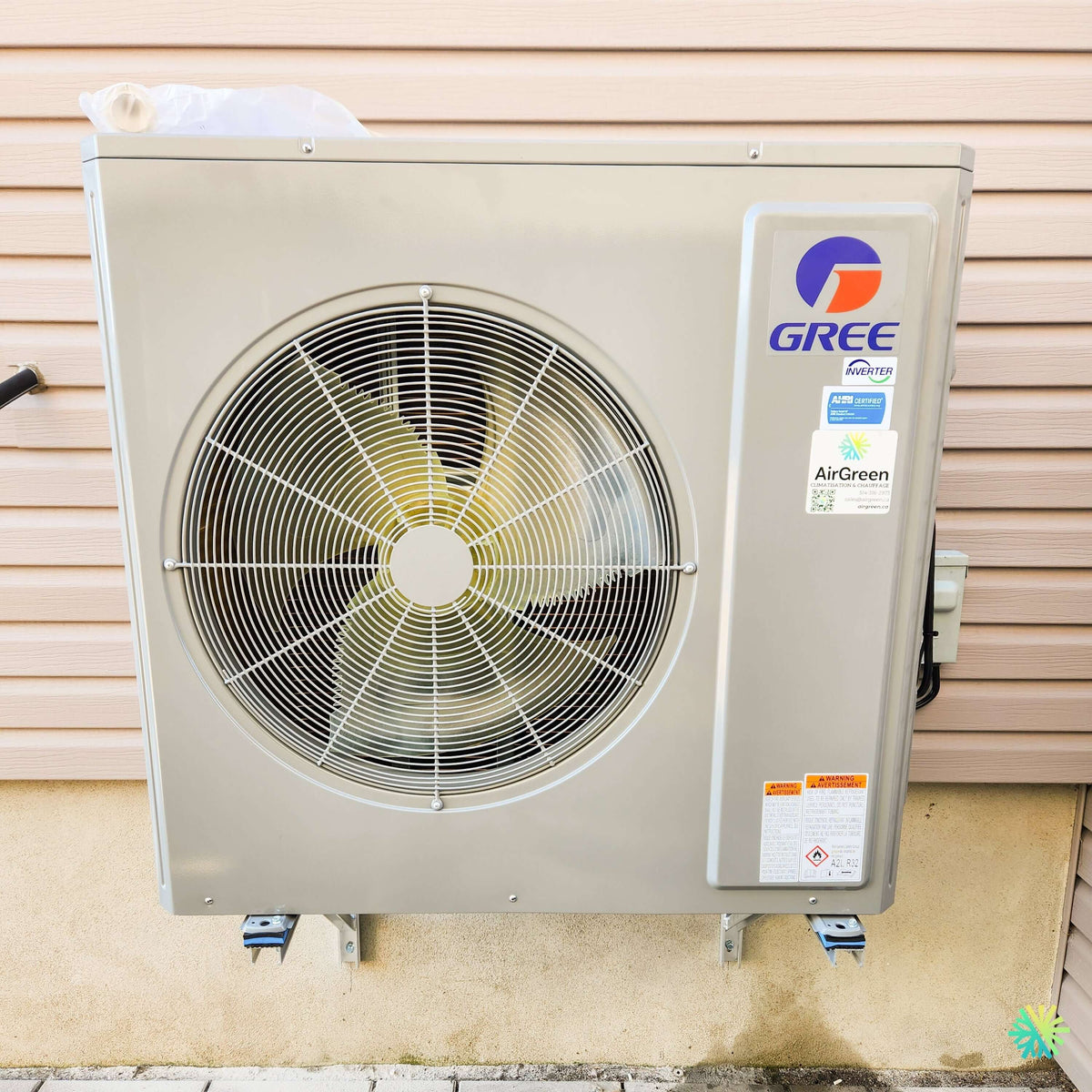
The installed system is a 3-ton GREE FLEXX R32 central heat pump, with the GUD36W2/NhE-D(U) outdoor unit paired with the GUD36AH2/G-D(U) air handler, mounted on brackets anchored into the foundation against a vinyl-clad wall.
The installed pairing
- Outdoor unit: GUD36W2/NhE-D(U) — single fan, 1/6 HP motor
- Air handler: GUD36AH2/G-D(U)
- Rated capacity: 34,000 BTU for both cooling and heating
- Modulation: 18,000 to 37,000 BTU
- SEER2: 18 — HSPF2: 10 — EER2: 12 — COP: 3.2
- AHRI number: 217120760, ENERGY STAR certified
- R32 refrigerant, factory charge of 2.9 lb (102.3 oz)
- Heating down to -30 °C, cooling from -15 °C to 54 °C
- 208-230 V : outdoor MCA 27.7 A / MOCP 30 A, indoor MCA 5.3 A / MOCP 15 A
- Indoor unit: 21 1/4 x 48 1/5 x 21 1/4 in., 163.1 lb (74 kg)
- Factory-installed Wi-Fi, A2L leak detection probe included
Removing the old system: what is regulated by law
A replacement begins with dismantling, and this step is not left to the contractor’s discretion.
The refrigerant contained in the old system—R-22 or R-410A, depending on the age of the unit—must be recovered into an approved cylinder using recovery equipment by a technician holding the required environmental certification. Venting it into the atmosphere is illegal in Quebec, yet it is still seen on rushed job sites where no one is watching.
We collect it, weigh what was recovered, and transport the bottle to a return point. The recovered quantity is recorded in the file. The owner will never see this line on their electricity bill, but it is part of what they are buying when they choose one installer over another.
The copper in the old refrigerant line is also removed. A line that was used for an R-22 system with mineral oil cannot be reused as-is for a circuit R32 operating with POE oil: incompatible oil residues circulate and attack the new compressor. On this project, the line was completely replaced.
The measurement almost no one takes: external static pressure
This is the heart of the project, and it is the least understood aspect of all residential central air conditioning.
A central heat pump does not produce its advertised BTUs in a vacuum. It produces them at a given airflow, which is itself achieved at a given static pressure. If the ductwork offers more resistance than expected, the blower cannot deliver the airflow, the coil does not receive enough air, and the actual capacity drops—in both heating and cooling.
Even before finalizing the quote, we connect a differential pressure gauge to the existing system and measure the external static pressure on both sides of the equipment. What we regularly find in homes on the South Shore and in Montérégie:
- Clearly undersized return-air openings, often just one and often too small.
- Thick, high-filtration indoor filters installed by the homeowner with the best intentions, which alone double the system's resistance.
- Branches capped off during a renovation and never rebalanced.
- Tight elbows and crushed sections behind a suspended ceiling.
In Saint-Robert, the measurements led to two corrections before installation: enlarging the return-air opening and replacing the filter cabinet with a model offering a much larger media surface area at equivalent filtration efficiency.
Why filter surface area changes everything
A finer filter is not necessarily more restrictive. What matters is the media surface area available to the airflow. A 4-inch-thick pleated filter with a large developed surface area can filter more finely than a 1-inch flat filter while creating less resistance.
This is the most cost-effective improvement a homeowner can make to an existing system: it improves air quality, reduces static pressure, increases actual airflow, and extends the interval between replacements. We systematically include it in replacement quotes rather than leaving it as an option.
Latent load: what the summers in Saint-Robert impose
The house is located in a low, flat area near Lavallière Bay and Lake Saint-Pierre. In summer, the air is heavy. The house's load is therefore not just a matter of heat—it is largely a matter of humidity.
A central system dries the air by cooling it below its dew point across the indoor coil. For this to work, the system needs sufficient run time. An oversized unit reaches the temperature setpoint in fifteen minutes, shuts off, and leaves the humidity behind. The house is cool and clammy: the worst of both worlds.
That is exactly why we refused to “go up one size for safety.” The modulation range of the 34,000 BTU system — from 18,000 to 37,000 BTU — allows the unit to run for long periods at low output during humid July days instead of cycling on and off. The result is measured with a hygrometer, not just the thermostat.
We also explain what a heat pump does not do: it does not replace a dehumidifier in an unconditioned basement, and it does not correct a source of structural moisture. In a low-lying home, we always inspect the perimeter drainage, the crawl-space vapor barrier, and the dryer venting before concluding that the HVAC system will solve everything.
Bracket mounting against a vinyl-clad wall
The outdoor unit is suspended on a galvanized steel support, with vibration-isolating pads between the cabinet and the crossbars, against a vinyl-clad wall and above a paver walkway.
The key technical point: vinyl siding carries no load. It is stapled in place, floats to allow for expansion, and forms part of the wall's drainage plane. A bracket bolted into vinyl siding will sag, tear the siding, and create a path for water to enter behind the cladding.
On this job, the brackets were anchored into the concrete foundation wall, below the siding line. This is the strongest and most durable solution:
- The load — 187.5 lb for the unit, plus winter ice — is supported by solid concrete.
- No penetrations are made through the wall's drainage plane.
- Vibrations are transmitted to the foundation rather than the floor framing, making them much less audible indoors.
Every penetration is sealed. The bundle of piping and wiring entering the house is fitted with a drip loop, and the disconnect box is mounted within easy reach.
The clearance beneath the unit and the paver walkway
Installing a low-mounted unit above a traffic surface requires special care. Defrost water will fall onto the pavers all winter. We therefore plan either to divert the drainage or install a drainage bed beneath the unit, and we discuss this with the client before drilling.
Clearance beneath the cabinet must also remain sufficient to prevent accumulated snow from reaching the coil. A height that seems generous in June is no longer so in February.
Commissioning during the cooling season: the readings are finally clear
An installation carried out in summer offers an advantage that emergency winter jobs do not: performance readings in cooling mode are usable.
Our commissioning sequence on this job:
- Dry nitrogen leak test on the new line, with timed hold and reading.
- Deep evacuation with a micron gauge, followed by an isolated pump rise test.
- Weighed charge: actual line length, minus the 24.6 ft (7.5 m) precharged length, plus 0.32 oz per foot (30 g/m). 3/8-inch liquid line, 3/4-inch gas line, maximum length 98.4 ft (30 m), maximum elevation difference 49.2 ft (15 m).
- Measurement of actual airflow and static pressure after duct system modifications.
- Recording the temperature difference between return and supply air, compared with the expected target for the day's ambient humidity.
- Verification of the A2L detection sensor's operation and mitigation mode.
- 24 VAC thermostat configuration and pairing of the factory-installed Wi-Fi.
The recorded readings are documented on a form given to the homeowner. They provide the baseline reference: in five years, a technician will know whether or not the system has drifted.
Mistakes to avoid when replacing a central system
- Choose the wire gauge based on the old unit. The old system may have been oversized from the outset. Repeating the mistake for another fifteen years makes no sense.
- Reuse the refrigerant line from an R-22 system. Mineral oil residue shortens the life of the new compressor.
- Ignore static pressure because “the ducts are already there.”
- Install a 1-inch high-filtration filter on an already restricted duct system.
- Oversize the system for peace of mind, which ruins summer dehumidification.
- Skip refrigerant recovery from the old unit.
- Anchor a support bracket in vinyl siding rather than in the structure or foundation.
- Do not keep the commissioning record. Without a baseline reference, any future diagnosis starts from scratch.
Grants: the special case of replacement
The GUD36W2/NhE-D(U) + GUD36AH2/G-D(U) pairing, certified ENERGY STAR under AHRI number 217120760, qualifies for Quebec assistance programs for heat pumps.
Replacement cases require particular attention: programs distinguish between adding an efficient appliance where there was none, replacing a fossil-fuel system, and replacing an existing electric appliance. The amounts and conditions are not the same, and an application filed under the wrong category is rejected.
Three items we validate before ordering:
- Does the exact pair appear on the list of eligible equipment, with the correct AHRI number.
- Which work category applies based on what is being removed.
- What is the submission deadline from the invoice date.
The rules change every year. We confirm eligibility in writing before the equipment is ordered, not once the installation is complete.
What Saint-Robert illustrates better than any sales pitch
Two contractors can offer the same GREE FLEXX R32, at the same price, with the same manufacturer's warranty. One will have measured static pressure, enlarged the return air, redone the refrigerant line, recovered the old refrigerant, weighed the charge, and provided a measurement report. The other will have simply swapped one box for another.
The second system will work. It will consume more, dehumidify less effectively in July, lose capacity at -20 °C, and no one will understand why—because the measurement that would have explained it was never taken.
Our presence in Montérégie and Greater Montreal
At AirGreen, we design, install, and maintain central heat pumps, ductless heat pumps, air conditioners, VRF systems, and air exchangers in Montreal, Laval, Longueuil, on the North Shore, on the South Shore, and throughout Montérégie, including Saint-Robert, Saint-Ours, Sainte-Victoire-de-Sorel, Yamaska, and the Sorel-Tracy area.
Our teams work on both lowland homes with existing ductwork and urban multi-unit buildings. Load calculations, ductwork measurements, and documented commissioning are part of the work in both cases.
Have your system assessed before it forces your hand
If your central system is more than twelve years old, your home stays humid in July despite the air conditioning, or your summer bills have increased without any change in your habits, it is worth having an assessment done now rather than during a heat wave.
Contact AirGreen for a load calculation, a static pressure measurement of your ductwork, and a detailed quote for a GREE FLEXX R32 system. You will know what is actually limiting your current installation before choosing its replacement.
The big day, step by step
The main steps of this kind of job at AirGreen. Every house has its quirks: the estimate brings them out.
We look at the ducts, the current indoor module, the electrical panel and the planned spot for the outdoor unit.
The equipment combination, capacity and price, in writing. We check whether the combination qualifies for assistance programs.
Access protected, old unit disconnected and removed when it is being replaced.
Electric furnace or air handler, with its coil, connected to the supply and return ducts.
On a level base, raised above the snow, with free space all around.
Insulated, they enter through a sealed opening and run to the indoor coil.
Dedicated circuits, accessible disconnect, a thermostat that works with the heat pump and the backup heat.
Leak test, vacuum, start-up, airflow check and a test of both modes.
Filter, thermostat, backup heat in extreme cold: what to know before winter.
- The on-site estimateWe look at the ducts, the current indoor module, the electrical panel and the planned spot for the outdoor unit.
- The quoteThe equipment combination, capacity and price, in writing. We check whether the combination qualifies for assistance programs.
- Getting readyAccess protected, old unit disconnected and removed when it is being replaced.
- The indoor moduleElectric furnace or air handler, with its coil, connected to the supply and return ducts.
- The outdoor unitOn a level base, raised above the snow, with free space all around.
- The refrigerant linesInsulated, they enter through a sealed opening and run to the indoor coil.
- Electrical and thermostatDedicated circuits, accessible disconnect, a thermostat that works with the heat pump and the backup heat.
- Tests and start-upLeak test, vacuum, start-up, airflow check and a test of both modes.
- The walkthroughFilter, thermostat, backup heat in extreme cold: what to know before winter.
What would it look like at your place?
Two quick checks with real numbers: what heat costs, and what your current heaters add up to in BTU/h.
Conversion: 1 W = 3.412 BTU/h. An indication, not a load calculation: baseboards and furnaces are often stronger than the real need, and they can stay as backup. AirGreen confirms the capacity on site.
Four mistakes we do not make
Flip each card to see what we do instead.
Your own project, step by step
What to do, season by season
Three habits per season for this unit. They take a few minutes and prevent many calls.
- Check the indoor module's filter.
- Clear winter debris from the outdoor unit.
- Test cooling before the heat arrives.
- Check the filter more often in peak season.
- Keep registers and returns clear.
- Watch condensate drainage near the coil.
- Change or clean the filter.
- Test heating and backup heat before the cold.
- Book periodic maintenance.
- Clear snow around the outdoor unit.
- Store nothing in front of the indoor module.
- Note any unusual noise or smell and call us.
Is your home ready?
Check what applies at your place. A "no" is not a refusal: it is what we sort out during the estimate.
Four statements: true or false?
It all comes down to details you have just seen.
1. A central heat pump uses the house's ducts.
It connects to the existing ducts to heat and cool everywhere.
2. In extreme cold, electric backup heat can take over.
The indoor module (furnace or air handler) works with the heat pump and takes over in extreme cold.
3. The filter only gets changed when the unit breaks down.
A dirty filter cuts airflow. It gets checked regularly.
4. You can reuse the old unit's size without checking.
The house may have changed: insulation, windows, added rooms. Capacity is confirmed on site.
0 / 4 right answers
What people ask us about this kind of work
Can I keep my current ducts?
What happens in extreme cold?
Furnace, air handler, ducted: what is the difference?
Are there grants?
Do I need a permit?
How much can I save?
How is the LogisVert assistance calculated?
Will my current thermostat work?
Central or wall units: which one?
Does AirGreen hold the required licences?
Is the estimate free?
No question matches. Write to us: we answer.
More jobs to see, near you
By town, by equipment or by region: browse more than 4,700 published projects.
Each dot: a town where AirGreen has published projects. The glowing dot: this job.
Every house has its constraints. We see them before we install.
The on-site estimate is free and the quote follows within 24 hours.
Text and photo: a real AirGreen Climatisation & Chauffage job. The diagrams are generic illustrations of the type of installation, not a survey of this job site. Sources of the added figures: airgreen.ca product pages (NEEP / AHRI performance), Hydro-Québec (Heat pumps page, LogisVert, read on 13 October 2026), Régie de l’énergie (rate D as of 1 April 2026).