
Installation of a 5-ton GREE FLEXX R32 central heat pump in Saint-Dominique, MRC des Maskoutains
A 39.9-amp appliance cannot simply be added to an existing electrical service at a glance: here’s how we installed a 54,000 BTU GREE FLEXX R32 central heat pump in Saint-Dominique, addressing the electrical side before the HVAC side.
- City
- Region
- Equipment
- Brand
- Challenges
- Published
The job on one screen
The article, chapter by chapter
39.9 amps on an existing service: the electrical question almost nobody asks before signing
In Saint-Dominique, on the edge of the land separating Saint-Hyacinthe from the Yamaska Valley, the house to be air-conditioned was well above average for the area. Large main floor, rear addition, fully finished basement. The load calculation pointed to the largest pairing in the lineup: a 5-ton GREE FLEXX R32 central heat pump.
The most decisive conversation in this project was not about comfort or efficiency. It was about the electrical panel.
A unit with an MCA of 39.9 A and an MOCP of 45 A cannot be added to an existing electrical service based on a quick glance. Yet that happens regularly, and the homeowner finds out the day the service trips during a heat wave or the first severe cold snap.
The installed system
- Outdoor unit: GUD60W2/NhE-D(U) — two fans, 2 × 1/6 HP motors
- Air handler: GUD60AH2/G-D(U)
- Rated capacity: 54,000 BTU in cooling, 53,000 BTU in heating
- Modulation: 35,000 to 55,000 BTU in cooling, 35,000 to 60,000 BTU in heating
- HSPF2: 10.5 — the best seasonal heating efficiency in the entire FLEXX R32 lineup
- SEER2: 18.5 — EER2: 11.7 — COP: 3.4
- AHRI number: 217120762, ENERGY STAR certified
- R32 refrigerant, factory charge of 4.6 lb (162.3 oz)
- Heating down to -30 °C, cooling from -15 °C to 54 °C
- 208–230 V: outdoor MCA 39.9 A / MOCP 45 A, indoor MCA 7.7 A / MOCP 15 A
- Indoor unit: 24 4/5 x 52 1/16 x 21 1/4 in, 199.5 lb (90.5 kg)
- Outdoor unit: 35 1/2 x 49 3/5 x 13 1/3 in, 241.4 lb (109.5 kg)
- Factory-installed Wi-Fi, A2L leak detection sensor included
Why 5 tons here—when we more often recommend the opposite
Our usual instinct is to size systems down, not up. An oversized unit starts, reaches the setpoint, shuts off, and leaves moisture behind in summer.
This project was an exception for a measurable reason: the calculated load exceeded the maximum capacity of the 4-ton pairing for a significant part of the heating season. Dropping down one size would have meant running the equipment at the top of its range for weeks, with electric backup heat being called on much earlier.
The 5-ton modulation range — 35,000 to 60,000 BTU in heating — is also broad enough to avoid short cycling during the shoulder seasons.
A CPSC2 of 10.5: what this figure really means
The CPSC2, or HSPF2, measures the heat produced over an entire season relative to the electricity consumed. It is the indicator that matters in Quebec, far more than the TRÉS2, which is discussed constantly.
The 5-ton pairing displays 10,5, the highest value in the series. In a home whose energy bill is driven more by heating than air conditioning, this is the figure that determines the investment's actual return.
MCA and MOCP: two numbers, two roles, constant confusion
These two values appear on every nameplate and are poorly understood by a large part of the market.
What the MCA determines
The MCA — minimum circuit ampacity — determines the size of the conductors. It is the minimum capacity required for the cable supplying the equipment. At 39.9 A, you do not run a cable chosen “by eye” or salvaged from an old 3-ton central air conditioner.
What the MOCP determines
The MOCP — maximum overcurrent protection — determines the size of the protective device. It is the highest-rated circuit breaker or fuse permitted, in this case 45 A. This does not mean that exactly 45 A must be used: it is a ceiling. A lower rating is acceptable if it remains higher than the MCA and does not trip during normal operation.
The most common mistake
It involves sizing the cable based on the circuit breaker rather than the MCA, or worse, installing a circuit breaker larger than the MOCP “to prevent nuisance tripping.”
A circuit breaker that exceeds the MOCP no longer protects the equipment against a short circuit or ground fault within the time specified by the manufacturer. The compressor's overload protection is internal to the equipment; the circuit breaker has a different role, and upsizing it amounts to removing that protection.
The home's electrical load calculation
Before the order is confirmed, an electrical load calculation is performed by a licensed electrical contractor in accordance with the applicable requirements in Quebec.
What is included in the addition
- The living area and general lighting.
- Fixed appliances: stove, water heater, dryer, dishwasher, and well pump, if applicable.
- The home's existing heating system.
- The new central heat pump and its electric backup.
- Any known future load: an EV charger, workshop, detached garage.
One technical point that often changes the outcome: when the heat pump and electric backup cannot operate simultaneously and the interlock is installed according to code, the calculation may consider only the larger of the two loads rather than their sum. This is precisely the kind of detail that determines whether an existing service entrance is sufficient—and another reason to have a professional perform the calculation rather than estimate it.
The three possible outcomes
- The service entrance is sufficient. A dedicated circuit is added to the panel, and that is the end of the matter.
- The service entrance is sufficient, but the panel is full. An additional distribution panel or panel replacement resolves the situation without modifying the service entrance.
- The service entrance is not sufficient. The service must then be upgraded, requiring an application to Hydro-Québec and a lead time measured in weeks. This is the scenario that derails a schedule when discovered on the morning of installation instead of three weeks earlier.
We raise this issue during the assessment visit. An informed homeowner can plan and budget; a surprised homeowner has to deal with the consequences.
The disconnect switch and flexible conduit
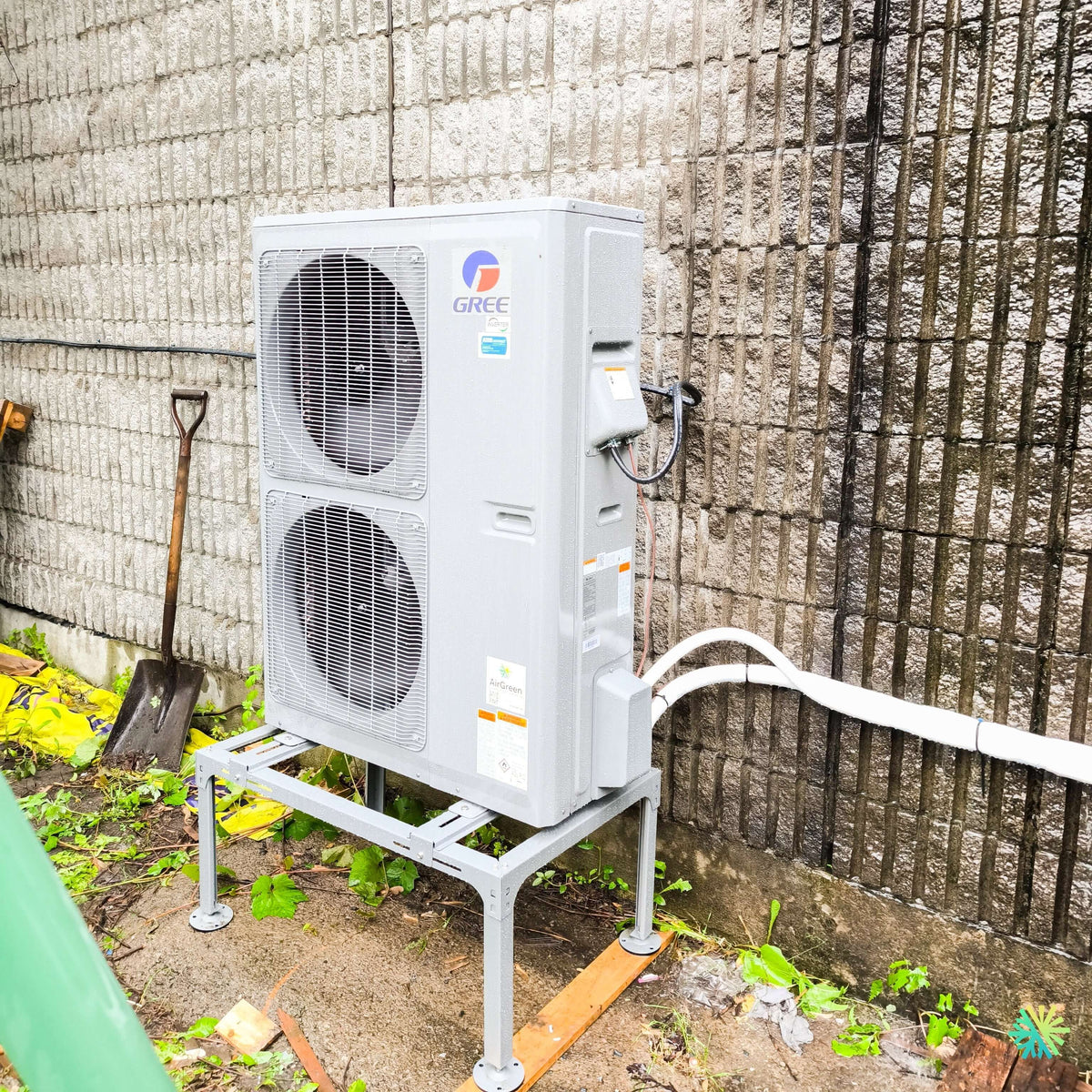
On the wall, within reach of the equipment, the disconnect box is connected to the cabinet by a short flexible conduit. This is not a cosmetic detail.
- It allows you to shut off the power on site, without having to return to the panel, before any work is carried out.
- The flexible conduit absorbs the compressor’s vibrations and the differential movement between the equipment and the wall. A rigid connection puts strain on the cable and the entry point.
- It must remain accessible year-round, so it should be mounted high enough not to disappear under the snow and kept clear of any stored items.
The cable run is secured and protected, and its entry into the cabinet is made through the designated opening with the appropriate cable clamp.
Voltage drop: the calculation country homes overlook
In a village or row house, the panel and outdoor unit are rarely on the same side of the building. A cable run of 25, 30, or 40 metres is nothing unusual.
Over a long distance, the voltage delivered to the equipment is lower than the voltage at the panel. A compressor operating at low voltage draws more current for the same power, runs hotter, and wears out faster. The generally accepted design rule limits voltage drop to a small percentage of the nominal voltage, which sometimes requires upsizing the conductors beyond the MCA.
It’s an additional cost of a few dozen dollars for cable during an installation, and a difference of several years in the compressor’s lifespan.
The finish of the piping run
The refrigerant line set runs along the wall in a rigid line set cover before entering the house. This finish serves four functions, none of them decorative.
Why use a line set cover instead of simple tape
- Ultraviolet protection. The insulation on a refrigerant line exposed to sunlight cracks within a few summers. Once the insulation is cracked, the suction line condenses in summer and loses heat in winter.
- Mechanical protection. A lawn mower, snowblower, ladder, or fallen branch: a rigid cover withstands what tape cannot hold back.
- Run continuity. Regular fasteners prevent sagging between support points and vibrations against the siding.
- Work that ages well. A clean run stays clean. A taped run visibly deteriorates within three years, and the owner ends up judging it—often along with the rest of the work.
The insulation must cover both lines
On a traditional air conditioner, only the suction line is insulated. On a heat pump operating in heating mode, both lines take part in the heat exchange, and both must be insulated along the entire run, including where they pass through the wall and up to the connections.
The building entry is fitted with a drip loop and fully sealed, both outside and inside.
The foundation: a 241 lb load on shifting ground
The unit rests on a galvanized steel frame with adjustable feet, anchored to a stable surface and leveled during installation.
Adjustable feet are not used only for installation. Quebec soil shifts: freezing, thawing, settling. An adjustable support makes it possible to level the unit again during a maintenance visit without dismantling anything. On a 241.4 lb unit whose base pan must drain defrost water to a specific location, a misalignment of just a few degrees results in retained water and accumulated ice.
The costliest electrical mistakes
- Reusing the circuit from an old central air conditioner without checking its rating against the new MCA.
- Installing a breaker larger than the MOCP to prevent trips whose actual cause lies elsewhere.
- Ignoring the length of the run and the resulting voltage drop.
- Discovering the service capacity on the day of installation instead of during the assessment.
- Placing the disconnect too low or behind a seasonal obstacle.
- Omitting the lockout between the heat pump and the supplemental heat, which unnecessarily inflates the load calculation and incorrectly leads to the conclusion that a service upgrade is required.
Subsidies: what is covered and what is not
The GUD60W2/NhE-D(U) + GUD60AH2/G-D(U) pairing, certified ENERGY STAR under AHRI number 217120762, qualifies for Quebec heat pump assistance programs, and its CPSC2 of 10.5 positions it favorably in performance-based criteria.
A budget warning, because it comes up repeatedly: electrical work required to accommodate the unit—such as adding a panel or upgrading the service—is generally not covered by programs aimed at the equipment. A homeowner who builds a budget solely around the system price and the advertised incentive amount may face a substantial gap.
We include the electrical work in the quote rather than leaving it as “to be confirmed.” Program amounts and rules change every year, and we confirm eligibility before ordering the equipment.
What Saint-Dominique shows: the heat pump is only half the project
For a system pairing of this size, the HVAC equipment is the predictable part of the project. What varies from one home to another is what powers it: service capacity, space in the electrical panel, run length, and connection quality.
An installer who never discusses electricity during an assessment for a 39.9 A unit has not yet begun evaluating the project.
Our coverage in Montérégie and Greater Montreal
At AirGreen, we design, install, and maintain central heat pumps, ductless wall-mounted heat pumps, air conditioners, VRF systems, and air exchangers in Montreal, Laval, Longueuil, on the North Shore, on the South Shore, and throughout Montérégie, including Saint-Dominique, Saint-Hyacinthe, Sainte-Hélène-de-Bagot, Saint-Pie, and Saint-Simon.
Our teams regularly work on homes whose electrical service dates back to the time of construction and has never been reviewed. It is the first thing we look at when a good-sized home requires a complete central system.
Have your entire project assessed
Before comparing quotes for a central heat pump, ask each contractor three questions: What is the capacity of my electrical service? What is the MCA of the proposed unit? And are the electrical components included in the quoted price? The answers will tell you more than any technical data sheet.
Contact AirGreen for a load calculation for your home, an assessment of your electrical capacity, and a detailed quote for a GREE FLEXX R32 system. You will know the cost of the complete project before committing.
The job tools
Two quick checks with real numbers: what heat costs, and what your current heaters add up to in BTU/h.
Conversion: 1 W = 3.412 BTU/h. An indication, not a load calculation: baseboards and furnaces are often stronger than the real need, and they can stay as backup. AirGreen confirms the capacity on site.
How the job unfolds
The main steps of this kind of job at AirGreen. Every house has its quirks: the estimate brings them out.
We look at the ducts, the current indoor module, the electrical panel and the planned spot for the outdoor unit.
The equipment combination, capacity and price, in writing. We check whether the combination qualifies for assistance programs.
Access protected, old unit disconnected and removed when it is being replaced.
Electric furnace or air handler, with its coil, connected to the supply and return ducts.
On a level base, raised above the snow, with free space all around.
Insulated, they enter through a sealed opening and run to the indoor coil.
Dedicated circuits, accessible disconnect, a thermostat that works with the heat pump and the backup heat.
Leak test, vacuum, start-up, airflow check and a test of both modes.
Filter, thermostat, backup heat in extreme cold: what to know before winter.
- The on-site estimateWe look at the ducts, the current indoor module, the electrical panel and the planned spot for the outdoor unit.
- The quoteThe equipment combination, capacity and price, in writing. We check whether the combination qualifies for assistance programs.
- Getting readyAccess protected, old unit disconnected and removed when it is being replaced.
- The indoor moduleElectric furnace or air handler, with its coil, connected to the supply and return ducts.
- The outdoor unitOn a level base, raised above the snow, with free space all around.
- The refrigerant linesInsulated, they enter through a sealed opening and run to the indoor coil.
- Electrical and thermostatDedicated circuits, accessible disconnect, a thermostat that works with the heat pump and the backup heat.
- Tests and start-upLeak test, vacuum, start-up, airflow check and a test of both modes.
- The walkthroughFilter, thermostat, backup heat in extreme cold: what to know before winter.
What we check on a job like this one
Each number is a point we check on site. Switch between summer and winter to watch air and heat move.
In summer, the outdoor unit rejects the house's heat outside.
Generic illustration of this type of installation, not a survey of this job site. Tap a number.
It captures or rejects heat outside. It sits on a level base, above the snow, with free space all around.
The insulated refrigerant lines enter the house through a sealed opening and run to the indoor coil.
A shut-off switch near the outdoor unit isolates it safely for service.
Sitting on the indoor module, it moves heat between the house air and the refrigerant.
Electric furnace or air handler: its fan pushes air through the ducts. The electric backup takes over in extreme cold.
Supply ducts bring air to the rooms; returns bring it back to the unit. Their condition matters as much as the unit's.
It protects the coil and the fan. A dirty filter cuts airflow, so it gets checked regularly.
It runs the heat pump and the backup heat. It must be compatible with the installed system.
Is your home ready?
Check what applies at your place. A "no" is not a refusal: it is what we sort out during the estimate.
Good habits, once the unit is in place
Six simple habits that keep the unit going. Your list stays on this device.
What to do, season by season
Three habits per season for this unit. They take a few minutes and prevent many calls.
- Check the indoor module's filter.
- Clear winter debris from the outdoor unit.
- Test cooling before the heat arrives.
- Check the filter more often in peak season.
- Keep registers and returns clear.
- Watch condensate drainage near the coil.
- Change or clean the filter.
- Test heating and backup heat before the cold.
- Book periodic maintenance.
- Clear snow around the outdoor unit.
- Store nothing in front of the indoor module.
- Note any unusual noise or smell and call us.
The right pages, at the right time
Four statements: true or false?
It all comes down to details you have just seen.
1. A central heat pump uses the house's ducts.
It connects to the existing ducts to heat and cool everywhere.
2. In extreme cold, electric backup heat can take over.
The indoor module (furnace or air handler) works with the heat pump and takes over in extreme cold.
3. The filter only gets changed when the unit breaks down.
A dirty filter cuts airflow. It gets checked regularly.
4. You can reuse the old unit's size without checking.
The house may have changed: insulation, windows, added rooms. Capacity is confirmed on site.
0 / 4 right answers
What people ask us about this kind of work
Can I keep my current ducts?
What happens in extreme cold?
Furnace, air handler, ducted: what is the difference?
Are there grants?
Do I need a permit?
How much can I save?
How is the LogisVert assistance calculated?
Will my current thermostat work?
Central or wall units: which one?
Does AirGreen hold the required licences?
Is the estimate free?
No question matches. Write to us: we answer.
More jobs to see, near you
By town, by equipment or by region: browse more than 4,700 published projects.
Each dot: a town where AirGreen has published projects. The glowing dot: this job.
An on-site estimate, the right capacity, the right equipment.
The on-site estimate is free and the quote follows within 24 hours.
Text and photo: a real AirGreen Climatisation & Chauffage job. The diagrams are generic illustrations of the type of installation, not a survey of this job site. Sources of the added figures: airgreen.ca product pages (NEEP / AHRI performance), Hydro-Québec (Heat pumps page, LogisVert, read on 13 October 2026), Régie de l’énergie (rate D as of 1 April 2026).