
Installation of a GREE FreeMatch R32 five-zone heat pump in Saint-Polycarpe, in Vaudreuil-Soulanges
Five identical GREE FreeMatch R32 indoor units in Saint-Polycarpe, in a living room with a nine-foot ceiling: why the unit is not mounted flush to the ceiling, how this height affects the sensor and maintenance, and why a heat pump does not dry out the air in winter.
In summer, the outdoor unit rejects the house's heat outside.
Generic illustration of this type of installation, not a survey of this job site. Tap a number.
Mounted level on a wall plate, high enough for the air to reach the whole room, with enough space around it to slide the filters out easily.
The refrigerant lines, the communication cable and the drain go through the wall in a single opening, sealed against water, cold air and insects.
Two insulated copper pipes connect the two units. Outside, a line cover can protect them from sun, knocks and weather.
A shut-off switch near the outdoor unit isolates it safely for service. It must stay accessible at all times.
The compressor and the fan. In heating mode it captures heat from the outdoor air, even in winter, and moves it inside.
On the ground or on the wall, it keeps the unit above accumulated snow. The unit stays clear and defrost water can drain away.
The fan needs to blow freely. Storage, a fence or a wall too close, and efficiency drops while noise goes up.
Why this indoor unit is not pressed against the ceiling, and why it was the right choice
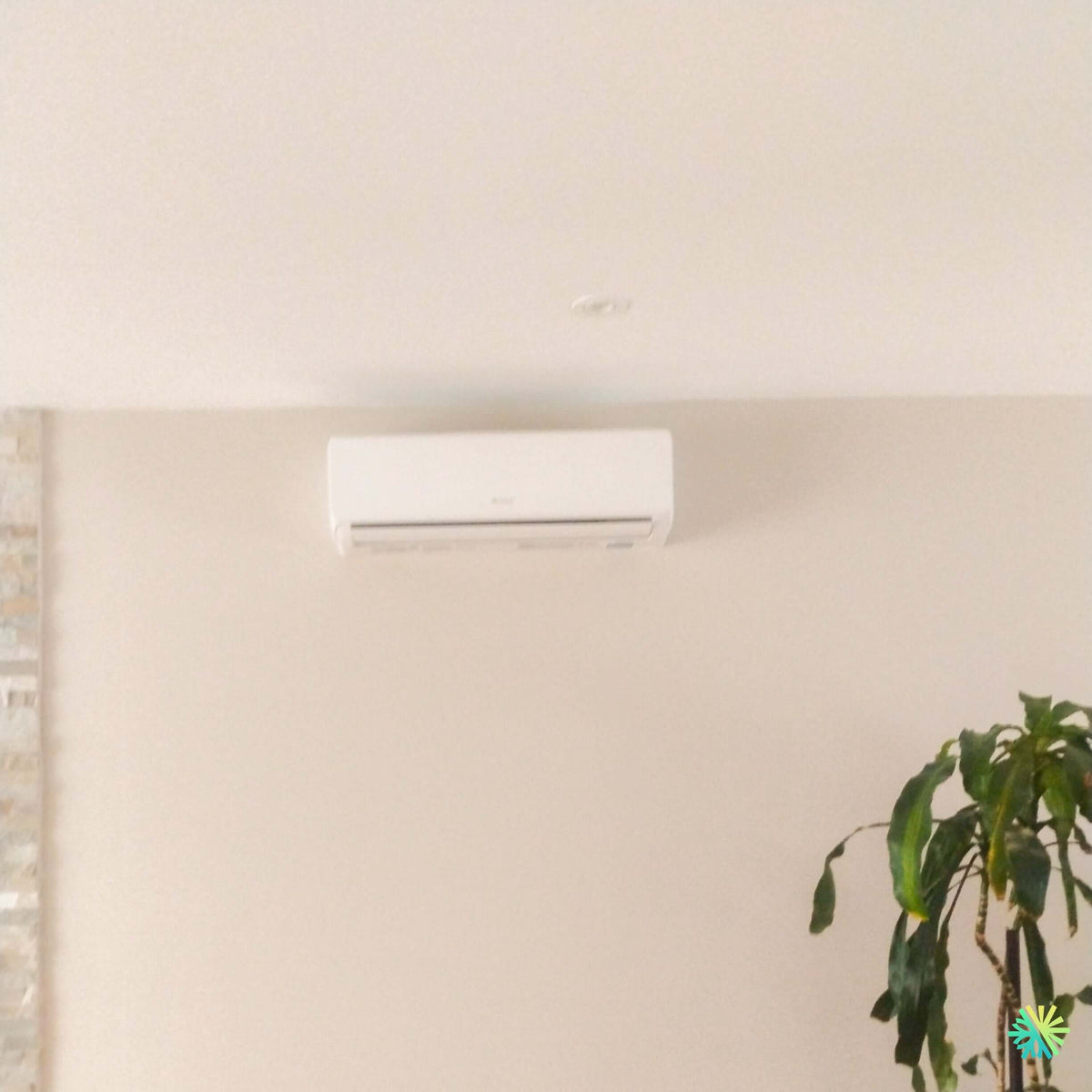
Look at the photo. There is an unusual amount of space between the top of the unit and the ceiling. In nearly all the installations we document, the wall-mounted indoor unit is positioned as high as possible. Not here—and this is not an oversight; it was a decision made with a measuring tape during the technical visit, in Saint-Polycarpe, in the Vaudreuil-Soulanges RCM.
The installation height of a wall-mounted heat pump is treated by most installers as obvious: mount it as high as possible and move on to the next job. Yet it is one of the few parameters that affects safety, perceived comfort, control accuracy, and ease of maintenance over the next fifteen years. At AirGreen, we install HVAC systems throughout Montérégie, Montreal, Laval, Longueuil, the North Shore, and the South Shore, and this question comes up whenever a ceiling exceeds the standard height.
The context: Saint-Polycarpe, in the Suroît's agricultural plain
Saint-Polycarpe covers roughly seventy square kilometres in the Suroît area, southwest of Montérégie. The territory is flat—we are in the St. Lawrence Lowlands—and crossed through its centre by the Delisle River. The local economy remains agricultural, centred around a village core that is home to a heritage church and a microbrewery established in the early 2000s. The municipality borders Saint-Clet, Coteau-du-Lac, Les Coteaux, Saint-Zotique, Rivière-Beaudette, Saint-Télesphore, and Sainte-Justine-de-Newton.
This flat terrain also simplified a decision we had to weigh carefully elsewhere in the same RCM: preparing the base for the outdoor unit, which we covered in detail in our Rigaud article, where the land was sloped and the bedrock was exposed. Here, the soil is uniform, the terrain is level, and the raised base sits on a draining stone bed—the matter is settled.
The property is a newer, compact, well-insulated house with nine-foot ceilings on the ground floor, a decorative stone accent wall in the living room, all-electric baseboard heating, and no ductwork. Five rooms to condition.
Five zones, five identical heads
- Living room (stone wall, nine-foot ceiling) : 9,000 BTU/h
- Kitchen and dining room : 9,000 BTU/h
- Primary bedroom : 9,000 BTU/h
- Second bedroom : 9,000 BTU/h
- Enclosed office : 9,000 BTU/h
Total: 45,000 BTU/h on a compressor nominally rated at 42,000 BTU/h in cooling, or 107%. This is the first configuration in this series where all five heads are rigorously identical, and this is not a shortcut in ordering: this house has rooms of comparable dimensions, a uniform envelope, and an orientation that does not create a dominant zone.
Three concrete benefits follow, which we had already observed on installations with four identical heads like those in Saint-Bernard-de-Lacolle and Dundee:
- A single filter reference for the entire house, which genuinely changes the likelihood that maintenance will be performed.
- Identical behavior from room to room: the same fan speeds, the same noises, the same settings. Occupants learn once.
- No oversized head in a small room, so no zone is inherently condemned to short-cycling.
The honest counterargument: a perfectly uniform configuration leaves no reserve in a room that might need it later, for example if the living room became an open-concept area after a partition was demolished. This choice assumes that the house layout will not change.
The selected unit
Five zones require the GWHD(42)ND6MO: the only unit in the GREE FreeMatch R32 range approved for two to five indoor units, a constraint detailed in our Sainte-Martine article.
The values that support the sales pitch: SEER2 21, HSPF2 10, EER2 12, COP 3.9, code AHRI 214931590 in ductless configuration (214931596 ducted, 214931600 mixed), heating operation down to -30 °C, heating modulation from 8,870 to 54,590 BTU/h, MCA 30 A and maximum protection of 45 A on a single dedicated circuit—with the indoor units powered by the outdoor unit—, 2,700 g of R32 factory charge, integrated A2L leak detector, intelligent defrost, automatic voltage adaptation, 79 kg at 1,020 × 826 × 427 mm. ENERGY STAR certified according to the manufacturer's data sheet.
The height band: two limits, and a space between them
The height of a wall-mounted head is not unrestricted. It is bounded by two values, both taken from the indoor unit's documentation, never from installer habit.
The lower limit is the minimum installation height listed on the nameplate. This is not a comfort recommendation: it is a requirement related to the R32 refrigerant, classified as A2L, intended to ensure that a potential leak disperses rather than accumulating at floor level. We published the values recorded on a nameplate in our Dundee article, noting that they depend on the model and charge, and that only the nameplate of the unit actually installed is authoritative.
The upper limit is the clearance above the unit casing required by the installation manual. A unit installed too close beneath the ceiling draws in some of its own discharged air again and reads an inaccurate return-air temperature. We detailed these clearances in our Verchères article.
In a room with a standard eight-foot ceiling, these two limits almost meet: there is no choice to make; the unit goes wherever it can. In a nine-foot room, a band appears—and that is where the design work begins.
To be precise, this band must be checked at the exact location being considered, not at the center of the room: in our Saint-Télesphore article, in the neighboring municipality, it was a sloped ceiling that made measurement at the installation point decisive.
Why we positioned it within the band
Three reasons, in order of importance for this project.
- The return-air sensor. A wall-mounted head measures the temperature of the air it draws in, at the top. In a nine-foot room, warm air accumulates beneath the ceiling: a unit mounted right up against the ceiling measures the warmest layer in the room and considers itself satisfied, even though the occupied zone, at seated height, is not. Stratification and its consequences were discussed in our Saint-Amable article; here, lowering the unit simply brings its sensor closer to the occupants' reality.
- Maintenance. A filter located nine feet above the floor is cleaned from a stepladder. A filter you can reach by raising your arms gets cleaned. This is not a technical detail; it is the variable that determines whether the unit will still perform well in eight years.
- The wall's aesthetics. On a tall wall with decorative stone, a unit mounted right against the ceiling appears to hang in midair. Lowered, it becomes part of the composition. This argument comes last, but it matters to the client who lives in the room.
What lowering it costs, and how we compensate for it
Nothing is free. A lowered unit loses some reach: the supply-air jet travels along the ceiling and crosses the room more effectively when it starts higher up. In a long room, this loss would be unacceptable. Here, the living room is moderately sized, and the jet reaches the opposite wall without difficulty. The issue of jet trajectory and ceiling obstacles is covered in depth in our Sainte-Martine article.
Second compensation: the minimum fan speed was increased by one step in this zone during commissioning, restoring the reach without perceptible noise.
Third point, non-negotiable: the selected height was measured, recorded in the file, and verified against the nameplate of the actual unit delivered, not against that of a neighboring model. For five heads, this verification is performed five times.
January's dry air: what a heat pump changes, and what it does not
It is the most common service call in January and February, and it is almost always a misunderstanding: “ever since we got the heat pump, the air has been dry.”
In heating mode, a wall-mounted unit does not dry out the air
Precision is important because the confusion stems from a real phenomenon observed in summer. In air-conditioning mode, the indoor coil is cold: water vapor in the air condenses on it, the water goes down the drain, and the room air genuinely dries out. This is the mechanism we explained in our Saint-Édouard article.
In heating mode, it is the opposite. The indoor coil is warm. Nothing condenses on it, no water goes down the drain, and the amount of water vapor in the house does not change by a single gram. A wall-mounted unit in heating mode does not remove humidity. Physically, it cannot.
So where does January's dryness come from?
From outside and from the building envelope.
Cold air contains very little water vapor. At -20 °C, even when saturated, it carries only a minimal amount. Whenever this air enters—through infiltration, ventilation, or open doors—and is heated to 21 °C, its relative humidity plummets. A well-insulated, heated home in very cold weather therefore dries out on its own, heat pump or not. The same occupants experienced this phenomenon with their baseboard heaters; they simply did not attribute it to anything.
What the heat pump actually changes: the sensation
This is the valid point behind the complaint, and it is real.
An electric baseboard heater warms a room through slow convection, with little noticeable air movement. A wall-mounted unit continuously moves air. Evaporation from the surface of the skin, mucous membranes, and plant leaves depends directly on air speed. At exactly the same relative humidity, a room with moving air feels drier than a still room.
The plant visible in the photo is also an excellent indicator: leaf tips that turn yellow and droop on a plant placed in an appliance's airflow do not indicate a problem with the appliance, but continuous exposure to moving air. The solution is to move the plant out of the airflow path—not lower the setpoint again.
What we adjust during commissioning to reduce the sensation: directing the louvers upward in heating mode rather than toward occupants, setting the fan speed to automatic rather than fixed, and keeping the temperature setpoint stable—a thermostat raised by three degrees because you feel cold produces a rapid burst of hot, dry air, exactly the effect we were trying to avoid.
Humidify, yes—but with a hygrometer and caution
If the measured level is genuinely low, humidification is the right solution. Three rules to follow before buying anything.
- Measure first. A hygrometer costs just a few dollars. Acting without measuring means correcting a number you do not have.
- Never overhumidify during a Quebec winter. This is the costly mistake. Above a certain level, vapor condenses on cold surfaces: first on the windows, where it can be seen, then inside wall assemblies, where it cannot be seen and causes damage for years. The target level must be lowered as the outdoor temperature drops, never kept constant throughout the winter.
- Take ventilation into account. An air exchanger is necessary for air quality, but it exhausts humid air and introduces dry air. The humidifier and air exchanger must be adjusted together, not separately. It is also worth noting that a wall-mounted unit does not ventilate or introduce any outdoor air, a point discussed in our Beauharnois article.
Mistakes to Avoid
- Systematically mounting the head unit flush with the ceiling because that is what is usually done, without checking the permitted range on the nameplate and in the manual for the delivered model.
- Lowering a head unit “for aesthetic reasons” in a long room, where the loss of range becomes a comfort problem.
- Blaming the heat pump for dry air and lowering the setpoints accordingly—it does not add a single gram of water vapor.
- Installing a humidifier without a hygrometer and setting it once for the winter.
- Leaving a plant or armchair directly in the airflow.
- Standardizing on five identical head units in a house with rooms of different sizes: it was justified here, but it is not a general rule.
- Forgetting to register the warranty: 10 years of standard coverage, extended to 12 years upon registration with the distributor and proof of installation.
Rebates and eligibility
The GWHD(42)ND6MO is listed as eligible for local rebates on the manufacturer's product sheet. For an electrically heated residence in Vaudreuil-Soulanges, Hydro-Québec's energy-efficiency programs (LogisVert) and Rénoclimat generally apply; Chauffez vert, which targets the replacement of fossil-fuel heating, does not apply. The criteria change from year to year, and the declared AHRI number must correspond to the combination actually installed; otherwise, an application may be rejected for a purely administrative reason.
What we provide at the end of the project
The serial number of each head unit associated with its room, the installation height selected for each one and the nameplate value against which it was validated, the measured length of the five lines, the quantity of R32 added and weighed, the port-by-port assignment, the commissioning readings, the dedicated circuit number, and the warranty registration date.
At AirGreen, we design, install, and maintain multi-zone wall-mounted heat pump, air conditioning, and heating systems in Saint-Polycarpe, Coteau-du-Lac, Les Coteaux, Saint-Zotique, Vaudreuil-Dorion, and throughout the Vaudreuil-Soulanges RCM, as well as in Montreal, Laval, Longueuil, on the North Shore, and on the South Shore. In a room with a high ceiling, the installation height is decided during the technical visit, not on the morning of installation.
AirGreen — RBQ 5645-9605-01 — (514) 316-2973 — sales@airgreen.ca
How it goes, from the first call to the end
The main steps of this kind of job at AirGreen. Every house has its quirks: the estimate brings them out.
We look at the room, the outside wall, the line route and where the outdoor unit will go. That is where the capacity gets chosen.
Model, capacity and price, in writing. We also check whether the model qualifies for assistance programs.
Floors and furniture protected, wall plate position marked level, wall opening located.
A single opening, with the slope the drain needs to flow outside.
Set on a stand raised above the snow, with the clearances the manufacturer requires.
Connected, insulated and protected. The opening is then sealed against water, cold air and insects.
A dedicated circuit and an accessible disconnect near the outdoor unit.
Leak test, vacuum, then start-up and a check of heating and cooling.
Remote, modes, filters: we show you the essentials before we leave.
- The on-site estimateWe look at the room, the outside wall, the line route and where the outdoor unit will go. That is where the capacity gets chosen.
- The quoteModel, capacity and price, in writing. We also check whether the model qualifies for assistance programs.
- Getting readyFloors and furniture protected, wall plate position marked level, wall opening located.
- The wall openingA single opening, with the slope the drain needs to flow outside.
- The outdoor unitSet on a stand raised above the snow, with the clearances the manufacturer requires.
- Lines, cable and drainConnected, insulated and protected. The opening is then sealed against water, cold air and insects.
- The electrical workA dedicated circuit and an accessible disconnect near the outdoor unit.
- Tests and start-upLeak test, vacuum, then start-up and a check of heating and cooling.
- The walkthroughRemote, modes, filters: we show you the essentials before we leave.
And at your place?
Two quick checks with real numbers: what heat costs, and what your current heaters add up to in BTU/h.
Conversion: 1 W = 3.412 BTU/h. An indication, not a load calculation: baseboards and furnaces are often stronger than the real need, and they can stay as backup. AirGreen confirms the capacity on site.
What to do, season by season
Three habits per season for this unit. They take a few minutes and prevent many calls.
- Clean the indoor unit's filters.
- Clear leaves and debris left on the outdoor unit by winter.
- Test cooling before the first hot days.
- Clean the filters more often when the unit runs a lot.
- Keep plants away from the outdoor unit.
- Check that no water drips from the indoor unit.
- Rake the leaves around the outdoor unit.
- Test heating before the first cold days.
- Book periodic maintenance before winter.
- Keep snow away from the stand and the front of the unit.
- Let the unit defrost: it is normal.
- Never hit the ice on the fins; call us if the unit stays iced up.
Which type of equipment for your project?
Pick what looks like your need.
Four mistakes we do not make
Flip each card to see what we do instead.
What people ask us about this kind of work
Does a wall-mounted heat pump heat in winter?
Wall-mounted or multi-zone: how do I choose?
Where does the outdoor unit go?
Are there grants?
Do I need a permit?
How cold can it heat?
How much can I save?
How is the LogisVert assistance calculated?
Is it noisy?
The outdoor unit is covered in ice: is that normal?
Does AirGreen hold the required licences?
Is the estimate free?
No question matches. Write to us: we answer.
Useful pages for what comes next
More jobs to see, near you
By town, by equipment or by region: browse more than 4,700 published projects.
Each dot: a town where AirGreen has published projects. The glowing dot: this job.
Tell us about your house. We come and see it for free.
The on-site estimate is free and the quote follows within 24 hours.
Text and photo: a real AirGreen Climatisation & Chauffage job. The diagrams are generic illustrations of the type of installation, not a survey of this job site. Sources of the added figures: airgreen.ca product pages (NEEP / AHRI performance), Hydro-Québec (Heat pumps page, LogisVert, read on 13 October 2026), Régie de l’énergie (rate D as of 1 April 2026).