
Installation of a FUJITSU ORION XLTH+ wall-mounted heat pump in Saint-Jacques-le-Mineur
Textured ceiling, no rear exit possible: here’s how we installed a FUJITSU ORION XLTH+ 12,000 BTU wall-mounted heat pump in Saint-Jacques-le-Mineur, with a decorative line set cover and real-world performance down to -30 °C.
In summer, the outdoor unit rejects the house's heat outside.
Generic illustration of this type of installation, not a survey of this job site. Tap a number.
Mounted level on a wall plate, high enough for the air to reach the whole room, with enough space around it to slide the filters out easily.
The refrigerant lines, the communication cable and the drain go through the wall in a single opening, sealed against water, cold air and insects.
Two insulated copper pipes connect the two units. Outside, a line cover can protect them from sun, knocks and weather.
A shut-off switch near the outdoor unit isolates it safely for service. It must stay accessible at all times.
The compressor and the fan. In heating mode it captures heat from the outdoor air, even in winter, and moves it inside.
On the ground or on the wall, it keeps the unit above accumulated snow. The unit stays clear and defrost water can drain away.
The fan needs to blow freely. Storage, a fence or a wall too close, and efficiency drops while noise goes up.
When a textured ceiling and a wall with no rear exit dictate the entire project
At Saint-Jacques-le-Mineur, homes have a character all their own: large lots, bungalows and cottages built between the 1970s and 1990s, original stucco ceilings, and heating still largely provided by electric baseboards. This was exactly the context in which we worked at the home of this resident of the Jardins-de-Napierville RCM, who experienced two opposite realities depending on the season: heavy Hydro-Québec bills from December to March, and an unlivable upper floor from mid-June to the end of August.
The mandate was clear. A single wall-mounted heat pump, a single air-distribution point, real performance in cold weather, and a clean visual result in a living area. We selected the FUJITSU ORION XLTH+, H-series single-zone configuration, in its 12,000 BTU configuration — indoor unit ASUH12KTAS, outdoor unit AOUH12KTAP1.
The on-site assessment: what guided the equipment selection
Before proposing anything, we measure. Always. Load calculations are not an administrative formality: they are what separates an HVAC installation that works from a heat pump that short-cycles, gets dirty, and disappoints as soon as the first cold spell arrives.
The findings from the assessment:
- Approximately 900 sq. ft. of space to heat and cool, partially open-plan, with natural airflow toward the bedrooms.
- Original insulation that was adequate but had not been upgraded, with windows replaced about a dozen years ago.
- No rear exit possible at the desired mounting point: the wall selected by the client faces an adjoining room, not the outdoors.
- Very limited clearance between the top of the lintel and the textured ceiling.
- An electrical panel with available space, but far from the connection point.
These five points determined the rest of the project.
Why the FUJITSU ORION XLTH+ and not another unit
An appliance is not chosen by its marketing sheet, but by how its performance curves behave at the temperatures we actually experience in the Montérégie region.
Cooling capacity, backed by the numbers
The ORION XLTH+ 12,000 BTU model delivers a rated capacity of 12,000 BTU/h in cooling (modulating from 3,100 to 17,300 BTU/h) and 15,300 BTU/h in heating (modulating from 4,500 to 27,300 BTU/h). This point deserves attention: the unit provides more heating than cooling, which corresponds exactly to the profile of a Quebec home.
But the figure that really matters is the capacity retention as the mercury plunges:
| Outdoor temperature | Available heating capacity |
|---|---|
| -15 °C | 171 % of rated capacity |
| -21 °C | 156 % |
| -26 °C | 128 % |
| -30 °C | 103 % |
In other words, at -30 °C—that is, below the threshold of the harshest nights recorded on the South Shore—the unit still delivers more than its rated capacity. The official heating operating range extends down to -30 °C (-22 °F), with no cutoff device that shuts the unit down when it is needed most. That is precisely the difference between a “four-season” heat pump on paper and a heat pump designed for cold climates.
Efficiency ratings
- SEER2: 31.5
- HSPF2 (Region V): 11.3
- EER2: 16.7
- COP: 4.88
ENERGY STAR certification, including Cold Climate recognition. The latter is not merely cosmetic: it is often the eligibility criterion for rebate programs.
R-32 refrigerant
The series uses R-32, whose global warming potential is 675, compared with 2,088 for R-410A—a 68% reduction. The required refrigerant charge is also lower for equivalent performance. For a homeowner who keeps their house for fifteen or twenty years, this is an equipment choice that will age well as regulations become stricter.
Quiet in a living space
The indoor unit drops to 23 dB(A) in silent mode, with six fan speeds plus an automatic mode. In a living room where people watch television in the evening, this level of control makes all the difference: the unit does not need to blow hard to maintain the setpoint because the Inverter compressor modulates instead of starting and stopping. The outdoor unit, meanwhile, measures around 48–49 dB(A), with an activatable low-noise operating mode—useful when the nearest neighbor is fifteen meters away.
The installation, step by step
Indoor installation beneath a textured ceiling
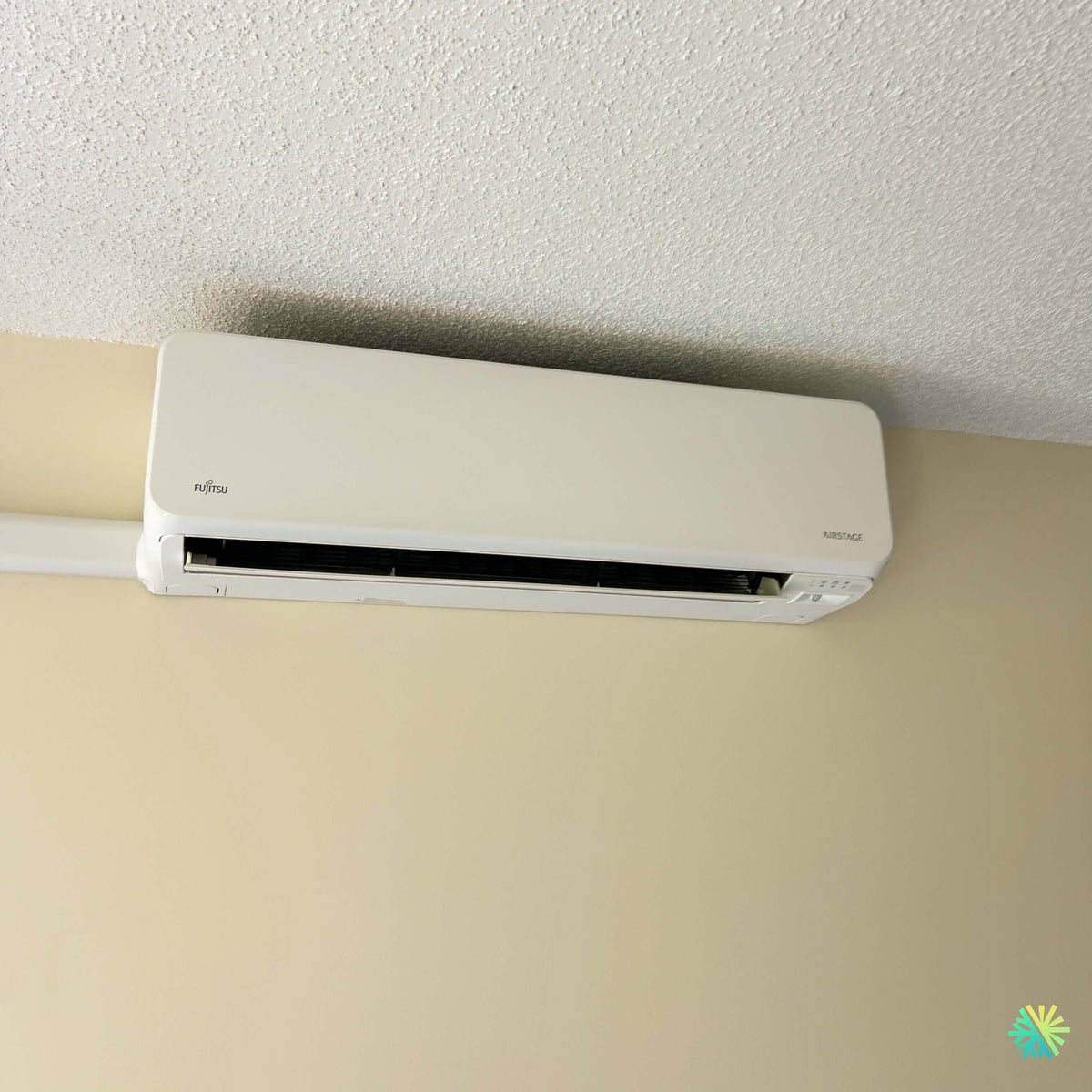
The final-result photo shows the constraint: the unit is mounted high, very close to the stucco ceiling. The FUJITSU ORION XLTH+ measures 295 mm high, 894 mm wide, and 280 mm deep, and weighs 14 kg. Its compact size allowed us to respect the manufacturer’s clearances while keeping the unit aligned with the ceiling line, without restricting the return air.
Two precautions were taken here:
- Protecting the stucco. A textured ceiling is marked by the slightest contact and can never be repaired perfectly. We masked the area and worked on the mounting plate from the side rather than from above.
- Locating the studs. The mounting plate was secured to the structure, not just the drywall. A 14 kg indoor unit that vibrates for twelve years on hollow-wall anchors will eventually shift—and whistle.
Lateral routing of the lines
This is the technical core of the project. Since the mounting wall did not face the exterior, the lines could not exit directly behind the unit. We therefore routed them horizontally to the left, to the nearest exterior wall, fully enclosed in a white decorative line set cover.
This detail, visible in the photo, is what distinguishes a carefully executed installation from a sloppy one:
- The line set cover is level and parallel to the ceiling line, with no waviness.
- Original corner fittings and end caps, with no visible tape or silicone.
- The condensate drain line integrated into the same line set cover, with a continuous slope—never a reverse slope, never a “belly” where water can pool.
- A sealed, properly oriented exterior penetration to prevent water infiltration during rain driven by westerly winds.
The series allows up to 20 m of piping (factory pre-charge covering 14.9 m) and a maximum elevation difference of 14.9 m, with 3/8 in. gas and 1/4 in. liquid lines. This margin gave us the freedom to choose the most logical outdoor location acoustically and for snow removal, rather than having to settle for one. Final run length: approximately 7.5 m, well within the pre-charged length.
The outdoor unit and the Montérégie winter
The AOUH12KTAP1 unit—716 × 820 × 315 mm, 42 kg—was installed on raised wall brackets, well above the accumulated snow level and outside the roof's fall line. The series incorporates a base pan heater designed for extremely cold climates: it prevents melted ice from refreezing in bulk at the bottom of the unit, which is the leading cause of performance degradation in February.
A wind deflector is available as an option on certain models, along with a snow hood and hail protection—accessories we recommend on a case-by-case basis depending on the property's orientation, particularly in open, windy areas such as Saint-Jacques-le-Mineur and Saint-Philippe.
Electrical power supply
The circuit was wired for 208-230 V / 60 Hz / single-phase power, protected by a 20 A circuit breaker, with an outdoor disconnect switch near the unit. The ProCore™ coils, made of highly corrosion-resistant copper, complete the picture in terms of durability.
Commissioning
Vacuuming according to industry best practices, checking for leaks, recording pressures and temperatures in heating and cooling modes, configuring the integrated Wi-Fi and the AIRSTAGE mobile app, then providing the customer with a complete demonstration: backlit remote control, economy, powerful, and minimum-heat modes, automatic restart, and above all, maintenance of the washable indoor filters.
Total job duration: one day, two technicians.
What we see too often—and how to avoid it
Mistakes that cost homeowners dearly
- Oversizing “to be sure.” An oversized heat pump does not modulate, short-cycles, dehumidifies poorly, and wears out faster. On this job, modulation down to 4,500 BTU/h in heating mode is worth more than an 18,000 BTU unit.
- Skipping the line set cover to save $200. An exposed set of bare conduits, subjected to sunlight and the elements, deteriorates and hurts the home's resale value.
- Neglecting the condensate slope. This is the most common cause of water damage mistakenly attributed to the unit.
- Installing the outdoor unit on the ground, directly on the slab. In the Montérégie region, snow and ice build up. Raised supports are not a luxury.
- Forgetting to clean the filters. Two minutes a month protect the advertised performance.
Rebates: what to check before signing
The ENERGY STAR certification, including cold-climate recognition, places the FUJITSU ORION XLTH+ in the category of equipment generally targeted by Quebec programs—notably Hydro-Québec's LogisVert and Rénoclimat. Amounts, eligibility criteria, and possible combinations between programs change from year to year and depend on the type of heating being replaced, the preliminary energy assessment, and the unit's exact configuration. At AirGreen, we verify eligibility when preparing the quote, using the rates in effect that day, and provide the technical documentation required for the application. We never promise an amount before confirming it.
Our coverage on the South Shore and beyond
Saint-Jacques-le-Mineur is in an area we serve constantly: Saint-Philippe, La Prairie, Candiac, Delson, Saint-Constant, Napierville, Saint-Rémi, and the entire South Shore. We also serve Montreal, Laval, Longueuil, and the entire North Shore, with more than fifteen teams on the road.
Every wall-mounted heat pump installation we carry out follows the same logic: a load calculation first, then equipment selection, followed by a duct routing plan designed to last and blend into the room, and documented commissioning. Annual HVAC maintenance completes the process, because a well-installed but poorly maintained unit loses its advantage within three winters.
Ready to get your quote
If your home on the South Shore, in Montreal, Laval, Longueuil, or the North Shore deserves the same treatment, email us at sales@airgreen.ca or call us at (514) 316-2973. We travel to you, take measurements, and provide a detailed quote—unit, exact model, capacity, routing, electrical work, and eligibility for rebates, line by line.
How it goes, from the first call to the end
The main steps of this kind of job at AirGreen. Every house has its quirks: the estimate brings them out.
We look at the room, the outside wall, the line route and where the outdoor unit will go. That is where the capacity gets chosen.
Model, capacity and price, in writing. We also check whether the model qualifies for assistance programs.
Floors and furniture protected, wall plate position marked level, wall opening located.
A single opening, with the slope the drain needs to flow outside.
Set on a stand raised above the snow, with the clearances the manufacturer requires.
Connected, insulated and protected. The opening is then sealed against water, cold air and insects.
A dedicated circuit and an accessible disconnect near the outdoor unit.
Leak test, vacuum, then start-up and a check of heating and cooling.
Remote, modes, filters: we show you the essentials before we leave.
- The on-site estimateWe look at the room, the outside wall, the line route and where the outdoor unit will go. That is where the capacity gets chosen.
- The quoteModel, capacity and price, in writing. We also check whether the model qualifies for assistance programs.
- Getting readyFloors and furniture protected, wall plate position marked level, wall opening located.
- The wall openingA single opening, with the slope the drain needs to flow outside.
- The outdoor unitSet on a stand raised above the snow, with the clearances the manufacturer requires.
- Lines, cable and drainConnected, insulated and protected. The opening is then sealed against water, cold air and insects.
- The electrical workA dedicated circuit and an accessible disconnect near the outdoor unit.
- Tests and start-upLeak test, vacuum, then start-up and a check of heating and cooling.
- The walkthroughRemote, modes, filters: we show you the essentials before we leave.
And at your place?
Two quick checks with real numbers: what heat costs, and what your current heaters add up to in BTU/h.
Conversion: 1 W = 3.412 BTU/h. An indication, not a load calculation: baseboards and furnaces are often stronger than the real need, and they can stay as backup. AirGreen confirms the capacity on site.
What to do, season by season
Three habits per season for this unit. They take a few minutes and prevent many calls.
- Clean the indoor unit's filters.
- Clear leaves and debris left on the outdoor unit by winter.
- Test cooling before the first hot days.
- Clean the filters more often when the unit runs a lot.
- Keep plants away from the outdoor unit.
- Check that no water drips from the indoor unit.
- Rake the leaves around the outdoor unit.
- Test heating before the first cold days.
- Book periodic maintenance before winter.
- Keep snow away from the stand and the front of the unit.
- Let the unit defrost: it is normal.
- Never hit the ice on the fins; call us if the unit stays iced up.
Which type of equipment for your project?
Pick what looks like your need.
Four mistakes we do not make
Flip each card to see what we do instead.
What people ask us about this kind of work
Does a wall-mounted heat pump heat in winter?
Wall-mounted or multi-zone: how do I choose?
Where does the outdoor unit go?
Are there grants?
Do I need a permit?
How cold can it heat?
How much can I save?
How is the LogisVert assistance calculated?
Is it noisy?
The outdoor unit is covered in ice: is that normal?
Does AirGreen hold the required licences?
Is the estimate free?
No question matches. Write to us: we answer.
Useful pages for what comes next
More jobs to see, near you
By town, by equipment or by region: browse more than 4,700 published projects.
Each dot: a town where AirGreen has published projects. The glowing dot: this job.
Tell us about your house. We come and see it for free.
The on-site estimate is free and the quote follows within 24 hours.
Text and photo: a real AirGreen Climatisation & Chauffage job. The diagrams are generic illustrations of the type of installation, not a survey of this job site. Sources of the added figures: airgreen.ca product pages (NEEP / AHRI performance), Hydro-Québec (Heat pumps page, LogisVert, read on 13 October 2026), Régie de l’énergie (rate D as of 1 April 2026).