FUJITSU AIRSTAGE
ORION XLTH
ASUH12KZAS / AOUH12KZAH1 · AHRI 214888802
Also sold as GENERAL AIRSTAGE.
See the product page
514-316-2973
sales@airgreen.ca
Wall-mounted heat pumps
Five 12,000 BTU wall-mounted heat pumps, one per brand (FUJITSU AIRSTAGE ORION XLTH, GREE EXTRÊME R32, HITACHI airHome 800, LG ARTCOOL DELUXE R32, SHARP CHU R32): coldest certified point, stated heating range and every capacity published below −15 °C, with ...

"Handles extreme cold" means nothing until you know at what temperature, with what capacity and according to which document. Here are five 12,000 BTU wall-mounted heat pumps, one per brand, listed in alphabetical order with their coldest certified point, the heating range each manufacturer states and every capacity published below −15 °C. You sort them yourself.
FUJITSU AIRSTAGEASUH12KZAS / AOUH12KZAH1 · AHRI 214888802
Also sold as GENERAL AIRSTAGE.
See the product page GREE
GWH12AVDXE-D6DNA1B/I / GWH12AVDXE-D6DNA1B/O · AHRI 215386290
Also called SAPPHIRE R32.
See the product page HITACHI
RAK-XJ12PHAA / RAC-XJ12WHAA · AHRI 215911631
See the product page LG
KNSAL121A / KUSAL121A · AHRI 216368960
See the product page SHARP
AY-XP12CHU / AE-X12CHU · AHRI 217512736
See the product pageFor the same Montréal room needing 12,000 BTU/h, here is the estimated electricity at Hydro-Québec Rate D, taxes included. Heating is calculated with HSPF2 region V, the coldest in the standard, and the five units go through the same method as on all our comparison pages. Electric baseboards remain the reference.
| Heat pump | Winter · heating | Summer · cooling | Full year | Less than with baseboards, in winter |
|---|
The amounts change with the sliders and price chosen above. Brands in alphabetical order.
AirGreen method v1.1, November 9, 2026. An estimate is for comparing units under the same conditions; this amount is not a promise.
At first, the order is alphabetical. Tap a column to order the five by that measurement, then tap it again to reverse the order. Note: the coldest points are not measured at the same temperature.
Certified values: AHRI, through the NEEP database, viewed November 17, 2026; heated base pan: "pan heater" field of the NEEP records. Ranges and weights: each manufacturer's documents (see sources). Bars: same scale for all five in each column.
Bring the thermometer down from 8.3 °C to −35 °C. At each stop, each heat pump shows what really exists at that temperature: a value certified by NEEP, a manufacturer value outside the certificate, two published values on either side, or only a stated heating range with no figure. Nothing is calculated between two points.
Montréal markers: −9.2 °C, January mean, and −13.5 °C, January mean daily minimum (Environment and Climate Change Canada, 1991-2020 normals, Montréal-Trudeau); −23.1 °C, heating design temperature (Natural Resources Canada, HOT2000).
The five certificates share a single cold point: −15 °C (5 °F). Lower down, they stop between −26.1 and −35 °C; the thermometer descent above follows them one by one.
Solid bar: maximum certified capacity at −15 °C, COP alongside. Hollow dot: each unit's coldest certified point, each at its own temperature; they do not compare with one another.
Pick two of the five units: below −15 °C, the chart places each published value at its exact temperature, telling NEEP-certified points apart from manufacturer tables. At first, the page shows the two units certified lowest.
The cards repeat what the documents say about winter, and nothing else. "Not stated" or "not found" means a document is silent on that point, not that the feature is missing.
FUJITSU AIRSTAGE: yes, 150 W (NEEP record).
GREE: yes, 72 W (NEEP record).
HITACHI: yes, 150 W (NEEP record).
LG: yes, 90 W (NEEP record).
SHARP: not declared to NEEP.
FUJITSU AIRSTAGE: −26 to 24 °C.
GREE: −30 to 30 °C.
HITACHI: −30 to 24 °C.
LG: −35 to 18 °C.
SHARP: −30 to 24 °C.
FUJITSU AIRSTAGE: "no shutoff device" at low temperature (brochure FG8153D).
GREE: not stated in the brochure.
HITACHI: not stated in the brochure.
LG: not stated in the brochure.
SHARP: not stated in the submittal.
FUJITSU AIRSTAGE: automatic defrost and restart.
GREE: low-voltage start; anti-corrosion coated fins.
HITACHI: "FrostWash"; anti-corrosion blue fins (airHome brochure).
LG: not found in the documents consulted for this page.
SHARP: "Hot Gas Pipe" defrost; automatic restart.
FUJITSU AIRSTAGE: built-in Wi-Fi, AIRSTAGE Mobile app.
GREE: Wi-Fi connectivity.
HITACHI: not found in the documents consulted for this page.
LG: not found in the documents consulted for this page.
SHARP: SHARP AIR app.
FUJITSU AIRSTAGE: not stated in brochure FG8153D.
GREE: not stated in the brochure.
HITACHI: not stated in the brochure.
LG: not stated in the brochure.
SHARP: 10 °C (50 °F) function.
Documents: FUJITSU AIRSTAGE, brochure FG8153D (rev. 4/2025); GREE, EXTRÊME R32 brochure no. 032025; HITACHI, airHome 800 brochure (Dec. 2024, _CA) and technical catalogue; LG, brochure PO_LG_R32_ArtCool_Mirror_Deluxe_04_25_CA_EN; SHARP, catalogue MNSPLT-CHUCU 1.1.1 and submittal AE-X12CHU_AY-XP12CHU-EN1 (January 2026). Heated base pan: NEEP records, viewed November 17, 2026.
Each manufacturer publishes its indoor unit's sound levels by fan speed, with its own method and its own number of speeds.
Reading dB(A). The smaller the number, the less you hear the unit, as the ear perceives it. Each dot marks a published fan speed.
Five ways of measuring. FUJITSU AIRSTAGE and HITACHI specify an anechoic chamber, the other three do not; the number of published speeds runs from four to eight, and one brand's "low" is not another's.
Every published speed
Five measurement methods, so five rows to read separately.
FUJITSU AIRSTAGE: brochure FG8153D and submittal 12KZAH1. GREE: brochure no. 032025 and Airy Inverter R32 service manual. HITACHI: airHome 800 brochure and installation manual IA2693:A (precharged length, add-on rate). LG: ArtCool Mirror and Deluxe brochure (04/25). SHARP: catalogue MNSPLT-CHUCU 1.1.1 and submittal AE-X12CHU_AY-XP12CHU-EN1. Base pan: NEEP records. Published inch fractions are converted to decimals.
The original article discussed FUJITSU AIRSTAGE, GREE, Mitsubishi Electric and TOSOT. AirGreen does not sell Mitsubishi Electric; for TOSOT, the page presents no model, since no certified record with an A2L refrigerant was checked. To keep the comparison fair, the page takes one 12,000 BTU wall unit per brand, using R-32, each offered on AirGreen's site and chosen for its published extreme-cold data: FUJITSU AIRSTAGE ORION XLTH (the series that replaces the LMAS the article mentioned), GREE EXTRÊME R32, HITACHI airHome 800, LG ARTCOOL DELUXE R32 and SHARP CHU R32. One model's values do not describe the whole brand.
Not every document says. FUJITSU AIRSTAGE writes that the ORION XLTH has no shutoff device at low temperature; the other documents consulted give a heating range without saying what happens below it. Below the last published value, the page shows no figure: see "The thermometer descent".
The need for backup heat depends on the room's heat loss at Montréal's design temperature (−23.1 °C according to HOT2000) and on the capacity the chosen unit publishes at that temperature. An on-site load calculation determines it; "The thermometer descent" shows what each manufacturer publishes around −23.1 °C.
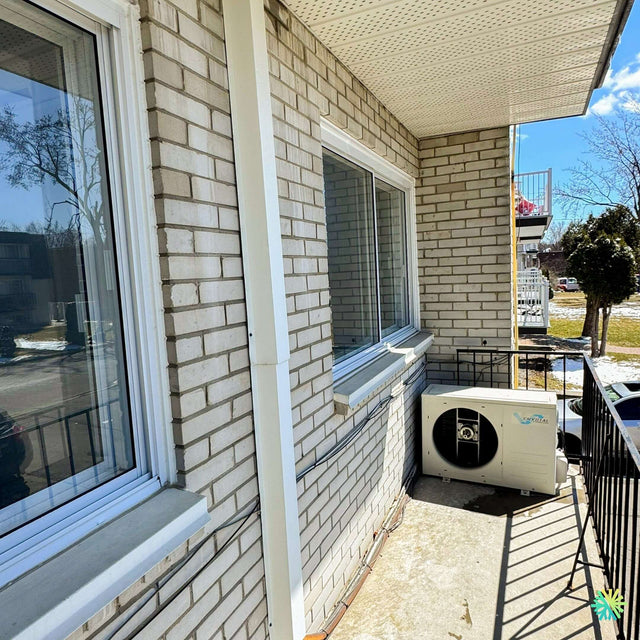
The outdoor unit must be able to defrost and drain its water without being buried: a raised stand, a spot sheltered from snow sliding off the roof and clearance around the unit are planned at installation, according to the manufacturer's manual. According to NEEP, four of the five declare a heated base pan; the SHARP CHU's NEEP record does not declare one.
According to NEEP, all five are listed as ENERGY STAR and cold climate; eligibility itself is confirmed on the official list on the day of purchase, and this page states no amount. Two units have another name: GENERAL AIRSTAGE for the ORION XLTH, SAPPHIRE R32 for the GREE EXTRÊME R32.
No comparison here: the five manufacturers publish their terms in forms too different to set side by side. The terms of the chosen model are attached to your quote.
higher: the highest value of a measurement taken under the same conditions, nothing more. No marker on capacities and COPs by temperature, since the order changes from one temperature to the next.
For a home exposed to extreme cold, bring to your appointment the room's area, its insulation and the planned outdoor location: the load calculation starts from there.
Data checked November 17, 2026. Performance: AHRI certificates and the NEEP database. Capacities outside the certificate, ranges, dimensions, weight, line set, sound and features: according to the manufacturer, with their document. When a source contradicts the AHRI certificate, the certificate prevails. Original article fully rebuilt on November 17, 2026 using the method of our comparison pages.
Trademarks. FUJITSU AIRSTAGE, ORION, GREE, HITACHI, airHome, LG, ARTCOOL and SHARP are trademarks of their respective owners. Logos are used only to identify the products compared. AirGreen is a retailer of these brands; this page is not produced, sponsored or endorsed by the manufacturers.
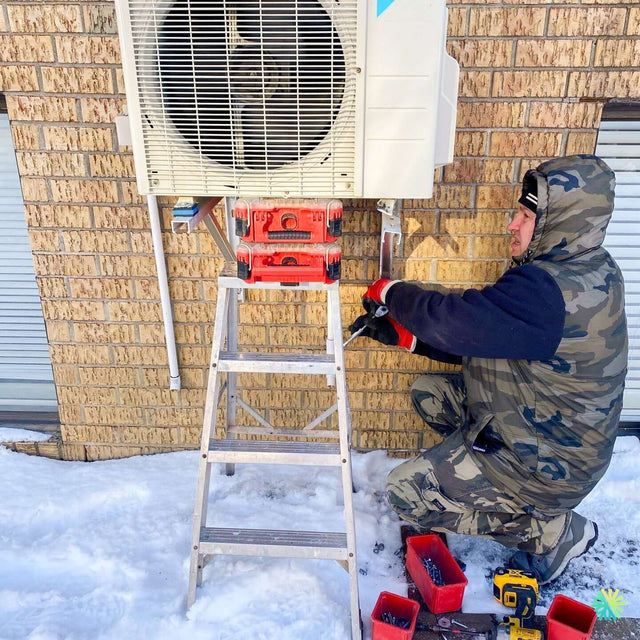
Photos: AirGreen and manufacturers, for identification.
Does a figure look wrong? Write to us: every reported figure is rechecked.
An AirGreen advisor assesses your situation on site, free of charge, and gives you a quote within 24 hours.