
Wall-mounted heat pumps
Why does your wall-mounted heat pump seem to consume as much as a traditional electric heater?
Short answer
Why is your wall-mounted heat pump consuming so much? AirGreen explains common mistakes and real solutions for optimal energy performance in Montréal, Laval, Longueuil, the North Shore and the South Shore.
In detail
A wall-mounted heat pump is often seen as the go-to energy-efficient solution for heating and cooling in Québec. Yet, some homeowners are surprised to find their system seems to consume just as much—or even more—than a conventional electric heating system. At AirGreen, thanks to our extensive experience in HVAC installations in Montréal, Laval, Longueuil, the North Shore, and the South Shore, we’ve identified several common causes behind this issue. Here’s a detailed analysis, based on real situations we've encountered with our clients.
A common misconception: a wall-mounted heat pump is always more economical than baseboard heating
It’s true that under optimal conditions, a wall-mounted heat pump can significantly reduce energy consumption. However, when the unit is poorly matched or misused, it can quickly lose efficiency—to the point where its consumption rivals that of a traditional heating system.
Several factors are at play here: oversized or undersized capacity, improper installation, poor maintenance, or even incorrect use of programmable settings.
Sizing errors that harm energy performance
One of the most frequent problems we encounter during our site visits in Montréal and on the South Shore is improper sizing of the heat pump. An oversized unit constantly runs in short cycles, never reaching optimal performance. Conversely, an undersized unit has to run nonstop, which increases energy consumption and reduces the system’s lifespan.
At AirGreen, we always insist on performing a full thermal analysis of the building before any installation. This avoids costly mistakes and ensures long-term performance optimization.
Concrete example: misconfigured system in Laval
We were recently called to a home in Laval where a competitor had installed a Gree Lomo 18,000 BTU wall-mounted heat pump. The homeowner, alarmed by high energy bills, assumed the unit was defective. Upon inspection, we discovered the system was too powerful for the serviced space, causing a series of short cycles.
We recommended installing a 12,000 BTU model better suited to the home’s square footage, paired with a smart thermostat for more accurate control. The result: a consumption reduction of over 35% and a noticeable improvement in thermal comfort.
Improper maintenance: the silent enemy of efficiency
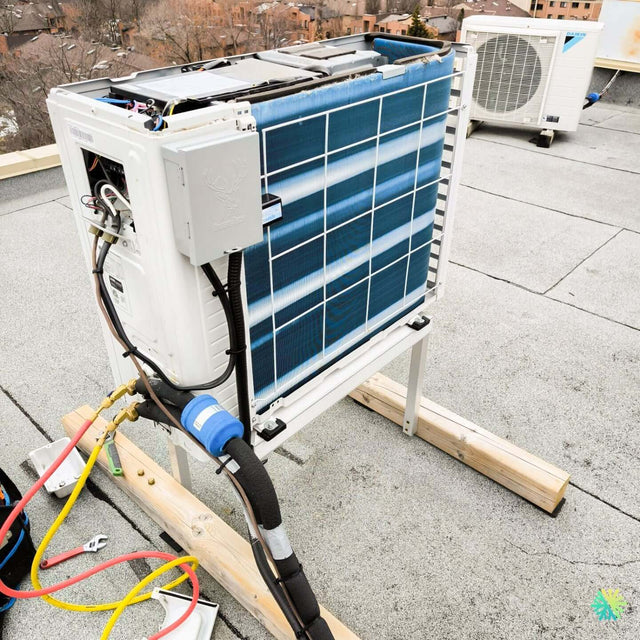
Another often-overlooked factor is HVAC maintenance. A clogged filter, dust buildup inside the indoor unit, or a blocked outdoor heat exchanger can drastically reduce your system’s efficiency.
Our maintenance teams regularly operate in Longueuil and on the North Shore to provide cleaning, pressure checks, fan calibration, and sensor verification. These services extend your unit’s lifespan and ensure stable consumption over time.
Usage that’s not adapted to Québec winters
Québec winters are harsh, and not all wall-mounted heat pumps are designed to handle them. Some entry-level models lose their efficiency below -15°C. The compressor then has to work harder and longer, leading to overconsumption.
At AirGreen, we only recommend units built for cold climates, such as the Fujitsu KZAH, Sharp ZU1, or Gree Extreme, which maintain efficiency down to -30°C. When properly installed and used with smart settings, these models remain far more economical than electric heating.
Programming and user behavior
One of the most underestimated elements behind a heat pump’s consumption is user behavior. Letting the temperature swing too much between day and night, or turning the system off completely when leaving, can cause energy spikes when restarted.
We advise our clients in Montréal and elsewhere to adopt stable programming, with moderate temperature shifts and continuous airflow, to stabilize thermal loads and avoid energy surges.
Practical tips to reduce your wall-mounted heat pump’s consumption
Here are the best practices we share with our clients during installations and maintenance visits:
-
Have a professional thermal assessment done before purchasing your unit.
-
Choose a wall-mounted heat pump properly sized to your home’s square footage, insulation, and orientation.
-
Clean the filters every month and schedule annual professional maintenance.
-
Install a smart thermostat to regulate temperatures precisely.
-
Avoid large temperature fluctuations between day and night.
-
Choose models designed for Québec’s cold winters.
Conclusion: Controlled consumption requires a comprehensive approach
If your wall-mounted heat pump consumes as much as a traditional electric heating system, that doesn’t mean it’s doomed. At AirGreen, we believe that a well-planned, properly sized, well-maintained, and correctly used installation can achieve far superior performance. With our expertise across Greater Montréal, we can guide you toward a solution that’s efficient, high-performing, and truly cost-effective.
Unsure about your current setup? Thinking about upgrading to a more efficient wall-mounted heat pump? Contact us today. At AirGreen, we turn your comfort needs into sustainable, controlled results.
You made it to the end.Share it with someone it could help.
Related questions
Multi-Zone Wall-Mounted Heat Pumps: How a Poor Installation Destroyed a Family’s Peace in LavalWall-Mounted Heat Pump and Air Conditioning: Why Is Your Unit Struggling to Cool During a Québec Heat Wave?Why Is Your New Wall-Mounted Heat Pump Breaking Down Regularly? Answers from Québec ExpertsHow a Longueuil Homeowner Transformed His Energy Bills Thanks to a Multi-Zone Wall-Mounted Heat PumpYour Wall-Mounted Heat Pump Losing Efficiency? Here's How to Check in 5 Easy StepsWall-mounted heat pumps and efficiency: how a simple cleaning can boost your performance by 25%5 situations where your wall-mounted heat pump wastes energy (and how to fix them)The 8 Commandments from AirGreen Experts to Avoid a Winter Breakdown of Your Wall-Mounted Heat Pump
AirGreen Climatisation & Chauffage
From reading to your home.
An AirGreen advisor assesses your situation on site, free of charge, and gives you a quote within 24 hours.
- RBQ licence 5645-9605-01Subclasses 15.8, 15.10 and 16
- Free on-site estimateAn advisor assesses your needs
- Quote within 24 hoursClear and detailed
Contents
AirGreen glossary