


Galvanized Round Damper (Balancing Key)
The round damper and its quadrant key that set how much air goes down a branch.
AirGreen codeAG-VC-01106
514 316-2973 · sales@airgreen.ca
Quick facts
The galvanized round damper is installed in a round duct branch to adjust its airflow. Its balancing key, on the outside of the duct, turns an inner blade: open, the air flows freely; partly closed, the branch gets less air.
The basic balancing tool
An overheated room above the furnace, a cold bedroom at the far end of the house: in most cases, the difference comes from how the air is split between the branches. By slightly restricting the branches that get the most, the dampers send air back to the rooms that are short of it. The same principle applies to the branches of an air exchanger, to set the fresh air supply or exhaust for each room.
Six diameters
Available in 4, 5, 6, 8, 10 and 12 in. Choose the nominal diameter of the duct it will be installed on.
Where and how to install it
- In a straight run, away from elbows, for a more stable setting.
- Where the key will stay accessible, even after the ceiling is finished.
- Screwed and sealed with aluminum tape or mastic at each end.
Adjust with the system running, in small steps, and note the final position of each key. Never fully close all the branches in the same area: the unit needs its full airflow.
Supplied, installed and adjusted by AirGreen
We install dampers and balance duct systems in Montréal, Laval, Longueuil, on the South Shore and the North Shore. RBQ licence 5645-9605-01, subcategory 15.8 Ventilation. For availability or a quote, call us at 514 316-2973 or email sales@airgreen.ca with the diameter and the quantity.
The valve on each branch
The damper is the balancing tool: it holds back branches that get too much air so the others get their share.
- Balancing the branches of a forced-air system
- Setting the airflow on air exchanger branches
- Cutting back the air sent to a seldom-used room
- Adding adjustment to a branch that has none
6 sizes, one page
Each size has its own AirGreen code. Tap a row to select it.
| Dimensions | AirGreen code |
|---|---|
| 4 in | AG-VC-01101 |
| 5 in | AG-VC-01102 |
| 6 in | AG-VC-01103 |
| 8 in | AG-VC-01104 |
| 10 in | AG-VC-01105 |
| 12 in | AG-VC-01106 |
Nominal round duct diameter.
Specifications
From the manufacturer’s documentation. A value the manufacturer does not publish is not listed.
What to know before installing
- Choose the damper with the same nominal diameter as the duct.
- Install it in a straight run, somewhere that will stay reachable.
- Do not fully close a forced-air branch: the equipment needs its total airflow.
- Mark the key position once balancing is done.
You may also need
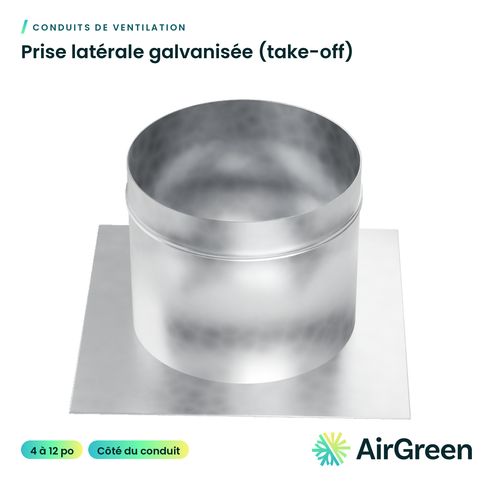 Galvanized Side Take-Off
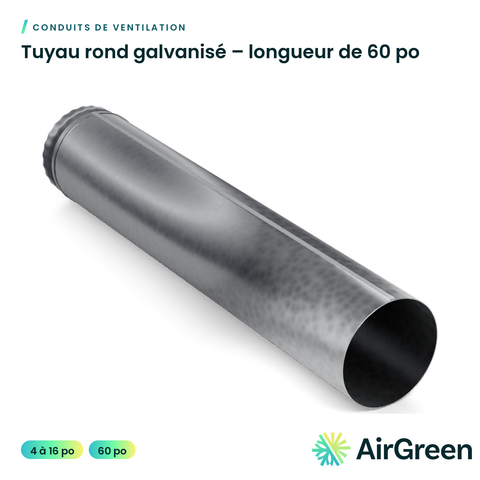 Galvanized Round Pipe – 60 in Length
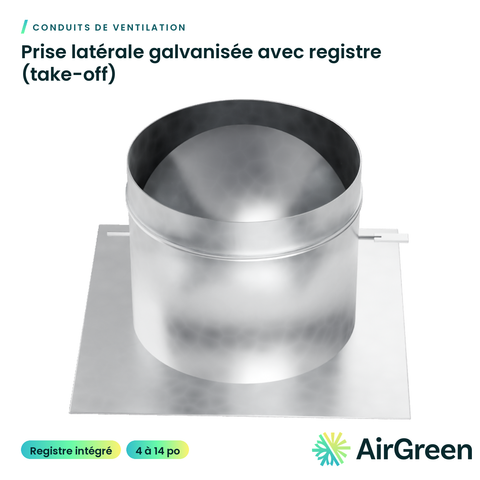 Galvanized Side Take-Off with Damper
 Galvanized Round Backdraft Damper
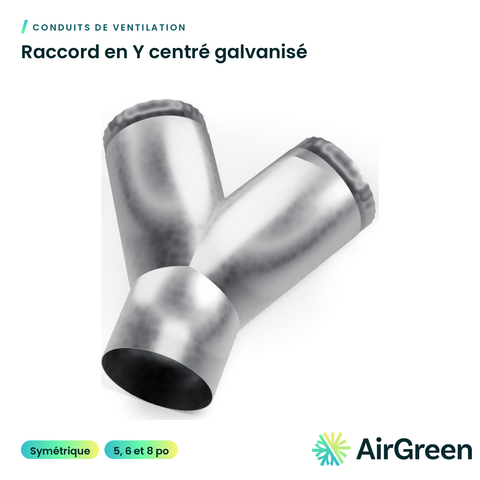 Galvanized Centred Y Fitting
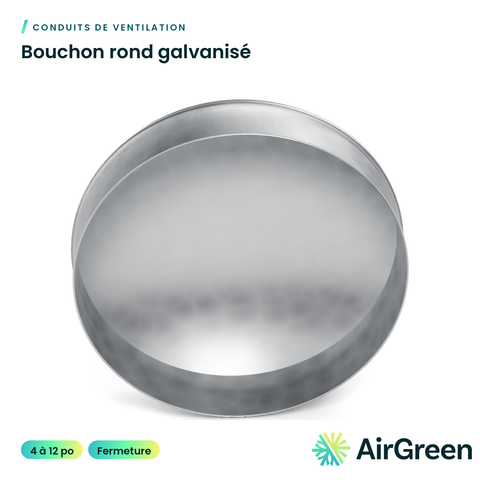 Galvanized Round End Cap
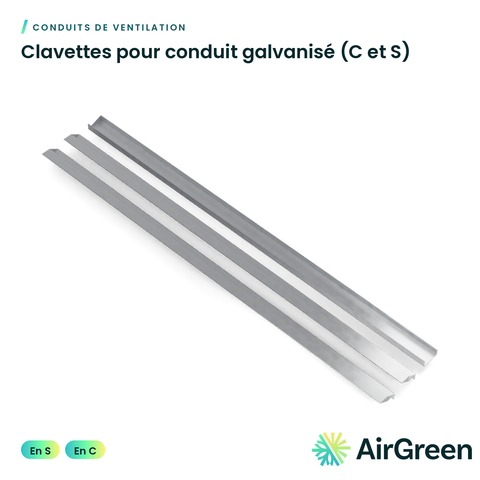 Cleats for Galvanized Duct (C and S)
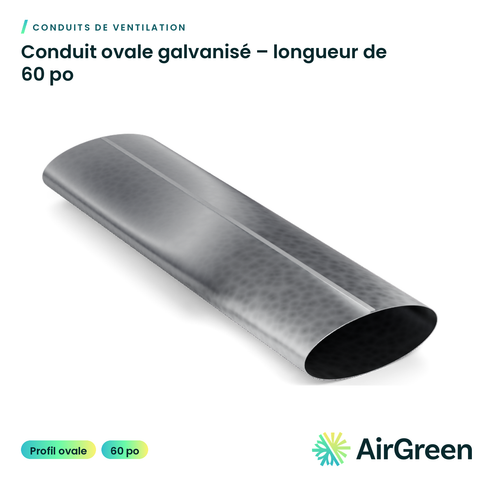 Galvanized Oval Duct – 60 in Length
Ventilation ductsSee all
Frequently asked questions
Where should the damper go?
On the branch, in a straight and reachable run, ideally near the trunk. Avoid placing it hard against an elbow.
Can I close a branch completely?
Better not to fully close forced-air branches: the equipment needs enough total airflow. Cut back the rooms that get too much instead.
Damper or backdraft damper?
A damper is set by hand and stays where you put it. A backdraft damper opens by itself when air flows and closes when it stops, to block return air.
Can you balance my system?
Yes. We install dampers and set airflow room by room on our jobs across Greater Montréal.
Precise airflow, room by room
Tell us the size and the quantity: we confirm availability and send you a quote. Or let our technicians install it for you.
Specifications from the manufacturer’s documentation, checked on October 7, 2026.