
Service Call for a Central Heat Pump in Laval-Ouest

What we checked
Items tick as you read the diagnosis.
A central rooftop heat pump that was cooling poorly: an accurate HVAC diagnosis in a cluttered mechanical space
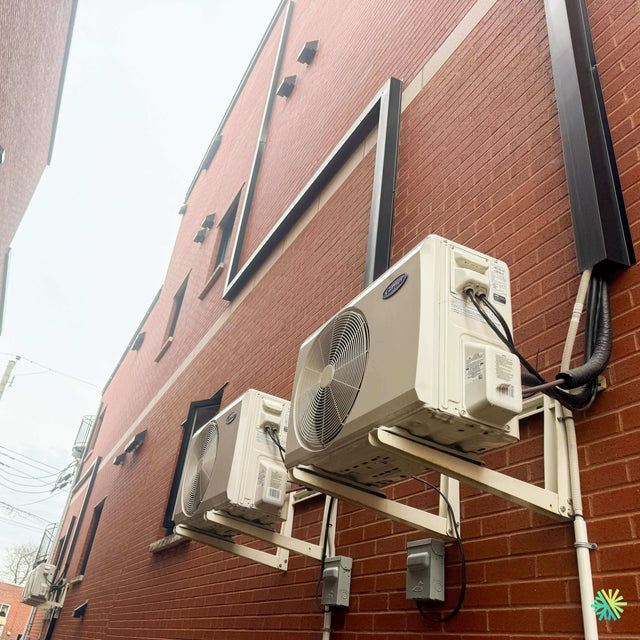
In Laval-Ouest, our AirGreen team responded to a HVAC service call on a central heat pump installed in an outdoor mechanical area, surrounded by several other air conditioning and heating units. The outdoor unit, visible on site with its top fan, side refrigerant connections, dedicated electrical supply, and placement on a wooden base, served the comfort of a residence connected to a duct network. The client contacted us because the system was still running but no longer able to maintain a stable indoor temperature.
The main symptom was a loss of cooling performance. The heat pump started, the outdoor fan ran, air circulated through the ducts, but the house remained too warm on sunnier days. The client also noticed that cycles were longer than before and that the outdoor unit seemed to produce a louder noise at startup. In a central system, this type of problem can come from several causes: insufficient airflow in the ducts, clogged outdoor coil, weakened condenser, worn contactor, abnormal refrigerant pressure, tired fan motor, or restriction in the circuit.
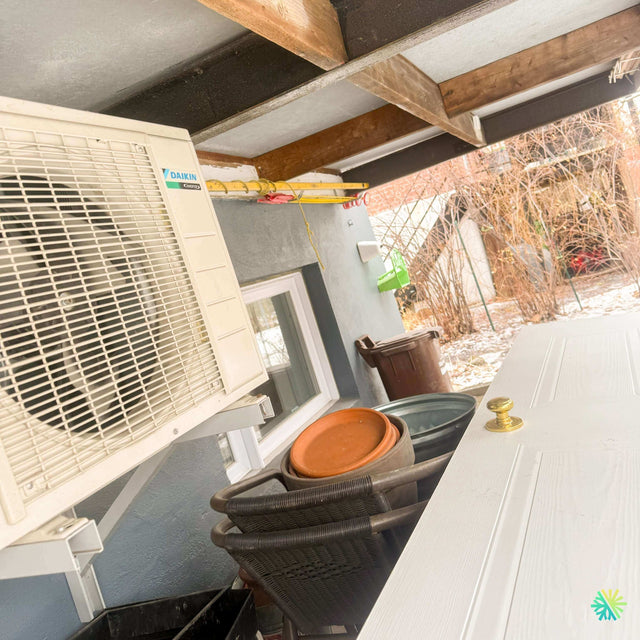
From the moment we arrived, one element caught our attention: the unit’s environment. The device was placed in a dense mechanical area, with several nearby condensers, wiring close by, gravel, support bases, and roofing elements. In this type of installation, technical access, air circulation, and the condition of the condenser become essential. A central heat pump can be mechanically sound but lose much of its efficiency if it poorly rejects heat due to a dirty coil, a weakened fan, or insufficient clearance.
An outdoor central unit exposed to dust, debris, and roofing stresses
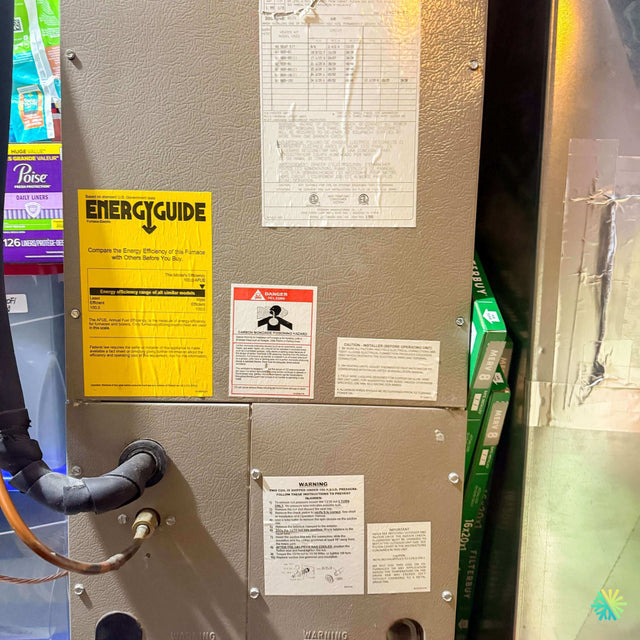
The outdoor unit inspected in Laval-Ouest had the characteristics of a residential central heat pump connected to a furnace or an indoor air handling unit. The exact BTU capacity had to be confirmed by the nameplate, but the device’s size generally corresponded to a central residential installation, often in a range of about 24,000 to 36,000 BTU depending on the area served, building insulation, and duct configuration.
On top of the unit, the fan cover showed an accumulation of dust and dirt. The condenser fins, meanwhile, had to be carefully inspected because dirt is not always visible from the front. On a roof or in an outdoor mechanical area, devices easily draw in fine particles: dust, pollen, small debris, roofing residues, dry leaves, mineral dust from gravel, and dirt carried by the wind.
This buildup can create a significant problem. The condenser must reject the heat absorbed inside the house. If the outdoor coil is dirty, pressure increases, the compressor works harder, the fan runs longer, and the system delivers less cooling. The client then perceives an uncomfortable house, even if the heat pump seems to be "working."
Symptoms reported by the client
During the call, the client described several signs that already guided our diagnosis:
- the house took too long to cool down;
- the air blown through the registers seemed less cool than before;
- the outdoor unit started with a sharper noise;
- the cycles were prolonged;
- the system seemed to work better in the morning than during periods of high heat;
- no major internal water leaks had been observed;
- the thermostat responded normally, but the requested temperature was difficult to reach.
This last point is particularly revealing. When a central heat pump works better in the morning than in the afternoon, the heat rejection capacity of the outdoor unit must be checked. A compressor may still start, a fan may still run, but if heat exchange is limited, performance drops as soon as demand increases.
Electrical inspection: contactor, capacitor, and connections
We started by securing the intervention and inspecting the power supply of the unit. On a central heat pump, the external electrical components undergo heavy stress: heat, humidity, vibrations, frequent cycles, and exposure to temperature variations. The side panel was opened to check the condition of the contactor, the run capacitor, the connections, the low voltage control wires, and the power wiring.
The contactor showed normal wear signs, with contacts marked by repeated cycles. The capacitor was tested to verify its actual capacity against its nominal value. A weakened capacitor may allow the fan motor or compressor to start but with more difficulty, more noise, and higher consumption. In some cases, the machine still runs but starts poorly, heats up more, and eventually breaks down on a hot day.
In this specific case, our diagnosis revealed a weak capacitor and a contactor that needed close monitoring. The priority was to stabilize startup, reduce electrical stress, and prevent a complete failure. We therefore replaced the faulty part and corrected the necessary connections.
Inspection of the outdoor fan and air discharge
The top fan is a critical component on this type of unit. It must pull air through the outdoor coil and expel heat upwards. If the motor weakens, if the blades are unbalanced, if the grille is clogged, or if airflow is disrupted by the environment, the heat pump quickly loses efficiency.
During our inspection in Laval-Ouest, we checked:
- the fan rotation;
- the motor noise;
- the stability of the blades;
- the condition of the top grille;
- vibrations at startup;
- the hot air discharge;
- the presence of dust on the cover and around the opening.
The fan was working, but the environment and dirt buildup contributed to less efficient heat dissipation. Simple mechanical operation is not enough: the actual airflow must be adequate. A central unit can appear to be running while operating under poor conditions.
Condenser cleaning and improved heat exchange
After electrical checks, we performed a technical cleaning of the outdoor unit. The goal was not only to improve the heat pump’s appearance but to restore airflow through the coil. In central systems, cleaning the condenser can directly impact operating pressure, discharge temperature, and cycle duration.
We removed accessible dirt, cleared critical areas, and cleaned the coil using a method suited to the condition of the unit. It is important to avoid damaging the fins, as they are thin and can easily bend. A poor cleaning method can further reduce airflow instead of improving it.
After cleaning, the air discharge was more consistent. The compressor operated under better conditions, and the performance tests showed a more stable response. For the client, this resulted in improved indoor comfort and a heat pump that no longer behaved as forcefully as it did initially.
An HVAC repair that restored performance without unnecessary replacement
The goal of a good HVAC service call is not to replace a device as soon as it shows a sign of weakness. Our role is to determine whether the failure comes from a specific component, lack of maintenance, poor installation conditions, or excessive general wear. In this case in Laval-Ouest, the central heat pump could still be reliably put back into service with a targeted intervention.
Operation tests after repair
Once the corrections were made, we restarted the unit and observed its behavior over a full cycle. Tests focused on startup, fan operation, compressor stability, thermostat response, outdoor air rejection, and indoor supply air temperature.
The system restarted more cleanly. The initial noise was reduced, the outdoor fan ran more steadily, and the heat pump seemed to evacuate heat better. Inside, the air distributed through the ducts was more consistent, which confirmed that the problem was not only related to the indoor unit or thermostat.
We also recommended that the client monitor performance during the hottest days. On an older central heat pump or one installed in a demanding environment, it is important to validate behavior under real conditions, not just during a few minutes of testing.
Why diagnosis was more important than simply replacing a part
Many owners think a central air conditioning problem comes down to a broken part. In reality, HVAC failures are often the result of a combination of factors. In this case, the weakened condenser explained part of the difficult startup, but the dirty condenser also contributed to the loss of performance. If we had only replaced the electrical part without cleaning the unit, the system would have continued to work too hard. Conversely, cleaning without electrical testing would not have fixed the startup weakness.
It is this comprehensive approach that distinguishes a lasting repair from a temporary fix. A central heat pump repair must take into account electricity, refrigerant, ventilation, heat rejection, installation environment, and the actual system behavior.
Common mistakes to avoid with a central rooftop or mechanical zone heat pump
The intervention in Laval-Ouest highlighted several common mistakes observed on central installations in Montréal, Laval, Longueuil, on the North Shore, and the South Shore.
The first mistake is neglecting access around the unit. Even if the device is installed outside, it must be able to breathe and be properly maintained. A cluttered area complicates repairs and can hinder airflow.
The second mistake is waiting for the system to stop completely. A heat pump that starts more noisily, cools less, or runs longer is already sending signals. Preventive intervention often costs less than a major compressor failure.
The third mistake is believing the thermostat is always the cause. The thermostat may be well programmed and working correctly, while the outdoor unit can no longer provide the necessary capacity.
The fourth mistake is adding refrigerant without a complete diagnosis. A lack of performance does not automatically mean a leak. Before talking about recharging, airflow, condenser cleanliness, electrical components, and operating temperatures must be checked.
Signs indicating that a service call is necessary
A central heat pump should be inspected quickly if any of the following symptoms appear:
- less cool air at the registers;
- abnormally long cycles;
- louder noise at startup;
- circuit breaker trips;
- very hot or very noisy outdoor unit;
- outdoor fan hesitates or does not start;
- unusual frost on refrigerant lines;
- uncomfortable home despite a normal setting;
- unexplained increase in electricity consumption.
These signs do not all mean the machine is at the end of its life. Many problems can be fixed with accurate diagnosis and targeted repair. The important thing is to intervene before repeated stress damages the compressor or the ventilation motor.
AirGreen expertise for residential central systems
AirGreen regularly services central heat pumps, electric furnaces, air treatment systems, wall units, MultiZone systems, and HVAC accessories in Greater Montreal. Our approach is based on a complete understanding of the system, not just the unit visible outside.
In a central installation, the outdoor unit is only part of the potential problem. Comfort also depends on the indoor fan, indoor coil, filter, ducts, thermostat, registers, drainage, and the actual capacity of the unit. When a client calls us about reduced performance, we look for the real cause before proposing a solution.
In Laval-Ouest, this method helped avoid premature replacement. The client received a more stable heat pump, improved cooling, and a better understanding of the condition of their installation.
Final result: comfort restored and operation stabilized
At the end of the intervention, the central heat pump operated with a more stable start, better air discharge, and improved cooling performance. Cleaning the condenser, electrical checks, and replacing the weakened component helped reduce stress on the unit. The client was reassured that the system could still be used while understanding the points to monitor for upcoming seasons.
This type of service call perfectly illustrates the importance of professional intervention. A central heat pump installed in an outdoor mechanical area requires more than just a quick look. It must be inspected using a clear method, with concrete tests and a thorough analysis of the operating conditions.
Central heat pump repair service in Laval-Ouest and Greater Montreal
AirGreen offers a full HVAC repair service for residential central systems in Laval-Ouest, Montreal, Laval, Longueuil, on the North Shore and the South Shore. Whether your central heat pump cools less, makes noise, starts with difficulty, freezes, trips the breaker, or runs without reaching the requested temperature, our team can perform an accurate diagnosis and offer the right solution.
A central unit represents a significant investment. Before deciding it needs to be replaced, a well-executed service call can reveal a simpler, faster, and more cost-effective solution. At AirGreen, we always prioritize a logical, transparent repair tailored to the actual condition of the system.
The same service at your place?
Cleaning, repair or maintenance: tell us about your unit and we schedule the visit.
- RBQ licence 5645-9605-01Subclasses 15.8, 15.10 and 16
- $5M liability insuranceOn every job
- 15+ yearsFamily-owned, based in Montréal