Repair of a Carrier Wall-Mounted Heat Pump in Montreal
| Service | Repair | Unit | Wall-mounted heat pump |
|---|---|---|---|
| Brand | Carrier | Area | Montréal |
| Published | October 20, 2026 | Reading | 10 min |
Attachment 1 · job photo

An intermittent failure on a Carrier wall-mounted heat pump installed high on a brick wall
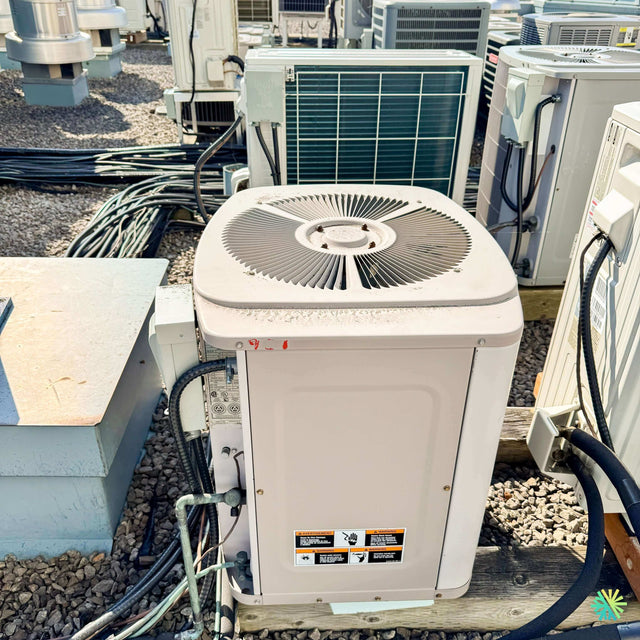
During a service call in Montreal, our AirGreen team worked on a Carrier wall-mounted heat pump installed at the back of a brick residential building, in a typical setup for plexes, condos, and multi-unit buildings found in several central neighborhoods of the city. On site, several outdoor units were mounted on metal wall brackets, with refrigerant lines, electrical cables, and protective conduits running along the rear facade.
The client had contacted us about a problem that had become increasingly common: the heat pump would sometimes run, then stop without warning. At other times, the indoor unit would blow air, but the temperature wouldn’t match the setpoint. In cooling mode, comfort was uneven; in heating mode, the system sometimes seemed hesitant before starting. This type of symptom can have several causes: lack of refrigerant, coil blockage, weakened condenser, faulty electronic board, poor electrical contact, inadequate drainage, or unstable communication between the indoor unit and the outdoor condenser.
At AirGreen, we approach this kind of situation with a structured method. A successful HVAC repair is not just about randomly replacing a part. It’s necessary to understand the machine’s actual behavior, confirm electrical and refrigeration measurements, inspect the physical installation, and check the immediate environment of the outdoor unit. In this particular case, access to the units was already a technical challenge: the condensers were installed high up, on wall mounts, in a narrow passage between two buildings.
An outdoor installation that required a thorough inspection
The Carrier wall-mounted heat pump inspected was a compact outdoor mini-split unit, connected to an indoor wall unit. The exact capacity was not clearly readable from a distance on the service photo, but the device’s size matched a common residential application, typically used to cool and heat an open area, a dwelling, a main room, or a section of a condo.
Upon our arrival, we paid attention to several visible elements:
- the overall condition of the outdoor condenser;
- the sturdiness of the wall mounts;
- the presence of vibrations or resonance;
- the condition of refrigerant fittings;
- the protection of cables and refrigerant lines;
- the drainage of defrost water;
- the proximity between outdoor units;
- the airflow around the fan;
- the condition of electrical boxes and disconnect switches.
In buildings in Montreal, Laval, Longueuil, the North Shore, and the South Shore, we often see similar installations: several outdoor wall units grouped on a rear facade, with little space to work and an environment exposed to the elements. This context directly influences the diagnosis. A unit that works properly in an open environment can lose efficiency when poorly ventilated, too close to an opposite wall, clogged with alley dust, or subjected to repeated freeze-thaw cycles.
Symptoms reported by the client
The client described three main symptoms to us:
- The heat pump would start, then stop after a certain time.
- The outdoor fan sometimes seemed to run slower than usual.
- The indoor temperature no longer matched the demand, especially on colder or very humid days.
These clues pointed us toward a potential problem on the outdoor unit side. In many cases, a Carrier wall-mounted heat pump may seem functional indoors, while the outdoor condenser fails to maintain the pressure, airflow, or necessary electrical sequence. The client had also noticed a slight abnormal noise at startup, like a short buzzing before the fan fully activated.
First step: electrical safety and visual inspection
Before any handling, our technicians cut the power at the outdoor disconnect switch. This step is essential, especially when working on a unit installed at height with visible cables and exposed electrical boxes. We then inspected the disconnect switch, the connections, the condition of the wiring, and the possible presence of moisture in the box.
During this intervention, we noted slight oxidation on some connections, as well as significant dirt buildup in the lower part of the condenser. The outdoor coil showed an accumulation of dust, urban debris, and compacted dirt. This was not enough to immediately conclude the cause of the failure, but it was an obvious aggravating factor.
A Carrier outdoor condenser must breathe freely. When the coil is blocked, the machine has to work harder to exchange heat. This can cause increased pressure, shorter cycles, loss of efficiency, protective shutdowns, and premature wear of some components.
Electrical diagnosis: a weakened capacitor and an unstable contact
After the visual inspection, we performed electrical measurements. The outdoor fan capacitor test showed a value below the expected range. A weakened capacitor can produce exactly the observed symptoms: hesitant start, irregular fan, humming noise, intermittent shutdown, and reduced performance.
We also checked the contactor, connection terminals, and control signals. A slightly loose connection was found in the electrical compartment. This type of problem is common on units exposed to vibrations, temperature variations, and humidity. Even when a connection still seems functional, poor contact can create resistance, cause local heating, or temporarily interrupt electrical communication.
The final diagnosis combined two elements: a weakened outdoor fan capacitor and an unstable electrical connection. The coil's dirt buildup also contributed to the overall performance loss.
Service performed on the Carrier wall-mounted heat pump
Our team replaced the faulty capacitor with a part compatible with the device's specifications. We then tightened and secured the problematic connection, inspected the other terminals, and checked the wiring integrity. The electrical area was cleaned and inspected to reduce the risk of recurrence.
We also performed targeted cleaning of the outdoor coil. This step is important: replacing a part without correcting the operating conditions can provide a temporary result, but the machine is likely to break down again more quickly. The cleaning improved airflow through the condenser and reduced the system's workload.
The main steps of the repair were as follows:
- safe power shutdown of the outdoor unit;
- opening of the service panel;
- inspection of electrical components;
- capacitor testing;
- replacement of the weakened capacitor;
- fixing an unstable electrical contact;
- cleaning of the outdoor coil;
- fan check;
- power restoration;
- test in cooling and heating mode;
- control of start and stop cycles;
- operation validation with the customer.
Refrigeration check and performance after repair
After restarting, we let the heat pump run long enough to observe a full cycle. The outdoor fan started normally, without hesitation or abnormal noise. Temperatures measured at the indoor unit were much more stable, and the machine responded correctly to the setpoint.
We also checked for signs that could indicate a refrigerant leak: abnormal frost, excessive performance drop, inconsistent pressure, visible oil near fittings, or unstable compressor behavior. No obvious signs of an active leak were found during the intervention. The main problem was indeed electrical and mechanical, with a secondary impact related to dirt buildup.
For the customer, the result was immediate: the Carrier wall-mounted heat pump returned to regular, quieter, and more predictable operation. The part started reaching the requested temperature again without premature shutdown.
What this Carrier repair in Montreal shows about wall-mounted heat pump maintenance
A wall-mounted heat pump can operate for years with little intervention, but that doesn’t mean it can be ignored. In Montreal, outdoor units are exposed to harsh conditions: snow, ice, humidity, alley dust, leaves, vibrations, freeze-thaw cycles, summer heat, and sometimes limited ventilation space. On brick buildings, especially when several condensers are installed on the same facade, the environment can accelerate wear on certain components.
Why a small component can cause a major failure
The capacitor is a small but essential part. It helps the fan motor or compressor start properly and maintain stable operation. When it weakens, the machine may still run at times, making diagnosis more complex for the customer. The device does not always fail completely; it simply becomes less reliable.
Here are some typical signs of a weakened capacitor or an electrical problem on a wall-mounted heat pump:
- buzzing noise at startup;
- outdoor fan that starts slowly;
- intermittent shutdown;
- indoor unit that blows air without really heating or cooling;
- circuit breaker that trips occasionally;
- normal operation some days, then failure the next day;
- loss of efficiency without apparent reason.
In this type of situation, it is best to avoid repeated restarts. Forcing a machine to restart multiple times can worsen the problem and damage other more expensive components, including the fan motor, electronic board, or compressor.
Mistakes to avoid before a HVAC service call
When a Carrier, Fujitsu, Gree, Mitsubishi, Sharp, Lennox, or other brand wall-mounted heat pump starts to operate intermittently, certain actions can worsen the situation. We recommend avoiding:
- repeatedly resetting the circuit breaker;
- hitting or shaking the outdoor unit;
- spraying the condenser with too much pressure;
- opening electrical panels without training;
- replacing a part without diagnosis;
- automatically assuming refrigerant is missing;
- ignoring an unusual startup noise.
In this intervention in Montreal, the client was wise to call us before the breakdown became complete. The problem was fixed without major replacement of the unit. A later intervention could have caused additional wear on the motor or compressor.
A particular challenge: outdoor units installed at height
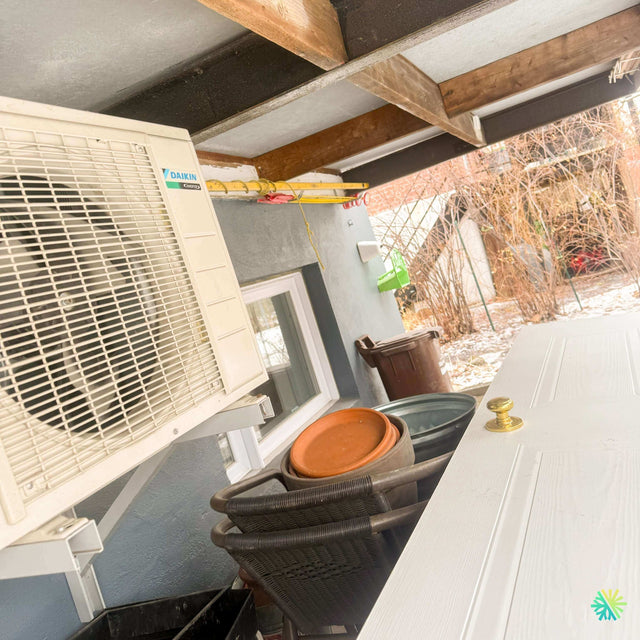
The service photo shows a very common context for AirGreen: outdoor condensers installed on wall mounts, in a narrow area, on a rear brick facade. This type of installation requires experience. Work must be done cleanly, access secured, existing ducts protected, and damage to neighboring systems avoided.
When there are multiple units side by side, it is also important to ensure that each heat pump properly dissipates its heat and that the fans do not interfere with each other. Poor air circulation can reduce efficiency, increase operating pressure, and cause noise or performance complaints.
Our AirGreen technicians are familiar with this type of setup in residential buildings and condominiums in Montreal, Laval, Longueuil, the North Shore, and the South Shore. Each intervention requires a full assessment of the environment, not just the machine.
Practical tips to extend the lifespan of a Carrier wall-mounted heat pump
After the repair, we gave the client some simple recommendations to maintain the system's performance:
- have the indoor unit cleaned regularly;
- keep the outdoor unit clear;
- check that nothing is blocking the fan;
- monitor unusual noises;
- avoid repeated on-off cycles;
- schedule preventive HVAC maintenance;
- have any performance drop inspected quickly;
- do not wait for an intermittent breakdown to become permanent.
Regular maintenance often helps spot problems before they become costly. On a Carrier wall-mounted heat pump, proper cleaning and electrical inspection can make a big difference in stability, energy consumption, and indoor comfort.
Final result: comfort restored and client reassured
At the end of the intervention, the heat pump was operating normally in both cooling and heating modes. The outdoor fan responded correctly, the startup was stable, and the indoor unit produced a temperature consistent with the demand. The client was able to resume normal use of their system without considering a full replacement.
This repair clearly shows the importance of an accurate diagnosis. A breakdown that seems major can sometimes be fixed by a targeted intervention, provided the right components are checked in the right order. At AirGreen, our priority is to offer the most logical, durable, and best-suited solution to the actual condition of the device.
Why choose AirGreen for a Carrier wall-mounted heat pump repair
AirGreen regularly works on wall-mounted heat pumps, wall air conditioners, MultiZone heat pumps, central systems, PTAC / VTAC units, and HVAC accessories in Greater Montreal. Our teams understand the realities of urban buildings, condominiums, multiplexes, single-family homes, and light commercial buildings.
For a repair of a Carrier wall-mounted heat pump in Montreal, our approach stands out by:
- a complete diagnosis before any recommendation;
- rigorous electrical and mechanical inspection;
- special attention to the existing installation;
- clear communication with the client;
- solutions adapted to the real context;
- field expertise on residential and multi-unit HVAC systems.
Whether it’s an intermittent breakdown, an unusual noise, a loss of performance, a drainage problem, a clogged coil, a defective motor, or an electrical issue, our team can intervene with method and precision.