Service Call for a Fujitsu Wall-Mounted Heat Pump in Saint-Bruno
| Service | Service call | Unit | Wall-mounted heat pump |
|---|---|---|---|
| Brand | Fujitsu | Area | Saint-Bruno-de-Montarville |
| Published | October 15, 2026 | Reading | 10 min |
Attachment 1 · job photo

A Fujitsu Halcyon heat pump that was no longer meeting the heating demand in Saint-Bruno
In Saint-Bruno, on the South Shore of Montreal, our AirGreen team was called for a HVAC service call concerning a Fujitsu Halcyon wall-mounted heat pump installed outdoors on a metal support against a brick wall. The client had noticed a drop in performance for some time: the machine would start, seem to run for a few minutes, then lose intensity. Inside, the blown air was no longer as warm as before, especially during cooler mornings.
This type of symptom may seem simple, but in the case of an inverter wall-mounted heat pump, several elements can be involved: air restriction, faulty sensor, communication problem between the indoor and outdoor units, unstable power supply, electronic board, outdoor fan, lack of refrigerant, or partial obstruction of the outdoor coil. Our role is to avoid quick conclusions and proceed with a complete diagnostic method, step by step.
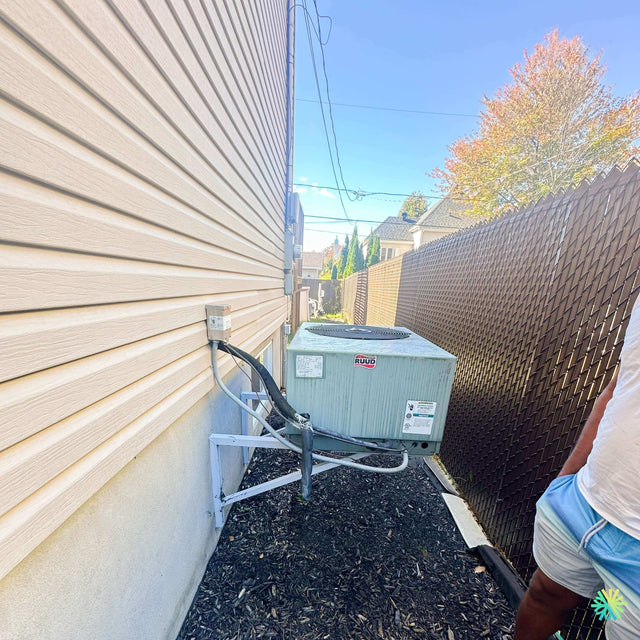
On site, the Fujitsu outdoor unit was clearly visible: installed on an elevated base, near an electrical disconnect switch, with refrigerant lines protected by an insulated conduit. The environment also showed several important clues: dead leaves accumulated around the base, a relatively tight lateral space between two wooden structures, and direct exposure to the brick wall, which can influence air circulation around the condenser.
A compact but demanding wall-mounted heat pump type machine
The observed machine corresponds to a Fujitsu wall-mounted heat pump, from the Halcyon series, a very common residential system in Greater Montreal. This type of system consists of a wall-mounted indoor unit and a compact outdoor condenser. Unlike a central heat pump, it does not rely on a complete duct network, which makes it particularly popular for houses, condos, extensions, and targeted residential spaces.
Even though the condenser seems compact, a wall-mounted heat pump is a complete technical system. The outdoor unit notably contains:
- an inverter compressor;
- an outdoor fan;
- a power electronic board;
- temperature sensors;
- an outdoor heat exchanger;
- electrical and communication connections;
- valves and refrigeration components.
In this specific case, the client did not report a total breakdown, but rather a loss of efficiency. This is often more complex to diagnose than a completely stopped machine because the system is partially working. So, it’s necessary to check not only if the machine starts but also if it operates correctly under real load.
Symptoms observed before our arrival
The client had noticed three main problems. First, the heat pump took much longer than before to reach the requested temperature. Next, the outdoor unit sometimes seemed to slow down or stop while the indoor demand was still active. Finally, a slight vibration noise was heard near the condenser during certain operating phases.
These signs pointed us toward a full performance diagnosis, rather than a simple random part replacement. An effective HVAC repair always starts with understanding the machine’s actual behavior: when does the problem occur, in heating or cooling, at startup or after several minutes, in mild or colder weather, with what temperature setting, and how often?
In Saint-Bruno, as in Montreal, Laval, Longueuil, on the North Shore and the South Shore, wall-mounted heat pumps are heavily used. They must handle significant temperature variations, humidity, defrost cycles in winter, leaves in autumn, and sometimes installation conditions that limit outdoor ventilation. All these factors can affect performance.
Visual inspection of the outdoor installation
The first step was inspecting the outdoor unit. The Fujitsu condenser was installed on a metal stand, which is generally preferable to direct ground installation, especially in Quebec’s climate. This helps protect the unit from snow buildup, ground-level moisture, and certain debris.
However, the immediate environment had some issues to address. Leaves were present around the unit and near the bottom of the condenser. Although this may seem minor, an accumulation of leaves can reduce airflow, retain moisture, and promote dirt buildup on the outdoor coil. Over time, the system has to work harder to transfer heat, which can cause a drop in performance, longer cycles, and sometimes protective shutdowns.
We also checked the available space around the unit. In this type of installation, air circulation is essential. A heat pump does not simply produce heat or cold: it exchanges heat with the outside air. If air circulation around the condenser is poor, the machine loses efficiency. This can become even more apparent during periods of high demand.
Electrical check and communication between units
After the visual inspection, our technician performed an electrical check. The outdoor disconnect switch, visible connections, and communication wiring were inspected. On a Fujitsu wall-mounted heat pump, a communication anomaly can cause intermittent behaviors: incomplete startup, unpredictable shutdown, error code, or reduced operation.
In this case, a slightly loose connection in the outdoor communication wiring was identified. This kind of problem can be hard to spot because the machine may operate normally for a while, then react differently depending on vibrations, humidity, or electrical load. The wire was not completely disconnected, but the contact was not optimal.
We then secured the connections, checked the tightness, inspected the condition of the wires, and tested the communication stability between the indoor and outdoor units. This step was essential before proceeding further, as replacing an electronic board without validating the connections would have been a costly and unnecessary mistake.
Targeted cleaning of the condenser and clearing of the base
The next step was targeted cleaning of the outdoor unit. Without turning the service call into full maintenance, we removed debris around the base and inspected the outdoor coil. The coil was not completely blocked, but it had enough dust and residue to affect performance.
A dirty outdoor coil forces the compressor to work harder. In heating mode, the heat pump must extract heat from the outside air. If the exchanger breathes poorly, the system loses efficiency. In cooling mode, the problem appears differently: poor heat dissipation, higher operating pressure, less stable cooling.
We therefore cleared the sensitive areas, cleaned the accessible surfaces, and recommended more thorough maintenance during the next seasonal cycle. For devices exposed to leaves, dust, and landscaped areas, regular maintenance can make a significant difference in the compressor's lifespan and system stability.
Outdoor fan and vibration check
The noise reported by the customer was then evaluated. The outdoor fan was working, but a slight vibration was noticeable during a speed change. On an inverter heat pump, the speed varies according to demand; some noises may therefore appear only at specific speeds.
Our technician checked the fastening points, the stability of the metal support, vibrations transmitted to the wall, and elements that could touch the unit or the refrigerant line duct. Part of the noise came from slight contact between the line protection and a rigid element near the unit. This contact amplified the vibration when the compressor changed speed.
We repositioned and secured the affected section to reduce sound transmission. This type of correction seems simple but is very important for the customer's comfort. A heat pump can function mechanically well while generating unpleasant noise if a vibration is transmitted to a nearby structure.
Diagnosis confirmed, correction made, and performance stabilized
After electrical checks, targeted cleaning, and vibration correction, we restarted the Fujitsu wall-mounted heat pump in heating mode. The system was observed during a full cycle to validate its behavior. The indoor unit responded correctly to the demand, the outdoor unit maintained its operation, and the blown air temperature was more stable.
The final diagnosis combined several factors: an external communication connection to tighten, a slight restriction due to the external environment, and a vibration amplified by the positioning of an element near the condenser. No major replacement was necessary during this call, which is excellent news for the customer.
Why the diagnosis should not stop at the first symptom
In many service calls, the risk is focusing on a single symptom. A machine slowing down might suggest a refrigerant shortage. A vibration might suggest a faulty fan. A drop in heating might suggest a worn-out compressor. However, in this case, the problem was mainly due to installation, environment, and connection details.
At AirGreen, we prioritize a comprehensive approach because a poorly diagnosed heat pump repair can lead to unnecessary expenses. Replacing an electronic board, adding refrigerant, or ordering a fan motor without clear evidence can be costly for the customer without addressing the real cause of the problem.
Our service in Saint-Bruno prevented this scenario. The Fujitsu system was tested, corrected, and restored to stable operation without major replacement.
Mistakes to avoid with an outdoor wall-mounted heat pump
This service illustrates several common mistakes we observe in the field, both in Montreal and Laval, Longueuil, on the North Shore and the South Shore.
Allowing leaves to accumulate around the condenser
Dead leaves, twigs, and debris may seem harmless but harm ventilation. They can also retain moisture near the base of the unit. Regular visual checks are recommended, especially in the fall.
Ignoring small vibration noises
A slight noise can become more significant over time. It may also indicate that a duct, fastener, or guard is touching a surface that amplifies the sound. Fixing it early often prevents comfort degradation.
Jumping to the conclusion of a refrigerant shortage too quickly
A drop in performance is not automatically caused by a refrigerant leak. Before adding refrigerant, ventilation, temperatures, pressures, sensors, electricity, and communication must be checked.
Neglecting clearance around the outdoor unit
A heat pump needs to breathe. When installed near a wall, fence, wooden structure, or landscaping, ensure proper air circulation.
Result for the client: more stable heating and quieter operation
At the end of the service, the client noticed a clear improvement in performance. The airflow was more consistent, intermittent shutdowns no longer occurred during tests, and external vibration was reduced. The client also received simple recommendations to maintain their machine’s performance: keep the area around the condenser clear, monitor leaf buildup, and schedule periodic maintenance.
For a Fujitsu heat pump, operational stability depends as much on the quality of the machine as on its environment. Proper installation and maintenance help extend the system's lifespan and maintain reliable comfort during heating and cooling seasons.
AirGreen expertise in residential HVAC repair
Our team regularly works on Fujitsu, Gree, Sharp, Daikin, Mitsubishi, Midea, Tosot, York, Trane, and many other brands of wall-mounted heat pumps, wall air conditioners, central heat pumps, multi-zone systems, and residential HVAC equipment. Each brand has its particularities, but our method remains the same: observe, test, confirm, correct.
In this case in Saint-Bruno, field experience was decisive. A diagnosis based solely on an error code or reported symptom could have led to a wrong conclusion. By inspecting the outdoor unit, wiring, coil, support, vibrations, and the system’s actual behavior, we were able to solve the problem effectively.
An intervention that highlights the importance of preventive maintenance
Even a reliable machine can lose performance if exposed to debris, vibrations, or weakened connections over time. A service call is not just for fixing a breakdown; it also helps understand how the machine ages in its real environment.
For owners of wall-mounted heat pumps in Saint-Bruno and elsewhere in Greater Montreal, a professional inspection can help prevent more costly problems. A small electrical anomaly, a partially blocked coil, or insufficient clearance can reduce energy efficiency and accelerate system wear.
AirGreen for your service calls in Saint-Bruno and Greater Montreal
AirGreen offers HVAC repair, diagnostics, maintenance, and installation services for wall-mounted heat pumps on the South Shore, in Saint-Bruno, Longueuil, Montreal, Laval, and on the North Shore. Whether your unit heats less effectively, makes noise, displays an error code, leaks, freezes, or starts intermittently, our team can intervene with a structured and professional approach.
This repair of a Fujitsu wall-mounted heat pump in Saint-Bruno clearly demonstrates our way of working: not replacing unnecessarily, not guessing, not hiding the problem, but finding the real cause and restoring the system's performance.