
AirGreen job in
Repair of an electric furnace in Dorval
Stylised map, not to scale.
- Montréal
- Laval
- Longueuil
- South Shore
- North Shore
An HVAC service call in Dorval for a central furnace that was heating irregularly
During this service call in Dorval, our AirGreen team worked on a central electric furnace installed in a residential mechanical closet, connected to a duct network, a central coil, and a Honeywell humidification accessory mounted on the air return. The client had contacted us because the heating was no longer as stable as before: some rooms became comfortable quickly, while others remained cool despite a constant heating demand on the thermostat.
This type of situation requires a complete system analysis, not just a simple furnace check. A central electric furnace works with several elements that must function together: the thermostat, electrical relays or sequencers, heating elements, the fan, the filter, the ducts, the registers, the air return, and sometimes accessories like a humidifier or a central heat pump. When one of these elements causes a restriction or unstable control, comfort in the home can become very uneven.
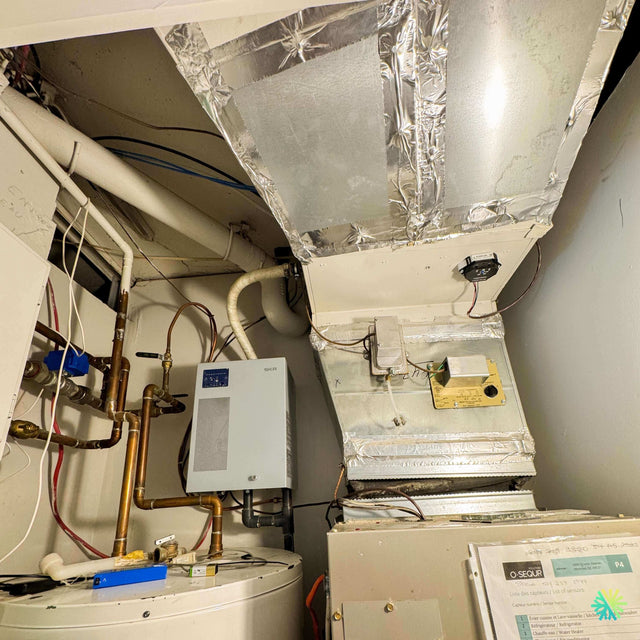
In this particular case, the mechanical environment was especially tight. The furnace was located in a storage space where several objects were piled around the unit. A flexible duct, a Honeywell humidifier, drainage fittings, a filter accessible from the bottom of the return, and several low-voltage cables around the network were also visible. For an HVAC technician, these details are important: they affect access, safety, air circulation, and the quality of the diagnosis.
A central electric furnace installed in a confined space
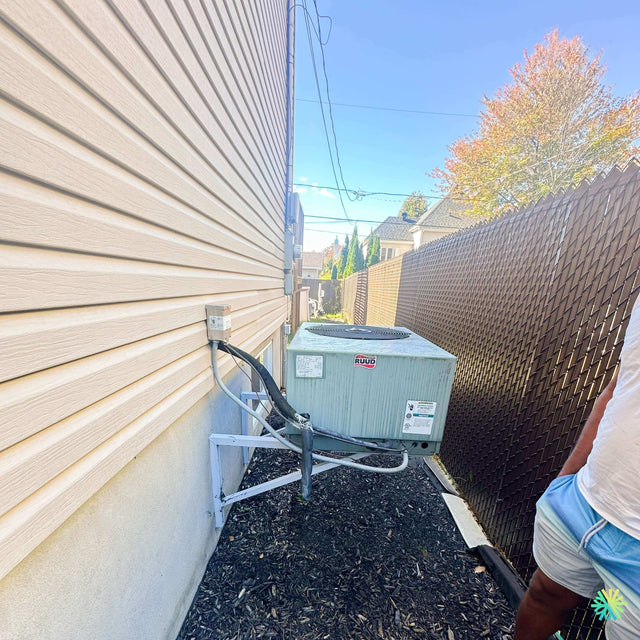
The installation observed in Dorval corresponds to a typical central system: an indoor cabinet connected to distribution ducts, with a vertical air return and a humidification accessory connected to the network. This type of configuration is common in houses in Montreal, West Island, Laval, Longueuil, the North Shore, and the South Shore.
The particularity here was the limited space around the furnace. A mechanical closet can be functional, but it must remain accessible and clear. When objects are placed against the unit, near the filter, around the drain, or in front of the access panels, it can complicate maintenance and, in some cases, harm ventilation or safety.
Our first step was therefore to secure the work area and check the visible elements before opening the service panels. On an electric furnace, this approach is essential: the overall condition of the system must be confirmed before handling the internal electrical components.
Symptoms reported before our arrival
The client described heating that was less reliable than usual. The system started, but the indoor temperature rose slowly. The ventilation sometimes seemed strong, sometimes weak, and the blown air did not always feel equally warm. These symptoms can be caused by several different problems:
- a filter that is too restrictive or poorly positioned;
- insufficient airflow in the return;
- a ventilation motor that is not running at the correct speed;
- a relay or sequencer that does not activate all the heating elements;
- a thermal safety device that cuts off part of the heating;
- an unstable thermostat or low-voltage wiring;
- a humidifier or an accessory duct poorly integrated into the air return;
- a partial obstruction in the ducts.
At AirGreen, we avoid replacing parts without confirmation. An effective HVAC repair starts with a rigorous diagnostic method. The goal is to identify the real cause of the problem, not just to temporarily eliminate the symptom.
Inspection of the filter, air return, and ducts
One of the first points checked was the airflow path. In a central system, airflow is as important as heat production. An electric furnace may have heating elements in good condition, but if the fan cannot circulate enough air, the heat will not be distributed properly.
We inspected the return section, the filter location, and the visible ducts. The presence of a clearly identified filter on the lower part of the return allowed us to check its orientation, condition, and possible impact on air restriction. A filter that is too dirty or too dense can make the furnace work harder, increase the internal temperature of the unit, and cause abnormal cycles.
We also examined the flexible ducts and visible metal fittings. A flexible duct that is too compressed, too bent, or poorly attached can reduce airflow. In a house, this can result in a poorly heated room, louder air noise, or a system that runs longer to reach the requested temperature.
Honeywell humidifier inspection
The installation also included a Honeywell humidifier connected to the duct network. This accessory is useful in winter to improve indoor comfort, especially when the air becomes very dry. However, a humidifier must be well maintained and properly integrated into the central system.
We checked:
- the visual condition of the humidifier;
- the connection to the duct;
- the pipes and wires connected to the accessory;
- the possible impact on the air return;
- the presence of water marks or abnormal condensation;
- the overall operation of the associated control.
A poorly maintained humidifier can create secondary problems: water leakage, excessive humidity in the duct, mineral buildup, air restriction, or malfunction of the control. In this project in Dorval, checking the humidifier was part of the overall diagnosis because the device was directly integrated into the return section.
Electrical diagnosis, airflow correction, and full recommissioning
Heating sequence control
After external checks, we proceeded with the electrical diagnosis of the electric furnace. On this type of device, the heating elements do not always activate all at once. They are often controlled by relays or sequencers that progressively start the heating stages. This logic prevents a sudden electrical demand and allows the fan to distribute heat properly.
Our technicians checked the heating demand at the thermostat, the furnace response, the fan activation, and the behavior of the heating stages. A common problem with an aging electric furnace is that a heating stage no longer engages properly. The system then seems to be working, but it does not deliver its full capacity.
In this case, the analysis identified a combination of two factors: air circulation that needed improvement and a heating control that required correction. The system was not completely stopped, but it no longer provided consistent performance. This is precisely the kind of situation where a professional diagnosis prevents a bad decision, such as replacing the entire furnace when a targeted intervention can restore operation.
Correction of restrictions and cleaning of critical areas
We started by correcting elements related to air circulation. The filter was checked, the return area cleared, and accessible ducts inspected. In a mechanical closet, it is important that air can circulate unobstructed and that service panels remain accessible.
We also explained to the customer that a mechanical space should not become an overly cluttered storage area. Even if some objects do not directly block a grille, they can complicate access in an emergency, hide a leak, press on a drainage pipe, or prevent quick maintenance. For a central electric furnace, clear access is a safety and performance factor.
Intervention on the electrical control
Once the airflow was verified, we proceeded with the electrical part. After testing, we performed the necessary intervention on the heating control to ensure a more stable activation of the elements. Depending on the exact furnace configuration, this intervention may involve replacing or repairing a relay, a sequencer, or a connection that no longer responds properly.
In this case, the goal was to restore a reliable heating sequence: heat call, fan startup, element activation, maintaining airflow, then controlled shutdown when the requested temperature is reached. An unstable sequence can create uneven heating and the impression of intermittent failure, even if the unit seems to be working at the time of inspection.
Operation tests after repair
After the correction, we ran a full heating cycle. This step is essential for an electric furnace. A simple startup of a few seconds is not enough to confirm that the system is repaired. The behavior must be observed during a real cycle, the stability of the blown air checked, the fan listened to, safety shutdowns monitored, and the heating stages confirmed to respond correctly.
The tests confirmed a clear improvement in operation:
- More stable startup;
- More constant blown air;
- Better distribution in the ducts;
- No abnormal shutdown during the observed cycle;
- More consistent operation between the thermostat demand and the furnace response.
The customer regained more reliable heating and received precise advice on maintenance to prevent the problem from recurring.
Practical advice given to the customer
At the end of the service call, we took the time to explain the important points. Good HVAC service is not just about fixing the device: it also helps the owner understand simple actions that protect their system.
We recommended:
- to check the filter regularly during the heating season;
- to keep the space in front of the furnace completely clear;
- to avoid storing objects against access panels;
- to monitor changes in noise in the ducts;
- to have the Honeywell humidifier checked before or during winter;
- to avoid closing too many ventilation grilles in the house;
- to request a diagnosis as soon as heating becomes irregular.
These tips are especially important in homes equipped with a central system. Air restrictions or poor controls can impact the entire residence.
Mistakes to avoid with a central electric furnace
During our interventions in Dorval, Montreal, Laval, Longueuil, on the North Shore and the South Shore, we often encounter similar situations. Many problems could have been avoided with more regular maintenance.
Replacing the thermostat too quickly
A thermostat could be the cause, but you shouldn’t start there without a diagnosis. If the furnace is receiving the heating demand properly, the problem might be in the relay, sequencer, fan, filter, or internal safety devices.
Ignoring the filter
The filter is a small component with a big impact. A dirty filter can reduce airflow, increase system pressure, and cause abnormal heating cycles.
Using the mechanical room for storage
A mechanical closet must remain accessible. Items placed near a furnace can hinder maintenance, hide leaks, block access, or complicate quick interventions.
Neglecting the humidifier
A central humidifier must be inspected. A dirty evaporator panel, problematic water supply, or poor connection can affect comfort and cause issues around the ducts.
Closing multiple registers
Closing too many air vents can unbalance the system's pressure. A central furnace is designed to work with a certain volume of air. Changing this volume without analysis can reduce performance.
An intervention that reassures the customer before the cold seasons
For the client in Dorval, the most important result was peace of mind. The furnace was not just restarted: it had been inspected, tested, and adjusted. The client now knew what signs to watch for and how to maintain their system to keep better comfort.
The repair stabilized the heating, improved air distribution, and reduced the risk of intermittent shutdowns. In a family home, this type of intervention makes a real difference, especially when the central system is responsible for the main heating.
AirGreen’s approach to HVAC repairs in Dorval
At AirGreen, we approach every electric furnace repair with a comprehensive view of the system. We don’t just look at the furnace cabinet. We also analyze the ducts, the return air, the filter, the accessories, mechanical access, electrical controls, and the actual system behavior during operation.
This method is essential for residential central systems. An apparent breakdown can have several causes. A furnace may heat less effectively because a relay is failing, because a filter is blocking the air, because a humidifier is poorly maintained, or because the duct network creates too much resistance. The right diagnosis allows for effective repair and avoids unnecessary expenses.
Electric furnace repair service in Montreal, Laval, Longueuil, North Shore, and South Shore
AirGreen offers a complete HVAC repair, maintenance, and diagnostic service for central electric furnaces in the greater metropolitan area. Whether the service call is in Dorval, Montreal, Laval, Longueuil, on the North Shore or the South Shore, our priority remains the same: understand the system, fix the root cause, and restore reliable heating to the client.
A well-maintained electric furnace can provide excellent comfort for many years. However, it should be inspected as soon as the heating becomes irregular, the blown air changes, the fan seems to struggle, or certain parts become colder. A quick intervention often resolves the problem before it becomes more costly.
The same service at your place?
Cleaning, repair or maintenance: tell us about your unit and we schedule the visit.
- RBQ licence 5645-9605-01Subclasses 15.8, 15.10 and 16
- $5M liability insuranceOn every job
- 15+ yearsFamily-owned, based in Montréal