Repair of an Electric Furnace in Mercier–Hochelaga-Maisonneuve
| Service | Repair | Unit | Electric furnace |
|---|---|---|---|
| Area | Mercier–Hochelaga-Maisonneuve | Published | October 16, 2026 |
| Reading | 9 min | ||
Attachment 1 · job photo

An HVAC service call in a dense mechanical space: irregular heating, condensate, and safety to check
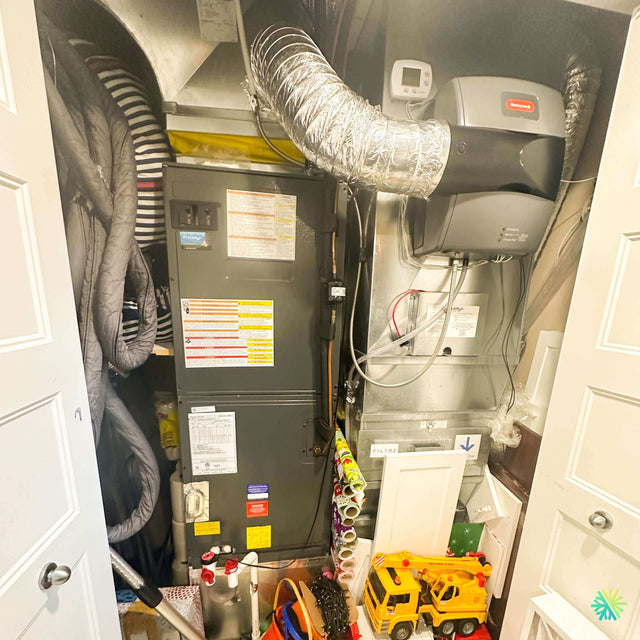
In a residential building in Mercier–Hochelaga-Maisonneuve, in Montreal, our AirGreen team intervened for an operational problem on an electric furnace installed in a particularly crowded mechanical room. The device was connected to a network of metal ducts, with an aluminum insulated section, a nearby water heater, copper plumbing, a water detection system, low voltage cables, and several visible drains. This kind of environment requires a methodical approach, as a simple symptom—lack of heating, irregular ventilation, or intermittent shutdown—can be caused by several elements around the furnace, not just the furnace itself.
The client contacted us because the system no longer provided stable comfort. At times, the air seemed to circulate normally, then the ventilation would weaken. The heating did not always respond with the same intensity, and the installation seemed to produce uneven cycles. In a Montreal home where the mechanical space is shared among several pieces of equipment, an effective HVAC repair starts with a thorough reading of the environment: ducts, drain, electrical supply, controls, air return, safety accessories, and the general condition of the connections.
On site, the machine corresponded to a residential central electric furnace, installed vertically and connected to an air distribution network. The exact model and nameplate were not readable in the provided photo, but the observed configuration matches a device used to distribute warm air in rooms, sometimes combined with an air conditioning coil or a central heat pump. In this type of system, the capacity is often between about 10 kW and 20 kW, roughly equivalent to 34,000 to 68,000 BTU/h depending on the electrical configuration and the housing demand. However, the priority was not to guess the exact power but to understand why the system was losing its consistency.
An installation where condensates could influence operation
The first element that caught attention was the presence of ducts and drains around the furnace. In many central installations, even when the call concerns heating, the condensate network must be inspected. If the unit is combined with central air conditioning or a central heat pump, the water produced in cooling mode passes through a drain or condensate pump. A blockage, incorrect slope, poorly configured trap, or partially blocked pipe can cause water accumulation, trigger a safety feature, or create moisture in the mechanical compartment.
In this specific case, the system also included a visible water detection device on the installation, which led us to check whether an alarm, a safety shutdown, or a moisture condition could have influenced the equipment's behavior. Many owners immediately think of a major failure when ventilation or heating becomes intermittent. However, a water-related safety feature, a slow drain, or poorly evacuated condensation can sometimes give the impression that the furnace is defective.
Our diagnosis therefore included an inspection of the following points:
- the condition of visible drains and condensate pipes;
- the drainage slope;
- the presence of moisture around the base of the unit;
- the operation of the safety or water detection device;
- the condition of insulated ducts;
- signs of leaks, corrosion, or overflow;
- the stability of the ventilation cycle;
- the furnace's response to a heating demand.
This approach is essential in neighborhoods like Mercier–Hochelaga-Maisonneuve, where many homes are renovated in stages. It is not uncommon to find a furnace, a water heater, plumbing lines, a water detector, and ducts added or modified over the years. The technician's job is to distinguish what is normal, what is tolerable, and what is likely to cause a short-term failure.
Electrical diagnosis and heating sequence
An electric furnace operates according to a precise sequence. The thermostat sends a request, the internal control receives the signal, the ventilation activates, then the heating elements operate in stages. If the blower motor does not provide enough airflow, if a relay becomes unstable, or if a thermal limit triggers, the system may heat irregularly.
During this service call, we tested the device's response by simulating a heating demand. The goal was to verify if the furnace correctly received the signal and if each operating step proceeded without abnormal interruption. We also paid attention to the visible low voltage cables around the installation, as a poorly secured wire, weakened connection, or exposed connection can cause intermittent shutdowns that are difficult to reproduce.
The checks focused on:
- the signal from the thermostat;
- the continuity of low voltage wires;
- the control relays;
- the blower motor response;
- the blowing temperature;
- the safety limits;
- the system behavior during several cycles;
- the clearance around the device.
We found that the problem was not a simple complete failure, but rather a combination of factors: air circulation to optimize, cluttered mechanical environment, drain to monitor, and connections to secure. This type of diagnosis is more complex than replacing a single part, but it provides a better long-term result.
Intervention performed on the electric furnace
After the diagnostic phase, we proceeded with a technical reorganization of the accessible installation. The priority was to stabilize the operation of the electric furnace and reduce the risk of recurrence. In such a confined space, every move must be precise: moving a pipe, pulling a wire, or forcing a panel can create a new problem.
The intervention included:
- complete inspection of accessible furnace panels;
- ventilation motor check;
- heating sequence test;
- thermostat signal check;
- checking low voltage electrical connections;
- localized cleaning of accessible areas around the blower;
- visual inspection of the duct network;
- checking the drain and signs of water;
- safe repositioning of certain elements around the device;
- final test in real operation.
We also advised the client to keep a clear space around the furnace and water heater. In a compact mechanical room, objects placed near the equipment can hinder ventilation, complicate service access, and hide signs of condensate or moisture problems.
The role of airflow in an electric furnace repair
Airflow is often underestimated. An electric furnace can have heating elements in good condition and still perform poorly if the air does not circulate properly. When the blower works against a too restrictive filter, a crushed duct, or an obstruction, the internal temperature can rise quickly. The device may then reduce its operation or trigger a thermal safety.
In this service call in Montreal, we paid special attention to air distribution. The visible ducts had several transitions and insulated sections. This type of network can work very well, but it must remain airtight, stable, and clean. A leak at a joint, a sag in a flexible section, or an obstruction in the air return can cause a significant loss of comfort.
We explained to the client that the performance of a central system does not depend solely on the furnace. It also depends on everything around it: ducts, grilles, air return, filter, thermostat, drains, insulation, and clearance. That is why an electric furnace repair should always be seen as an intervention on a complete system.
Common problems observed with this type of installation
Central systems installed in tight mechanical spaces often have the same types of problems. During our service calls in Montreal, Laval, Longueuil, on the North Shore and the South Shore, we regularly encounter similar situations.
Common causes include:
- dirty or overly restrictive filter;
- partially blocked air return;
- weakened blower motor;
- unstable relay or electrical sequencer;
- low voltage wire poorly secured;
- slow or clogged condensate drain;
- water detector triggered;
- poorly sealed duct;
- damaged insulation around a duct;
- thermostat misconfigured;
- thermal limit activated due to lack of airflow.
In this case in Mercier–Hochelaga-Maisonneuve, the presence of a dense mechanical environment made the diagnosis even more important. The water heater, copper pipes, ducts, and safety accessories were all located in a confined area. A superficial inspection could have led to a hasty conclusion. Instead, we validated all operating conditions before confirming the necessary corrections.
Mistakes to avoid before calling for a furnace breakdown
When an electric furnace starts to operate irregularly, several reflexes can worsen the situation. Some customers turn up the thermostat temperature sharply, thinking it will force the unit to heat faster. In reality, this does not solve the underlying problem. If the airflow is low or a safety device is triggered, the furnace will not become more efficient just because the setpoint is higher.
Another pitfall is ignoring signs of water around the unit. A small trace of moisture may seem insignificant, but it can indicate a slow drain, excessive condensation, or a leak from another piece of equipment. In a mechanical room housing a furnace and a water heater, it is essential to quickly identify the exact source of the water.
It is also important to avoid replacing components without diagnosis. A motor, relay, or thermostat can be expensive, and replacement becomes unnecessary if the problem actually comes from an air blockage, an unstable wire, or a triggered safety device. At AirGreen, we favor a structured method: observe, measure, test, correct, then validate.
Service call result: stabilized operation and reassured customer
After checks and adjustments, the electric furnace returned to a more stable cycle. The ventilation responded better, the heating demand was more consistent, and no abnormal shutdowns were observed during the final test. We confirmed that the system could continue to operate, while recommending regular monitoring of drains, the filter, and the space around the unit.
The customer mainly gained understanding. Instead of receiving a vague answer, they were able to know which elements truly influenced their comfort. We explained why the system needed to remain accessible, why drainage should not be neglected, and why ventilation is as important as heating power.
This intervention highlights the importance of specialized HVAC service in the Montreal residential context. Installations are not always new, mechanical spaces can be very tight, and each building has its own particularities. A good repair is not just about restarting the machine: it’s about restoring reliable operation and reducing the risk of repeated breakdowns.
AirGreen expertise tailored to electric furnaces in Greater Montreal
AirGreen regularly handles electric furnace repair, HVAC maintenance, central system inspections, ventilation issues, electrical failures, condensate drain problems, and service calls related to combined systems with air conditioning or central heat pumps. Our team serves Montreal, Laval, Longueuil, the North Shore, and the South Shore, with solid knowledge of local residential installations.
In neighborhoods like Mercier–Hochelaga-Maisonneuve, Rosemont, Anjou, Villeray, Côte-des-Neiges, Verdun, or Ahuntsic, electric furnaces are often installed in spaces where every centimeter counts. This reality requires technicians who can work cleanly, diagnose accurately, and offer solutions tailored to the actual condition of the system.
For a furnace that blows weakly, stops without an obvious reason, heats less effectively, seems to trigger a safety shutoff, or shows signs of moisture around the unit, a quick service call often prevents a complete breakdown. In this specific case, the intervention in Mercier–Hochelaga-Maisonneuve helped stabilize the heating, check critical components, and reassure the client about the next maintenance steps.
Lasting comfort comes from a combination of good diagnostics, targeted repairs, and prevention. This is exactly the approach we apply at AirGreen for every residential HVAC repair.