
Repair of a Trane Electric Furnace in Delson

A service call in Delson for a Trane electric furnace that no longer heated steadily
In Delson, AirGreen was called for an intermittent heating problem on a Trane electric furnace installed in a compact mechanical space, connected to a central duct network. The customer noticed irregular behavior: the device would start, blow air, then seem to lose intensity. At times, the air came out lukewarm rather than hot, and the indoor temperature struggled to reach the thermostat setpoint, especially during colder periods.
This type of situation is common with aging or poorly maintained central systems: the furnace operates "apparently," but it no longer delivers the expected heating power. In a house or condo in Delson, on the South Shore, this kind of breakdown quickly becomes uncomfortable, especially when the central system is the main source of heating. Our intervention was therefore aimed at identifying the real cause of the problem, avoiding unnecessary replacement, and restoring stable performance.
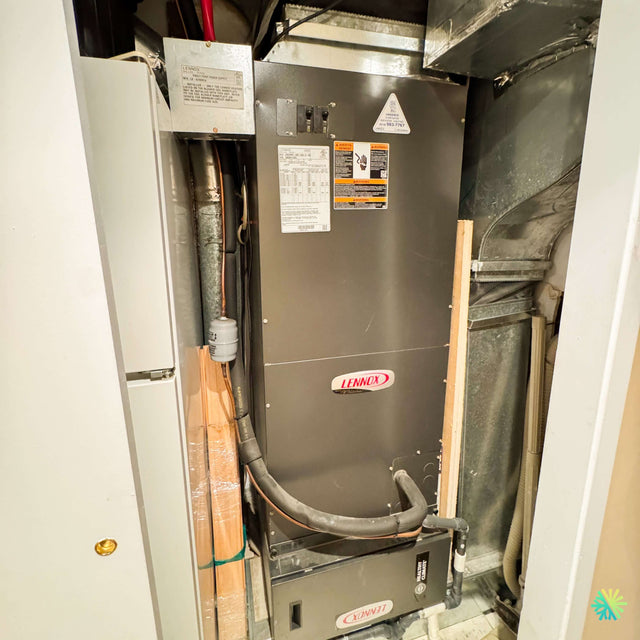
The brand visible on the device was Trane, a well-known manufacturer in the HVAC field. The exact model was not clearly readable in the photo, but the configuration corresponds to a central electric furnace / ducted indoor unit, with electrical power supply, control board, heating elements, blower fan, distribution plenum, and duct network connection.
A classic symptom: air circulates, but heating does not follow
The customer did not report a total breakdown. This is precisely what made the diagnosis more delicate. An electric furnace can seem to be working because the fan starts, but that does not necessarily mean the heating elements are activating properly.
In this case, the observed symptoms were compatible with several possible causes:
- a defective or intermittent heating sequencer;
- an electrical element that no longer activates;
- a thermal protection that cuts off heating for safety;
- poor airflow in the ducts;
- a filter that is too restrictive or clogged;
- an unstable low voltage connection between thermostat and furnace;
- a weakened relay, fuse, or contactor;
- too high static pressure in the ventilation system;
- a control problem preventing the full activation of heating stages.
A common mistake is to conclude too quickly that the furnace is “done.” However, in many cases, targeted repairs can extend the equipment’s lifespan and restore reliable comfort without immediately incurring the costs of a full replacement.
Visual inspection of the Trane furnace
Upon arrival, we began with a complete visual inspection of the installation. The furnace was installed in a confined space, which requires special attention. When access is limited, some components can be difficult to check, and poor air circulation around the unit can worsen certain problems.
We observed several important elements:
- a Trane metal cabinet connected to a main vertical duct;
- a distribution plenum above the unit;
- mechanical fittings around the unit;
- thermostat and control wires visible on the side;
- electrical labels and wiring diagrams on the panel;
- a typical residential central system installation;
- a tight maintenance space, requiring a structured working method.
The general condition of the installation indicated that the unit had already been in service for several years, but nothing immediately suggested a major failure. We therefore proceeded with a series of electrical, thermal, and airflow tests to isolate the real cause.
Electrical diagnosis: validate the power supply before replacing parts
On an electric furnace, the diagnosis always starts with safety and power supply. Unlike a wall heat pump or a wall air conditioner, an electric furnace can draw significant power. Therefore, circuits must be checked thoroughly before working on internal components.
We checked:
- the main power supply voltage;
- the status of the circuit breakers;
- the presence of voltage at the internal distribution block;
- the 24 V low voltage circuit;
- the signal coming from the thermostat;
- the connections to relays and sequencers;
- the heating calls;
- the continuity of the elements;
- the current consumed when the stages activate;
- the behavior of the blower fan.
The thermostat was indeed sending a heating request, but the startup sequence was not consistent. The fan would start, then the heating became irregular. During some cycles, not all heating stages seemed to activate properly. This type of behavior often points to a weakened sequencer, a relay that sticks poorly, or a safety device that cuts power to the elements.
The role of the sequencer in an electric furnace
In an electric furnace, the heating elements should not all start at exactly the same time. The sequencer allows stages to activate progressively to avoid a sudden current surge and ensure a controlled temperature rise.
When a sequencer becomes defective, symptoms can vary:
- heating that starts only every other time;
- air blown only lukewarm;
- cycles that are too short;
- elements that do not all activate;
- unstable indoor temperature;
- breaker that can sometimes trip;
- fan running without sufficient heat.
In this case in Delson, measurements taken during the heating call showed incomplete and irregular activation. The unit was not dead, but it was no longer following its heating sequence properly.
Airflow check: a factor often underestimated
An electric furnace can also protect itself if the airflow is insufficient. The heating elements produce a lot of heat; if the air does not circulate quickly enough through the unit, the internal temperature rises and a safety limit can interrupt the heating.
We therefore checked the condition of the filter, the air returns, the pressure felt at the blower, and the general condition of the plenum. Even when a filter looks "not so dirty" to the eye, it can become too restrictive depending on its density, age, and the fan’s power. A poorly matched high-performance filter can also increase static pressure and reduce airflow.
In central systems in Montreal, Laval, Longueuil, the North Shore, and the South Shore, we often encounter this problem: a customer installs a very dense filter to improve air quality, but the furnace was not designed for this additional resistance. Result: less airflow, more internal heat, more stress on components, and sometimes safety shutdowns.
Intervention performed: targeted repair and recommissioning
After the tests, we proceeded with targeted repairs. The goal was to correct the heating sequence, secure the connections, and confirm that the furnace could operate stably under real demand.
The steps of the intervention included:
- safe power shutdown;
- controlled opening of access panels;
- inspection of internal connections;
- low voltage wire inspection;
- testing relays and the sequencer;
- Replacement of the defective component responsible for irregular activation;
- Tightening of accessible connections;
- Validation of heating elements;
- Blower fan check;
- Complete test with heating call at the thermostat;
- Measurement of the supply air temperature after stabilization;
- Maintenance recommendations to prevent recurrence.
Once the repair was done, the Trane furnace regained a more consistent heating sequence. The blown air was warmer, the cycle was more stable, and the customer could again maintain a comfortable temperature.
Why the furnace should not have been replaced immediately
When a central system starts heating poorly, many homeowners fear they will have to replace the entire furnace. In some cases, replacement is indeed the best option, especially when the equipment is very old, parts are hard to obtain, or several major components are weakened.
But in this specific case, the furnace still had service potential. The problem was mainly a control component and an unstable heating sequence, rather than a complete device failure. A well-targeted repair therefore avoided premature expense.
At AirGreen, we always prioritize an honest and technical approach: repair when appropriate, recommend replacement when it is truly more cost-effective, and clearly explain options to the customer.
Mistakes to avoid with a central electric furnace
A Trane electric furnace or one from another brand can last a long time if well maintained, but certain habits accelerate breakdowns.
Ignoring signs of intermittent heating
Irregular heating is not a minor issue. Even if the house eventually reaches the desired temperature, an unstable cycle can indicate a malfunctioning component. The longer the delay in intervention, the greater the risk to relays, elements, the fan, or internal protections.
Using a filter that is too restrictive
Indoor air quality is important, but you need to choose a filter compatible with the system. A filter that is too dense can reduce airflow, cause overheating, and decrease furnace efficiency. You need to find the right balance between filtration and HVAC performance.
Closing too many ventilation grilles
Some homeowners close vents in unused rooms to "save." In a central system, this practice can increase duct pressure and harm overall operation. A central furnace is designed for a specific airflow.
Waiting for a complete breakdown
A furnace that heats poorly often gives warnings before breaking down. Unusual noises, short cycles, lukewarm air, overheating smell, tripping breaker, or unstable temperature are signs to take seriously.
Result: comfort restored and client reassured
After the repair, we performed several test cycles to confirm system stability. The fan started correctly, the heating stages activated more predictably, and the supply air temperature was consistent with the expected operation of an electric furnace.
The client especially appreciated understanding the problem. Rather than receiving a vague answer, they got a clear explanation: the Trane furnace did not necessarily need to be replaced, but it required a precise correction in its heating sequence and special attention to airflow.
This transparency is essential in our service calls. Successful HVAC repair is not just about replacing a part; it must also enable the owner to know how to use their system, what to watch for, and when to schedule maintenance.
AirGreen: expertise in electric furnace repair in Delson and Greater Montreal
AirGreen regularly services residential central systems in Delson, Montreal, Laval, Longueuil, on the North Shore and South Shore. Our technicians work on various types of HVAC equipment: electric furnaces, central heat pumps, central air conditioners, wall-mounted heat pumps, multi-zone systems, air exchangers, humidifiers, dehumidifiers, PTAC, VTAC, and ventilation accessories.
A comprehensive diagnostic method
Each service call is approached with a structured method. We do not replace a part simply because a symptom seems to match. We validate signals, voltages, temperatures, cycles, components, and installation conditions.
For an electric furnace, this may include:
- thermostat test;
- reading the low voltage circuit;
- control of heating stages;
- checking components;
- inspection of relays and sequencers;
- blower motor test;
- measurement of the supply air temperature;
- evaluation of the filter and airflow;
- inspection of accessible ducts;
- checking thermal safety devices;
- maintenance or replacement recommendations.
This thoroughness helps avoid incomplete diagnoses and temporary repairs that do not address the root cause of the problem.
Repair or replace: how to make the right decision
For an electric furnace, the decision depends on several factors: the age of the device, availability of parts, condition of the fan, state of the elements, quality of the ducts, frequency of breakdowns, repair costs, and the owner's future plans.
A repair is often logical when:
- the problem is clearly identified;
- the component to be replaced is accessible;
- the device structure is still in good condition;
- the main elements are working;
- the repair cost remains reasonable;
- the system still meets the home's needs.
Replacement becomes preferable when:
- breakdowns keep recurring;
- several major components are weakened;
- the system is noisy or inefficient;
- air distribution is deficient;
- comfort remains unstable despite repairs;
- the owner wants to upgrade with a more efficient central heat pump.
In all cases, our role is to help the client make an informed decision, without unnecessary pressure.
Maintenance tips after a repair
After an intervention like this in Delson, we recommend following some simple best practices:
- replace or clean the filter according to the recommended frequency;
- avoid overly restrictive filters without technical validation;
- keep return grilles clear;
- do not block air outlets;
- monitor short cycles or temperature fluctuations;
- have the furnace inspected before the cold season;
- report any overheating smell or unusual noise quickly;
- check that the thermostat is working properly;
- schedule preventive HVAC maintenance if the system is old.
These actions help improve comfort, reduce the risk of breakdowns, and extend the furnace's lifespan.
A repair that demonstrates the importance of diagnosis
This service call in Delson clearly shows why a professional diagnosis is essential. The client might have thought the Trane furnace was at the end of its life, while the main problem came from a specific malfunction in the heating sequence. By combining electrical tests, airflow inspection, and analysis of the actual device behavior, we were able to restore heating effectively.
For homeowners in Delson and Greater Montreal, AirGreen offers a comprehensive HVAC repair service, capable of working on both recent systems and older equipment. Whether it's a Trane electric furnace, a central heat pump, a wall air conditioner, or a ventilation system, we focus on precision, safety, and lasting comfort.

The same service at your place?
Cleaning, repair or maintenance: tell us about your unit and we schedule the visit.
- RBQ licence 5645-9605-01Subclasses 15.8, 15.10 and 16
- $5M liability insuranceOn every job
- 15+ yearsFamily-owned, based in Montréal