
AirGreen job in
Repair of a Mitsubishi Electric Wall-Mounted Heat Pump in Lorraine
Stylised map, not to scale.
- Montréal
- Laval
- Longueuil
- South Shore
- North Shore
An aging Mitsubishi Electric wall-mounted heat pump leaking inside and barely blowing air anymore
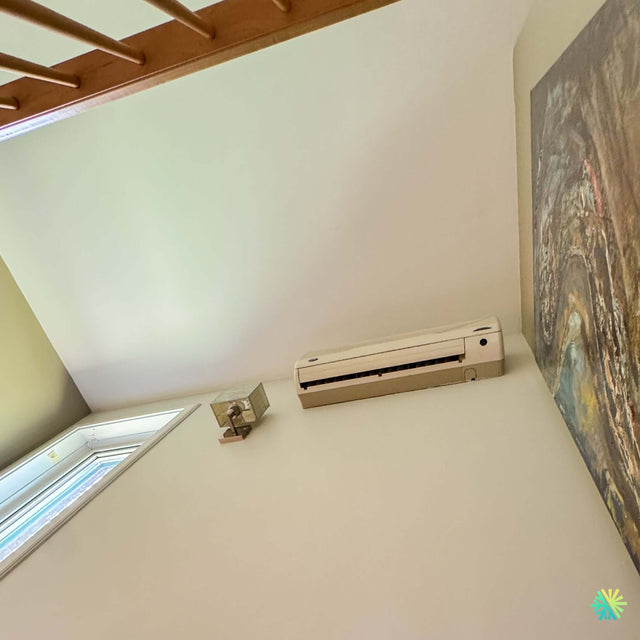
In Lorraine, on the North Shore, our AirGreen team was called for residential HVAC service on a Mitsubishi Electric wall-mounted heat pump installed for several years in a narrow wall cavity near the ceiling. The indoor unit, beige with age, showed typical signs of a device that has served well for a long time but was beginning to accumulate the effects of time: reduced airflow, dust in the louvers, musty smell at startup, and especially, occasional water dripping from the front of the device.
The client contacted us because the heat pump was no longer cooling as before. On hot days, the device would start, but the air seemed weak, the room took far too long to cool down, and a small drop of water sometimes appeared under the lower louver after prolonged operation. It was not a complete breakdown, but a set of fairly clear symptoms justifying a quick intervention.
On a wall-mounted heat pump of the mini-split type, water leakage inside can come from several causes: clogged condensate drain, dirty drain pan, very dirty evaporator, slightly misaligned installation, lack of airflow, ice formation on the indoor coil, saturated filter, or refrigerant charge problem. In this specific case, the visible age of the Mitsubishi Electric unit immediately led us to proceed with caution and method.
An older generation Mitsubishi Electric wall unit, still recoverable with a good diagnosis
The observed device was a Mitsubishi Electric wall-mounted heat pump, possibly from the residential Mr. Slim family, with an estimated capacity of around 12,000 BTU. Since the nameplate was not clearly readable from the front of the indoor unit, we verified the accessible elements on site rather than assuming an exact model. The important thing in this type of service call is to understand the actual condition of the system: the indoor unit, the drain, the tangential fan, the coil, the filters, the louvers, and the communication with the outdoor unit.
This type of Mitsubishi Electric equipment is known for its durability, but even a good machine cannot compensate for prolonged lack of maintenance. Over the years, dust, fine particles, hair, cooking smoke, ambient humidity, and organic residues can accumulate inside the wall unit. The result is often gradual: the device still works, but it becomes noisier, less efficient, more humid, and less comfortable.
At AirGreen, we regularly see this type of situation in Montreal, Laval, Longueuil, on the North Shore and on the South Shore. The machine does not necessarily need to be replaced. In many cases, targeted repair and thorough technical cleaning can restore excellent performance.
Symptoms observed before the intervention
During our inspection, several signs confirmed that the problem was not just a dirty filter. The lower louver was slightly marked by moisture, the inside of the unit showed visible dust buildup, and the airflow at the outlet was irregular. The heat pump responded to the remote control, but the airflow was weak.
The main symptoms were as follows:
- low airflow at the wall unit outlet;
- slow cooling of the room;
- musty smell at startup;
- occasional water drops under the indoor unit;
- slight noise from the tangential fan;
- dust-clogged filters;
- dirt buildup on the louvers and around the coil;
- slow and irregular condensate drainage.
These symptoms pointed to a combination of problems: partial drain blockage, dirty condensate tray, dirty indoor fan, and reduced heat transfer at the indoor coil.
Condensate drain diagnosis: the primary cause of water leakage
The first step was to check the drainage system. In air conditioning mode, a wall-mounted heat pump removes moisture from the air. This moisture condenses on the indoor coil, falls into a collection tray, then drains out through a drain pipe. If this pipe is blocked, even partially, water can back up into the tray and eventually leak into the room.
We opened the front panel, removed the filters, and inspected the tray. The drain was not completely blocked, but the flow was slow. A buildup of biofilm, damp dust, and residues had reduced the passage. This kind of obstruction is common on wall units that have not been deeply cleaned for several seasons.
We cleared the drain with appropriate tools, without forcing or damaging the fittings. Then, we tested the flow with controlled water to confirm that the drainage was working properly. After cleaning, the water drained much faster and without backup.
Cleaning of the tray, coil, and tangential fan
The drain was only part of the problem. The indoor unit also needed a more thorough technical cleaning. On a Mitsubishi Electric wall unit of this age, the tangential fan can accumulate a significant layer of dirt on its blades. When this happens, the fan still spins, but moves much less air. The customer may then feel that the heat pump lacks power, while the problem mainly comes from the airflow.
We cleaned the critical areas of the unit:
- washable filters;
- condensate tray;
- drain inlet;
- airflow flaps;
- tangential fan;
- surface of the indoor coil;
- accessible areas around the turbine;
- visible sensors and accessible connectors.
The cleaning was done carefully, as the plastics of an older unit can become more fragile over time. On this type of device, it is important to avoid forcefully removing clips, flaps, or panels. Professional repair also involves preserving the integrity of the equipment, especially when it is no longer new.
Indoor coil inspection: preventing ice formation
A dirty indoor coil can cause several problems. By reducing heat exchange, it can lead to decreased performance, excessive condensation, and sometimes even ice formation. When this ice melts, the water can exceed the capacity of the tray or flow through abnormal paths.
In this case in Lorraine, we did not observe any active ice block at the time of inspection, but the conditions were present to favor this problem during long operating periods: low airflow, dirty coil, and slow drain. By correcting these three elements, we reduced the risk of recurrence.
We also checked the discharge temperature after restarting. The temperature difference between return air and supply air became consistent again, indicating the system was regaining its cooling capacity without immediate refrigerant intervention.
Check of the outdoor unit and refrigeration circuit
Even though the visible problem was inside, we also validated the overall system behavior. On a wall-mounted heat pump, the indoor and outdoor units work together. Poor indoor performance can sometimes be linked to an outdoor issue: dirty outdoor coil, faulty outdoor fan, weakened condenser, refrigerant leak, or compressor problem.
In this intervention, the signs did not point to a major compressor failure. The system started correctly, the demand was transmitted, and performance improved after internal cleaning and drain clearing. No refrigerant recharge was done without clear indication.
This is a common mistake to avoid: when a unit cools less, you should not automatically conclude there is a refrigerant shortage. Before talking about leaks or recharging, you need to check the air, coil cleanliness, drain, filters, fan, and installation conditions.
An HVAC repair that restores performance without unnecessarily replacing the unit
Result after intervention: stronger air, restored drainage, and regained comfort
After cleaning, drain repair, and operational tests, the difference was clear. The air blown by the wall unit was stronger, more consistent, and cooler. The fan noise was more stable, the musty odor at startup had decreased, and the condensate pan drained normally.
We let the unit run long enough to verify that water was not coming back under the unit. The customer immediately noticed an improvement in comfort in the room. The Mitsubishi Electric heat pump was not new, but it was still functional and could continue to serve with more regular maintenance.
Results obtained:
- water drainage corrected;
- condensate drain unclogged;
- indoor drip pan cleaned;
- improved airflow;
- more efficient cooling;
- reduction of musty odor;
- quieter operation;
- customer reassured about the general condition of the machine.
Mistakes to avoid with an old wall-mounted heat pump
This intervention in Lorraine illustrates several common mistakes we often encounter in Greater Montreal.
Waiting until water flows abundantly
A small drop under a wall unit is already a warning. The longer the problem is ignored, the more the pan and drain can clog, and the greater the risk of damage to the wall or floor.
Cleaning only the filters
Filters are important, but they are only part of maintenance. The tangential fan, coil, and drain must also be inspected. A unit can have clean filters and still be very dirty inside.
Using inappropriate products
Some overly aggressive cleaning products can damage plastics, fins, or electronic components. HVAC cleaning must be done with the right tools and methods.
Forcing the louvers of an aging unit
Motorized louvers and facade clips can become fragile. Handling them carelessly can cause additional breakdowns.
Adding refrigerant without diagnosis
Poor cooling can be caused by lack of airflow or a dirty coil. An unnecessary recharge does not fix the problem and can harm operation.
Why the location of the indoor unit mattered in this service
The Mitsubishi Electric unit was installed near the ceiling, in a wall space framed by two wall returns. This setup can be aesthetic and practical, but sometimes makes access more delicate. The technician must work precisely to open the unit, protect the wall, handle parts, and clean without splashing.
In a confined space, airflow around the unit must also be monitored. A wall-mounted heat pump needs good air return from above and clear airflow forward. If dust accumulates on the air intake or if the room holds a lot of humidity, the unit works harder to provide less comfort.
The importance of preventive maintenance on the North Shore
In Lorraine, as in many areas of the North Shore, homes often use their wall-mounted heat pump for much of the year: air conditioning in summer, heating in the shoulder seasons, sometimes supplemental heating during cold spells. This extended use increases the importance of maintenance.
Regular maintenance allows you to:
- maintain good airflow;
- avoid musty odors;
- prevent drain blockages;
- improve energy efficiency;
- reduce the risk of water leaks;
- protect the compressor;
- extend the lifespan of the device.
At AirGreen, we recommend not waiting until the unit leaks or completely loses power before intervening. A well-planned service often costs less than an emergency repair after water damage.
AirGreen expertise tailored to Mitsubishi Electric wall-mounted heat pumps
Our teams regularly work on wall-mounted heat pumps, wall air conditioners, MultiZone systems, central heat pumps, electric furnaces, and various HVAC equipment in Montreal, Laval, Longueuil, on the North Shore and on the South Shore.
Repairing an older Mitsubishi Electric requires a different approach than a newer device. You have to consider the age of the plastics, the possible availability of parts, the condition of the drain, internal cleanliness, actual performance, and the reasonable cost of the intervention compared to replacement. In this case, the repair was relevant: the system still responded well once cleaned and fixed.
A precise, useful, and lasting service
This repair of a Mitsubishi Electric wall-mounted heat pump in Lorraine solved a concrete problem without unnecessary replacement. The client got back a cleaner, more efficient, and more reliable device. The water drainage was fixed, the airflow was restored, and the cooling performance became satisfactory again.
A good HVAC repair is not just about making the device work for a few minutes. It must identify the cause, fix the problem, test the result, and explain the steps to take to prevent the issue from recurring. This is the rigor we apply to every service call, whether in Lorraine, Montreal, Laval, Longueuil, on the North Shore or on the South Shore.

The same service at your place?
Cleaning, repair or maintenance: tell us about your unit and we schedule the visit.
- RBQ licence 5645-9605-01Subclasses 15.8, 15.10 and 16
- $5M liability insuranceOn every job
- 15+ yearsFamily-owned, based in Montréal