
Repair of a York Electric Furnace in Dollard-des-Ormeaux
The signs described in this article
Is it urgent?
Tick what you notice at home. This does not replace a diagnosis.
Your result appears here.
When a furnace stops heating properly: an HVAC service call that requires method, safety, and precision
In Dollard-des-Ormeaux, a customer contacted us about an intermittent heating problem on a residential furnace connected to a duct network. The system, installed in a confined mechanical space, showed several typical signs of an aging appliance: irregular startups, ventilation not always responding to the thermostat’s demand, inconsistent heat in some rooms, and growing concern from the customer about the equipment’s reliability before a colder period.
At AirGreen, we handle this type of HVAC service call with a structured approach. A furnace, whether electric or integrated into an older central system, cannot be diagnosed based solely on an apparent symptom. A heating failure can come from the thermostat, a relay, a low-voltage wire, a blower motor, a heating element, a safety switch, a control panel, or even an airflow problem in the ducts. It is precisely this complexity that makes the intervention of a qualified technician essential.
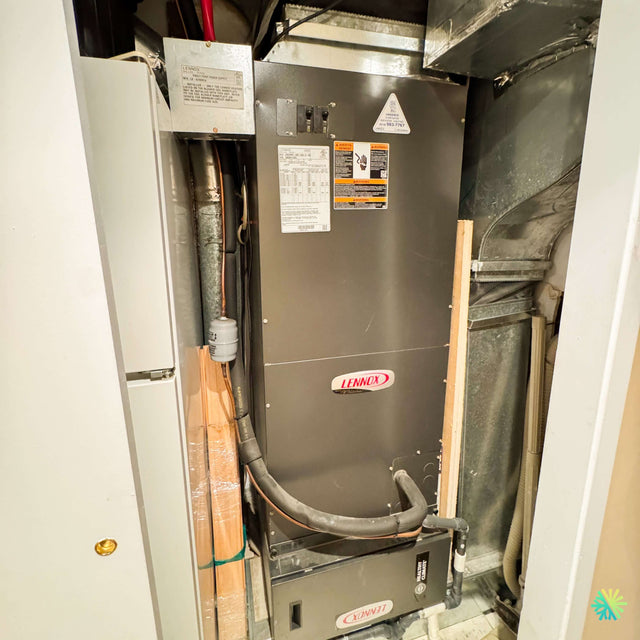
In this specific case, the York brand furnace had a classic central setup, with an indoor cabinet, front technical access, duct connections, and exposed wiring above the unit. The visual environment also highlighted the importance of a thorough inspection: tight space, existing ducts, wiring to verify, access panels, filter to check, and debris buildup around the equipment. Before any handling, our priority was to secure the work area and proceed with a step-by-step diagnosis.
A central furnace that is more than just “heating or not heating”
When a customer calls for a furnace repair in Dollard-des-Ormeaux, they often describe the problem in simple terms: “it’s not warm enough,” “the system starts then stops,” “the air is cold,” or “the fan is acting strangely.” Behind these symptoms, there can be several possible causes.
During this service call, the reported symptoms were as follows:
- indoor temperature difficult to maintain;
- irregular heating cycles;
- ventilation sometimes present without sufficient heat;
- more noticeable noise at startup;
- concern about the age and reliability of the device;
- uneven air distribution in the house.
This kind of problem is common in central systems serving multiple rooms. An electric furnace or a central furnace with electrical control components must operate as a complete system: the thermostat requests heating, the control panel receives the signal, relays or sequencers activate the required elements, the fan starts at the right time, safety devices confirm that conditions are normal, then warm air is pushed into the ducts.
If a single step fails, comfort quickly decreases.
AirGreen diagnosis: check before replacing
Our technician started with a complete visual inspection of the installation. This step is often underestimated but helps spot important clues: signs of overheating, weakened wires, questionable connections, poorly closed panels, clogged filter, dust accumulation, vibrations, poorly sealed ducts, or components that have already been modified during previous maintenance.
In this case, several points were methodically checked:
Thermostat and demand signal check
The first step was to confirm that the thermostat was correctly sending its heating demand. A poorly calibrated, poorly powered, or poorly programmed thermostat can give the impression that the furnace is defective, while the problem lies in the control.
We checked:
- the heating demand;
- the unit’s response;
- the continuity of the low voltage signal;
- the condition of the connections;
- the consistency between the displayed temperature and the actual temperature in the space.
This check ruled out a simple programming error and allowed us to proceed to the internal components.
Blower motor inspection
The blower is essential for comfort. Even if the heating part works, poor ventilation will prevent warm air from being properly distributed throughout the house. A dirty blower, a weak capacitor, a tired motor, or an unbalanced fan wheel can cause inefficient cycles, noise, and a lukewarm air sensation.
On site, we inspected the ventilation compartment, the general condition of the motor, vibrations, and the startup response. The noise reported by the client seemed related to a more difficult system startup, possibly worsened by the age of some components and the overall condition of the mechanical environment.
Control of relays, sequencers, and electrical connections
In an electric furnace, relays and sequencers play a major role. They allow heating elements to activate in a controlled way, without unnecessary overload. A worn relay can cause intermittent heating. A defective sequencer can activate only part of the elements or create an abnormal delay. A loose connection can cause local overheating, power loss, or complete failure.
Our technician therefore conducted an inspection of accessible connections, looking for signs of excessive heat, oxidation, loosening, or poor contact. In a central system, this step is essential to avoid unnecessarily replacing costly parts.
Air circulation check
A furnace can be mechanically sound but operate poorly if the air does not circulate properly. A dirty filter, blocked air return, crushed ducts, or closed registers can create a restriction. This restriction increases the fan's effort, reduces performance, and can trigger certain safety features.
During this service call in Dollard-des-Ormeaux, we paid special attention to the duct network and air return. A central installation must be evaluated as a complete system, not just as a mechanical box.
Identified problem: unstable operation caused by a combination of factors
After checks, the diagnosis showed that the problem did not come from a single isolated cause, but rather a typical combination on an older device: electrical controls to monitor, ventilation to optimize, general maintenance required, and air circulation to improve.
The customer initially thought the furnace needed to be replaced immediately. Our role is never to push for an automatic replacement. Our priority is to identify what can be repaired, what needs to be secured, and what deserves medium-term planning.
In this case, we clearly explained the following elements:
- Some electrical components showed signs of wear;
- The operation of the ventilation needed to be stabilized;
- Maintenance around the unit was necessary to improve access and reduce risks;
- The air distribution needed to be reviewed to avoid temperature differences;
- Follow-up would be recommended if symptoms returned after correction.
This transparency reassures the customer, especially when it concerns a central device that represents an essential part of the home's comfort.
A technical intervention designed to restore comfort and prevent repeated breakdowns
Repairing is not just about restarting the equipment. Good HVAC repair service must allow the system to operate more stably, safely, and predictably. That is exactly the goal of our intervention.
Securing and tidying the technical area
Before making adjustments, we secured access to the device. The installation image clearly illustrates a common challenge: central furnaces are often located in cramped or hard-to-reach mechanical spaces. Sometimes wires, ducts, panels, junction boxes, and structural elements limit visibility.
Adequate access is essential for:
- to inspect panels;
- to check connections;
- to replace a part if needed;
- to clean the compartments;
- to ensure the technician’s safety;
- to facilitate future maintenance.
We therefore took the time to work carefully, not forcing panels and respecting the integrity of existing ducts.
Adjustments and operational tests
Once the checks were completed, we made the necessary corrections to stabilize the system’s operation. Tests were conducted in several stages to confirm that the furnace responded properly to the heating demand.
We validated:
Startup
The system had to respond correctly to the thermostat call, without abnormal delay or premature shutdown.
Ventilation
The blower had to start at the right time, maintain sufficient air circulation, and operate without excessive vibration.
Heat produced
The temperature of the blown air had to be consistent with a normal heating demand, without unexplained alternation between cold and hot air.
Cycle stability
A central system must complete its cycle without unexpected interruptions. Too-short cycles often indicate an air restriction, a control problem, or a triggered safety feature.
Returning to rest
After the demand, the furnace must shut down properly and not leave the fan running inconsistently.
These validations are important because a repair that seems successful for thirty seconds can fail after a few minutes if the system is not tested under realistic conditions.
Result: more stable heat and a better-informed client
At the end of the intervention, the client experienced more consistent heating and a better understanding of the actual condition of their equipment. The furnace was able to meet the demand, the ventilation was more consistent, and the likely causes of the symptoms were clearly explained.
We also provided practical recommendations to avoid rapid further deterioration:
- replace or check the filter regularly;
- keep access to the furnace clear;
- monitor unusual noises at startup;
- do not ignore short cycles;
- have electrical connections checked if symptoms return;
- schedule preventive maintenance before cold periods;
- consider an evaluation for replacement if repairs become frequent.
What this type of service call teaches us
An electric or central furnace should never be diagnosed hastily. Many heating problems are misinterpreted. A client might think it’s a major breakdown when it’s actually a relay, filter, thermostat, or airflow restriction. Conversely, a system that temporarily restarts may hide a more serious electrical problem.
That’s why our approach is based on three principles: diagnosis, safety, and explanation. We want the client to know exactly what was checked, what was fixed, and what needs to be monitored.
Mistakes to avoid with a central furnace
Many owners in Montreal, Laval, Longueuil, the North Shore, and the South Shore wait until the system completely stops working before calling. Yet, the first signs of instability are often the most important.
Ignoring an unusual noise
A noise at startup can indicate a worn blower, vibration, a loose panel, or a motor under strain.
Leaving a clogged filter for too long
A dirty filter reduces airflow, increases system strain, and can cause overheating or poor heat distribution.
Changing the thermostat without understanding the problem
Increasing the requested temperature does not fix a breakdown. If the system doesn’t heat properly at 21 °C, it won’t heat better just because the thermostat is set to 25 °C.
Neglecting access to the unit
A cluttered mechanical space complicates repairs, increases intervention time, and can compromise safety.
Waiting too long before getting a diagnosis
A small electrical fault can develop into a more costly breakdown if not fixed.
AirGreen: local expertise in furnace repair and HVAC service
AirGreen regularly works on residential central systems in Greater Montreal. Whether it’s a furnace repair, heating diagnosis, ventilation problem, electrical failure, thermostat replacement, or a complete central system evaluation, our team works with a clear and professional method.
We serve Montreal, Laval, Longueuil, the North Shore, and the South Shore, with concrete knowledge of the region’s homes: tight mechanical basements, aging systems, existing ducts, energy conversions, electrical constraints, and comfort needs specific to the Quebec climate.
This intervention in Dollard-des-Ormeaux clearly illustrates our way of working: observe, test, understand, correct, and advise. A furnace is not just a device; it is the heart of a home’s winter comfort. When its operation becomes unstable, serious intervention is required.
Why a professional diagnosis makes all the difference
A professional diagnosis helps avoid two common problems: unnecessarily replacing a furnace that can still be repaired or, conversely, multiplying small repairs on a unit nearing the end of its useful life.
In this case, the customer received a clear answer: the system could be stabilized, but some signs of wear needed to be monitored. This information allows them to make better decisions, without pressure or surprises.
A good service call doesn’t just end with a system that restarts. It ends with a customer who better understands their installation, knows what to watch for, and can confidently plan their next steps.
A successful repair in Dollard-des-Ormeaux
The repair of this York furnace in Dollard-des-Ormeaux restored more reliable heating, improved operational stability, and reassured the customer about the overall condition of their system. Thanks to a thorough inspection, precise tests, and tailored recommendations, AirGreen turned a worrying service call into a useful, clear, and lasting intervention.
For any HVAC repair, any problem with an electric furnace, any service call on a central system, or any heating inspection in Greater Montreal, AirGreen offers a technical, honest approach focused on the real comfort of the customer.

From reading to your home.
An AirGreen advisor assesses your situation on site, free of charge, and gives you a quote within 24 hours.
- RBQ licence 5645-9605-01Subclasses 15.8, 15.10 and 16
- Free on-site estimateAn advisor assesses your needs
- Quote within 24 hoursClear and detailed