Central heat pump repair in Côte Saint-Luc
| Service | Repair | Unit | Central heat pump |
|---|---|---|---|
| Area | Côte-Saint-Luc | Published | November 12, 2026 |
| Reading | 9 min | ||
Attachment 1 · job photo

A central heat pump exposed to cold, humidity, and the stresses of a technical terrace
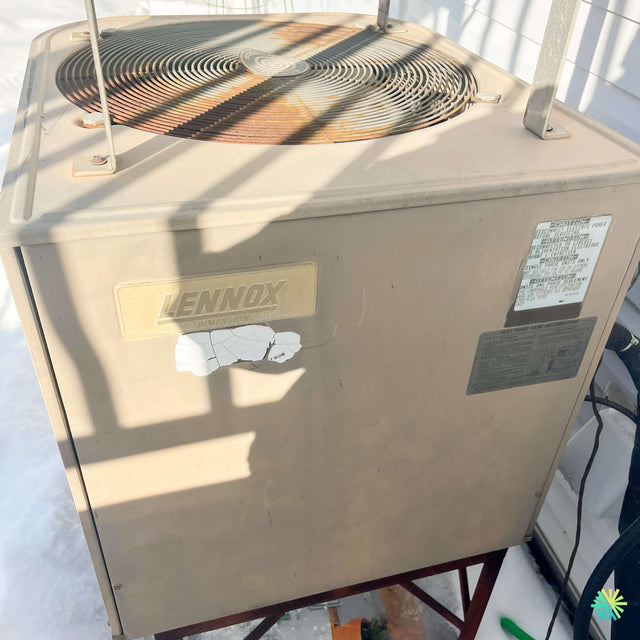
In Côte Saint-Luc, our AirGreen team was called for a HVAC service call on a central heat pump installed on an outdoor terrace, set back from a brick building, near a busy area. The outdoor unit was placed in a confined space, behind a wooden fence, with some snow still visible around the base and refrigerant lines exposed running along the ground before entering the building.
The client had contacted us due to irregular performance issues. The central heat pump was no longer delivering the expected output: the system seemed to start, but the indoor temperature did not always follow the setpoint. Some cycles were too long, the air blown through the ducts sometimes became less warm or less cool depending on the requested mode, and an unusual noise near the outdoor unit eventually worried the occupants.
On site, the installation environment immediately gave us several clues. An outdoor central heat pump located on a technical terrace faces particular challenges: snow accumulation, freeze-thaw cycles, persistent humidity, vibrations transmitted through the structure, exposure to winds, and sometimes difficult access for maintenance. In this context, a failure can stem from either an internal component or an installation condition that has become problematic over time.
An old central unit, but still recoverable with a thorough diagnosis
The observed device was a condenser of a central heat pump of residential size, connected to an indoor duct network. This type of system is common in Montreal, Laval, Longueuil, on the North Shore and the South Shore, especially in houses, duplexes, and small buildings where heating and air conditioning are distributed to several rooms from a single central unit.
Even if the exact brand and nameplate were not clearly identifiable from a distance, the visible configuration matched a typical residential capacity outdoor central heat pump, often sized between 24,000 and 36,000 BTU, depending on the building’s heat load, duct network size, and associated indoor system power.
The client had reported several symptoms:
- outdoor unit starting without consistent output;
- prolonged cycles;
- more noticeable noise around the condenser;
- reduced performance during temperature variations;
- concern related to exposed refrigerant pipes;
- presence of moisture and snow near the device;
- suspected possible leak or pressure loss.
These symptoms can be associated with several causes: lack of refrigerant, restriction in the circuit, clogged outdoor coil, weakened outdoor fan, electrical condenser losing capacity, worn contactor, defrosting problem, faulty sensor, or compressor efficiency loss. On a central heat pump, it is always important to avoid jumping to conclusions too quickly.
First step: secure the space and observe the actual installation
Before any technical measurement, our technician assessed the space around the unit. Access was limited by the fence, the terrace, and the proximity of the building. Refrigerant lines and cables were visible on the ground, partially exposed to the elements. This detail is important: a poorly protected refrigerant line or degraded insulation can cause efficiency losses, condensation, localized freezing, or accelerated wear.
We also paid attention to the base of the unit. A central heat pump must be stable, sufficiently clear, and protected against water or snow accumulation. Even a slight tilt or obstruction around the bottom of the device can affect drainage, ventilation, and heating mode operation.
In this specific case, the snow still present near the unit showed that the device had probably been operating in real winter conditions, with defrost cycles activated. When a heat pump operates in heating mode in cold weather, it must regularly manage frost on the outdoor coil. If defrosting is incomplete, too frequent, or poorly controlled, performance quickly drops.
Checking electrical operation
The first series of tests focused on accessible electrical components. We checked the power supply, connections, contactor condition, capacitor behavior, and compressor startup. On older central heat pumps, a partial electrical failure can give the impression of a refrigeration problem.
A weakened capacitor, for example, can allow the motor to start but with less power, leading to unstable cycles, less effective outdoor ventilation, and progressive overheating. A worn contactor can also cause intermittent interruptions, which are difficult to reproduce if the system is not tested under real demand.
In this service call in Côte Saint-Luc, the startup was present, but the unit’s behavior was not perfectly stable. We therefore continued with a more comprehensive analysis of the refrigeration circuit and ventilation.
Checking the outdoor coil and airflow
The outdoor coil was a critical point of the inspection. In the photo, you can see a unit that has already gone through several seasons of use. The condenser fins, protective grille, and the lower area of the unit needed to be carefully checked.
A dirty or partially clogged outdoor coil limits heat exchange. In air conditioning, this prevents heat from being properly expelled outside. In heating, it limits the unit’s ability to capture the available energy in the outdoor air. In both cases, the compressor works harder and consumption increases.
We inspected the airflow around the unit, the presence of debris, the condition of the fins, and signs of frost or residual moisture. Technical cleaning of the condenser was part of the necessary actions to obtain reliable readings. Measuring the pressures of a system with a clogged coil can lead to a misleading diagnosis.
Measuring pressures and analyzing the refrigeration circuit
Once the basic operation was confirmed, our technician proceeded to read the refrigeration behavior. On a central heat pump, pressures must be interpreted according to several factors: outdoor temperature, indoor temperature, operating mode, airflow, condition of the indoor filter, coil condition, and type of refrigerant.
We checked if the system showed signs consistent with:
- an insufficient refrigerant charge;
- a partial restriction;
- poor evaporation;
- difficult condensation;
- a reversing valve problem;
- insufficient outdoor ventilation;
- a loss of compressor efficiency.
The goal was not simply to “add gas.” A refrigeration system is a closed circuit. When refrigerant is missing, you have to ask why. A recharge without diagnosis can hide a leak and cause a new failure a few weeks or months later. Conversely, an overload can raise pressures and damage the compressor.
What the diagnosis revealed
The intervention highlighted a combination of typical problems of an aging central heat pump installed in an exposed environment:
Performance weakened by the general condition of the outdoor unit
The condenser was not in optimal condition. The accumulation of dirt, exposure to moisture, and proximity to snow reduced the quality of heat exchange. This partly explained the prolonged cycles and performance drop.
Protection of the refrigerant lines to be improved
The pipes visible on the floor required special attention. The external insulation of the refrigerant lines must remain in good condition to avoid thermal losses and protect the piping from weather conditions. Damaged or poorly fixed insulation may seem secondary, but it affects the system’s efficiency and durability.
Operation to be monitored at the electrical level
Some components showed signs of wear consistent with the age of the installation. Even when the unit starts, it does not guarantee that all components are working within their ideal parameters. We therefore explained to the client which elements needed to be monitored and which parts could become priorities if the symptoms returned.
Recoverable performance, but with limits
The central heat pump could still operate, but it needed technical maintenance, adjustments, and monitoring. Our role was to restore the best possible performance without hiding from the client the limits of a device that has already been in service for several seasons.
Work performed during the service call
We carried out a structured intervention to stabilize the system and restore the unit’s more consistent operating capacity.
Targeted condenser cleaning
The outdoor coil was cleared and cleaned to improve airflow. This step helped reduce working pressure and improve heat exchange. On a central heat pump, a well-done cleaning can sometimes make a significant difference in indoor comfort.
Checking and correcting exposure points
We inspected visible lines, insulated sections, exposed fittings, and areas subject to cold. Recommendations were given to the client to improve pipe protection and limit the impact of weather.
Function test after intervention
Once the checks were completed, we restarted the system and observed its behavior under demand. The cycle was more stable, the outdoor unit breathed better, and the indoor system’s response was more consistent. The client saw that the HVAC repair was not just about replacing a part but about restoring the entire installation to better operating conditions.
Practical lessons from a service call in Côte Saint-Luc
Never ignore the environment around the heat pump
An outdoor unit placed on a terrace, roof, or enclosed area must be maintained more carefully than a unit installed on the ground in an open space. Air must circulate freely. Snow must not accumulate against the base. Lines must be protected. Vibrations must be monitored.
In Côte Saint-Luc as elsewhere in Greater Montreal, outdoor installations face harsh conditions. Freeze-thaw cycles, humidity, hot summer heat, and rapid temperature changes put a lot of stress on HVAC components.
Mistakes to avoid
Several mistakes can turn a minor problem into an expensive repair:
Waiting for the system to stop completely
A central heat pump that runs longer, becomes noisy, or loses efficiency already gives signals. A quick service call often helps avoid a more serious breakdown.
Automatically think about a refrigerant recharge
Lack of performance is not always caused by refrigerant loss. The coil, fan, indoor airflow, electrical components, and installation must also be checked.
Neglecting exposed refrigerant lines
Damaged insulation, poorly supported piping, or a line exposed to the ground can cause efficiency losses and accelerate wear. This detail is especially important for terrace installations.
Ignoring the filter and indoor network
Even if the outdoor unit is visible, the problem can also come from inside: dirty filter, insufficient air return, weak fan, or poorly balanced ducts. A true analysis of a central heat pump must consider the entire system.
An intervention that reassures the client and clarifies the next steps
At the end of the service call, the client had a clear understanding of the condition of their system. Performance had been improved, weak points identified, and recommendations were precise. This kind of transparency is essential: a successful repair is not only measured by the device restarting but also by the client’s understanding of their equipment.
At AirGreen, we work on central heat pumps, air conditioning systems, electric furnaces, wall units, multi-zone systems, and other HVAC equipment in Montreal, Laval, Longueuil, on the North Shore and the South Shore. Every service call is treated as a complete technical case, with on-site diagnosis, clear explanations, and a solution tailored to the building’s reality.
This central heat pump repair in Côte Saint-Luc clearly illustrates our approach: observe the installation, understand the symptoms, test the components, fix what can be fixed, then guide the client towards the right decisions. Indoor comfort was improved, the device's operation became more stable, and the client left with concrete answers rather than just a hypothesis.