
Repair of a Lennox central heat pump in Bois-des-Filion

A central heat pump frosted over during the heating season: a diagnosis that couldn’t wait
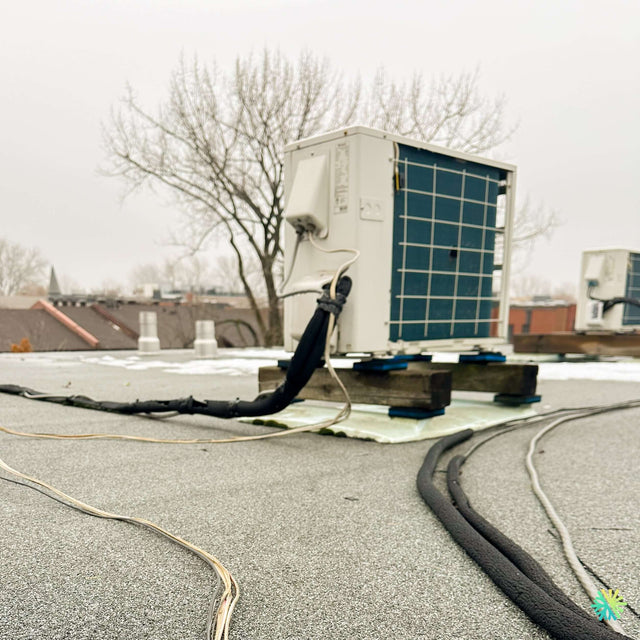
During this service call in Bois-des-Filion, on the North Shore, our AirGreen team worked on a Lennox central heat pump installed outdoors, against a masonry wall, with refrigerant lines entering directly into the central indoor system. The client contacted us after noticing a significant drop in heating inside the house, longer than usual operating cycles, and visible ice buildup on the outdoor unit.
On site, observing the machine immediately gave us several important clues. The outdoor unit showed vertical frost marks on the grille, snow accumulation at the base, a heavily insulated refrigerant line but visibly exposed to the cold, as well as a fairly tight proximity to the brick wall. The nameplate identified a Lennox central heat pump, model ML14XP1-030-230-21, a unit of about 30,000 BTU, often associated with a capacity of 2.5 tons, powered by 208/230 V.
This type of equipment is designed to operate for both heating and cooling, but when a central heat pump starts to accumulate frost abnormally in winter, quick action is needed. A bit of temporary frost can be normal under certain weather conditions. However, a persistent layer, ice traces that quickly return after defrosting, or a loss of performance inside the home usually indicate a deeper problem: incomplete defrosting, faulty sensor, air restriction, inadequate refrigerant charge, weakened fan motor, or electronic board issue.
A Lennox central system exposed to winter conditions on the North Shore
In Bois-des-Filion, winter conditions can be particularly demanding for a central heat pump. Rapid temperature changes, humidity, blowing snow, ice on the ground, and frequent freeze-thaw cycles can challenge the outdoor components. In this intervention, the Lennox unit was installed very close to the building, with refrigerant lines coming out of the wall and descending toward the device.
This setup requires special attention for three reasons:
- the space around the unit directly influences air circulation;
- snow and ice can partially block the bottom of the condenser;
- the refrigerant and electrical lines must remain well protected, insulated, and sealed.
In this specific case, the client had noticed that the heat pump was running for a long time, but the air blown inside seemed less warm. The central system compensated more, which created a feeling of instability: some rooms reached the requested temperature more slowly, while others remained uncomfortable. This behavior is typical of a central heat pump that can no longer properly extract outdoor heat or that loses some of its efficiency due to deficient defrosting.
Symptoms reported by the client
Before opening the device, we took the time to validate the symptoms. The client described a progressive situation rather than a sudden breakdown. The machine was not completely stopped, but it was no longer delivering the expected performance.
The observed and reported signs included:
- visible ice formation on part of the outdoor unit;
- longer heating cycles;
- decreased comfort in the house;
- feeling that the system is "struggling";
- defrosting that seemed insufficient or too infrequent;
- presence of snow and moisture around the base;
- very cold and partially frosted refrigerant line.
These elements led us to a complete diagnosis of the heating mode, rather than just a simple restart. A common mistake in this kind of situation is to quickly conclude that refrigerant is missing. An inadequate charge can indeed cause frost, but it is only one possibility among several. At AirGreen, we always check the entire system before recommending an expensive intervention.
Diagnostic HVAC: defrosting, pressure, ventilation, and electrical components
A central heat pump repair requires a rigorous method, especially when the outdoor unit has frost. In this project in Bois-des-Filion, we proceeded step by step to identify the real cause of the performance loss and avoid any unnecessary replacement.
Defrost cycle verification
The first step was to observe the unit’s behavior in heating mode. A central heat pump must be able to temporarily reverse its cycle to defrost the outdoor coil. This process is essential in winter because air moisture can condense and freeze on the outdoor coil.
We checked:
- the heat pump’s ability to enter defrost mode;
- the reaction of the outdoor fan during the cycle;
- the coil temperature;
- the behavior of the reversing valve;
- the signals sent by the defrost board;
- the condition of the outdoor temperature sensor and coil sensor;
- the apparent frequency of the cycles.
The main problem was incomplete defrosting. The machine tried to operate but could not properly remove the ice buildup. The system remained in a reduced performance zone, forcing the heat pump to work longer for a lesser result.
Inspection of the sensor and defrost board
On a Lennox central heat pump like this one, defrost control relies on sensitive components: sensors, electronic board, timing sequences, and reading operating conditions. If a sensor transmits incorrect information, the machine may think defrosting is unnecessary or, conversely, trigger a cycle at the wrong time.
Our tests revealed an unstable reading from the defrost sensor. This anomaly explained why ice persisted on the outdoor unit despite heating cycles. We also inspected the control board, connectors, and wires to check for simple connection problems, oxidation, or damaged wires.
The area where the lines enter the wall also showed signs of aging in the insulation and sealant. Although this point was not the main cause of the failure, it was an issue to fix to protect long-term performance.
Inspection of the outdoor fan motor
Ineffective defrosting can also be worsened by an outdoor fan that is not working properly. We therefore checked the motor, blades, startup, noise, vibrations, and airflow through the fins.
In this case, the fan was working, but frost buildup on the grille and snow near the base hindered air exchange. We cleared the area, cleaned accessible points, and ensured nothing was blocking airflow around the condenser.
Refrigerant check: pressure, temperatures, and actual performance
After securing the unit and evaluating the defrost, we performed a refrigerant check. Operating pressures, line temperatures, and compressor behavior were compared to outdoor conditions. This step is essential to distinguish a refrigerant issue from a control or ventilation problem.
A low refrigerant charge can cause frost, but in this case, the overall behavior indicated a combination of poor defrosting and airflow disruption due to outdoor conditions. Therefore, we did not recommend blindly adding refrigerant. This decision is important: adding refrigerant without confirmation can damage the compressor, reduce efficiency, and create a more costly problem.
Service performed on the Lennox central heat pump
After the diagnosis, we proceeded with the necessary corrections to restore stable operation. The intervention included:
- Replacing the defective defrost sensor;
- Checking the defrost control board and connections;
- Cleaning accessible areas of the outdoor coil;
- Clearing snow and frost around the unit;
- Inspection of the outdoor fan motor;
- Checking the operation of the reversing valve;
- Checking pressures and temperatures in heating mode;
- Partial correction of insulation around the refrigerant lines;
- Complete operational test after restarting.
Once the sensor was replaced and the cycle validated, the heat pump was able to perform a more consistent defrost. Residual frost decreased, the system regained better stability, and the central heating became more consistent throughout the house.
Why this repair was preferable to an immediate replacement
The client wanted to know if the unit needed to be replaced. The answer always depends on the machine’s age, the compressor’s condition, parts availability, repair cost, and expected performance after service. In this case, the Lennox central heat pump still showed signs of acceptable operation: the compressor started, the fan responded, the indoor system received the thermostat’s request, and the fault was localized.
We therefore opted for a targeted repair, accompanied by clear recommendations. Replacing a central heat pump is a significant investment. When the fault is identifiable and the unit can regain reasonable performance, professional repair can extend the system’s lifespan while allowing the client to plan a possible replacement without urgency.
Mistakes to avoid when a central heat pump is frosting
This intervention in Bois-des-Filion illustrates several common mistakes we also encounter in Montreal, Laval, Longueuil, on the North Shore and the South Shore.
Never break ice with a hard tool
Using a screwdriver, hammer, or metal object to remove ice can damage the fins, puncture a coil tube, or cause a refrigerant leak. Defrosting must be done carefully.
Do not cover the outdoor unit
A central heat pump needs air to operate. Covering it, even partially, can worsen the problem, increase operating pressure, and cause a more serious breakdown.
Do not jump to conclusions about a refrigerant shortage
Frost can be caused by a faulty sensor, a defrosting issue, a weak fan, air restriction, or incorrect charge. A thorough diagnosis is essential.
Do not let snow accumulate around the base
Snow can limit air circulation and promote ice formation. Regular clearing around the unit helps maintain better performance in winter.
The importance of proper HVAC maintenance before the cold season
A central heat pump like this Lennox ML14XP1 requires preventive maintenance, especially when it serves as the main or partial heating source for the home. Before winter, it’s recommended to check the condition of the outdoor coil, drains, supports, electrical connections, sensors, thermostat, indoor filters, and defrost operation.
A clogged indoor filter, for example, can also harm the overall efficiency of the central system. Even if the visible problem is outside, the performance of a central heat pump depends on the entire network: outdoor unit, indoor coil, furnace or central fan, ducts, thermostat, and controls.
A concrete result: stabilized heating and a reassured client
After the repair, we let the system run long enough to confirm cycle stability. The outdoor unit no longer showed the same persistent frost behavior, startup was smooth, and the home regained more consistent warmth. The client also received practical advice to monitor the heat pump over the next few days: watch for frost formation, keep the outdoor area clear, check indoor temperature, and contact us quickly if excessive ice returned.
This type of intervention demonstrates the importance of a structured HVAC service. It’s not just about getting a machine running again, but understanding why it lost performance, correcting the real cause, and protecting the equipment against recurrence.
AirGreen, specialist in central heat pump repair on the North Shore
At AirGreen, we regularly work on central residential systems in Greater Montreal, including Montreal, Laval, Longueuil, the North Shore, and the South Shore. Service calls for central heat pumps require precise expertise, as symptoms can look similar even when the causes are very different.
In this project in Bois-des-Filion, the combination of frost, decreased performance, and an unstable defrost cycle required a thorough analysis. By targeting the defrost sensor, validating the electrical components, and checking the refrigeration conditions, we were able to efficiently restore the machine to service without unnecessary intervention.
The same service at your place?
Cleaning, repair or maintenance: tell us about your unit and we schedule the visit.
- RBQ licence 5645-9605-01Subclasses 15.8, 15.10 and 16
- $5M liability insuranceOn every job
- 15+ yearsFamily-owned, based in Montréal