
Repair of a wall-mounted heat pump in Ville-Marie
Beforewhat the article reports

Afterresults described
On a Ville-Marie roof, a wall-mounted heat pump exposed to the elements required more than a simple restart
In Ville-Marie, in the heart of Montreal, our AirGreen team was called for a wall-mounted heat pump repair where the outdoor unit was installed on a flat roof. The client reported irregular operation: the device would start at times, then seemed to lose power, with an indoor temperature no longer following the setpoint. Under certain conditions, the wall-mounted heat pump almost stopped producing effective heating or cooling, despite a clear demand from the thermostat or remote control.
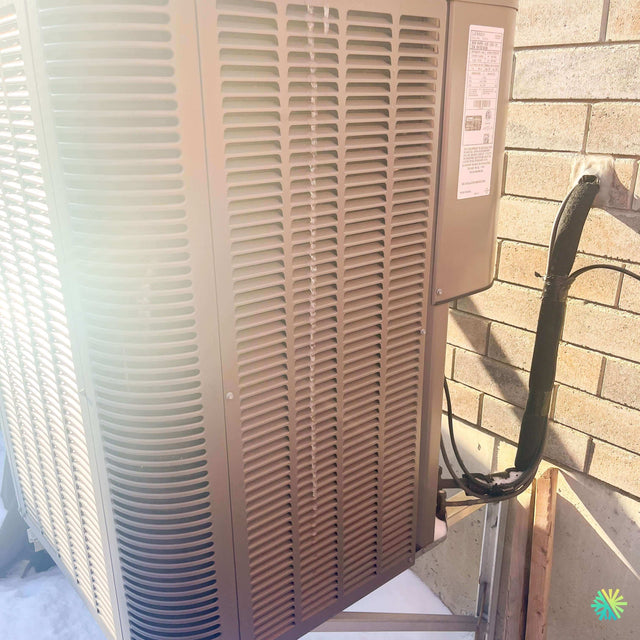
The service image reveals a very common context in the central neighborhoods of Montreal: several outdoor units installed on a roof membrane, refrigerant lines running over a long distance, insulation exposed to sun, cold, rain, and wind, as well as communication cables visible near the device. This type of installation requires special attention because the problem does not always come from the unit itself. It can also come from the environment: deteriorated insulation, poorly protected refrigerant line, weakened electrical connection, unstable support, snow accumulation, or moisture infiltration in a junction box.
In this case, it was not enough to just see that the compressor started or that the fan was running. A real HVAC repair required understanding why the performance had dropped, why the cycles were unstable, and how to prevent the problem from returning after a few days of operation.
A wall-mounted heat pump with an outdoor unit on the roof
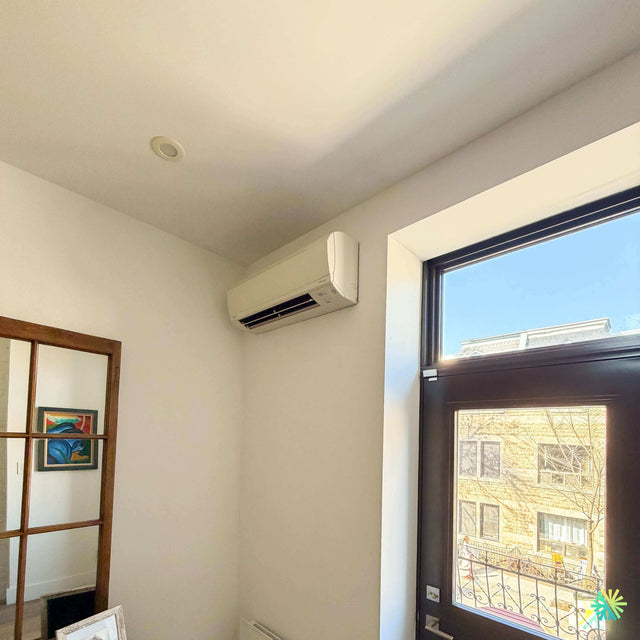
The observed system was a residential wall-mounted mini-split heat pump, connected to an indoor wall unit located inside the dwelling. The exact brand was not clearly readable from the outdoor unit visible in the photo, but the configuration matched a typical residential capacity wall-mounted heat pump installation, usually between 12,000 and 18,000 BTU, depending on the served area, building insulation, and interior space exposure.
In Ville-Marie, this type of installation is common in condominiums, renovated multiplexes, urban housing, small residential buildings, and mixed-use spaces. The roof often becomes the only available place to install the outdoor unit, especially when facades, balconies, or backyards do not allow for a discreet and compliant installation.
The client had noticed several symptoms:
- difficulty stabilizing indoor temperature;
- longer heating or cooling cycles;
- performance drop during cold or humid days;
- intermittent noise coming from the outdoor unit;
- occasional shutdown after prolonged demand;
- concern about the pipes and cables visible on the roof;
- impression that the device was running, but without real output.
These signs can be related to several causes: low refrigerant charge, circuit restriction, damaged insulation on the lines, communication problem between the indoor and outdoor units, electronic board affected by humidity, oxidized connector, poor defrosting, slowed outdoor fan, or faulty temperature sensor.
The challenges of HVAC intervention on a flat roof
Even before opening the unit, our technician assessed the installation around the device. The roof showed typical service conditions: exposed membrane, residual snow, supports on blocks, refrigerant lines protected by a black sheath, visible electrical cables, and the presence of other outdoor units nearby.
A wall-mounted heat pump installed on a flat roof experiences different stresses than a unit placed on the ground or on a wall bracket:
Direct exposure to freeze-thaw cycles
Cold, snow, and humidity affect connections, electrical boxes, insulation, and supports. Slight water infiltration can cause oxidation or intermittent interruptions.
Length of refrigerant lines
When the outdoor unit is far from the indoor unit, the lines can cover a significant distance. Damaged insulation reduces system efficiency, especially in heating mode.
Risk of vibration
Support blocks must remain stable. A unit vibrating on a roof can transmit noise to the building and fatigue the refrigerant connections over time.
More complex technical access
Roof work requires transporting tools, securing the work area, protecting the membrane, and avoiding unnecessary pulling or moving of existing lines.
Initial diagnosis: check the entire system, not just the outdoor unit
Our diagnosis began with a visual inspection of the outdoor unit, supports, lines, and wiring. The refrigerant pipes were grouped and insulated, but some exposed sections on the roof deserved a thorough check. Visible cables on the ground also needed inspection to ensure they were not pinched, cracked, or weakened by exposure.
Electrical power check
We checked the power supply to the outdoor unit, the disconnect switch, connections, and the unit’s response during a demand for operation. A wall-mounted heat pump may seem broken when the problem actually comes from an unstable communication signal or a weakened outdoor connection.
On mini-split systems, the communication cable is essential. It allows the indoor and outdoor units to exchange control information. A loose, oxidized, or damaged wire can cause intermittent shutdowns, error codes, or unpredictable operation.
Refrigerant line inspection
We then checked the refrigerant lines visible on the roof. The black sheath protected the pipes, but some sections showed signs of external wear. On a wall-mounted heat pump, insulation is not just an aesthetic detail. It protects efficiency, limits heat loss, reduces condensation, and preserves the stability of the refrigeration cycle.
Open, compressed, or deteriorated insulation can cause:
- loss of heating capacity;
- excessive condensation;
- localized freezing;
- overconsumption;
- longer cycles;
- compressor fatigue;
- indoor discomfort despite a running system.
Outdoor fan operation check
The outdoor fan had to spin freely, without friction or excessive vibration. We observed the startup, speed, noise, and airflow through the coil. A slowed or obstructed outdoor fan can significantly reduce efficiency, especially when the unit needs to extract heat from the outside air in cold weather.
Inspection of the outdoor coil
The outdoor unit’s coil was exposed to dust, leaves, urban particles, and temperature variations. In Ville-Marie, roofs often accumulate fine debris from traffic, trees, nearby construction, and urban dust. Even if the unit looks clean from afar, the fins can be partially blocked.
We checked air circulation and the condition of the fins to confirm that heat transfer was not limited by dirt buildup.
What the diagnosis revealed
The main problem was not a total compressor failure. The outdoor unit responded to demand, but its performance was compromised by a combination of factors related to installation and outdoor exposure.
Line insulation to correct
Some parts of the line protection had lost their effectiveness. This situation is common on roofs, where UV rays, snow, standing water, and temperature variations accelerate material wear. We recommended and performed targeted correction of accessible insulation to reduce losses and protect the pipes.
Securing external connections
Electrical and communication connections were inspected, tightened when necessary, and protected against moisture. This type of check is essential when a customer reports intermittent operation.
Necessary coil cleaning
The outdoor coil needed cleaning to improve heat exchange. On a wall-mounted heat pump, a dirty outdoor coil reduces both cooling and heating.
An installation to monitor to prevent recurrences
The rooftop location was not problematic in itself, but it required regular maintenance. An outdoor unit installed on the roof should not be forgotten just because it is not visible daily.
Work carried out on site
Our intervention was carried out in several stages to restore reliable operation and avoid superficial repairs.
Technical cleaning of the outdoor unit
We cleaned the outdoor coil and cleared the air circulation areas. This step improved heat transfer and reduced the compressor's workload. After cleaning, the unit breathed better and the cycles became more consistent.
Correction of line insulation
Exposed line sections were inspected and corrected where insulation was weakened. The goal was to protect system efficiency, especially in heating mode, when the heat pump must efficiently transfer energy between outside and inside.
Wiring and connection check
Accessible connections were checked to reduce the risk of interruption. We paid special attention to wires exposed to the roof and near wet areas. An unstable connection can create symptoms that are difficult to diagnose if the device is operating normally when the technician arrives.
Complete operational test
After the corrections, we restarted the system in demand mode. The outdoor unit started more cleanly, the fan operated steadily, and the indoor response was more consistent. The customer noticed better operational consistency and improved comfort.
Why this repair in Ville-Marie shows the importance of targeted HVAC maintenance
A wall-mounted heat pump on a roof should be inspected at least once a year
Unlike a unit installed on a balcony, an outdoor rooftop unit is not regularly observed by the owner. The first signs of wear can therefore go unnoticed for a long time. It is often only when comfort decreases that the customer discovers the real condition of the lines, supports, cables, and coils.
For buildings in Montreal, but also for similar installations in Laval, Longueuil, on the North Shore and the South Shore, we recommend monitoring:
- condition of pipe insulation;
- stability of the supports;
- cleanliness of the outdoor coil;
- presence of vibrations;
- visible cables;
- signs of abnormal ice;
- drainage around the unit;
- unusual noises at startup.
Mistakes to avoid with a wall-mounted heat pump installed on the roof
Ignoring exposed refrigerant lines
A poorly protected refrigerant line can reduce efficiency without causing an immediate breakdown. The system continues to operate, but it consumes more and provides less comfort.
Waiting for an error code
Not all problems trigger a code. A gradual drop in performance can come from dirt buildup, insulation issues, or reduced airflow.
Moving pipes without a qualified technician
Refrigerant lines must not be pulled, bent, or moved to clear a roof. A tight bend or mechanical stress can cause a restriction or leak.
Neglecting the indoor unit
Even though the photo shows the exterior, the indoor unit must also be checked. Dirty filters, a clogged fan, a poorly positioned sensor, or a slow drain can produce similar symptoms.
A concrete result: restored comfort and more stable operation
At the end of this wall-mounted heat pump repair in Ville-Marie, the system was running more consistently. The client regained better temperature stability and a clear understanding of the causes: the unit was not simply “weak,” it was suffering from the combined effects of an exposed outdoor installation, insulation needing correction, a coil to clean, and connections to secure.
At AirGreen, we approach every HVAC service call as a thorough technical investigation. We work on wall-mounted heat pumps, wall air conditioners, MultiZone systems, central heat pumps, and other residential equipment in Montreal, Laval, Longueuil, on the North Shore and the South Shore. Our priority is to find the real cause, make the necessary corrections, and provide the client with practical advice to extend the life of their system.
This intervention in Ville-Marie highlights an important lesson: a well-installed wall-mounted heat pump can provide excellent comfort, but when placed on a roof, it must be protected, inspected, and maintained rigorously. This attention to detail helps prevent repeated breakdowns, performance losses, and emergency calls at the worst time of the season.
The same service at your place?
Cleaning, repair or maintenance: tell us about your unit and we schedule the visit.
- RBQ licence 5645-9605-01Subclasses 15.8, 15.10 and 16
- $5M liability insuranceOn every job
- 15+ yearsFamily-owned, based in Montréal