
Repair of a wall-mounted heat pump in Montreal

What we checked
Items tick as you read the diagnosis.
An aging wall-mounted heat pump that required a complete HVAC intervention
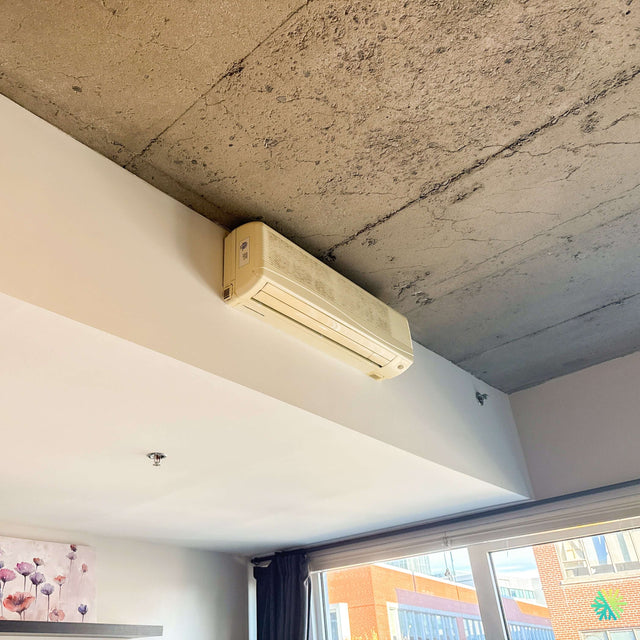
During this service call in Montreal, our AirGreen team was tasked with inspecting a wall-mounted heat pump installed for several years in a residence where indoor comfort had become unstable. The indoor unit, mounted high near the ceiling, showed several visible signs of wear: a weakened casing, misaligned panels, traces of old adhesive tape, dirty deflectors, and dust accumulation around the air outlet.
Upon our arrival, the client explained that the unit still worked intermittently but no longer distributed air evenly. Some days, the airflow seemed weak; other times, the unit produced an unpleasant vibration noise at startup. There was also concern about a possible condensate leak, as the wall beneath the unit had already shown slight signs of moisture after long periods of air conditioning.
In this type of situation, a simple visual check is never enough. A professional HVAC repair must confirm the mechanical, electrical, refrigeration, and sanitary condition of the equipment. At AirGreen, we regularly work on wall-mounted heat pumps like these in Montreal, but also in Laval, Longueuil, on the North Shore, and on the South Shore, where many units installed more than ten or fifteen years ago continue to operate, sometimes at the cost of a significant drop in performance.
Initial diagnosis: what the image already revealed
Even before removing the panels, several technical clues were visible. The right side of the unit appeared to have been opened or temporarily repaired in the past. The black tape, placed around a section of the casing and near the flap, likely indicated an attempt to stabilize the cover or a moving part. This kind of makeshift fix may seem practical short-term, but it often ends up causing other problems: vibration, partial obstruction of the flap, difficulty accessing the filter, or poor air circulation.
The front grille also showed dust buildup. On a wall-mounted heat pump, indoor air constantly passes through the filters, evaporator, and cylindrical fan. When maintenance is neglected, dust compacts on the fan wheel, reduces airflow, and forces the unit to work longer to reach the requested temperature. The result is often the same: less comfort, more noise, higher electricity consumption, and increased risk of ice on the coil.
We therefore proceeded with a multi-step diagnosis:
- inspection of the casing and wall mounts;
- checking the filters and the condition of the indoor coil;
- testing the tangential fan;
- checking the motorized flap;
- checking the condensate drain;
- reading the unit’s responses in cooling and heating modes;
- inspection of accessible electrical connections;
- general assessment of communication between the indoor and outdoor units.
Symptoms reported by the customer
The customer did not describe a total breakdown. The device still started, but its behavior was irregular. This distinction is important because a heat pump that works “a little” can be more complex to diagnose than a unit that is completely stopped. In this specific case, the main symptoms were as follows:
Reduced airflow: the air came out less forcefully than before, especially in the center of the unit.
Vibration noise: at startup, the casing emitted an intermittent noise, amplified when the flap oscillated.
Uneven cooling: the unit struggled to reach the requested temperature, even after several minutes of operation.
Suspicious condensate: the client feared the start of a leak inside.
Deteriorated appearance: the unit had clearly undergone temporary adjustments, raising a safety and durability concern.
These symptoms can have several causes. Low airflow can come from clogged filters, a dirty fan, a worn-out motor, a blocked coil, or a refrigerant shortage. A vibration noise can come from a broken casing, a weakened wall mount, an unbalanced fan wheel, or a misaligned flap. A water leak can be related to a partially blocked drain, inadequate slope, a faulty condensate pump, or a coil that freezes and thaws too quickly.
Technical inspection of the wall unit
After securing the work area, we removed the accessible panels to inspect the inside of the unit. The unit was old and its plastic had lost some of its rigidity. This is a common situation for devices exposed for years to cycles of heat, cold, and humidity. The retaining clips become brittle, the flaps misalign, and vibrations transmit more to the casing.
The filters were dirty but still recoverable. The inner coil had a layer of fine dust, especially in less visible areas. The fan wheel was much more problematic: several blades were covered with deposits, which largely explained the loss of airflow and the noise. A dirty fan wheel no longer spins perfectly balanced; it can create a vibration that resonates through the casing.
We also checked the condensate drain. The passage was not completely blocked, but it showed signs of buildup. A partially clogged drain may work during a short test, then back up after several hours of air conditioning use. That’s why our technicians don’t just pour a little water into the tray: we inspect the flow, the slope, the presence of deposits, and risk areas.
Targeted cleaning and correction of unstable elements
The first step of the repair was to clean the elements responsible for the loss of performance. We carefully cleaned the filters, the accessible coil, the condensate tray, and the fan wheel. In this type of intervention, precision is essential: overly aggressive cleaning can damage the evaporator fins or further weaken aging plastics.
We then removed the temporary fastening elements that were hindering the proper operation of the flap. Tape had been used to hold part of the casing, but it slightly restricted the movement of a moving part. We realigned the panel as much as possible, stabilized the contact points, and reduced vibration areas. In some cases, it is possible to replace body parts; in others, especially when the model is old or hard to identify, it is necessary to assess whether the repair remains cost-effective.
Our goal was clear: to make the device safe, quiet, and functional, while providing the customer with honest information about the general condition of the wall-mounted heat pump.
Electrical verification and operational tests
After the mechanical and sanitary portion, we performed electrical checks. Accessible connections were inspected, startup reactions were observed, and the unit was tested in different modes. An aging wall-mounted heat pump can sometimes show symptoms related to a worn electronic board, an inaccurate temperature sensor, or a fan motor losing efficiency.
In this case, the device still responded correctly to the main controls. The motorized flap remained fragile but functional after realignment. The fan regained a significantly higher airflow after cleaning. The vibration noise, although not completely eliminated due to the age of the casing, was significantly reduced.
We also observed the cooling production and operational stability. The intervention confirmed that the main problem was mostly due to dirt buildup, instability of the casing, and drainage to monitor, rather than an immediate major failure of the compressor or the main board.
Result: improved comfort and better-informed customer
At the end of the service call, the unit was blowing more freely, the vent worked better, vibrations were reduced, and the drainage had been cleaned. The customer immediately noticed better air distribution in the room. We also took the time to explain the device’s limits: a repair can extend the lifespan of a wall-mounted heat pump, but it does not turn an aging unit into a new system.
This transparency is part of our approach. A wall-mounted heat pump repair must be useful, but it must also help the customer make a good decision for the future. When parts become hard to find, plastic becomes fragile, noise returns quickly, or repair costs add up, replacement can become more advantageous. Conversely, when a good cleaning, adjustment, and drainage correction are enough, pushing for a premature replacement would be unnecessary.
What this intervention reveals about the maintenance of wall-mounted heat pumps
An old wall unit can hide several simple problems
Many customers contact us thinking their heat pump is “done for,” when a significant part of the problem comes from a lack of maintenance. A dirty fan wheel, a partially blocked drain, or a neglected filter can give the impression that the device lacks power. Yet, a well-done intervention can often restore a very acceptable level of performance.
That said, improvised solutions should be avoided. Adhesive tape, temporary shims, manually forced vents, or artificially held panels can worsen the damage. An indoor unit of a wall-mounted heat pump contains moving parts, sensors, electrical connections, and a condensate tray. Any rough modification can create noise, leaks, or additional risks.
Mistakes to avoid with a wall-mounted heat pump
On the ground, in Montreal, Laval, Longueuil, on the North Shore and on the South Shore, we often see the same mistakes:
Wait for the water to flow before taking action
A partially blocked drain sometimes gives warning signs: musty smell, gurgling noise, small marks on the wall, accumulation in the pan. Waiting for a visible leak can cause damage to drywall, paint, or flooring.
Cleaning only the filters
Filters are important, but they are only part of the system. The fan wheel, coil, and condensate pan can also accumulate deposits. Superficial maintenance does not always fix airflow losses.
Forcing the dampers
When the damper no longer moves properly, do not force it by hand. The mechanism may be connected to a small fragile motor. Rough handling can break the gear or further misalign the system.
Ignoring vibrations
A vibration is not just an annoying noise. It can indicate an unstable casing, an unbalanced wheel, a weakened support, or a displaced internal part. The longer you wait, the more the vibration can wear down components.
When to repair and when to replace
The decision depends on several factors: the age of the unit, parts availability, compressor condition, level of dirt buildup, frequency of breakdowns, and overall repair cost. In this Montreal case, the repair was relevant because the unit still responded to controls, the main problem was accessible, and the client wanted to extend its use in the short term.
However, we also explained that a replacement might make sense if symptoms return quickly or if a major part becomes necessary. The new wall-mounted heat pumps often offer better energy efficiency, quieter operation, Wi-Fi options, better modulation, and improved heating performance. For many homeowners, especially in Greater Montreal, replacement can also be part of a broader reflection on year-round comfort.
The AirGreen approach to HVAC service calls
At AirGreen, we approach every HVAC service call with a structured method. We don’t just note that the unit is old or dirty. We seek to understand why the system is malfunctioning, what repairs are possible, and which recommendations are truly useful for the client.
Our team works on wall heat pumps, wall air conditioners, MultiZone systems, central heat pumps, PTAC / VTAC units, consoles, cassettes, and other light residential or commercial equipment. This varied experience allows us to quickly recognize signs of ventilation, drainage, electronic control, or refrigeration performance issues.
In this repair, the goal was not just to get the device running again. It was necessary to restore more stable operation, reduce vibrations, improve airflow, secure drainage, and provide the client with a clear reading of the actual condition of their heat pump.
Comfort restored thanks to precise intervention
After the final tests, the part regained a more regular airflow. The client noticed that the device responded better, with less noise and improved distribution. The heat pump was not new, but it had regained performance more consistent with its current capabilities.
This intervention clearly illustrates the importance of professional service for aging wall systems. A wall heat pump repair in Montreal may seem simple at first glance, but it requires a good understanding of possible causes: dust, vibration, drainage, moving parts, casing aging, and electrical behavior. It is this combination of technical analysis and field experience that allows AirGreen to offer reliable service, whether in Montreal, Laval, Longueuil, on the North Shore or on the South Shore.

The same service at your place?
Cleaning, repair or maintenance: tell us about your unit and we schedule the visit.
- RBQ licence 5645-9605-01Subclasses 15.8, 15.10 and 16
- $5M liability insuranceOn every job
- 15+ yearsFamily-owned, based in Montréal