
Service Call for a Wall-Mounted Heat Pump in Laval
Beforewhat the article reports

Afterresults described
A wall-mounted heat pump that had to heat efficiently despite the cold, snow, and a high installation location
In Laval, in the middle of winter, our AirGreen team was called for a service call on a wall-mounted heat pump installed on an outdoor wall bracket, directly on the brick facade of a residential building. The situation was typical of HVAC interventions we often encounter in Greater Montreal: an outdoor unit exposed to cold, snow, frequent defrost cycles, and an installation where technical access had to be carefully assessed before any intervention.
The client had contacted us because the wall-mounted heat pump no longer seemed to provide the expected heating performance. Indoor comfort had become irregular: some heating periods worked normally, then the unit seemed to slow down, blow less warm air, or stop operating for longer than usual. In a home primarily heated by a heat pump, this type of behavior quickly becomes concerning, especially when outdoor temperatures drop.
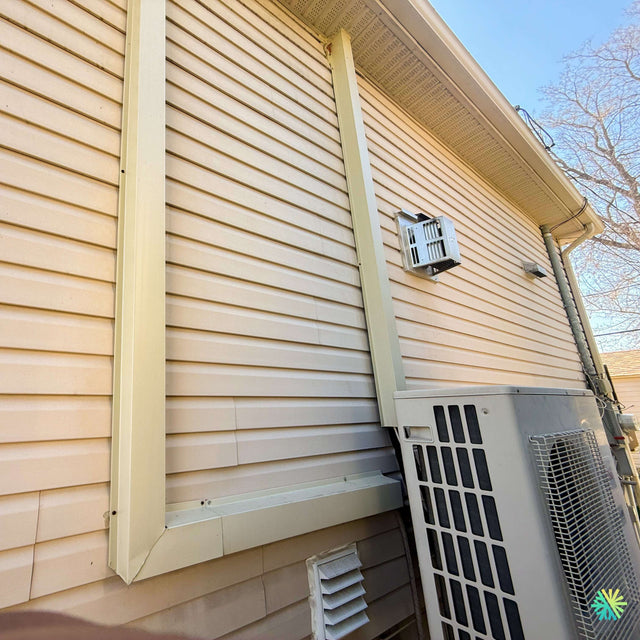
Upon our arrival on site in Laval, several visible elements helped us guide the diagnosis. The outdoor unit was securely mounted on wall brackets, above the snow level, which is generally good practice for an HVAC installation in the Quebec climate. However, the front-facing configuration, the proximity to the masonry, the vertical routing of refrigerant and electrical lines, as well as winter conditions required a thorough inspection: ventilation of the outdoor unit, clearances, defrost water drainage, vibration, electrical supply, communication with the indoor unit, and compressor behavior.
A first visual analysis of the outdoor installation
The observed outdoor unit was a mini-split type wall-mounted heat pump, installed on a metal wall bracket. This type of installation is common in Laval, Montreal, Longueuil, on the North Shore and the South Shore, especially in apartment buildings, duplexes, triplexes, and small residential buildings where floor space is limited.
On this intervention, our attention focused on several points:
- clearance under the outdoor unit relative to snow accumulation;
- the stability of wall mounts and absence of excessive movement;
- the condition of the outdoor fan;
- possible ice traces around the coil;
- the behavior of the defrost cycle;
- the apparent condition of refrigerant lines;
- protection of wiring and drain;
- the presence of vibration transmitted to the building structure.
A wall-mounted heat pump may seem simple from the outside, but in heating mode, its operation is very demanding. The outdoor unit must capture heat from cold air, manage moisture that turns into frost, trigger defrost cycles at the right time, then resume heating without abnormal performance loss. When one of these elements is disrupted, the client quickly feels a drop in comfort.
Symptoms reported by the client
The client explained to us that the unit was working, but not always consistently. The heat pump sometimes seemed to start properly, then reduce its power. At other times, the indoor fan kept running, but the air blown was less warm. The client also noticed longer shutdown periods, possibly related to defrost cycles.
This type of symptom can come from several causes:
- an outdoor coil partially blocked by frost;
- an inaccurate outdoor temperature sensor;
- a control board that poorly manages defrosting;
- an insufficient or unstable refrigerant charge;
- a restriction in the refrigerant circuit;
- a slowed outdoor fan;
- irregular power supply;
- intermittent communication between the indoor and outdoor units;
- an accumulation of defrost water that refreezes under or around the unit.
Our role is never to jump to conclusions. A good wall-mounted heat pump repair relies on a structured diagnosis, step by step, because several problems can produce the same symptoms.
CVAC Diagnostic: check before replacing
The first step was to verify the general operation of the unit. We observed startup, compressor noise, outdoor fan rotation, and the unit’s reaction to heating demand. The goal was to confirm whether the heat pump was truly broken, in protection mode, or simply going through an extended defrost cycle.
We then checked the accessible electrical components: power supply voltage, condition of connections, communication between components, and the unit’s response to the indoor control. On several service calls in Laval, a wall-mounted heat pump that seems to lose efficiency can sometimes suffer from a minor electrical issue: loose terminal, oxidation, fuse, worn circuit breaker, or connector exposed to moisture.
In this specific case, the unit was responding to demand, but its heating performance was irregular. We therefore continued with an analysis of the refrigeration cycle and defrosting behavior.
The crucial role of defrosting in winter
In heating mode, a wall-mounted heat pump extracts heat from the outside air. When the air is humid and cold, frost can form on the outdoor coil. This is normal up to a certain point. The unit must then initiate a defrost cycle: it temporarily reverses its operation to warm the outdoor coil and melt the ice.
The problem occurs when the defrost cycle is too frequent, too long, incomplete, or improperly triggered. The customer may then believe the heat pump is no longer heating, while it is actually spending an excessive amount of time defrosting. Conversely, if defrosting does not trigger correctly, ice accumulates, blocks airflow, and greatly reduces heating capacity.
During this service, we examined the condition of the coil and signs of water or ice around the outdoor unit. The elevated installation limited direct contact with snow on the ground, which was positive. However, the water produced during defrosting had to be able to flow freely, without refreezing against the wall or under the unit.
Checking clearances and outdoor ventilation
An outdoor heat pump unit needs to breathe. Even if it is installed on a wall, clearance around the unit remains essential. Poor air circulation can cause:
- a drop in efficiency;
- abnormal pressure in the refrigeration circuit;
- an increase in defrosting time;
- premature compressor wear;
- a more pronounced noise;
- higher electrical consumption.
In the case of this wall-mounted heat pump in Laval, the unit was exposed to a brick facade, with a relatively clear configuration towards the front. We still checked that nothing blocked the air outlet, that the fan turned freely, and that the device was not too close to an obstacle that could create a cold air return towards the coil.
Inspection of the wall support and vibrations
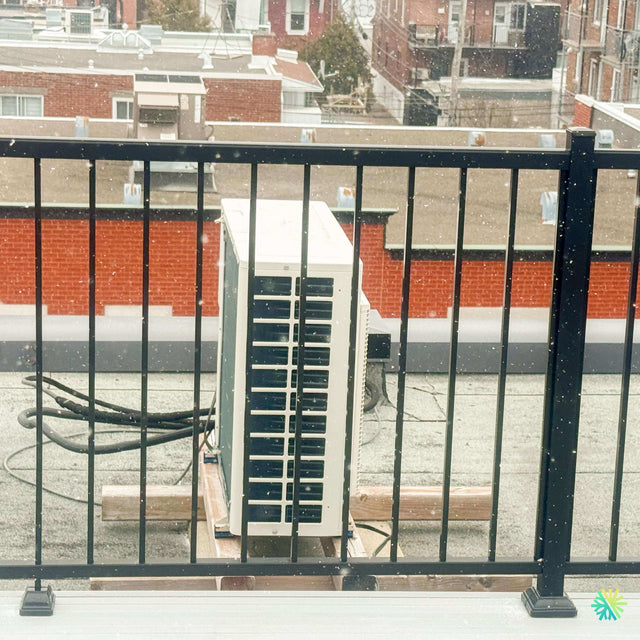
The image clearly shows an outdoor unit installed on metal supports fixed to the wall. This type of support is often preferable when the device must be kept above the snow. However, a wall installation can transmit vibrations to the building structure if the fastenings, vibration dampers, or the device’s level are not adequate.
During our service call, we inspected:
- the condition of the brackets;
- the wall mounting;
- the unit’s base;
- the vibration points;
- the anti-vibration rubbers;
- the refrigerant lines to detect any mechanical tension.
Excessive vibration can be mistaken for a motor or compressor failure. It can also eventually weaken the refrigerant fittings or create disturbing noises inside the home. In this type of building in Laval, we pay special attention to acoustic transmission, especially when the unit is installed near windows or bedrooms.
Analysis of refrigerant lines and wall passage
The visible refrigerant lines ran vertically along the front facade before entering the building. This passage must be well protected, well insulated, and properly sealed. Damaged insulation can cause performance loss, condensation, or even localized freezing problems.
During our inspection, we verified that the lines were not pinched, that the insulation was in place, that the fittings showed no signs of suspicious oil, and that the routing did not create tension on the outdoor unit. An oil stain near a fitting is often a sign of refrigerant leakage. A drop in charge can explain a heat pump that heats less effectively, frosts abnormally, or runs longer without reaching the requested temperature.
Tests performed on site
To confirm the diagnosis, our technician carried out a series of practical checks:
- comparison between the requested temperature and the ambient temperature;
- measurement of the blowing temperature at the indoor unit;
- observation of the outdoor unit's behavior in heating mode;
- fan rotation check;
- inspection of the outdoor coil;
- checking compressor noise;
- checking electrical connections;
- search for signs of leaks or restrictions;
- validation of the defrost cycle.
These steps help distinguish a real fault from a misunderstood normal behavior. In winter, many customers worry when a heat pump temporarily stops blowing warm air during defrosting. What is not normal is an endless defrost cycle, repeated heat loss, or ice buildup that returns too quickly.
The most likely cause: reduced performance due to winter conditions and defrost management to be optimized
In this case, the symptoms pointed to a combination of factors: winter conditions, frequent defrost cycles, and reduced performance due to partial frost buildup around the outdoor coil. The device was not completely stopped, which ruled out a total compressor failure or a complete power outage. However, its performance was unstable, and the unit seemed to need intervention to regain more consistent operation.
We carried out targeted cleaning of accessible areas, checked the outdoor airflow, and validated the device’s behavior after restoring the demand. When necessary, this type of intervention can also lead to a follow-up recommendation: more advanced pressure testing, leak detection, sensor replacement, adjustment of defrost drainage, or replacement of an electronic component if the defrost cycle remains abnormal.
Why you should not simply “force” the device
A common mistake is to sharply increase the requested temperature, constantly change modes, or repeatedly restart the device. In some cases, this worsens the situation. A modern wall-mounted heat pump operates with precise electronic logic. If it detects an anomaly in temperature, pressure, communication, or defrosting, it can reduce its power or go into protection mode.
Forcing the device without diagnosis can cause:
- premature compressor wear;
- higher electrical consumption;
- even more frequent defrost cycles;
- an intermittent fault that is more difficult to diagnose;
- a worsening of an existing refrigerant leak.
That is why a structured HVAC service call is often more economical than a series of improvised tests.
Result of the intervention: stabilized heating and better-informed customer
After the checks and corrections made on site, the heat pump was put back into operation and its behavior was observed during heating demand. The goal was to ensure the outdoor unit was ventilating properly, that heating resumed normally, and that the customer understood the difference between a normal defrost cycle and a failure symptom.
The customer was reassured on several important points: the elevated installation is favorable in winter, the device was not completely broken, and the observed signs could be corrected or monitored before leading to a major failure. We also explained the signs to watch for in the following days:
- rapid ice buildup on the outdoor unit;
- warm indoor air for long periods;
- new metallic noise or vibration;
- complete device shutdown;
- electrical smell;
- error code on the indoor unit;
- defrost water refreezing excessively.
What this intervention in Laval shows about wall-mounted heat pump maintenance
A wall-mounted heat pump installed in Greater Montreal must face very variable conditions: humidity, freezing rain, snow, cold winds, rapid thaws, and sudden temperature drops. In Montreal, Laval, Longueuil, on the North Shore and the South Shore, we regularly see devices that work well for part of the winter, then start showing signs of weakness as freeze-thaw cycles intensify.
Preventive maintenance and seasonal inspection often help avoid emergency calls. Even a well-installed system may require a check after a few seasons, especially if the device is heavily used for heating.
Best practices to remember to avoid a breakdown in winter
To extend the lifespan of a wall-mounted heat pump, we recommend monitoring several simple elements:
- keep the outdoor unit clear of snow;
- prevent ice from accumulating under the device;
- never hit the coil to remove ice;
- do not block the air outlet;
- check that defrost water can drain;
- clean the indoor filters regularly;
- request service if defrosting seems abnormal;
- avoid restarting the device without understanding the error code.
These actions do not replace a professional diagnosis, but they reduce the risk of breakdowns and improve the overall system performance.
AirGreen expertise for residential HVAC service calls
At AirGreen, we work every week on wall-mounted heat pumps, wall air conditioners, MultiZone heat pumps, central heat pumps, and other residential systems in Greater Montreal. Our approach is practical: we start from the actual symptoms, analyze the installation, test the components, and clearly explain what needs to be done.
A good diagnosis is not just about replacing a part. It involves understanding why the failure occurred. In this case in Laval, the location of the outdoor unit, winter exposure, defrost cycle, and ventilation were all important factors. This comprehensive view allows for proposing a lasting solution rather than a temporary fix.
A well-executed HVAC repair starts with an accurate diagnosis
This intervention in Laval perfectly illustrates the importance of a service call for a wall-mounted heat pump carried out methodically. A device that heats less effectively does not necessarily need to be replaced. It could be a defrosting issue, air circulation problem, drainage, sensor, refrigerant charge, vibration, or electrical connection.
By examining the entire system, we were able to stabilize the operation, reassure the client, and provide clear guidance for the future. For owners in Montreal, Laval, Longueuil, the North Shore, and the South Shore, this type of intervention shows that professional HVAC service can extend equipment lifespan, improve comfort, and prevent more costly repairs.
A wall-mounted heat pump is a high-performance device, but it must be installed, maintained, and repaired with care. When exposed to Quebec's winter conditions, every detail matters: clearance, drainage, support, ventilation, defrosting, and electronic diagnostics.

The same service at your place?
Cleaning, repair or maintenance: tell us about your unit and we schedule the visit.
- RBQ licence 5645-9605-01Subclasses 15.8, 15.10 and 16
- $5M liability insuranceOn every job
- 15+ yearsFamily-owned, based in Montréal