
Repair of a wall-mounted heat pump in Saint-Eustache

What we checked
Items tick as you read the diagnosis.
An aging wall unit that no longer cooled properly in a space with a concrete ceiling
In Saint-Eustache, on the North Shore, our AirGreen team was called for a common but often misdiagnosed problem: an indoor wall heat pump that still seemed to be working but no longer provided the expected comfort. The unit was installed high above a large window, in a room with an exposed concrete ceiling. The unit, a residential mini-split wall type, showed typical signs of an older system: slightly yellowed plastic, tired air louvers, possible dust accumulation in the fins, and irregular airflow.
The client contacted us because the wall heat pump was producing less cool air than before, with lower airflow and noisier operation at startup. The room became uncomfortable on hot days, especially near the large windows, where solar gains quickly increased the indoor temperature. The system responded to the remote control, the indicators were active, but the final result was no longer satisfactory.
In this kind of situation, it is essential not to jump to conclusions about a major breakdown. A wall heat pump repair can involve a refrigerant problem, a faulty sensor, a dirty fan, a partially blocked drain, a weakened ventilation motor, or simply a combination of several small failures that gradually reduce performance.
An interior configuration that directly influences efficiency
The location of this wall heat pump was unusual. Installed very high, near a concrete ceiling, the unit had to distribute air in a bright room exposed to a large glazed surface. This type of installation can work very well when the unit is clean, well calibrated, and properly maintained. However, as soon as the airflow decreases, performance drops quickly.
The exposed concrete ceiling retains and diffuses heat differently. The large window increases air conditioning loads in the summer. The wall unit must therefore blow air far enough and strong enough to mix the air throughout the room. If the fan is dirty or the fins are blocked, the cold air stays near the unit or does not descend well into the occupied area.
During our inspection, we paid attention to several visible and technical elements:
- the general condition of the indoor casing;
- the opening and closing of the air vents;
- the cleanliness of the filter;
- the condition of the indoor coil;
- possible buildup on the fan;
- the presence of humidity odors;
- the airflow at low, medium, and high speeds;
- the unit’s behavior in cooling mode;
- the system’s response to setpoint changes;
- the condensate drainage.
This first step helps understand whether the failure comes from lack of maintenance, an electrical fault, a refrigerant problem, or a mechanical failure.
Symptoms observed by the customer
The customer did not describe a complete failure. The wall-mounted heat pump started, but it took far too long to cool the room. The air seemed less cold, the indoor fan made a harsher noise, and some areas of the room remained warm despite a low setpoint.
These symptoms are very telling. A wall unit that runs without really cooling can be affected by several causes.
Insufficient airflow
A dirty filter or a clogged fan reduces the amount of air passing through the coil. The system may produce cold air but not distribute it properly.
Clogged indoor coil
Over the years, fine dust, cooking grease, textile fibers, and humidity can form a layer on the coil. This layer acts as an insulator and limits heat exchange.
Partially blocked condensate drain
When condensate water drains poorly, humidity accumulates in the indoor unit. This can cause odors, water flow noises, and sometimes safety shutdowns depending on the model.
Inaccurate temperature sensor
A poorly positioned, dusty, or aging sensor can give a wrong reading to the electronic board. The unit then thinks the temperature is reached too early or modulates inadequately.
Refrigerant charge to check
A drop in performance can also come from a leak or an improper charge. However, at AirGreen, we always check the condition of the indoor unit and airflow before drawing conclusions about the refrigerant.
AirGreen Diagnosis: inspection, tests, and troubleshooting logic
Our technician started by setting the wall-mounted heat pump to cooling mode with a low enough setpoint to force continuous operation. This method allows observing the actual behavior of the unit: fan speed, discharge temperature, outdoor compressor stability, electronic board response, and condensate production.
We then removed the filters to check their condition. On wall-mounted heat pumps, even a filter that looks “acceptable” on the surface can allow enough dust to pass through to clog the turbine and coil over time. The indoor turbine is often the big forgotten part of residential maintenance. When it is loaded with dust, it loses balance, generates more noise, and moves less air.
In this case, the airflow was not uniform. Some sections of the outlet blew properly, while others seemed much weaker. This observation indicated internal clogging rather than a simple remote control or operating mode issue.
We also checked the temperature difference between the air taken in by the device and the air blown out. This measurement, combined with airflow observation, helps distinguish a machine that produces cold but does not distribute it well from a machine that barely produces cold anymore.
Technical cleaning of the wall unit
After confirming that the indoor unit required a deep intervention, we protected the area under the device, which is especially important in this room where the heat pump is installed above a window and near finished surfaces. Cleaning a wall-mounted heat pump must be done carefully: it is not just about wiping the plastic.
We carried out targeted cleaning:
- removal and cleaning of filters;
- inspection of the indoor coil;
- cleaning of accessible fins;
- cleaning of the ventilation turbine;
- checking the condensate drainage;
- inspection of the drainage pan;
- check of the motorized flap;
- gradual restart of the device;
- airflow test after cleaning.
The turbine was one of the critical points. When it accumulates dust, it no longer pushes air evenly. It can also create a vibration noise, especially at startup or during speed changes. After cleaning, the airflow improved significantly, and the ventilation noise became more consistent.
Drain and condensate check
A wall-mounted heat pump in air conditioning produces water. This water must be properly drained outside or into a designated drainage system. A partially clogged drain can cause odors, indoor leaks, and persistent moisture in the unit.
In Saint-Eustache, as elsewhere on the North Shore, we often see drains exposed to temperature variations, dust, insects, or seasonal clogging. During this intervention, we verified that water was draining properly and that the indoor tray was not retaining excessive moisture. This step is especially important for older units, as plastics, seals, and drainage slopes can degrade over time.
Communication check with the outdoor unit
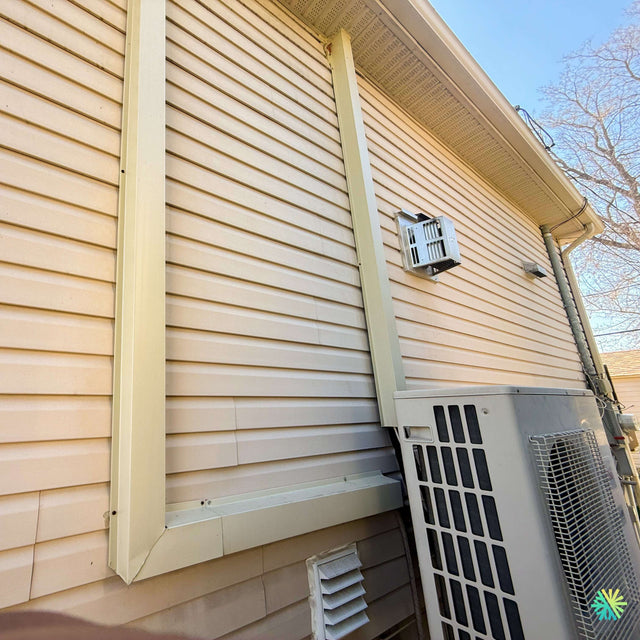
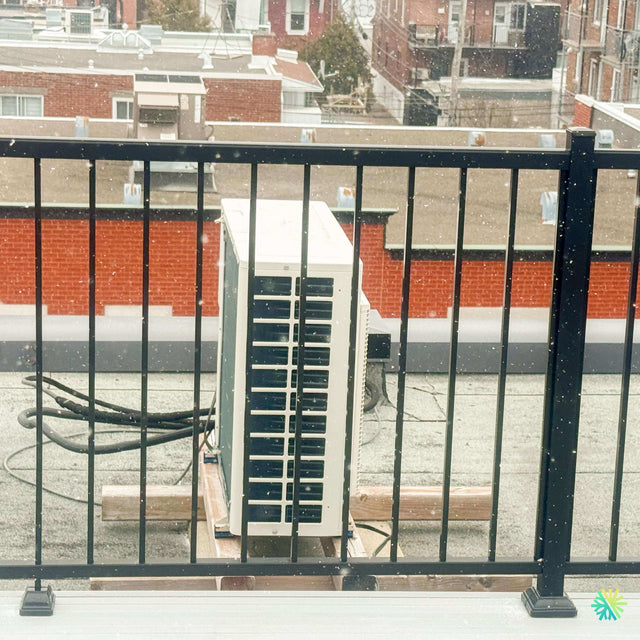
Even though the photo shows the indoor unit, a wall heat pump always operates with an outdoor unit. After the indoor intervention, we confirmed that the outdoor compressor responded correctly to the demand. A machine can have a clean indoor unit but lose performance if the outdoor unit is blocked, the outdoor fan weakens, or operating pressures are inconsistent.
We therefore carried out the necessary checks to ensure that the entire system was functioning logically. Communication between the indoor and outdoor units was stable. The compressor started normally, without immediate abnormal noise, and the performance after cleaning indicated that the main problem was initially due to indoor air restriction.
A performance restoration that brings back comfort and avoids premature replacement
After technical cleaning and HVAC checks, the wall heat pump in Saint-Eustache returned to much more satisfactory operation. The airflow was more consistent, the blown air was better distributed, and the room responded more quickly to the setpoint requested. The client was able to see that the unit did not necessarily need immediate replacement: it mainly needed a thorough diagnosis and appropriate servicing.
Why an old wall unit can still be useful
It is common for an owner to automatically think of replacement when their wall unit starts to lose efficiency. In some cases, replacement is indeed the best option, especially when the compressor is faulty, parts are no longer available, or the refrigerant used becomes difficult to manage. But in other cases, a well-executed repair can extend the life of the unit and restore acceptable comfort.
In this intervention, the indoor unit showed signs of age, but it still responded to controls and produced cold air. The problem was mainly with air distribution and internal condition. A precise intervention was therefore much more relevant than an immediate replacement without analysis.
Signs that a wall-mounted heat pump needs service
We explained to the client the signs to watch for in the coming weeks. An HVAC repair doesn’t end with just restarting the system: it also includes practical advice to prevent the problem from returning quickly.
The important signs to watch for are:
- Gradual decrease in airflow;
- Noise louder than before;
- Humidity odor at startup;
- Water leaking inside;
- Device runs for a long time without reaching the temperature;
- Vents that move poorly;
- Remote control responds, but performance is insufficient;
- Ice formation on pipes or the indoor unit;
- Short cycles or frequent stops.
These symptoms should not be ignored. The faster the intervention, the higher the chances of a simple repair.
Mistakes to avoid with a wall-mounted heat pump
Many wall-mounted heat pump problems could be avoided with good habits. In Montreal, Laval, Longueuil, on the North Shore and South Shore, we often see the same mistakes during our service calls.
Cleaning only the filters
Filters are important, but they only represent part of the system. The turbine, coil, drain pan, and vents must also be inspected.
Using unsuitable products
Some household products can damage plastics, leave odors, or create residues on the coil. A wall-mounted heat pump must be cleaned using methods suitable for HVAC components.
Continuously setting the temperature too low
Setting the device to a very low temperature does not solve a performance problem. If the airflow is low, the machine will run longer without delivering the desired result.
Ignoring turbine noise
A noise that increases over time is often a sign of clogging or imbalance. Waiting can strain the ventilation motor.
Waiting for a water leak before taking action
A partially clogged drain can be fixed before it causes interior damage. As soon as an unusual odor or moisture appears, an inspection is recommended.
An intervention tailored to the Saint-Eustache area
Saint-Eustache features a mix of houses, condos, and buildings with very varied configurations. Some installations are recent, others are several years old. Wall units installed high up, near large windows, or in spaces with unique ceilings require extra attention. The position of the device influences the reach of the air, the perception of comfort, and how dust accumulates.
In this case, the location above the window made comfort highly dependent on airflow. Once the fan was cleaned and the air outlet rebalanced, the unit could better combat heat gains from the windows.
What this repair demonstrates
This service call shows that a request for a wall-mounted heat pump should never be treated as a simple quick visit. A device that “still works” may be experiencing significant performance loss. A device that “no longer cools enough” can sometimes be restored without immediate replacement. The difference lies in the quality of the diagnosis.
At AirGreen, we analyze the entire system: indoor unit, outdoor unit, ventilation, drainage, controls, environment, and actual behavior upon request. This approach allows us to provide the client with a clear answer: repair, maintain, monitor, or plan a replacement when truly necessary.
Final result: a quieter, more efficient device and a reassured client
At the end of the service, the wall-mounted heat pump offered better airflow, more stable cooling, and quieter operation. The client received clear explanations about the cause of the problem, maintenance steps to follow, and signs to watch for in upcoming seasons.
AirGreen provides repair services for wall-mounted heat pumps in Saint-Eustache, as well as throughout Montréal, Laval, Longueuil, on the North Shore and the South Shore. Whether it's an issue with airflow, noise, water leaks, condensate, electrical failure, electronic board, compressor, or reduced performance, we always prioritize precise, clean, and lasting intervention.

The same service at your place?
Cleaning, repair or maintenance: tell us about your unit and we schedule the visit.
- RBQ licence 5645-9605-01Subclasses 15.8, 15.10 and 16
- $5M liability insuranceOn every job
- 15+ yearsFamily-owned, based in Montréal