
Repair of a Wall-Mounted Heat Pump in Vaudreuil-Dorion

A leak under the indoor unit: when a wall-mounted heat pump still cools but poorly drains its condensate
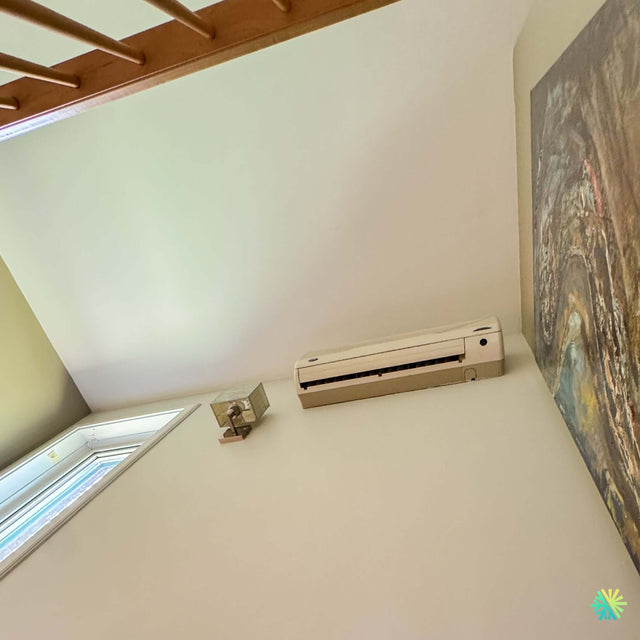
In Vaudreuil-Dorion, a homeowner contacted us for a problem that seemed minor at first but could quickly cause wall damage: his wall-mounted heat pump was still working, air was coming out of the indoor unit, but a vertical moisture stain appeared under the device. The unit was installed high up, near the ceiling, in a clean and clear indoor space. In the photo, you can clearly see a mini-split type wall unit, with a white front, a lower air flap, and a technical label on the right side. The size suggests a common residential capacity, usually around 9,000 to 12,000 BTU depending on the system configuration.
The main symptom was clear: water seemed to be coming down from the bottom of the unit or the back of the casing, leaving a discreet but visible mark on the wall. In this kind of situation, the customer often wonders if the device is breaking, if the outdoor compressor is at fault, or if the heat pump needs to be replaced. In reality, an internal leak on a wall-mounted heat pump is very often related to condensate drainage: partially clogged drain, dirty condensate tray, insufficient slope, dust accumulation in the evaporator, or ice formation that then melts inside.
At AirGreen, we handle this type of HVAC service call with a rigorous method. A leaking unit should not be diagnosed by sight alone. It is necessary to check the drainage, airflow, filter condition, cleanliness of the evaporator, turbine, flap, condensate tray, and the device’s behavior in cooling mode. This approach allows us to fix the problem at its source, rather than just wiping the water and waiting for the leak to return.
The context of the service call in Vaudreuil-Dorion
The customer had noticed that the heat pump was still cooling the room, but the operation was no longer as clean as before. The device seemed to produce cool air, but after a prolonged period of operation, a water line appeared on the wall directly below the unit. The main concern was potential damage to the paint, drywall, and inside the wall.
The reported symptoms were typical:
- vertical water stain under the wall-mounted heat pump;
- visible moisture after several hours of air conditioning;
- feeling that the unit was working harder;
- possibly reduced airflow;
- concern about an internal leak or blocked drain;
- need for a diagnosis before the wall is damaged.
In Montreal, Laval, Longueuil, on the North Shore and the South Shore, we regularly see this type of problem during hot and humid periods. The more humid the indoor air, the more condensate the indoor unit produces. If the flow is slowed, even slightly, water can accumulate in the pan, overflow, and then come out the front or back of the unit.
First check: condensate drainage
Upon arrival, our first priority was to confirm whether the leak was indeed coming from the drainage system. On a wall-mounted heat pump, condensation water should fall into an internal pan, then drain through a pipe that usually runs behind the wall or inside a duct. If this drain is partially blocked, water can accumulate until it overflows from the casing.
We carefully opened the indoor unit to inspect the condensate pan. Since the unit is installed high on the wall, the work had to be done cleanly, without causing additional leakage. A protective cover was placed under the unit to prevent any spills during testing.
The flow test confirmed that drainage was too slow. The water poured into the pan did not drain as smoothly as expected. This indicated a partial blockage of the drain or a buildup of deposits in the pan. This type of blockage does not always prevent the unit from working, but it becomes problematic when the heat pump runs for a long time, especially in humid weather.
Cleaning the condensate pan and clearing the drain
The solution began with a targeted cleaning of the condensate pan. Over time, dust, moisture, and microdebris form a sticky substance that slows drainage. This buildup can also create an unpleasant odor when the unit is running. In some cases, the drain is not completely clogged: it is simply restricted enough to cause overflow during long periods of air conditioning.
We cleared the drain, rinsed the evacuation path, and confirmed that the water was exiting properly. This step is essential in any wall-mounted heat pump repair related to a leak. A drain that seems clear on the first test can still be partially blocked further along the path. That is why we always perform a full validation after cleaning.
When drainage returned to a normal flow, we retested under real conditions. Water flowed properly into the drain, with no backflow into the casing and no dripping on the wall.
Inspection of filters, evaporator, and turbine
A condensate leak is not always caused solely by the drain. Poor airflow can also cause abnormal moisture buildup on the evaporator. If the filters are dirty, if the turbine is dust-laden, or if the evaporator is clogged, air circulation is reduced. The unit can then produce irregular condensation, form small frost areas, or send water in a direction that no longer perfectly matches the tray.
We therefore checked the filters. They needed cleaning, which partly explained the reduced airflow. The evaporator showed a light to moderate accumulation of dust, typical of a regularly used unit. The turbine was also inspected to ensure it was not excessively limiting the airflow.
A cleaning of the filters and accessible surfaces was performed. We then recommended a more thorough HVAC maintenance if the client wanted to further optimize performance and reduce the risk of recurrence. For a wall-mounted heat pump, periodic cleaning is not just a matter of comfort: it is also protection against leaks, odors, noise, and loss of efficiency.
Checking operation in cooling mode
After cleaning and clearing the drain, we restarted the wall-mounted heat pump. We observed the airflow, the operation of the flap, the stability of the ventilation, and the formation of condensate. The unit was left running to confirm that the water was following its normal path.
The result was clear: no more overflow, better drainage, more consistent airflow, and more stable operation. The client was able to confirm that the water mark was indeed caused by a drainage problem and not a major system failure. This distinction is important because it avoids unnecessary expenses and helps extend the device’s lifespan.
What this repair reveals about wall-mounted heat pump leaks
A wall-mounted heat pump can still cool properly while having a serious water drainage problem. That’s why you shouldn’t wait for the leak to become significant. A small mark on the wall is often the first sign of a deeper problem in the tray or drain.
In Vaudreuil-Dorion, the intervention corrected the cause before water damaged the wall. This is exactly the role of a good HVAC service call: intervene at the right time, identify the real source of the problem, and prevent a simple situation from becoming costly.
Common mistakes to avoid
The first mistake is believing a leak will disappear on its own. If the drain is partially clogged, the problem will return as soon as the device runs longer.
The second mistake is using harsh chemicals in the drain. Some products can damage plastics, release odors, or create risks for internal components.
The third mistake is disassembling the unit without knowing its internal structure. Clips, motorized flaps, sensors, and plastics in a wall-mounted heat pump can be fragile, especially after several years.
The fourth mistake is to quickly conclude there is a refrigerant shortage. A refrigerant shortage can cause freezing, but it is not the most common cause of a leak. In this case, the problem was mainly due to slow drainage and needed maintenance.
Why preventive maintenance makes all the difference
Regular maintenance greatly reduces the risk of water leaks. Filters must be cleaned by the owner, but this does not replace professional cleaning. Over time, dust bypasses the filters, sticks to the evaporator, accumulates in the turbine, and ends up in the condensate tray.
A well-done HVAC maintenance allows you to:
- maintain good airflow;
- prevent drain blockages;
- reduce musty odors;
- protect the wall and interior surfaces;
- improve cooling efficiency;
- extend the unit’s lifespan;
- detect signs of wear before a breakdown.
In areas like Vaudreuil-Dorion, Montreal, Laval, Longueuil, the North Shore, and the South Shore, humid summers put wall systems to the test. A wall-mounted heat pump used daily can produce a lot of condensation water. If the drain is not perfectly clear, leaks can appear quickly.
A service that reassures the client
At the end of this repair, the client knew exactly what had caused the leak. The indoor unit was inspected, the tray cleaned, the drain cleared, and the operation validated. The wall was no longer exposed to repeated dripping, and the heat pump could be used again with confidence.
This type of service perfectly illustrates our approach at AirGreen: we don’t just address the visible symptom. We find the cause, fix the problem, and explain the best practices to follow. An effective HVAC repair should improve comfort, protect the property, and give the client a clear understanding of the actual condition of their equipment.
AirGreen for wall-mounted heat pump repairs in Vaudreuil-Dorion
AirGreen operates in Vaudreuil-Dorion and throughout Greater Montreal for wall-mounted heat pump repairs, water leaks, blocked drains, performance losses, noises, odors, ventilation problems, and full diagnostics. Our technicians work on residential systems of various brands and capacities, whether it's a simple wall unit, a multi-zone system, or a more complex installation.
A wall-mounted heat pump that leaks, blows less strongly, or leaves marks on the wall should not be ignored. A quick diagnosis often helps avoid interior damage and restores the system without unnecessary replacement.

The same service at your place?
Cleaning, repair or maintenance: tell us about your unit and we schedule the visit.
- RBQ licence 5645-9605-01Subclasses 15.8, 15.10 and 16
- $5M liability insuranceOn every job
- 15+ yearsFamily-owned, based in Montréal