
AirGreen job in
Repair of a residential wall-mounted heat pump in Sainte-Marthe-sur-le-Lac
Stylised map, not to scale.
- Montréal
- Laval
- Longueuil
- South Shore
- North Shore
A wall unit installed high up that required precise diagnosis and safe intervention
In this residence in Sainte-Marthe-sur-le-Lac, our AirGreen team was called for a common problem on older wall HVAC systems: a wall-mounted heat pump installed very high in a stairwell, which was still working but whose performance no longer met the client’s expectations. The indoor unit, placed near the ceiling in a large open space, served a significant area of the house. Its position allowed it to distribute air well when in good condition, but made access for maintenance, cleaning, and diagnosis very difficult.
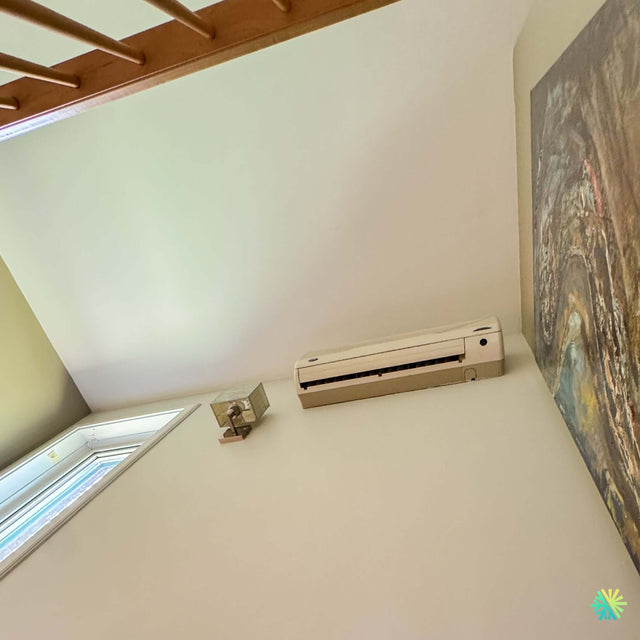
The photo taken on site clearly illustrates the technical context: a wall-mounted heat pump located above a staircase, near a large decorative window, in a high air volume where heat naturally accumulates at the top. A ladder was necessary to reach the unit, and the intervention had to be carried out carefully to protect the walls, window frame, hanging light fixture, and interior surfaces.
The client contacted us because the unit was no longer providing the usual comfort. In cooling mode, the air seemed less cold and the airflow was uneven. In heating mode, the unit took a long time to affect the room temperature. The client also noticed a louder noise than before, especially at startup and during ventilation speed changes. In a wall system installed high up, these symptoms can have several causes: clogged filters, dirty turbine, dirty evaporator, partially blocked air flap, poorly positioned sensor, partially clogged condensate drain, or loss of performance of the outdoor unit.
A wall unit difficult to access but essential for home comfort
This wall-mounted heat pump was an indoor mini-split unit, with an older appearance, with an estimated capacity between 12,000 and 18,000 BTU depending on its size and the volume served. The exact brand was not clearly readable on the visible front, but the configuration matched a classic residential wall system: high indoor unit, directional flap, washable filters, ventilation turbine, evaporator coil, condensate drain, and refrigerant connection to an outdoor unit.
In this type of installation, height plays an important role. Warm air naturally rises, which can help capture heat well in cooling mode, but can also distort the temperature perception if the device’s sensor reads a higher temperature than that felt by the occupants. In heating, warm air blown too high can remain accumulated at the top of the space if the flap orientation or ventilation speed are not properly adjusted.
Our technicians therefore approached the service call with two priorities: find the real cause of the performance loss, then optimize the unit’s operation considering its particular location.
Symptoms observed before the intervention
The client described a gradual degradation, not a sudden failure. This is often the case with wall heat pumps that have not been deeply cleaned for several seasons. The device starts, blows air, responds to the remote control, but its efficiency slowly decreases until it becomes uncomfortable.
The most important symptoms were as follows:
- Reduced airflow at the indoor unit outlet
- Less cold air blown in air conditioning
- Slow response in heating mode
- More pronounced ventilation noise
- Directional flap that seemed less smooth
- Slight odor at startup after a period of shutdown
- Difficult maintenance due to installation height
These clues already pointed the diagnosis towards an air circulation and internal clogging problem. A wall system can lose a lot of efficiency when its fan, filters, and coil are contaminated by dust, household particles, and moisture. The air flows less well, the blowing temperature becomes unstable, and the ventilation motor works harder.
Securing the work area
Before touching the device, we secured access. The unit was located in a narrow and high space, near a hanging light fixture and a window. We positioned the ladder stably, protected the surrounding surfaces, and prepared the necessary tools to avoid unnecessary climbing up and down.
This detail is important in residential HVAC service. Repairing a wall-mounted heat pump is not just about opening the device. It requires working cleanly, protecting the home, and ensuring that every handling is done safely for the client, the equipment, and our technicians.
Indoor unit diagnosis
Once access was secured, we inspected the indoor unit. The filters showed a notable accumulation of fine dust. The evaporator coil was partially clogged, and the ventilation fan contained visible deposits between the blades. This type of contamination directly reduces the volume of air distributed in the room.
We also checked:
- Condition of the washable filters
- Cleanliness of the indoor coil
- Condition of the fan wheel
- Movement of the air flap
- Operation of the ventilation speeds
- The device’s response to the remote control
- Possible presence of stagnant water in the condensate tray
- Drain flow
- Mechanical noises at startup
The condensate tray was not overflowing, but the drain showed slow evacuation. On a wall-mounted heat pump installed so high, a partially clogged drain can quickly become problematic. Water can accumulate, create odors, promote biofilm formation, and eventually cause dripping inside.
Verification of cooling operation
Even though the indoor unit appeared very dirty, we did not stop at this initial observation. A heat pump that blows weakly can also suffer from a refrigerant issue, a dirty outdoor unit, or a less efficient compressor. We therefore checked the consistency of the operation: startup, thermostat demand, temperature difference between return air and supply air, ventilation behavior, and cycle stability.
The measurements indicated that the system was capable of producing both cooling and heating, but the air distribution was severely limited by the condition of the indoor unit. The main issue was therefore not a major compressor failure, but a loss of performance related to dirt buildup and slow drainage.
Technical cleaning, drainage correction, and recommissioning of the wall-mounted heat pump
The intervention consisted of restoring the indoor unit to a much more efficient operating condition. In this specific case, the repair did not require replacing a compressor or an electronic board. The essential work was rather in technical cleaning, correcting the drainage, mechanical control of the flap, and final performance validation.
Complete cleaning of filters and coil
We carefully removed and cleaned the filters. On a wall heat pump, dirty filters create an immediate air restriction. The device may continue to operate, but it blows less, works longer, and consumes more energy.
The indoor coil was then cleaned using a method suitable for wall units. The goal was to clear the fins without damaging them and to remove deposits that prevented air from properly passing through the exchanger. A clogged coil can cause reduced efficiency, irregular blowing temperature, and in some cases, ice formation.
Cleaning the ventilation turbine
The turbine was one of the most important points of the intervention. When the blades are loaded with dust and dirt, they move less air, even if the motor runs normally. The client may then believe the system is low on refrigerant, while the problem lies in the indoor ventilation.
We thoroughly cleaned the turbine to restore a more regular airflow. After this step, the operating noise decreased and the airflow became more consistent. This improvement is often very noticeable to occupants, especially in a stairwell where sound travels easily.
Unblocking and rinsing the condensate drain
The condensate drain was checked and rinsed to ensure smooth flow. We removed the deposits causing the slowdown and confirmed that the water was draining properly. This step is essential to prevent water damage, odors, and future stoppages related to humidity.
In a high installation like this, the client cannot easily notice the start of a problem. A slight slowdown of the drain can go unnoticed until water begins to run down the wall. We therefore recommended periodic checks, especially before the warm season, when the device produces more condensation.
Damper adjustment and airflow optimization
The directional damper was inspected and adjusted. Since the unit is installed very high, air orientation plays a major role. In cooling mode, avoid directing air only upwards or too close to the ceiling. In heating mode, it is better to promote diffusion that pushes air toward the occupied area without creating an unpleasant draft.
We explained to the client how to use the ventilation modes and oscillation to improve distribution in this particular space. A wall-mounted heat pump placed in an open volume can be very effective, but it must be well oriented and regularly maintained.
Tests after repair
After cleaning and correcting the drainage, we restarted the unit and observed several operating cycles. The airflow was significantly better, the fan noise was more stable, and the blowing temperature better matched expectations. The client quickly noticed a difference in the air feeling at the unit’s outlet.
We verified:
- Unit startup
- Changes in ventilation speeds
- Damper operation
- Drain flow quality
- Blowing temperature
- Cycle stability
- No abnormal noise
- No visible water leak
The final result was a quieter, more efficient wall-mounted heat pump better suited to its location.
Advice given to the client to prevent recurrence
In Sainte-Marthe-sur-le-Lac, as in many areas of the North Shore, houses can be exposed to a lot of pollen, outdoor dust, and humidity variations. These elements quickly accumulate in the filters and inside the unit, especially when a system runs intensively in summer.
We recommended to the client to:
- Clean the filters more often during periods of heavy use
- Avoid waiting until the airflow becomes weak before performing maintenance
- Monitor for any odor at startup
- Check for water appearing under the unit
- Avoid blocking the airflow around the unit
- Schedule a complete technical cleaning when the unit becomes noisy or less efficient
We also reminded that a simple filter cleaning does not replace an internal cleaning. Filters capture some particles, but the fan, coil, and condensate tray still accumulate deposits over time.
Common mistakes with a wall-mounted heat pump installed high up
This type of installation requires special attention. The most common mistakes are postponing maintenance because the unit is hard to access, using only the automatic mode without adjusting the louvers, or concluding too quickly that the system is low on refrigerant gas.
A refrigerant shortage is possible in some service calls, but it should never be assumed without measurement. In this case, the performance drop was mainly due to poor air circulation and slow drainage. That’s why our structured diagnosis helps avoid unnecessary repairs and targets the right solution on the first visit.
AirGreen, specialist in wall-mounted heat pump repair on the North Shore
At AirGreen, we provide repair services for wall-mounted heat pumps, wall air conditioners, MultiZone systems, central heat pumps, and many other residential HVAC equipment. Our technicians travel to Sainte-Marthe-sur-le-Lac, on the North Shore, in Montreal, Laval, Longueuil, and on the South Shore to diagnose breakdowns, fix performance issues, and extend the lifespan of existing systems.
This intervention clearly demonstrates the importance of a service adapted to the real context of the home. A wall unit installed high up can offer excellent comfort, but only if it remains clean, well-drained, properly oriented, and correctly maintained. In this case, targeted repair and technical cleaning restored airflow, reduced noise, and reassured the client about the overall condition of their system.

The same service at your place?
Cleaning, repair or maintenance: tell us about your unit and we schedule the visit.
- RBQ licence 5645-9605-01Subclasses 15.8, 15.10 and 16
- $5M liability insuranceOn every job
- 15+ yearsFamily-owned, based in Montréal