
AirGreen job in
Central Heat Pump Repair in Châteauguay
Stylised map, not to scale.
- Montréal
- Laval
- Longueuil
- South Shore
- North Shore
On a flat roof in Châteauguay, an intermittent failure that hid a deeper electrical problem
In Châteauguay, our AirGreen team was called for a HVAC service call on a central heat pump installed on the flat roof of a residential building. The client contacted us because the system was no longer consistently responding to thermostat demands. Some cycles started normally, then others cut off too quickly. In cooling mode, the blown air was no longer as cool as before, and on cooler days, the heating mode seemed to take too long to stabilize the indoor temperature.
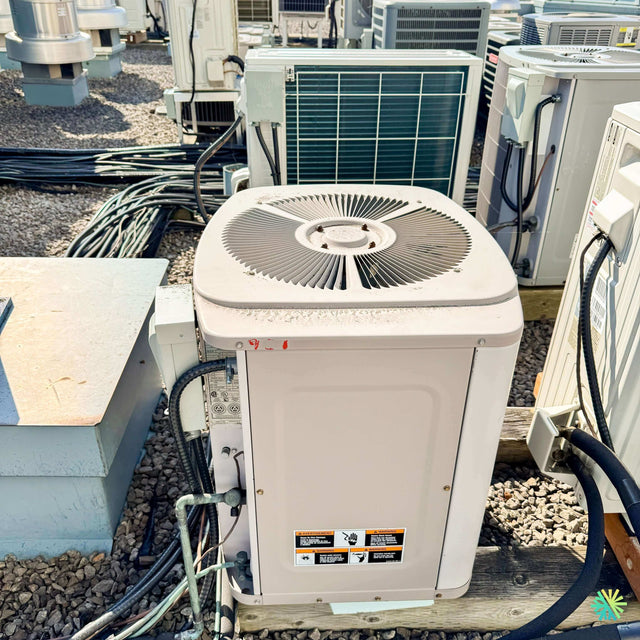
Upon arrival on site, the installation gave us several important clues. The outdoor unit was placed on a roof base, at the same level as other nearby condensers, with a set of cables and refrigerant lines exposed to outdoor conditions. This type of installation on a flat roof requires special attention: the equipment is directly exposed to sun, wind, water accumulation, snow, ice, freeze-thaw cycles, and vibrations transmitted by the structure. A central heat pump can operate for years under these conditions, but only if the electrical components, connections, drainage, and air clearance remain in good condition.
In this specific case, the exact brand and model were not clearly visible on the service photo, and we always avoid assigning a brand or capacity in BTU without directly reading the nameplate. However, the service clearly involved a residential central heat pump, connected to an indoor ducted air distribution system. Our diagnosis therefore focused on the essential elements: electrical supply, control signal, compressor start-up, outdoor fan operation, heat exchange at the condenser, connection condition, and overall performance after repair.
Symptoms reported by the customer
The customer described a frustrating but very typical situation of intermittent failures: the system did not seem completely out of service, which made the problem harder to pinpoint without thorough diagnosis. The heat pump could start, then stop, or operate without delivering the expected performance. This kind of behavior can give the impression that the thermostat is responsible, while the real cause is often in the outdoor unit.
The main symptoms observed or reported were as follows:
- irregular starts of the outdoor unit;
- shorter cycles than normal;
- less cool indoor air in cooling mode;
- prolonged operation without quickly reaching the setpoint;
- slight electrical noise at the moment of demand call;
- variable performance depending on outdoor temperature;
- customer concern about a possible compressor failure.
An intermittent failure on a central heat pump must be handled methodically. Replacing a part at random may temporarily make the problem disappear without fixing the cause. At AirGreen, we prioritize a measurement-based approach: voltage, amperage, control signal, capacitor condition, contactor, fan motor, refrigerant circuit pressures when required, supply air temperature, and system behavior after stabilization.
Roof access and installation inspection
Access to the roof was an important step in the intervention. On an installation like this, technicians must secure their movements, protect the roofing membrane, and avoid unnecessarily moving supports or lines. The units visible on the roof were placed on appropriate bases and slabs, but the environment also showed exposed cables and areas where the organization of the lines needed to be checked.
We inspected:
- the overall condition of the outdoor condenser;
- the sturdiness of the support base;
- the vibrations transmitted to the roof;
- the clearances around the unit;
- the electrical compartment;
- the low voltage connections;
- the contactor;
- the run capacitor;
- the outdoor fan motor;
- the condition of the coil;
- the refrigerant lines and their insulation;
- possible signs of water infiltration or corrosion.
This type of inspection is essential on flat roofs in Montreal, Laval, Longueuil, the North Shore, and the South Shore, where outdoor units are often exposed for many years to harsher conditions than a unit installed on the ground and protected by landscaping.
Electrical diagnosis: the heart of the problem
The first confirmed element on site concerned the unit’s startup. The thermostat signal reached the outdoor equipment well, but the contactor’s behavior was unstable. The contactor showed signs of wear, with marked contact points. When a contactor becomes worn, current can pass irregularly, cause buzzing, create resistance, and prevent the compressor or fan from receiving clean power at startup.
We then tested the run capacitor. Its value was outside the acceptable tolerance for reliable operation. A weakened capacitor does not always mean the unit will fail to start at all. Often, it still allows the system to run, but forces the motor and compressor to start with more difficulty. This is precisely what makes this type of failure deceptive: the customer sometimes hears the machine start, but the system no longer operates under normal conditions.
On a central heat pump repair, the capacitor is a relatively common part, but its role is critical. It helps the motors start and maintain stable operation. When it weakens, it increases electrical stress, reduces reliability, and can contribute to premature wear of much more expensive components.
Low-voltage connections exposed to roof conditions
We also paid special attention to low-voltage connections. On a flat roof, control wires are exposed to significant temperature variations, UV rays, humidity, and sometimes handling during other roofing work. A poorly protected connection can create an intermittent signal, which causes exactly the kind of symptoms observed: the heat pump receives the request but does not always execute it correctly.
In this case, some connections needed to be redone and better protected. Our technicians corrected weak points, tightened fittings, checked the continuity of the control circuit, and secured the wires to prevent them from resting freely on the membrane or being subjected to unnecessary mechanical stress.
This part of the work is often less visible than a part replacement, but it is essential. An HVAC electrical failure does not always come from a single broken component. It can result from a combination of small defects: worn contactor, weak capacitor, unstable low-voltage connection, poorly supported cable, moisture in the compartment, or repeated vibration.
Condenser cleaning and airflow verification
The outdoor coil showed an accumulation of dust and fine particles. On a roof, condensers often draw in debris that is not noticeable from the ground: dry dust, pollen, leaf fragments, roofing residues, dirt moved by the wind. A partially clogged coil reduces the unit's ability to reject or absorb heat, depending on the mode used.
We performed appropriate cleaning of the condenser, taking care not to damage the fins. The goal was to restore good airflow through the coil. After cleaning, the outdoor fan could operate under better conditions, and the system could regain more efficient heat exchange.
A common mistake is to believe that an outdoor unit that looks clean "to the eye" necessarily works well. However, a thin layer of dust embedded in the fins can sometimes reduce efficiency, especially during periods of high demand. For a central heat pump installed on a flat roof, regular maintenance is even more important because access is less obvious and owners rarely inspect the equipment themselves.
Replaced parts and corrections made
After diagnosis, our intervention included several targeted actions. We replaced the faulty start capacitor with a part compatible with the device's specifications. We also replaced the worn contactor to restore a cleaner and more reliable start. The low-voltage connections were redone and secured, then the electrical compartment was inspected to confirm that no other overheating points or advanced corrosion compromised the operation.
The intervention also included:
- power supply voltage verification;
- thermostat signal check;
- testing of the outdoor fan motor;
- validation of compressor startup;
- cleaning of the outdoor coil;
- visual inspection of refrigerant lines;
- inspection of apparent insulation;
- observation of the complete cycle after repair;
- temperature measurement to confirm performance improvement.
No refrigerant recharge was done without necessity. At AirGreen, we avoid unjustified refrigerant additions. A central heat pump is a sealed system: if the charge is truly low, the reason must be understood. Adding refrigerant without diagnosis can mask a leak, create an improper charge, or shift the problem to a more costly failure.
Result after repair
Once the parts were replaced and the connections corrected, the central heat pump was restarted. The startup was smoother, the electrical buzzing disappeared, and the outdoor fan operated steadily. After a few minutes of operation, the measured temperatures indicated improved performance. The system responded correctly to the thermostat’s demand and completed its cycle without premature shutdown.
For the client, the most important result was clear: the house regained more stable comfort, and the fear of an immediate compressor replacement was ruled out at this stage. However, we took the time to explain that the equipment must be monitored because flat roof installations age differently from ground installations. Vibrations, sun exposure, and humidity variations can accelerate the wear of connections and electrical components.
What this repair in Châteauguay reveals about maintaining central heat pumps
A central heat pump is not just an outdoor unit. It is a complete system that connects a condenser, a duct network, an indoor unit, a thermostat, a power supply, and a refrigerant circuit. When a breakdown occurs, it is important to avoid jumping to conclusions. In this project in Châteauguay, the system showed signs of weakness, but the main cause was a combination of electrical failures and a condenser that needed proper cleaning.
Mistakes to avoid with a central heat pump on a flat roof
Many problems could have worsened if the customer had waited too long. A heat pump that starts poorly can continue to operate for a while, but each difficult start stresses the compressor. The cost of a capacitor or contactor is minimal compared to replacing a compressor or a complete system.
The most common mistakes we observe during service calls in Châteauguay, Montreal, Laval, Longueuil, on the North Shore and the South Shore are as follows:
Believing an intermittent fault will fix itself
A system that works “half the time” is not stabilizing. It sends a clear signal that a component is weak, a connection is unstable, or an operating condition is no longer normal.
Immediately blaming the thermostat
The thermostat is often the first visible element to the customer, but it’s not always to blame. In this case, the control signal was indeed present; the problem was actually in the response of the outdoor unit.
Neglecting wires and connections on the roof
Low-voltage connections must be protected, supported, and checked. An exposed or poorly secured wire can cause interruptions that look like a major failure.
Delaying condenser cleaning
A dirty coil reduces efficiency, increases run time, and strains the system. Even a slight blockage can harm performance on hot days.
Adding refrigerant without confirming the cause
A drop in performance doesn’t automatically mean there’s a refrigerant leak. Airflow, the condition of the condenser, electrical components, and operating measurements must be checked before drawing any conclusions.
Why choose AirGreen for HVAC repair in Châteauguay
At AirGreen, we work on light residential and commercial systems throughout Greater Montreal. Our team understands the realities of flat roof installations, homes with existing ducts, aging equipment, and faults that don’t always present themselves clearly. A good HVAC repair requires experience but also discipline: measure, confirm, repair, test, and explain.
In this case, our intervention prevented a rushed replacement, corrected the immediate causes of the breakdown, and gave the client a clear understanding of the system’s condition. This is exactly the goal of professional service: restore comfort, secure operation, and help the owner make an informed decision for the future.
Practical advice after a central heat pump repair
After an intervention like this, we recommend the owner monitor certain signs over the following weeks:
- longer than normal startups;
- clicking, buzzing, or vibrating noise;
- too short cycles;
- air blown less cool or less warm;
- accumulation of water or ice around the unit;
- decreased comfort despite unchanged settings;
- circuit breaker tripping;
- unusual variation in electrical consumption.
Preventive maintenance before peak periods often allows detection of weakened capacitors, worn contactors, dirty coils, and fragile wires before a breakdown. For units installed on flat roofs, this inspection is even more useful because the equipment is not visible daily.
Restored comfort and a safer installation
At the end of the intervention, the central heat pump was operating more stably, with reliable startup and better heat exchange. The client received clear explanations about the replaced parts, possible causes of the breakdown, and points to monitor. The equipment was not new, but it was once again able to perform its role under safer and more predictable conditions.
This repair in Châteauguay clearly illustrates our approach at AirGreen: to intervene precisely, avoid guesswork, respect the existing installation, and provide clear service. Whether it's for a central heat pump, a wall-mounted heat pump, a wall air conditioner, a multi-zone heat pump, an indoor system, or equipment installed on a flat roof, our team serves Montreal, Laval, Longueuil, the North Shore, and the South Shore with the same attention to detail.
The same service at your place?
Cleaning, repair or maintenance: tell us about your unit and we schedule the visit.
- RBQ licence 5645-9605-01Subclasses 15.8, 15.10 and 16
- $5M liability insuranceOn every job
- 15+ yearsFamily-owned, based in Montréal