
Installation of a GREE All Match Slim Duct R32 Ducted System in Varennes – Integrated HVAC Ducted System in a Confined Space
In Varennes, AirGreen installs a GREE All Match Slim Duct R32 ducted system in a confined space, with integrated ducts, service access, and discreet HVAC comfort.
In summer, the outdoor unit rejects the house's heat outside.
Generic illustration of this type of installation, not a survey of this job site. Tap a number.
It captures or rejects heat outside. It sits on a level base, above the snow, with free space all around.
The insulated refrigerant lines enter the house through a sealed opening and run to the indoor coil.
A shut-off switch near the outdoor unit isolates it safely for service.
Sitting on the indoor module, it moves heat between the house air and the refrigerant.
Electric furnace or air handler: its fan pushes air through the ducts. The electric backup takes over in extreme cold.
Supply ducts bring air to the rooms; returns bring it back to the unit. Their condition matters as much as the unit's.
It protects the coil and the fan. A dirty filter cuts airflow, so it gets checked regularly.
It runs the heat pump and the backup heat. It must be compatible with the installed system.
A GREE ducted installation in Varennes where precision mattered as much as performance
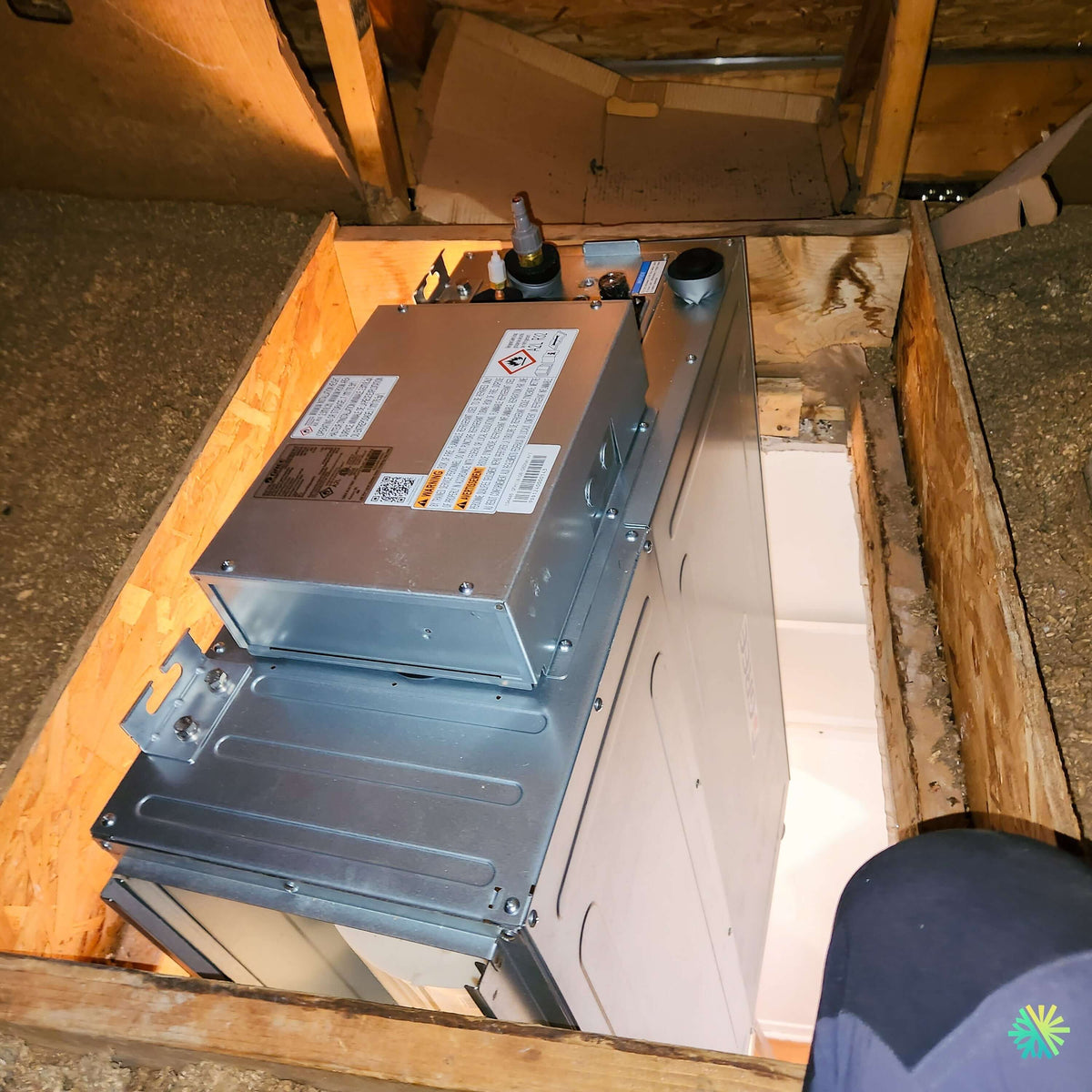
In Varennes, on the South Shore, our AirGreen team carried out a technical installation of a GREE All Match Slim Duct R32 ducted system, an HVAC solution designed to provide heating and cooling with discreet integration into the house structure. This project perfectly illustrates the type of installation where field experience makes all the difference: the indoor unit had to be inserted into a tight space, through an existing opening, with very little room to maneuver around the equipment.
In the photo taken during the work, you can clearly see the GREE indoor unit positioned in a structural box, surrounded by wood, insulation, and existing panels. The device is installed in a narrow technical space, probably between ceiling areas or in an accessible attic section. This context requires careful planning, as a ducted heat pump is not just about installing a machine: it is necessary to ensure air passage, air return, drainage, future access for HVAC maintenance, refrigerant connections, and mechanical stability.
In this project in Varennes, the client wanted a comfortable solution without a visible wall unit in the main rooms. The choice of a ducted system, also called Slim Duct, duct conduit or ductable, perfectly met this expectation. The indoor unit is hidden within the structure, while the treated air is distributed through ducts to the targeted areas of the house.
Why a GREE ducted system was the right choice for this residence
Homeowners who choose a GREE ducted system generally seek a more integrated solution than a traditional wall-mounted air conditioner. In a Varennes home, this approach becomes particularly relevant when wanting to preserve the appearance of rooms, avoid visible units on walls, and achieve more uniform air distribution.
The GREE All Match Slim Duct R32 series meets several residential needs:
- air condition and heat multiple rooms from a discreet indoor unit;
- integrate the equipment into a ceiling, false ceiling, attic, or technical space;
- reduce the visual impact of the installation;
- improve temperature stability in the served areas;
- adapt air distribution to the actual house plan;
- maintain a modern solution compatible with current comfort needs.
At AirGreen, we offer several options of GREE ducted systems, including models in 9,000 BTU, 12,000 BTU, 18,000 BTU, 24,000 BTU, 30,000 BTU, and 36,000 BTU, depending on the configuration, thermal load, and planned duct network. For this type of project, capacity selection should never be based solely on area. We also analyze insulation, windows, sun exposure, ceiling height, room layout, and duct routing constraints.
An installation in a confined space: the real challenge of the project
The main challenge of this installation in Varennes was access. The indoor unit had to be installed in a limited opening, surrounded by existing materials. This kind of situation requires a lot of method, as each step must be planned before finalizing the device's position.
In a confined space, mistakes can become costly. A poorly oriented device can complicate duct connections. A service panel that is hard to access can make future maintenance problematic. A poorly positioned drain can cause leakage risks. Insufficient clearance can hinder maintenance or technical inspections.
Our team therefore worked with a precise sequence:
- validating the available opening;
- checking the clearances around the indoor unit;
- positioning of the device to allow access to the connections;
- planning of the condensation drain;
- preparation of refrigerant lines;
- airflow control;
- coordination of the future duct network;
- checking access for the filter and service;
- secure equipment fastening;
- commissioning according to the manufacturer's procedures.
This approach is essential for HVAC ducted installations, especially in existing houses where the technical space was not originally designed to accommodate this type of equipment.
The importance of return air in a Slim Duct system
A Slim Duct system works properly only if the air circulates evenly. It is not enough to create air outlets to the rooms. An effective return air must also be planned so that the indoor unit can take back the air, treat it, and redistribute it properly.
In an installation like the one in Varennes, the return air must be considered with as much attention as the supply ducts. A poorly sized return air can cause several problems:
- reduced airflow;
- suction noise;
- uneven comfort;
- less efficient cycles;
- unbalanced pressure in rooms;
- reduced performance in heating or air conditioning.
At AirGreen, we always analyze the complete air circulation. For this installation, the limited space around the unit made this step even more important. The system had to remain compact, but without compromising flow or accessibility.
Static pressure: an essential technical point
GREE ducted systems can be configured according to different static pressure requirements, including options for low static pressure or high static pressure, depending on the models and the duct network. This concept is central in a ductable installation, as it determines the capacity of the indoor fan to push air through the ducts, elbows, grilles, and diffusers.
In an existing house, ducts sometimes have to bypass obstacles: beams, joists, insulated areas, limited openings, finished ceilings, or passages already occupied by other installations. The more complex the network, the more seriously the static pressure must be evaluated.
For this installation in Varennes, our goal was to maintain an efficient network with controlled pressure losses. This means avoiding ducts that are too long, abrupt reductions, unnecessary elbows, and poorly balanced outlets. A well-chosen system, but connected to a poorly designed network, will never provide the expected comfort.
The R32 refrigerant and the requirements of professional installation
The GREE All Match Slim Duct R32 range uses the refrigerant R32, a technology found in several recent heating and air conditioning systems. This refrigerant is valued for its efficiency in modern equipment, but it requires professional installation by qualified technicians.
Refrigeration connections, vacuuming, leak tests, connection validation, and startup must be performed rigorously. A ducted heat pump is not a device that can be installed roughly. The final performance directly depends on the quality of the work done on site.
At AirGreen, our refrigeration technicians follow best industry practices for every HVAC installation, whether in Varennes, Boucherville, Longueuil, Montreal, Laval, on the North Shore or the South Shore. This rigor ensures reliable operation, longer equipment life, and consistent comfort for the client.
An AirGreen project focused on integration, service access, and lasting comfort
Adapt the installation to the house, not the other way around
A good HVAC project is not about forcing a house to adapt to a machine. Instead, the equipment must be chosen and installed based on the reality of the building. This installation in Varennes is an excellent example.
The available space was limited. The indoor unit had to be positioned precisely in an existing opening. The wooden areas around the device show that the installation was done in an environment where the structure had to be respected. Our team therefore prioritized a clean, stable, and accessible integration.
In this type of situation, we must think short and long term. The immediate goal is to get the system running. The professional goal is broader: enable maintenance, reduce vibration risks, ensure good air circulation, protect connections, and prevent the customer from ending up with a difficult-to-maintain installation.
Condensate drainage: a detail that does not forgive
In air conditioning, the indoor unit produces condensation. This water must be properly drained. In a ducted installation located in a ceiling, attic, or confined space, drainage is one of the most important points.
Poor drainage can cause:
- water leakage into the structure;
- ceiling stains;
- odors;
- system shutdowns;
- material damage;
- avoidable service calls.
For this installation in Varennes, drain management was integrated from the planning stage. We always check the slope, route, access, and reliability of the drainage. When gravity is not enough, some installations may require a drain pump, depending on the configuration. The choice is made based on the site, not a standardized approach.
Acoustic comfort: essential in a concealed installation
A ducted system is often chosen because it is visually discreet. It must also be discreet to the ear. The noise level depends on several factors: air speed, duct dimensions, quality of transitions, air return, static pressure, and the location of the indoor unit.
In a house in Varennes, where the system can serve bedrooms, a corridor, or living spaces, acoustic comfort becomes an important criterion. We therefore pay attention to details that reduce air noise and vibrations:
- stable unit mounting;
- properly sized ducts;
- well-adjusted transitions;
- limitation of sharp bends;
- adapted air return;
- service access without unnecessary contact with the structure.
A well-thought-out installation allows the customer to enjoy comfort without constantly being reminded of the system’s presence.
Heating down to low temperatures depending on GREE models
Certain GREE ducted configurations are designed to offer heating performance suited to Quebec winters, with an operating capacity reaching -30 °C depending on the model. This feature is particularly appealing for homeowners looking to improve their winter comfort while using modern heat pump technology.
However, it is important to validate the exact model, capacity, and indoor-outdoor pairing. Not all systems have the same performance or certifications. At AirGreen, we avoid approximate recommendations. We check the client’s needs, the building, installation constraints, and the characteristics of the proposed model.
Subsidies: check eligibility according to the exact combination
Owners in Varennes, Montréal, Laval, Longueuil, the North Shore, and the South Shore often ask us questions about available subsidies for heat pumps. Some GREE systems may be eligible for financial aid programs, depending on their certification, performance, and the exact pairing of units.
For a ducted installation, this verification is particularly important. Eligibility does not depend only on the brand. It depends on the indoor model, the outdoor model, capacity, applicable certification, and criteria in effect at the time of the application.
At AirGreen, we help our clients keep useful documents after installation, including the invoice and necessary information when the model is eligible. This way of working facilitates procedures and reduces errors in applications.
Common mistakes to avoid with a ducted system
Ducted systems offer excellent comfort when well designed. However, poor installation can harm performance even with a good quality machine. Here are the mistakes we systematically avoid.
Installing the unit without planning for future access
In this project in Varennes, access was limited. It is precisely in this type of context that maintenance must be considered from the start. An inaccessible filter or a blocked panel can complicate every future intervention.
Undersizing the air return
A system that blows well but poorly returns air cannot operate optimally. The air return must be matched to the unit's capacity.
Creating an overly restrictive duct network
Too many elbows, ducts that are too narrow, or routes that are too long can reduce airflow and increase noise.
Neglecting the drain
A poorly installed drain can cause significant damage. It must be stable, accessible, and reliable.
Choosing capacity based only on the number of rooms
The actual thermal load depends on many factors. The number of rooms alone is not enough to select the right BTU capacity.
Comparing only the price of bids
Two offers may mention a GREE ducted heat pump but not include the same level of design, ductwork, finishing, commissioning, or after-sales service.
Why AirGreen is well positioned for this type of project
AirGreen is a GREE Elite dealer, with specialized experience in ducted systems, including low and high static pressure configurations as well as the All Match Slim Duct R32 series. This expertise is especially useful in projects like the one in Varennes, where space is limited and every technical decision influences the final result.
Our clients choose AirGreen for concrete reasons:
- clear estimate before work begins;
- recommendations tailored to the building;
- qualified technicians in HVAC installation;
- knowledge of GREE ducted systems;
- attention to service access;
- clean installation in existing homes;
- support for grant documents when applicable;
- local after-sales service in Montreal, Laval, Longueuil, on the North Shore and the South Shore;
- $5,000,000 liability insurance.
In this project, our team had to work precisely around an existing structure. This type of installation requires patience, a good site assessment, and an excellent understanding of mechanical constraints. This is exactly where our field experience becomes an advantage for the client.
Advice for Varennes homeowners considering a ducted heat pump
Before installing a GREE All Match Slim Duct R32 system, it is useful to prepare the project well. We recommend homeowners consider the following points:
- which rooms need heating and cooling;
- where the indoor unit could be installed;
- what space is available in the ceiling, attic, or false ceiling;
- where the duct network can pass;
- how the air return will be managed;
- where the outdoor unit will be located;
- what aesthetic constraints must be respected;
- what noise level is acceptable;
- future access for HVAC maintenance;
- the eligibility for a subsidy depending on the chosen model.
Good preparation allows for a more accurate quote and a more reliable installation. At AirGreen, we prefer to explain the constraints from the start rather than simplify a project that deserves a thorough analysis.
A result designed for many years of comfort
This installation of a GREE ducted system in Varennes clearly shows the benefits of an integrated solution when the client wants discreet comfort and well-planned air distribution. Despite limited space, the indoor unit was positioned to meet the project's technical constraints, with particular attention to access, drainage, air flow, and commissioning.
For the client, the result is an HVAC solution that integrates into the home without imposing a visible wall unit in the targeted rooms. For our team, it is a project that reflects our approach: design before installation, adapt the equipment to the building, and deliver durable work.
In Varennes, as elsewhere on the South Shore, the GREE All Match Slim Duct R32 systems are an excellent option for homeowners who want to combine efficiency, discretion, and comfort. Properly installed, a ducted heat pump can transform the indoor experience of a home while maintaining a discreet and well-integrated appearance.
How it goes, from the first call to the end
The main steps of this kind of job at AirGreen. Every house has its quirks: the estimate brings them out.
We look at the ducts, the current indoor module, the electrical panel and the planned spot for the outdoor unit.
The equipment combination, capacity and price, in writing. We check whether the combination qualifies for assistance programs.
Access protected, old unit disconnected and removed when it is being replaced.
Electric furnace or air handler, with its coil, connected to the supply and return ducts.
On a level base, raised above the snow, with free space all around.
Insulated, they enter through a sealed opening and run to the indoor coil.
Dedicated circuits, accessible disconnect, a thermostat that works with the heat pump and the backup heat.
Leak test, vacuum, start-up, airflow check and a test of both modes.
Filter, thermostat, backup heat in extreme cold: what to know before winter.
- The on-site estimateWe look at the ducts, the current indoor module, the electrical panel and the planned spot for the outdoor unit.
- The quoteThe equipment combination, capacity and price, in writing. We check whether the combination qualifies for assistance programs.
- Getting readyAccess protected, old unit disconnected and removed when it is being replaced.
- The indoor moduleElectric furnace or air handler, with its coil, connected to the supply and return ducts.
- The outdoor unitOn a level base, raised above the snow, with free space all around.
- The refrigerant linesInsulated, they enter through a sealed opening and run to the indoor coil.
- Electrical and thermostatDedicated circuits, accessible disconnect, a thermostat that works with the heat pump and the backup heat.
- Tests and start-upLeak test, vacuum, start-up, airflow check and a test of both modes.
- The walkthroughFilter, thermostat, backup heat in extreme cold: what to know before winter.
And at your place?
Two quick checks with real numbers: what heat costs, and what your current heaters add up to in BTU/h.
Conversion: 1 W = 3.412 BTU/h. An indication, not a load calculation: baseboards and furnaces are often stronger than the real need, and they can stay as backup. AirGreen confirms the capacity on site.
What to do, season by season
Three habits per season for this unit. They take a few minutes and prevent many calls.
- Check the indoor module's filter.
- Clear winter debris from the outdoor unit.
- Test cooling before the heat arrives.
- Check the filter more often in peak season.
- Keep registers and returns clear.
- Watch condensate drainage near the coil.
- Change or clean the filter.
- Test heating and backup heat before the cold.
- Book periodic maintenance.
- Clear snow around the outdoor unit.
- Store nothing in front of the indoor module.
- Note any unusual noise or smell and call us.
Which type of equipment for your project?
Pick what looks like your need.
Four mistakes we do not make
Flip each card to see what we do instead.
What people ask us about this kind of work
Can I keep my current ducts?
What happens in extreme cold?
Furnace, air handler, ducted: what is the difference?
Are there grants?
Do I need a permit?
How much can I save?
How is the LogisVert assistance calculated?
Will my current thermostat work?
Central or wall units: which one?
Does AirGreen hold the required licences?
Is the estimate free?
No question matches. Write to us: we answer.
Useful pages for what comes next
More jobs to see, near you
By town, by equipment or by region: browse more than 4,700 published projects.
Each dot: a town where AirGreen has published projects. The glowing dot: this job.
Tell us about your house. We come and see it for free.
The on-site estimate is free and the quote follows within 24 hours.
Text and photo: a real AirGreen Climatisation & Chauffage job. The diagrams are generic illustrations of the type of installation, not a survey of this job site. Sources of the added figures: airgreen.ca product pages (NEEP / AHRI performance), Hydro-Québec (Heat pumps page, LogisVert, read on 13 October 2026), Régie de l’énergie (rate D as of 1 April 2026).